
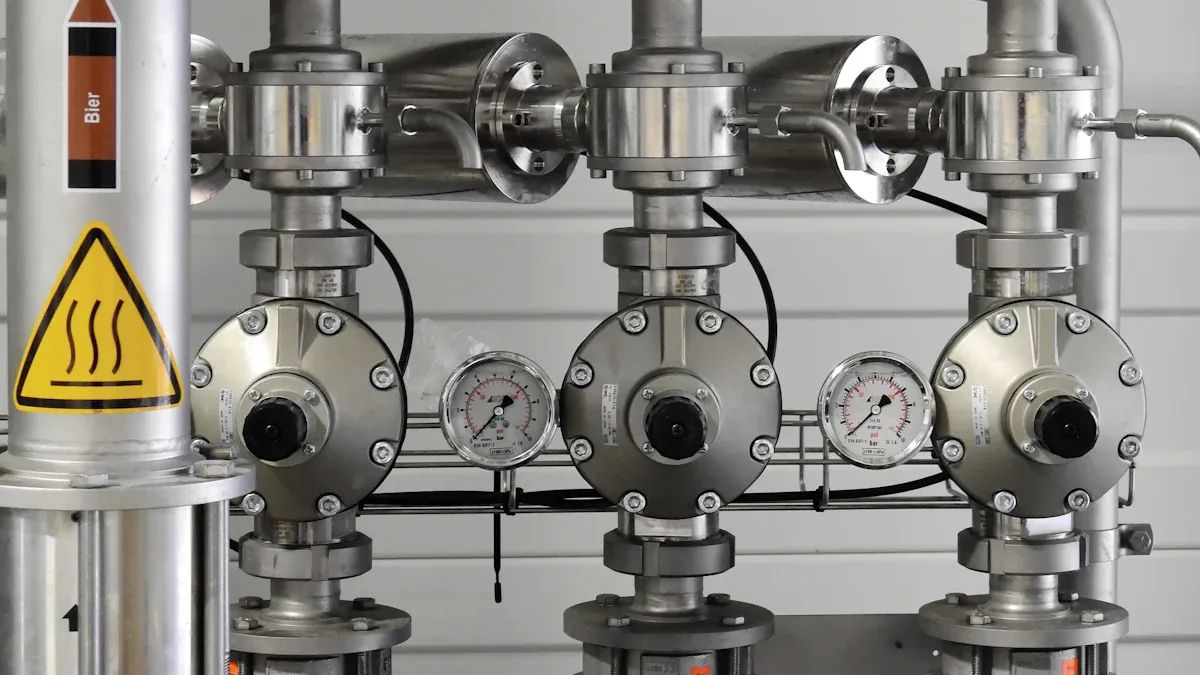
A proportional solenoid valve precisely controls fluid flow or pressure in proportion to an electrical input signal. This technology offers significant advantages in various applications. The market for these valves shows robust growth, with a projected CAGR of 6.98% from 2024 to 2032, reaching USD 813.33 million by 2032. Another forecast predicts market growth of USD 1.43 billion from 2025 to 2029, accelerating at a CAGR of 4.7%.
Key Takeaways
- Proportional solenoid valves control fluid flow very precisely. They can open to many different levels, not just fully open or fully closed.
- These valves are good for jobs needing exact control, like in medical devices or car parts. They help save energy by controlling fluid flow better.
- On/off valves are simpler. They are either fully open or fully closed. They work well for basic tasks where you do not need fine control.
Understanding the Proportional Solenoid Valve

How a Proportional Solenoid Valve Operates
A proportional solenoid valve precisely controls fluid flow or pressure. It uses a solenoid as an actuator to achieve variable valve positioning. Unlike standard on/off solenoid valves, a proportional solenoid valve operates through a range of positions. The plunger acts as the restrictor, allowing for nuanced control.
A proportional valve produces an output directly proportional to an electronically controlled input. An electrical current, often from a potentiometer, joystick, or PLC, regulates an electrical signal to the valve’s solenoid coil. The solenoid coil then converts this electrical input into a mechanical force. This force causes movement of the armature. Armature movement, in turn, applies force to the valve spool. This action enables flow control, pressure reduction, or directional control.
The fundamental principle involves a magnetic force directly proportional to the input signal strength. A weak signal generates a weak magnetic force. Conversely, a strong signal generates a strong one. This variable force acts against a spring-loaded actuator. It precisely positions an internal spool within the valve. For example, a 4mA signal might keep the valve closed. An 8mA signal could open it 25%. A 20mA signal would open it fully. This direct and repeatable relationship between the input signal and the valve’s opening allows for nuanced control over flow rate and pressure.
While proportional control with variable DC voltage is possible, static friction on the plunger’s guide points can impair sensitivity and cause hysteresis. To counteract this, the input signal often converts into a Pulse Width Modulated (PWM) voltage signal. Special control electronics perform this conversion. PWM controls the average voltage and current supplied to the solenoid by rapidly switching the power on and off. This rapid switching induces a fast but weak amplitude oscillation in the plunger. It maintains constant sliding friction and prevents static friction without affecting fluid flow. The ‘duty cycle’ describes the proportion of ‘on’ time to the total cycle duration. A higher duty cycle means more power supplied to the solenoid. For instance, a 50% duty cycle would move the spring and plunger to 50% of their operating range, proportionally changing the valve’s flow.
For high precision, advanced proportional valves incorporate a feedback loop. Many modern valves include an integrated position sensor, such as an LVDT. This sensor continuously measures the exact position of the spool and reports it to the controller. The controller then compares the actual position to the desired position. It adjusts the electrical signal to the solenoid in real-time to correct any discrepancies. This closed-loop system ensures the valve maintains its target position despite external disruptions like fluid pressure fluctuations, friction, or temperature changes.
Key components within a proportional solenoid valve facilitate its operation:
- Solenoid Coil: Generates a magnetic field when electricity flows through it.
- Plunger: A movable core within the coil that responds to the magnetic field.
- Spring: Returns the plunger to its initial position when the coil is de-energized.
- Valve Body: The housing for internal parts and directs fluid flow.
- Orifice: The opening through which fluid or gas passes.
- Valve Spool: Its position is determined by a command voltage from a PLC.
- LVDT (Linear Variable Differential Transformer): Provides feedback on the spool’s position, sending a voltage signal to the amplifier.
- Amplifier: Processes signals from the PLC and LVDT, sending current to the solenoid coil.
- Power Supply: Typically 24 volts, it powers the amplifier.
Proportional solenoid valves often utilize either needle-style or spool valves. These adjust the outlet orifice size based on the solenoid actuator’s position. The design emphasizes matching the dynamic flow geometry to fluid control needs. It also focuses on achieving precise positional control from the integrated solenoid actuator. Accuracy in these actuators is managed by shaping magnetic components. This ensures a linear and predictable force-versus-position characteristic. An opposing, linearly increasing force, typically provided by a spring, then balances this.
Key Characteristics of Proportional Control
Proportional control offers several distinct advantages. It provides continuous and precise modulation of fluid flow or pressure. This contrasts sharply with the binary on/off operation of traditional valves.
Proportional solenoid valves (PSOL valves) can exhibit a fast dynamic response time. This response time is approximately 20 milliseconds. Typical response frequencies for proportional valves range from 8Hz to 50Hz. The specific frequency depends on the valve type. This rapid response allows for quick adjustments in dynamic systems.
The accuracy and repeatability of a proportional solenoid valve are critical for high-performance applications.
| Specification | Value |
|---|---|
| Accuracy | ±0.5% F.S. |
| Repeatability | ±0.05% F.S. |
| Pressure Range | Vacuum thru 500 PSI (34.7 Bar) |
| Max Flow | 1.2 SCFM (34 LPM) |
| This high level of precision ensures consistent and reliable operation. It makes them suitable for demanding industrial processes where exact fluid management is essential. |
Proportional Solenoid Valve vs. On/Off Valve

Fundamental Operational Differences
The core distinction between proportional solenoid valves and on/off valves lies in their control capabilities. On/off valves operate in a binary fashion, meaning they are either fully open or fully closed. They provide only two switching states. In contrast, a Proportional Solenoid Valve offers continuous modulation. It can operate through a range of valve positions, allowing for precise adjustments.
The table below highlights key operational differences:
| Feature | On/Off Solenoid Valve | Proportional Solenoid Valve |
|---|---|---|
| Armature Positioning | Alternates between two fixed points | Variable positioning; armature can be at any point along stroke |
| Intermediate Positions | Not capable of maintaining positions between points | Capable of maintaining positions between fully open/closed |
| Control Sophistication | Simpler, good for switching applications | Requires more sophisticated electronic controls |
| Magnetic Force Curve | Steeper curve, highest forces at shorter stroke lengths | Relatively flat magnetic force curve |
While variable DC voltage can control the plunger proportionally, static friction can impair sensitivity. To counteract this, proportional valves often convert the inlet signal into a Pulse Width Modulated (PWM) voltage signal. This process uses special control electronics. PWM controls the average voltage by rapidly switching power on and off. This action causes the plunger to oscillate quickly with weak amplitude. This oscillation creates constant sliding friction, preventing static friction and allowing for precise control. The ‘duty cycle’ of the PWM signal directly controls the flow.
Advantages of a Proportional Solenoid Valve
Proportional solenoid valves offer significant advantages in applications requiring nuanced control. They provide continuous modulation from fully closed to fully open. This allows for precise control over flow rate or pressure based on an input signal. This dynamic range of control is crucial for complex systems. Furthermore, proportional valves can reduce energy waste. They optimize energy consumption through precise fluid flow regulation.
Note: Proportional valves are energy efficient by optimizing energy consumption through precise fluid flow regulation.
Limitations of On/Off Valves
On/off valves have inherent limitations due to their binary nature. They provide an all-or-nothing response, which is ideal only for simple switching applications. They cannot maintain intermediate positions between fully open and fully closed. This restricts their use in systems requiring variable flow or pressure. Regarding energy, solenoid valves require continuous power to hold their position in normally-closed designs. This leads to significant energy consumption over long periods. If an application requires frequent operations, on/off solenoid valves may be less efficient compared to alternatives that offer proportional control.
When to Choose a Proportional Solenoid Valve
Applications Requiring Precise Fluid Control
Proportional solenoid valves are essential when applications demand exact fluid management. These valves offer continuous modulation, allowing systems to achieve specific flow rates or pressures. This capability is critical in various high-stakes environments.
In the semiconductor field, proportional valves precisely control parameters like temperature, pressure, and gas concentration. They are vital in manufacturing equipment for deposition and etching processes. They also manage nitrogen gas flow for wafer transport. The analysis field relies on these valves for handling minute samples and reagents. This ensures accurate measurement results in equipment such as gas chromatographs, environmental gas measurement devices, and life science instruments. These valves manage O2 and CO2 concentrations in life science equipment.
General industrial fields use proportional valves in closed-loop control systems. This achieves precise flow and pressure control. Such control minimizes quality inconsistencies and improves efficiency. Proportional valves can handle a wide range of flows and pressures. For example, models like the PV3 offer flow ranges from 0-30 SLPM with pressure settings up to 100 PSI. The PC30 ProControl™ valves provide high flow up to 225 SLPM. The Balanced Servoid Series valves deliver precise flow rates up to 200 SLPM at 11 PSI for inert gases. These capabilities highlight their versatility in demanding applications.
Industry-Specific Benefits of Proportional Solenoid Valves
Proportional solenoid valves provide significant benefits across many industries. Their ability to offer precise electronic flow or pressure control makes them indispensable.
In the medical field, these valves play a vital role in critical applications. They allow real-time adjustments and stable flow or pressure. Oxygen concentrators use them to control oxygen flow and concentration. Ventilators rely on them for controlling inspiration and expiration flow. Anesthesia machines use them for mixing O2 and N2O to achieve specific anesthesia concentrations. These valves ensure accurate handling of liquids and gases within medical devices. They fine-tune oxygen levels in real-time based on a patient’s respiratory needs. This bridges the gap between manual intervention and autonomous adjustment. They also support patient safety by preserving steady pressure and maintaining predictable flow rates. This is crucial as mismatched pressure or inconsistent flow can have serious consequences. Ventilators use these valves to align oxygen delivery with individual breathing patterns. This ensures therapeutic precision even during fluctuating patient activity. Proportional valves offer excellent repeatability and resolution with fast response times. They are often coupled with flow or pressure sensors in closed-loop systems. This allows them to adjust to exact requirements in both static and dynamic applications.
Automotive systems also benefit greatly from proportional valves. These valves offer quicker response times and precise control. This makes them suitable for modern, electronically controlled automotive systems. They control shifts and shift timing by routing or modulating oil through the valve body. This happens at specific intervals or when a particular event occurs. Variable Valve Timing (VVT) solenoids change camshaft timing for better horsepower and fuel mileage. A study showed that direct acting solenoid valves in a shifting control system improved pressure response time and reduced leakage by 60% compared to conventional valves. This enhanced automatic transmission performance. Proportioning valves manage the air-fuel ratio in engines. This ensures optimal combustion efficiency and reduces emissions. They regulate fluid flow in transmissions to control vehicle speed. This provides accurate control over fluid ratios, ensuring systems operate at peak efficiency.
In HVAC systems, proportional solenoid valves are crucial for temperature and humidity regulation. They enable accurate modulation of liquids, gases, or steam. This is vital for optimal process performance. These valves improve process efficiency by matching supply to demand. This reduces energy consumption and minimizes process variability. Their fast response allows HVAC systems to quickly adapt to dynamic environmental conditions. This ensures consistent temperature and humidity. They regulate the flow of chilled or heated water through heat exchangers or coils. This allows for precise temperature management based on real-time temperature feedback. Their rapid actuation capabilities enable HVAC systems to promptly adjust to temperature fluctuations. This optimizes performance and reduces energy consumption. Some models actuate between 10 and 1000 milliseconds. This ensures optimal system performance for temperature and humidity regulation.
Proportional solenoid valves provide continuous, precise control for complex fluid management. On/off valves are best suited for simple, binary flow requirements. Selecting the correct valve type optimizes system performance, efficiency, and cost-effectiveness. This careful choice ensures optimal operation for any fluid control system.
FAQ
What is the primary difference between a proportional solenoid valve and an on/off valve?
Proportional valves offer continuous, precise fluid flow or pressure modulation. On/off valves only provide two states: fully open or fully closed, providing binary control.
In which industries do proportional solenoid valves provide significant benefits?
Proportional valves benefit medical, automotive, and HVAC industries. They enable precise control for critical applications like oxygen delivery, transmission shifts, and temperature regulation.
Can a proportional solenoid valve replace an on/off valve in any application?
While more versatile, proportional valves are not always necessary. On/off valves are more cost-effective for simple binary flow requirements where precise modulation is not needed.
Post time: Dec-18-2025