
European buyers of solenoid valves are no longer asking only about price, lead time, and coil voltage. Increasingly, they want to know whether seals contain PFAS-related materials, including familiar options such as FKM, Viton, and PTFE. This shift is being driven by the proposed ECHA universal PFAS restriction under REACH and by OEMs that are already redesigning bills of materials for future compliance. For valve users, the challenge is practical: how to reduce fluorinated materials without compromising sealing reliability, chemical resistance, temperature performance, or service life. This article explains what “fluoropolymer-free” really means, which alternatives are realistic, and how Flying Bull can support buyers evaluating compliant solenoid valve configurations today.
Why European Buyers Want Fluoropolymer-Free Solenoid Valve Seals
Understanding why European solenoid valve buyers are asking about fluoropolymer-free seals requires analyzing impending chemical regulations and evolving corporate sustainability mandates. This regional shift forces procurement teams to rethink standard sealing materials without compromising fluid control performance.
How to Define Fluoropolymer-Free Seals
In industrial fluid control, fluoropolymer-free seals refer to elastomeric or thermoplastic components manufactured entirely without per- and polyfluoroalkyl substances (PFAS). Traditionally, standard solenoid valves rely heavily on fluorinated materials such as Polytetrafluoroethylene (PTFE), Fluorocarbon rubber (FKM/Viton), and Perfluoroelastomers (FFKM) due to their exceptional chemical compatibility and high thermal resistance.
A strict fluoropolymer-free specification requires replacing these industry staples with non-fluorinated alternatives. Depending on the application’s specific media and pressure parameters, viable substitutes include:
- Ethylene Propylene Diene Monomer (EPDM): Excellent for hot water, steam, and mild alkaline solutions.
- Nitrile Butadiene Rubber (NBR): The standard choice for neutral fluids, compressed air, and petroleum-based oils.
- Non-fluorinated specialized polyurethanes: Utilized for high-wear or abrasive media applications.
Key Regulatory and OEM Drivers
The primary catalyst for this material transition is the regulatory landscape in the European Union. The European Chemicals Agency (ECHA) is actively advancing a universal restriction proposal under the REACH framework that targets over 10,000 PFAS compounds. Because standard FKM and PTFE fall under this broad chemical family, European buyers are moving quickly to future-proof their supply chains against potential bans.
Original Equipment Manufacturers (OEMs)—particularly in water treatment, food and beverage processing, and medical technology—are driving this demand to mitigate compliance bottlenecks. Furthermore, strict corporate Environmental, Social, and Governance (ESG) targets compel European procurement teams to phase out “forever chemicals” from their end-products. By proactively sourcing fluoropolymer-free solenoid valves, OEMs eliminate environmental liabilities, ensure uninterrupted market access, and align with the EU’s stringent sustainability benchmarks.
How to Compare Fluoropolymer-Free Seal Options
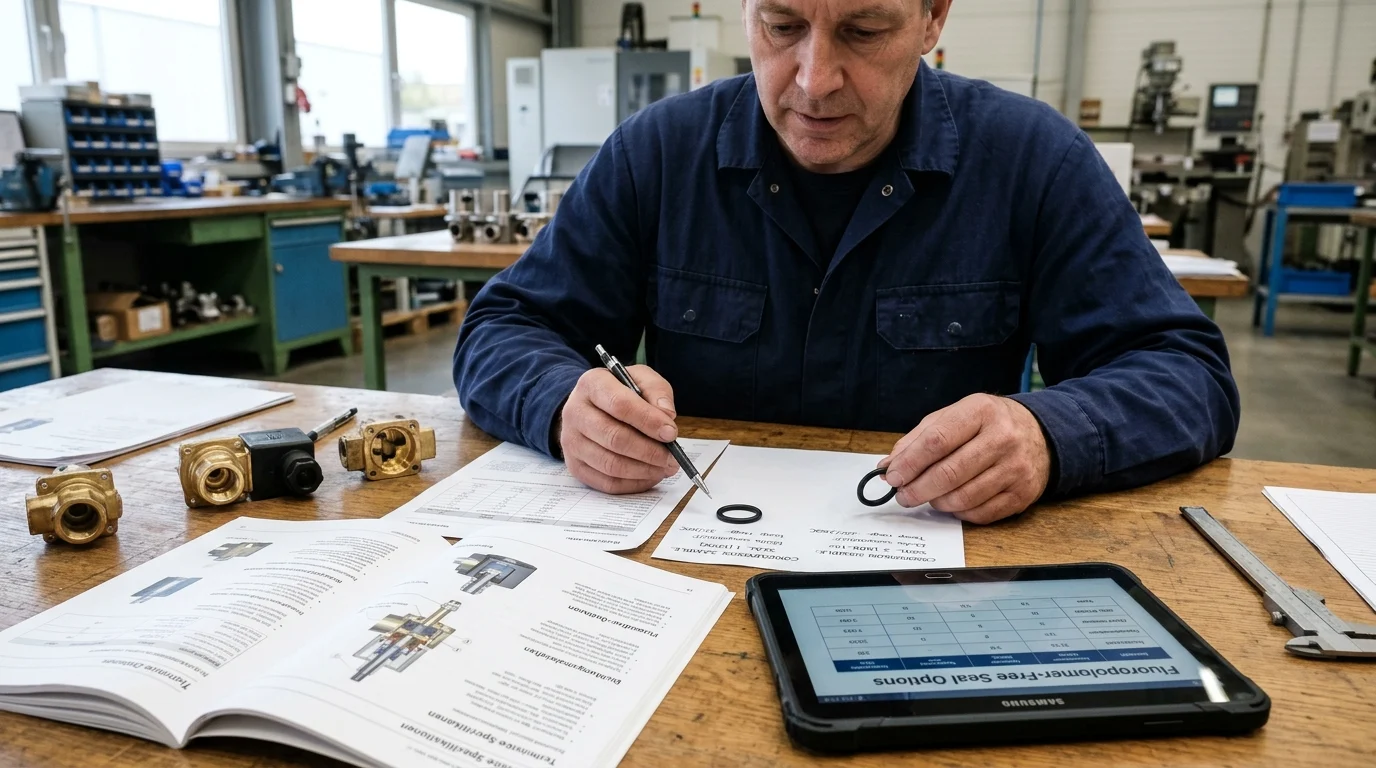
Replacing fluorinated seals in solenoid valves requires a meticulous evaluation of material science. Engineers must carefully balance regulatory compliance with the rigorous operational demands of industrial fluid control systems, keeping in mind the potential cost and service-life trade-offs associated with non-fluorinated elastomers.
Performance Trade-Offs to Check
The primary challenge in adopting fluoropolymer-free seals lies in managing performance trade-offs, particularly concerning thermal stability, chemical resistance, and overall service life. As detailed in the comparison table below, standard FKM and PTFE offer high thermal limits and excellent chemical resistance. Alternative fluoropolymer-free materials like EPDM and HNBR provide viable solutions for many applications, though engineers must carefully account for their specific temperature ceilings and media compatibilities.
Friction coefficients also vary considerably; PTFE offers an exceptionally low dynamic friction coefficient of roughly 0.04, requiring alternative seal geometries or specialized coatings when substituting with non-fluorinated compounds to prevent valve sticking.
| Material | Fluoropolymer Status | Max Temp (°C) | Dynamic Friction | Hydrocarbon Resistance | Notes |
|---|---|---|---|---|---|
| FKM | Contains PFAS (Fluoroelastomer) | 200 | Moderate | Excellent | Targeted by ECHA restriction proposal |
| PTFE | Contains PFAS (Fluoropolymer) | 260 | 0.04 | Excellent | Targeted by ECHA restriction proposal |
| EPDM | Fluoropolymer-Free | 150 | High | Poor | Unsuitable for mineral oils |
| HNBR | Fluoropolymer-Free | 150 | Moderate | Good | Performance varies by formulation |
Note: The values in the table above are indicative. Maximum temperatures and friction values vary by compound grade, filler, load, and lubrication. EPDM and HNBR specifications should always be confirmed per the manufacturer’s datasheet.
Media Compatibility and Application Fit
Application fit dictates the final material selection. Solenoid valves handling water, steam, or mild alkaline solutions can easily transition to peroxide-cured EPDM, which offers excellent longevity in these environments. However, systems managing aggressive transmission fluids or automotive oils require robust hydrogenated nitrile butadiene rubber (HNBR).
When evaluating components like Flying Bull’s model 0071372-00 electromagnetic valve, buyers must verify that internal armature seals and O-rings are specifically compounded for the intended media. Ensuring drop-in compatibility maintains the valve’s pressure ratings and response times while meeting emerging compliance standards.
How to Qualify and Source the Right Seal Solution
Transitioning a solenoid valve portfolio to fluoropolymer-free seals requires stringent qualification protocols and a strategic partnership with manufacturers capable of delivering consistent, high-purity elastomer batches without cross-contamination.
Practical Qualification Steps
Qualification of a new fluoropolymer-free seal demands accelerated life testing to guarantee long-term reliability. As an example of typical industry benchmarks, industrial buyers might subject new solenoid valve assemblies to millions of actuation cycles at maximum rated pressure and temperature. Post-cycle leak rates must be strictly monitored to meet the relevant ISO leakage class for specific pneumatic applications.
Furthermore, pressure decay tests and dynamic response time evaluations ensure the new seal material does not induce excessive drag on the valve armature. In complex automotive fluid-control circuits—such as those operating alongside a transmission clutch pressure sensor—validating the non-fluorinated seal’s integrity against high system pressure spikes is a critical qualification step.
Final Supplier and Material Selection Criteria
When finalizing supplier selection for PFAS-free solenoid valves, procurement teams must evaluate material traceability and production control. To verify PFAS-free status, buyers should mandate total fluorine screening via combustion ion chromatography (CIC) and request standardized supplier declarations of conformity confirming the absence of targeted compounds.
Additionally, supply chain logistics must be recalibrated. Because specialized non-fluorinated elastomers like premium HNBR can have longer raw material lead times, buyers should anticipate extended initial production schedules during the transition phase. Minimum Order Quantities (MOQs) may also shift, as custom-compounded fluoropolymer-free seals often require larger batch sizes to justify specialized mixing runs.
To successfully navigate this transition, buyers require partners with proven capabilities. Today, Flying Bull offers dedicated PFAS-free seal options, including advanced EPDM and HNBR compounds tailored for industrial valves. They provide comprehensive CIC test reports, clear declarations of conformity, and flexible MOQs to support pilot testing.
Key Takeaways
- European buyers should define fluoropolymer-free seals broadly because the proposed ECHA restriction covers over 10,000 PFAS compounds, including FKM and PTFE.
- A functionally PFAS-free seal should be evaluated against expected thresholds such as 25 ppb for targeted PFAS, 250 ppb for total PFAS, or 50 ppm for total fluorine.
- EPDM, NBR, and HNBR can replace fluorinated elastomers in selected solenoid valve applications, but media compatibility and temperature limits must be verified first.
- Substituting PTFE may require seal redesign because PTFE’s dynamic friction coefficient of about 0.04 is difficult to match with non-fluorinated materials.
- European OEMs are already requesting PFAS-free declarations, so suppliers should prepare documentation and testing support before regulations are finalized.
- Buyers should qualify alternative seal compounds in the actual valve, fluid, pressure, and duty-cycle conditions rather than relying on generic material charts.
Frequently Asked Questions
What does fluoropolymer-free mean for solenoid valve seals?
In this context, it means the seal is made without PFAS-based materials such as PTFE or FKM and is controlled to meet expected European PFAS limits, such as very low thresholds for targeted PFAS, total PFAS, or total fluorine.
Are FKM and Viton considered PFAS materials?
Yes. FKM, often known by the Viton brand name, is a fluorinated elastomer and falls within the broader PFAS discussion, even though buyers sometimes focus only on fluoropolymers like PTFE.
Why are European buyers asking for PFAS-free declarations now?
Many European OEMs are preparing for the proposed ECHA universal PFAS restriction under REACH and want to future-proof new designs, supplier approvals, and bills of materials before final legal timelines are confirmed.
Can EPDM or NBR replace fluorinated seals in every valve application?
No. EPDM, NBR, and HNBR can work in many applications, but engineers must verify temperature range, fluid compatibility, swelling, friction, and service life before replacing FKM or PTFE seals.
What performance risks come with replacing PTFE seals?
PTFE has very low friction, around 0.04 dynamic coefficient, so alternatives may require revised seal geometry, coatings, or testing to avoid sticking, leakage, or slower valve response.
Post time: Oct-26-2026