
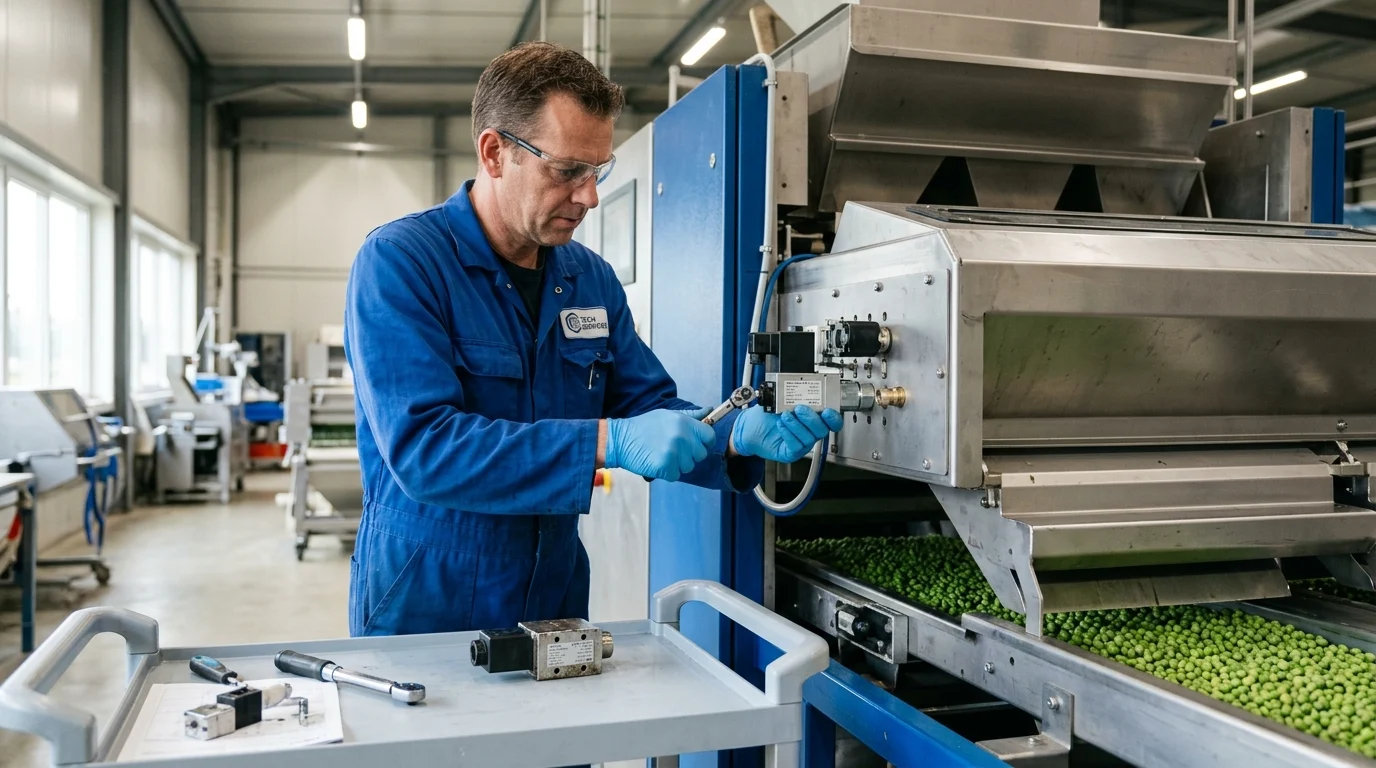
In a high-throughput optical sorting line, a small pneumatic component can decide whether valuable product stays in the accept stream or is blown away as waste. For European operators facing tight energy costs, strict uptime targets, and demanding purity requirements, sourcing the right 0071372-00-compatible solenoid valve is not just a maintenance task—it is a production-risk decision. This guide explains what to verify before purchasing, from 24V DC electrical compatibility and 0.2–0.8 MPa pressure performance to switching speed, lifecycle expectations, leakage risk, and supplier validation. The goal is simple: avoid costly misfits, protect sorter accuracy, and keep compressed-air consumption under control.
Strategic Importance of 0071372-00 Solenoid Valve Replacement
Optical sorting machinery relies heavily on high-speed pneumatic ejection systems to separate defective materials from product streams with pinpoint accuracy. Whether deployed in plastics recycling, grain processing, or mineral refinement, these machines utilize advanced optical sensors to identify anomalies in real time. At the core of the ejection mechanism, the 0071372-00 solenoid valve functions as the primary actuation device, dictating the precision of the sorting line. For European operators managing high-throughput facilities, understanding the strategic importance of timely valve replacement is critical to maintaining material yield and profitability.
Operating Risks of Solenoid Valve Failure
Solenoid valve degradation introduces severe operational risks, primarily manifesting as delayed actuation or inconsistent air blast volumes. In modern high-speed optical sorters, ejection nozzles must fire within sub-millisecond windows. A response delay of merely 1.5 to 2.0 milliseconds can result in a 12% to 15% increase in false rejects, blowing acceptable product into the reject stream. Furthermore, worn internal seals lead to continuous compressed air leakage. A single compromised valve can increase localized air consumption by up to 30 liters per minute. Multiplied across a manifold of 64 or 128 valves, this drastically inflates the energy burden on facility compressors and accelerates wear on adjacent pneumatic components.
Compatibility Requirements for 0071372-00 Valves
When procuring replacements, strict adherence to the 0071372-00 compatibility specifications is non-negotiable. These specialized valves are engineered to interface flawlessly with proprietary manifold blocks and sensitive electronic control boards. Operators must verify that the replacement unit matches the exact 24V DC coil voltage to prevent electrical overstress. Additionally, it must reliably accommodate operating pressures ranging between 0.2 and 0.8 MPa. The physical footprint, including port sizing, gasket profiles, and mounting hole alignment, must precisely mirror the original equipment. This guarantees a hermetic seal, preventing costly pressure drops and ensuring the equipment maintains integrity against ambient dust and moisture.
Key Specifications and Supplier Comparison Points
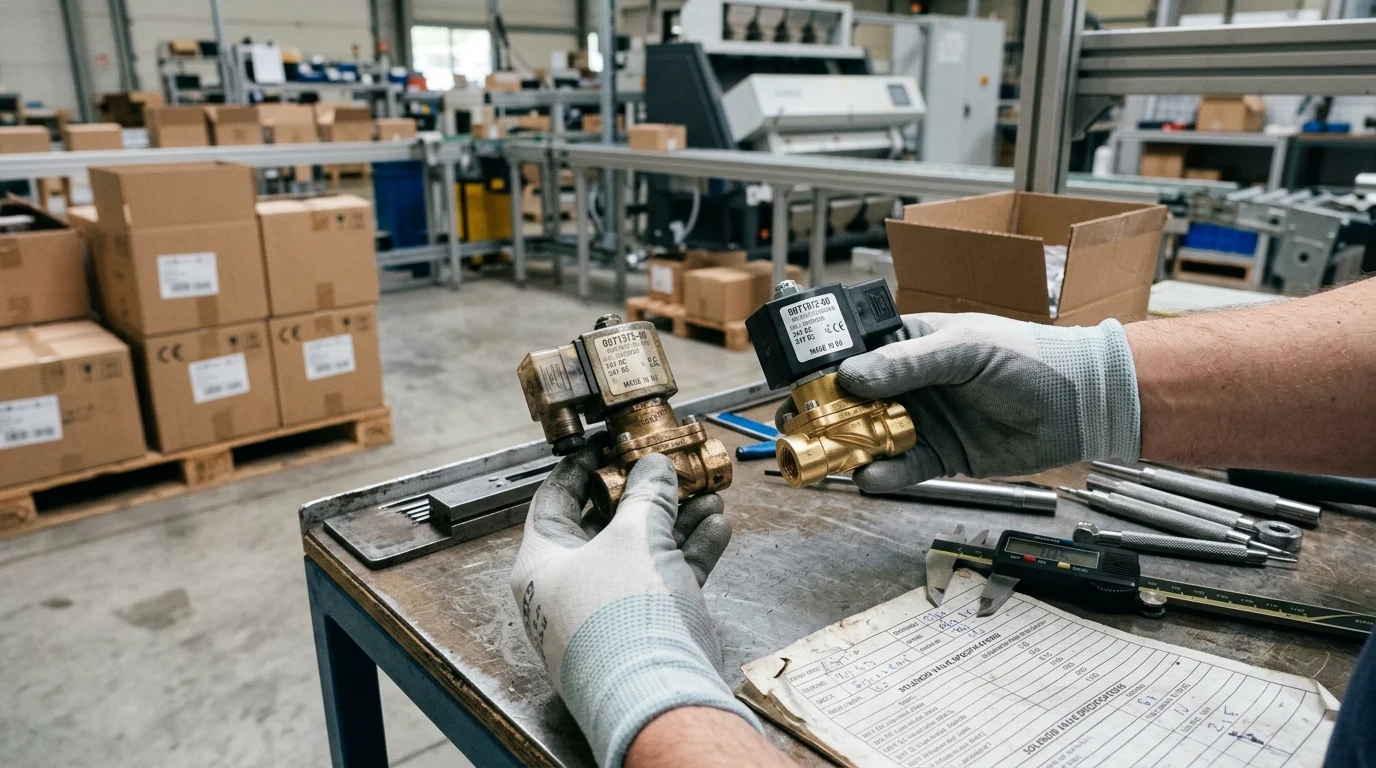
Evaluating potential suppliers requires a rigorous analysis of both technical specifications and commercial viability. Amidst global supply chain volatility, European buyers must balance the immediate capital expenditure of replacement parts against the long-term reliability and energy efficiency of the valves under continuous industrial operation.
Technical Parameters to Verify Before Approval
Before approving a new supplier for bulk procurement, engineering teams must validate several critical technical parameters. High-frequency sorting demands valves capable of sustaining rapid, continuous cycle rates without succumbing to thermal overload. Establishing an in-house test bench to verify these metrics is highly recommended.
| Technical Parameter | Standard Specification | Impact of Substandard Performance |
|---|---|---|
| Switching Frequency | > 1,000 Hz | Missed ejections at high belt speeds |
| Expected Lifespan | > 1 Billion Cycles | Frequent downtime and high maintenance costs |
| Power Consumption | < 5.0 Watts | Coil overheating and PCB strain |
| Protection Rating | IP65 or higher | Internal corrosion from ambient dust/moisture |
Ensuring the replacement valve meets these baseline metrics guarantees peak throughput. Deviations in power consumption can lead to localized heating, degrading coil insulation over time and resulting in premature short circuits that damage the main control board.
OEM vs Equivalent Options for European Buyers
The decision between sourcing original equipment manufacturer (OEM) parts versus equivalent alternatives is a central procurement challenge. While OEM valves offer guaranteed compatibility, they carry a substantial premium markup. Conversely, specialized aftermarket manufacturers offer equivalent 0071372-00 models that match the required dimensional and electrical tolerances at a reduced price point. European buyers can achieve unit cost reductions of 40% to 55% by qualifying reputable third-party suppliers. However, this advantage is only realized if the equivalent valve undergoes stringent validation. Operators must confirm that cycle longevity and response time match the OEM benchmark to prevent unexpected maintenance interventions from erasing initial procurement savings.
Final Sourcing Decision for European Optical Sorter Operators
The final sourcing decision extends beyond unit price and technical specifications. European facility managers must orchestrate a procurement strategy that actively mitigates supply chain friction, ensures regulatory compliance, and minimizes the total cost of ownership (TCO) while eliminating unexpected downtime.
Steps to Reduce Downtime and Customs Delays
Importing industrial pneumatic components into the European Union requires careful logistical planning to avoid customs delays. Buyers must ensure suppliers provide accurate commercial invoices featuring the correct TARIC classification code (typically 8481.20 for pneumatic transmission valves) alongside comprehensive CE certification and RoHS documentation. To neutralize the risk of extended downtime associated with shipping bottlenecks, operators are advised to establish a localized strategic inventory buffer. Maintaining a minimum order quantity (MOQ) buffer of 50 to 100 units on-site transforms a potential 10-to-14-day air freight delay into a seamless, zero-downtime maintenance event. This proactive approach is critical during peak processing windows.
Decision Criteria for Commercially Viable Replacement
A commercially viable replacement strategy relies on establishing robust vendor criteria. Procurement officers should prioritize suppliers that demonstrate ISO 9001 certified manufacturing processes and offer transparent warranty terms, ideally covering a minimum of 12 months or a guaranteed operational cycle count. Furthermore, operators must calculate the true total landed cost, factoring in the base unit price, shipping tariffs, import duties, and the projected mean time between failures (MTBF). When onboarding a new supplier, preventative maintenance schedules should be temporarily accelerated to monitor early-stage performance. By evaluating these strict criteria, operators can confidently secure a reliable, cost-effective supply of replacement valves.
Key Takeaways
- Replace worn 0071372-00 solenoid valves before delayed actuation increases false rejects by 12% to 15% in high-speed sorting lines.
- Verify exact 24V DC coil compatibility to protect sorter control boards from electrical overstress and overheating.
- Confirm the replacement valve supports 0.2 to 0.8 MPa operating pressure to maintain stable pneumatic ejection performance.
- Inspect port sizing, gasket profiles, and mounting alignment before installation to prevent leaks and pressure drops.
- Prioritize valves rated above 1,000 Hz, over 1 billion cycles, under 5.0 watts, and IP65 or higher for demanding European facilities.
- Test supplier samples under real operating conditions before bulk procurement to reduce downtime, energy waste, and quality risk.
Frequently Asked Questions
Why is timely replacement of a 0071372-00 solenoid valve important?
Delayed or inconsistent valve actuation can reduce sorting accuracy, increase false rejects, and raise compressed-air consumption. Replacing worn valves helps protect yield, energy efficiency, and overall sorter reliability.
What voltage should a 0071372-00 replacement valve use?
Operators should verify an exact 24V DC coil voltage match. Using the wrong voltage can overstress control boards, cause overheating, or lead to unreliable valve performance.
What operating pressure range should be checked before sourcing?
A compatible replacement should reliably operate within the required 0.2 to 0.8 MPa pressure range. This helps maintain consistent air blasts and stable ejection performance.
How can valve failure affect compressed-air costs?
Worn seals may cause continuous leakage. One compromised valve can add up to 30 liters per minute of air consumption, increasing compressor load and energy costs across large manifolds.
What physical compatibility details matter most?
Check port size, gasket profile, mounting hole alignment, and manifold fit. Even small mismatches can cause pressure loss, air leakage, or installation problems.
Post time: Oct-09-2026