
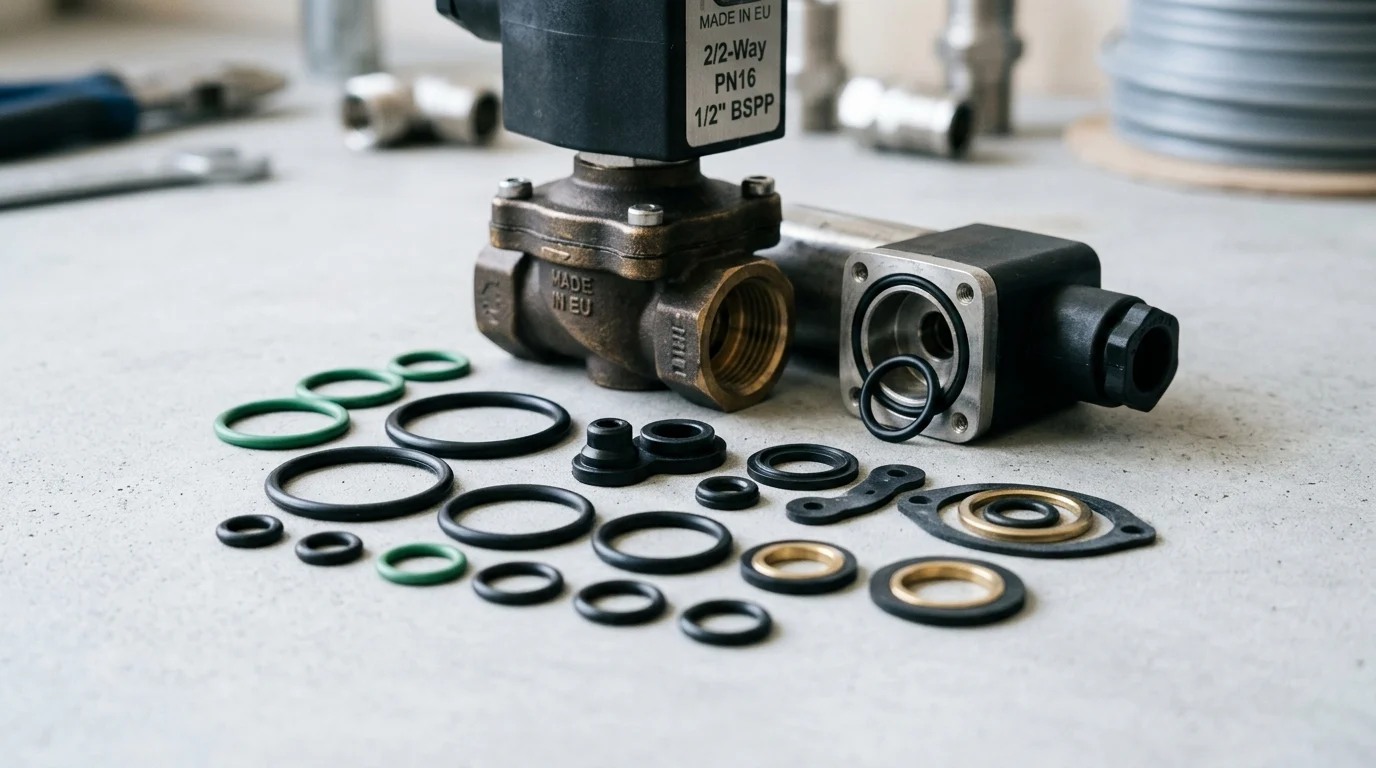
A solenoid valve may look like a rugged piece of industrial hardware, but its reliability often depends on a few grams of elastomer. In European plants running high-pressure hydraulics, automated pneumatics, chemical dosing, or petrochemical safety systems, a worn seal or mismatched O-ring can turn into leakage, erratic response, contamination, and expensive downtime. These components may operate under pressures above 300 bar, cycle millions of times, and face aggressive media and heat. This article explains why seal selection, material compatibility, compression design, and degradation monitoring deserve close attention—and how small specification errors can escalate into major operational failures.
Why Solenoid Valve Seals and O-Rings Matter
Solenoid valves function as critical control nodes in fluid and gas management systems across European industrial infrastructure, ranging from advanced manufacturing to automated chemical processing. However, the reliability of these precision instruments relies heavily on components that are often an afterthought in the procurement process: seals and O-rings.
Despite their minimal cost relative to the overall valve assembly, seal failures cause a disproportionate number of catastrophic system leaks and unplanned plant shutdowns. Operating under stringent pressure thresholds—often exceeding 300 bar in heavy hydraulic applications—these elastomeric barriers must maintain absolute integrity under varying thermal, dynamic, and chemical stresses. In the era of Industry 4.0, where predictive maintenance is paramount, understanding the exact lifecycle limits of these small components is essential for continuous operations.
What Solenoid Valve Seals and O-Rings Do
The primary function of seals and O-rings in a solenoid valve is to prevent fluid or gas bypass between internal ports and completely isolate the electromagnetic coil from the media. When the valve's armature actuates, dynamic seals must accommodate rapid mechanical cycling while maintaining a leak-tight boundary. This requires a precise "squeeze" or deformation of the elastomer, typically engineered between 10% and 30% of its original cross-section depending on the application. Static O-rings, conversely, secure external valve body interfaces against environmental ingress and internal pressure. In high-cycle pneumatic systems operating continuously at 5 to 10 bar, a dynamic seal might endure up to 50 million cycles over its operational lifespan. This necessitates exceptional abrasion resistance and dimensional stability to prevent cross-contamination.
How Seal Degradation Causes Downtime
Degradation of these elastomers initiates a rapid cascade of operational failures. Extrusion—characterized by the seal material being forced into clearance gaps—typically occurs when system pressures suddenly exceed the material's yield strength or when hardware clearances are improperly machined. Chemical attack manifests as severe swelling or embrittlement, sometimes reducing the seal's effective volume or causing micro-fractures that compromise the barrier. When a seal degrades, internal leakage alters the valve's response time, leading to actuator desynchronization. In highly regulated sectors like European petrochemical refining, a single compromised O-ring causing an uncommanded valve sequence can trigger automated safety protocols. This halts entire production lines, frequently costing facilities upwards of €50,000 per hour in lost throughput and requiring extensive diagnostic labor to locate the micro-leak.
Material Specifications and Compliance

Specifying the correct elastomeric compound is the most critical variable in solenoid valve engineering. Material selection must meticulously balance chemical compatibility, thermal parameters, and mechanical durability against the specific fluid or gas passing through the system. Selecting a suboptimal compound inevitably leads to rapid degradation and premature valve failure, whereas arbitrarily over-specifying materials can inflate component costs by an order of magnitude without yielding functional benefits.
Key Elastomer Materials to Compare
Industrial solenoid valves predominantly utilize four elastomeric compounds, each tailored for distinct operational envelopes. Fluoroelastomers (FKM/Viton) offer exceptional resistance to petroleum oils and high temperatures, operating reliably up to 200°C. Ethylene Propylene Diene Monomer (EPDM) remains the undisputed standard for steam and hot water applications, though it is fundamentally incompatible with petroleum-based fluids. Nitrile Rubber (NBR) serves as the cost-effective workhorse for general pneumatics and hydraulics, functioning optimally between -30°C and 100°C. For extreme chemical environments, Perfluoroelastomers (FFKM) provide nearly universal chemical resistance, albeit at a significant cost premium.
| Material | Temp Range (°C) | Primary Strengths | Notable Incompatibilities |
|---|---|---|---|
| NBR | -30 to 100 | Oil resistance, high tensile strength | Ozone, strong acids |
| EPDM | -40 to 150 | Steam, hot water, weathering | Petroleum oils, lubricants |
| FKM | -20 to 200 | High heat, aggressive chemicals | Skydrol, low molecular weight esters |
| FFKM | -20 to 320 | Universal chemical resistance | Fluorinated solvents |
European Compliance Factors for Seal Selection
European industrial markets impose stringent regulatory frameworks governing material safety, chemical composition, and batch traceability. For solenoid valves deployed in food and beverage processing, seals must adhere to EC 1935/2004 and FDA CFR 21.177.2600 standards, which dictate strict permissible extraction limits for elastomers in direct contact with consumables. In potable water applications, compounds must secure WRAS (UK), KTW/W270 (Germany), or ACS (France) certifications to ensure no harmful leaching occurs. Furthermore, all industrial seals imported or manufactured within the European Union must comply with REACH (Registration, Evaluation, Authorisation and Restriction of Chemicals) and RoHS regulations. This requires rigorous documentation ensuring the absence of restricted substances, such as specific phthalates or SVHCs (Substances of Very High Concern), keeping them strictly below the 0.1% weight-by-weight threshold.
Sourcing, Inspection, and Selection
Procuring high-performance seals requires rigorous supply chain oversight and exacting quality assurance protocols. Industrial buyers must thoroughly evaluate both the dimensional precision of the elastomeric components and the advanced manufacturing capabilities of the supplier to guarantee long-term valve reliability and prevent costly downtime.
How to Evaluate Dimensions and Quality
Quality inspection of O-rings and seals demands precision metrology and rigorous batch testing. Key dimensional parameters include the inside diameter (ID) and the cross-section (CS), which must adhere to strict tolerances defined by the ISO 3601-1 standard. For instance, a standard Class A O-ring with a 2.00 mm cross-section requires a tolerance of ±0.08 mm to ensure proper gland fill and prevent high-pressure extrusion. Surface defect inspection is equally critical; ISO 3601-3 outlines the maximum acceptable limits for flash, flow marks, and non-fills. Advanced manufacturing facilities now employ automated optical inspection (AOI) systems capable of detecting micro-defects smaller than 0.05 mm. Additionally, durometer testing ensures material hardness remains within the standard ±5 Shore A tolerance, keeping defect rates below 50 parts per million (PPM) for critical European aerospace and medical applications.
Choosing Standard or Custom Seals
The strategic decision between off-the-shelf and custom-engineered seals hinges heavily on application severity, hardware constraints, and overall production volume.
Key Takeaways
- Specify seal materials against the actual media, pressure, temperature, and duty cycle rather than choosing the cheapest or most expensive elastomer by default.
- Design O-ring compression carefully, as many solenoid valve seals require about 10% to 30% squeeze to maintain sealing without accelerating wear.
- Treat minor internal leakage as an early warning sign because it can change valve response time and desynchronize automated actuators.
- Check hardware clearances and pressure spikes in high-pressure systems, since extrusion can occur when elastomers are forced into gaps under excessive load.
- Plan preventive inspection for high-cycle pneumatic valves because dynamic seals may need to survive tens of millions of cycles in continuous service.
- Factor downtime risk into procurement decisions, as a low-cost O-ring failure can contribute to production losses exceeding €50,000 per hour in critical facilities.
Frequently Asked Questions
Why do solenoid valve seals fail before the valve itself?
Seals and O-rings face pressure, cycling, heat, and chemical exposure directly. Even when the valve body and coil remain functional, elastomer degradation can cause leaks, slow response, or unsafe actuation.
What seal squeeze is typically used in solenoid valves?
Many solenoid valve O-rings are designed with about 10% to 30% compression, depending on whether the seal is static or dynamic and on pressure, temperature, and media conditions.
How costly can a failed O-ring be in industrial operations?
In regulated European petrochemical or automated manufacturing environments, one leaking O-ring can trigger shutdowns and safety protocols, with lost throughput sometimes exceeding €50,000 per hour.
Which seal material is best for high-temperature oil service?
FKM, often known by the Viton trade name, is commonly specified for petroleum oils and elevated temperatures, with reliable performance in many applications up to about 200°C.
What causes seal extrusion in high-pressure valves?
Extrusion occurs when elastomer material is forced into clearance gaps, often because pressure spikes exceed the seal’s strength or because valve hardware clearances are too large.
Post time: Oct-07-2026