
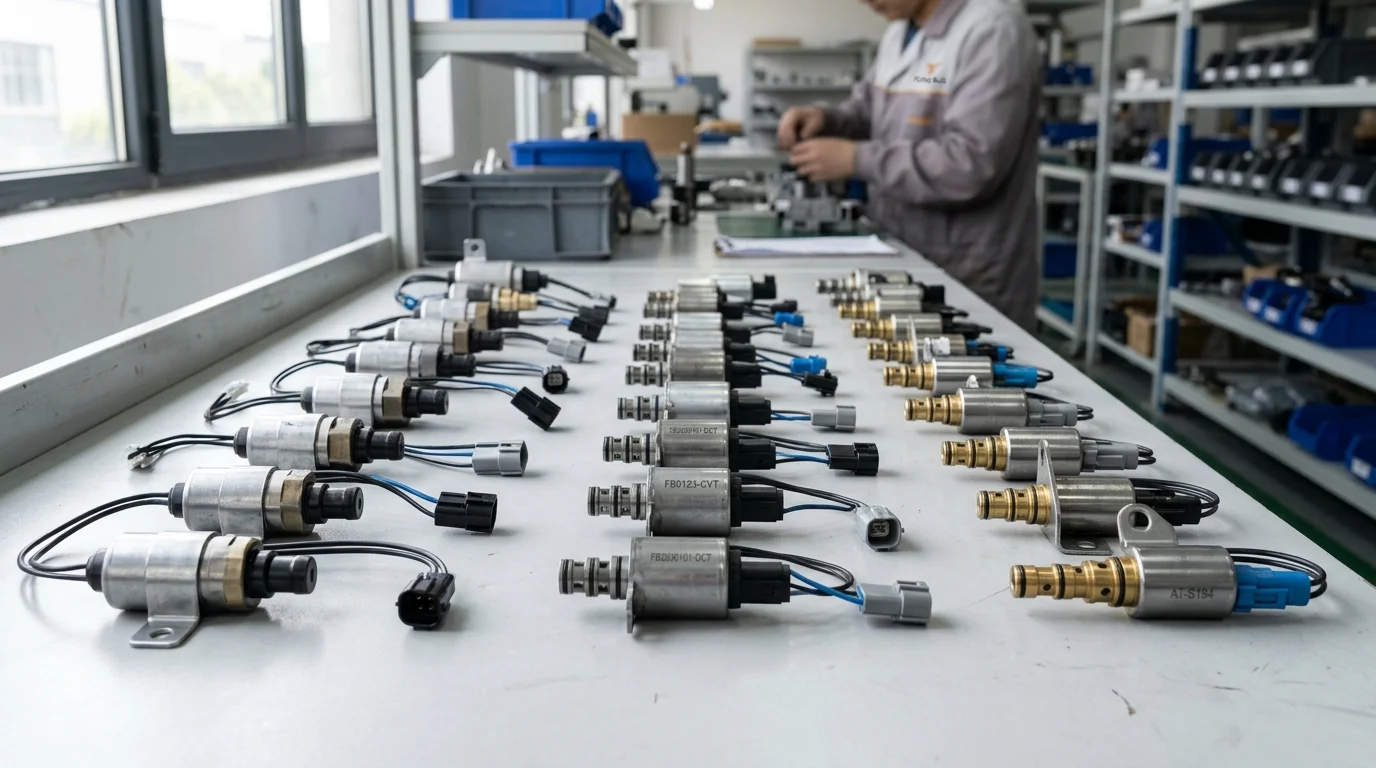
Transmission repair is becoming more component-focused as vehicle fleets age and complete mechatronic replacements remain costly. For US and EU aftermarket distributors, the challenge is not simply finding solenoid valves—it is building coverage that matches real-world demand across AT, CVT, and DCT applications without creating fitment risk. A production range of 20+ transmission solenoid valve models can help simplify sourcing, support rebuilders, and strengthen catalog competitiveness when it is backed by careful OE cross-referencing and technical validation. This article explains why broad model coverage matters, how different transmission architectures affect solenoid requirements, and what distributors should evaluate before adding new part numbers to their lineup.
Why Offer 20+ AT, CVT, and DCT Solenoid Valve Models
The automotive aftermarket requires distributors to manage a highly fragmented transmission landscape. Offering a consolidated portfolio of over 20 distinct transmission solenoid valve models—covering major OE platforms like Aisin, ZF, Jatco, and BorgWarner—helps streamline procurement and provides a clear value proposition for buyers. Demand for precision component-level repair is driven by rising average vehicle ages, limited core availability, and the high replacement costs of complete mechatronic assemblies. By cross-referencing top-selling OE part numbers and analyzing regional fleet mixes, distributors can build a comprehensive catalog that prevents lost sales and positions them as primary suppliers for transmission rebuilders and specialized repair facilities.
Coverage Across Major Transmission Types
Securing coverage across Automatic Transmissions (AT), Continuously Variable Transmissions (CVT), and Dual-Clutch Transmissions (DCT) ensures compatibility with the vast majority of the current passenger and light commercial installed base. Each architecture demands distinct solenoid characteristics. AT linear solenoids typically modulate line pressures to manage clutch pack engagement. CVT systems require highly responsive pressure control solenoids to adjust pulley ratios seamlessly, often operating under higher hydraulic pressures. Meanwhile, DCT solenoids must actuate rapidly to pre-select gears, preventing shift shock and maintaining continuous torque delivery.
However, distributors must note that broad transmission-family guidance is only a starting point. True compatibility is often overridden by specific solenoid functions, connector pinouts, calibration curves, valve-body generations, firmware/mechatronic pairing, fluid types, and superseding OE service updates.
Key Comparison Points for Distributors
When evaluating a supplier's 20+ model portfolio, aftermarket distributors must analyze specific technical parameters to ensure parity with original equipment specifications. The following table delineates the primary operational differences and distributor stocking considerations for each major transmission solenoid category.
| Transmission Type | Primary Solenoid Function | Typical Operating Pressure* | Expected Actuation Speed* | Common Failure Modes |
|---|---|---|---|---|
| AT (Automatic) | Line pressure & shift control | 5 – 20 bar | 150 – 300 ms | Valve body wear, debris contamination |
| CVT | Pulley ratio modulation | 10 – 60+ bar | 100 – 200 ms | Overheating, fluid degradation |
| DCT | Clutch engagement & fork actuation | 15 – 40 bar | 50 – 100 ms | Electrical faults, rapid cycling wear |
*Disclaimer: All pressure, response-time, cycle-life, PPM, MOQ, lead-time, and warranty figures vary significantly by OE platform, specific transmission design, and supplier agreements. These ranges are illustrative benchmarks. Distributors must confirm all specifications and commercial terms per specific part number and purchase contract before publication or buyer use. Real fitment validation requires checking OE-specific solenoid part numbers, as AT/CVT/DCT classifications alone do not determine compatibility.
How Flying Bull Supports US and EU Aftermarket Distributors
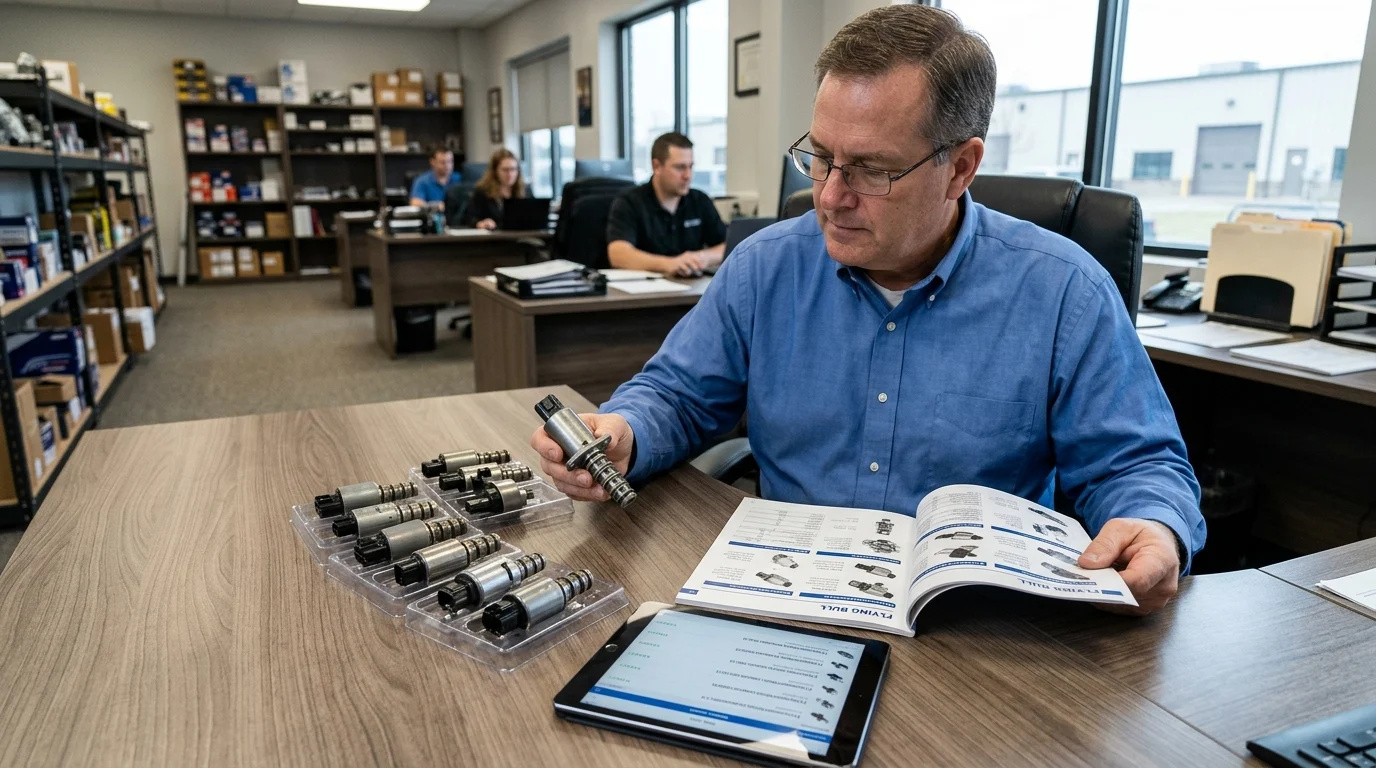
Supplying the competitive automotive aftermarkets of the United States and the European Union demands rigorous quality assurance and reliable supply chains. According to company documentation, Flying Bull structures its manufacturing and export frameworks to support the technical and logistical demands of these regions. Leveraging an export track record to the US and EU, the supplier states that its production methodologies align with IATF 16949 quality management principles. This approach aims to produce transmission solenoid valves capable of withstanding specific operational conditions, such as continuous fluid temperatures up to 120°C and pressures exceeding 60 bar in CVT applications.
Validation Standards for Solenoid Valves
Flying Bull states that it manufactures its components in IATF 16949-certified facilities. Solenoid valves undergo end-of-line functional testing to verify coil resistance, flow rate accuracy, and hydraulic leak integrity before packaging. To support long-term durability, representative statistical samples from production batches are subjected to accelerated life testing in internal laboratories. According to supplier specifications, these tests are designed to simulate up to 2,000,000 continuous actuation cycles at fluid temperatures peaking at 120°C (248°F). This validation matrix supports a targeted internal benchmark of less than 50 Parts Per Million (PPM) defects, aiming to provide distributors with documented reliability metrics necessary to confidently supply professional transmission rebuilders.
Aftermarket Requirements in the US and EU
The US and EU markets impose distinct regulatory and commercial expectations on automotive aftermarket components.
- Legal Obligations and Documentation: For European distributors, compliance with REACH and RoHS directives is required, restricting hazardous substances such as hexavalent chromium in solenoid plating processes. While Flying Bull targets these standards and typically provides supplier-generated documentation, buyers should request third-party laboratory certifications for full compliance verification.
- Importer of Record Responsibilities: For customs clearance, shipments are classified under standardized EU CN or US HTS codes (e.g., 8481.20 for hydraulic valves). Distributors must remember that they ultimately bear the legal and financial responsibilities of the importer of record, including duties and tariffs.
- Market-Driven Stocking: In the United States, inventory demand is heavily influenced by the regional fleet mix and the prevalence of heavy-duty applications, whereas EU markets lean heavily toward DCT and compact AT platforms.
- Commercial Terms: To support international inventory management, Flying Bull offers flexible Incoterms (such as FOB or DDP). Representative commercial terms—which must be verified per contract—include Minimum Order Quantities (MOQs) starting at 100 units per model, target production lead times of 30 to 45 days, and standard 12- to 24-month warranties.
How Distributors Can Source and Stock Solenoid Valves
Optimizing a transmission solenoid inventory requires balancing capital efficiency with market coverage. Stocking a diverse portfolio necessitates a practical playbook covering demand forecasting, fitment validation, traceability, defect handling, and inventory turns. A streamlined supply chain can help lower total landed costs and improve operational efficiency for aftermarket buyers.
Practical Steps to Reduce Sourcing Risk
Mitigating sourcing risk involves establishing resilient procurement frameworks focused on batch traceability and clear defect handling. To maintain high order fill rates without over-leveraging capital, purchasing managers should implement rolling forecasts aligned with manufacturer lead times. Regular audits of supplier defect rates and delivery schedules further protect against supply disruptions.
Key Takeaways
- Distributors should build solenoid valve catalogs around exact OE part numbers rather than relying only on AT, CVT, or DCT transmission categories.
- A portfolio of 20+ AT/CVT/DCT solenoid valve models can help reduce lost sales by covering major platforms such as Aisin, ZF, Jatco, and BorgWarner.
- CVT and DCT applications often require faster response and more demanding hydraulic control, so technical validation is essential before stocking.
- Before publishing fitment data, distributors should confirm connector pinouts, calibration curves, valve-body generations, fluid requirements, and superseding OE updates.
- US and EU aftermarket buyers can improve procurement efficiency by sourcing from suppliers with consolidated coverage across automatic, continuously variable, and dual-clutch transmissions.
Frequently Asked Questions
Why should distributors stock 20+ transmission solenoid valve models?
A broader portfolio helps cover fragmented AT, CVT, and DCT applications, reduces lost sales, and supports rebuilders who need component-level repair options instead of full mechatronic replacement.
Which transmission platforms are most important for aftermarket coverage?
Distributors should prioritize high-demand OE platforms such as Aisin, ZF, Jatco, and BorgWarner, then refine coverage using regional fleet data and top-selling OE part numbers.
Are AT, CVT, and DCT solenoid valves interchangeable?
No. Each transmission type uses different solenoid functions, pressure ranges, actuation speeds, connector designs, calibration curves, and valve-body requirements. Fitment must be confirmed by exact OE part number.
What should distributors check before adding a solenoid model?
Key checks include OE cross-reference, connector pinout, hydraulic function, calibration curve, valve-body generation, fluid compatibility, firmware pairing, and any superseding OE service updates.
Why is demand rising for transmission solenoid valves?
Demand is supported by aging vehicles, high replacement costs for complete assemblies, limited core availability, and the growing preference for precise component-level transmission repair.
Post time: Sep-15-2026