
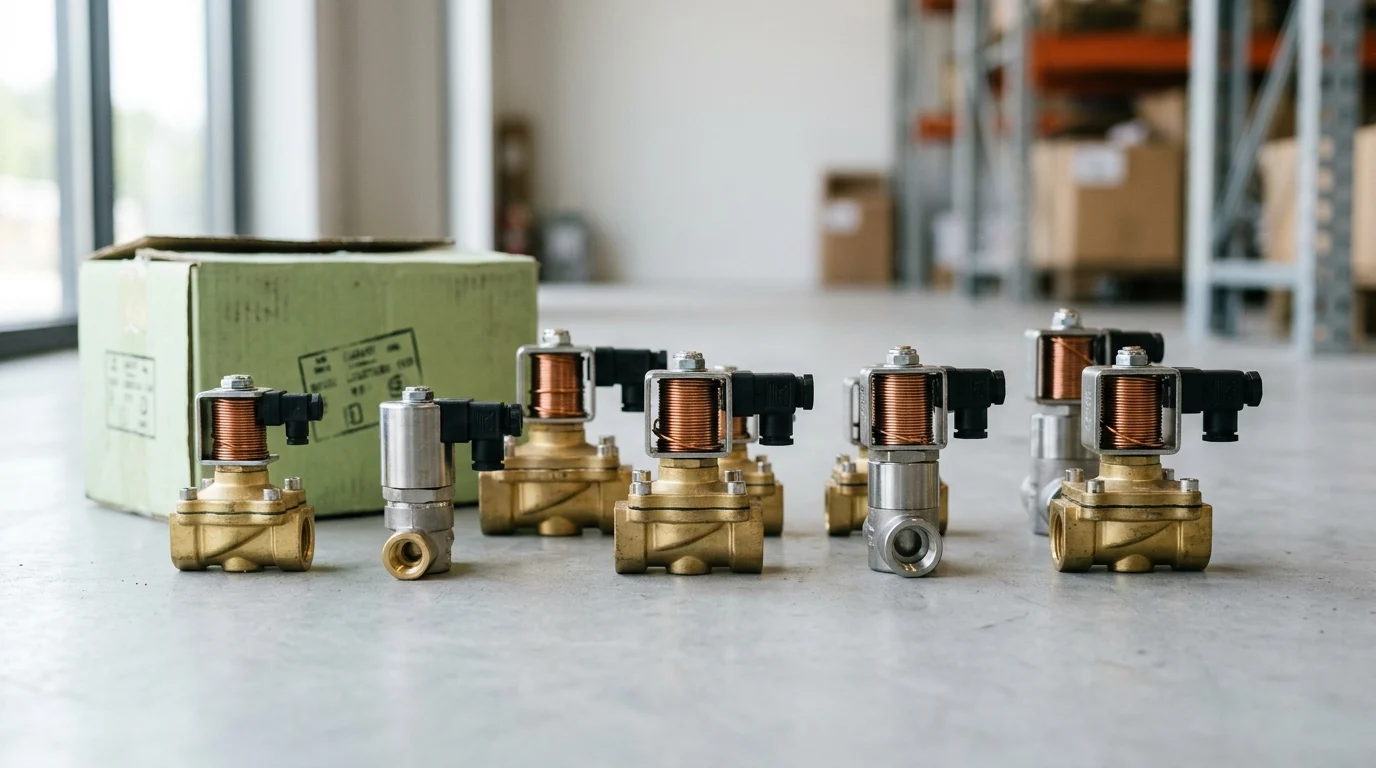
For US buyers sourcing solenoid valves from China, the quoted unit price is no longer the number that matters most. A valve that looks competitive at the factory gate can become unprofitable once MFN duty, Section 301 tariffs, possible AD/CVD exposure, freight, clearance costs, and working-capital timing are added. With a risk-adjusted tariff stack reaching 39.5% in worst-case models, procurement teams need to rebuild supplier comparisons around total landed cost, not EXW pricing. This article explains how tariff layers affect industrial and automotive solenoid valves, why HTS classification matters, and which practical tools can help buyers protect margin and cash flow.
Why the 39% Tariff Matters for Solenoid Valve Buyers
The implementation of aggregate tariffs that can reach a worst-case ceiling of 39.5% on industrial and automotive components sourced from China has fundamentally altered procurement strategies for US buyers. For solenoid valves, this elevated composite duty represents a significant structural cost risk that requires immediate recalibration of supply chain economics. Rather than treating these tariffs as temporary anomalies, buyers must model them as potential long-term exposures.
Tariff components and HTS classifications
Understanding this 39.5% figure requires breaking down how US Customs and Border Protection (CBP) applies overlapping duties to create a worst-case sensitivity model. As of mid-2025, solenoid valves typically fall under Harmonized Tariff Schedule (HTS) heading 8481. It is crucial to distinguish between industrial-grade and automotive-grade solenoid valves, as their HTS classification nuances, AD/CVD applicability, and viable alternative supplier pools differ significantly. General-purpose industrial valves often fall under subheadings like 8481.80.90, while automotive-grade valves use specialized classifications. The standard Most Favored Nation (MFN) duty rates for these components often range from 2% to 4.5%.
Under Section 301 tariffs, an additional 25% ad valorem duty applies to these specific HTS codes when originating from China. For most buyers, this creates a standard duty exposure of roughly 27% to 29.5%. However, when combined with specific trade enforcement measures—such as an illustrative 10% Anti-Dumping or Countervailing Duty (AD/CVD) modeling assumption on certain metal components from targeted suppliers—the effective penalty rate can push the total import duty scenario to a risk-adjusted ceiling of 39.5%. Because actual AD/CVD margins are order-specific and highly variable, procurement teams should use this 39.5% stack as a worst-case baseline rather than a universal statutory standard. Furthermore, buyers can employ proactive HTS engineering—legitimately redesigning or reclassifying components to fit more favorable subheadings—to actively manage and mitigate this duty exposure. However, buyers must proceed with caution; aggressive reclassification can trigger CBP scrutiny or penalties if deemed tariff evasion rather than legitimate product redesign.
Commercial risks for margins and pricing
The commercial implications of absorbing up to a 39.5% worst-case duty stack can severely impact gross margins. A brass-bodied proportional solenoid valve that previously cost $25.00 Ex Works (EXW) could incur nearly $10.00 in duties alone, before ocean freight and drayage are calculated. US manufacturers operating on standard 20% to 30% gross margins cannot absorb this impact without passing costs to end-users, risking market share loss to competitors utilizing nearshore supply chains.
Furthermore, this tariff burden restricts working capital. Duties are payable upon customs clearance, meaning buyers must finance this premium during the standard 60-to-90-day inventory holding period before realizing any revenue from the assembled final product. To mitigate these cash flow constraints, procurement teams should evaluate mechanisms like Foreign Trade Zones (FTZs), duty drawback programs, and bonded warehousing, which allow importers to defer, reduce, or recover duty payments on qualifying operations.
How to Recalculate Landed Cost

Recalculating the true cost of acquisition requires moving beyond simple EXW price comparisons and implementing a rigorous Total Landed Cost (TLC) model. Procurement teams must isolate every variable in the transit lifecycle to identify exactly where margin erosion occurs.
Separate unit price, duty, freight, and fees
To build an accurate TLC model, buyers must disaggregate the supplier invoice from logistics and compliance costs. Procurement teams can implement this formula directly: Total Landed Cost = EXW + Freight + Insurance + (Dutiable Value × (MFN + Section 301 + AD/CVD)) + Brokerage + Drayage. This formula isolates the base unit price, packaging fees, inland China freight, ocean or air freight, the standard MFN duty, the Section 301 penalty, any applicable AD/CVD, customs brokerage fees, and domestic US drayage.
For complex assemblies—such as a typical transmission solenoid kit found on B2B marketplaces—improper HTS classification can inadvertently trigger higher penalty tiers if components are misidentified as standalone electronics rather than mechanical valves. Segmenting these costs allows buyers to see that while a Chinese supplier might offer a 20% lower unit price than a domestic vendor, the combined weight of freight and a worst-case 39.5% duty stack can completely negate the initial savings.
Benchmark China against alternative sources
Once the Chinese TLC is accurately mapped, buyers must benchmark it against alternative global manufacturing hubs. Southeast Asia and Latin America represent the primary alternatives, offering significantly different tariff profiles. Evaluating these regions requires comparing higher base manufacturing costs against the savings generated by favorable trade agreements. The following illustrative hypothetical comparison—based on assumed freight rates and a modeled 39.5% worst-case China duty—highlights these regional differences.
| Cost Component | China (39.5% Duty) | Vietnam (4.5% Duty) | Mexico (USMCA 0% Duty)* |
|---|---|---|---|
| EXW Unit Price | $12.00 | $14.50 | $15.50 |
| Ocean/Cross-border Freight | $1.50 | $1.80 | $0.50 |
| Total Tariffs & Duties | $4.74 | $0.65 | $0.00 |
| Brokerage & Port Fees | $0.25 | $0.25 | $0.15 |
| Total Landed Cost | $18.49 | $17.20 | $16.15 |
*Note: 0% USMCA duty requires meeting strict rules-of-origin and incurs its own compliance and supplier qualification costs. The figures above are hypothetical and intended for illustrative purposes only.
This benchmarking exercise frequently reveals that despite Mexico’s 29% higher EXW price in the theoretical example above, the elimination of ocean freight volatility and the 0% USMCA duty rate results in a 12.6% reduction in Total Landed Cost compared to the Chinese baseline. However, sourcing from Mexico does not automatically guarantee zero duty; buyers must ensure that non-originating Chinese inputs meet strict USMCA rules-of-origin caveats, such as tariff-shift or regional-value-content requirements.
When to Switch Suppliers or Renegotiate
Data-driven TLC models ultimately force procurement executives to evaluate strategic shifts. Rather than making strictly binary decisions, buyers typically pursue blended strategies: aggressively renegotiating terms with the existing Chinese factory, dual-sourcing to mitigate risk, or initiating the complex process of transitioning to a new supplier entirely.
Compare Chinese suppliers with alternatives
While initial benchmarking identifies potential cost savings, comparing Chinese suppliers with alternatives operationally involves evaluating transition friction
Key Takeaways
- Use 39.5% as a worst-case duty baseline when stress-testing Chinese solenoid valve suppliers, not as a universal statutory rate.
- Confirm whether each valve is industrial-grade or automotive-grade because HTS classification and AD/CVD exposure can differ materially.
- Replace EXW-only comparisons with a total landed cost model that includes MFN duty, Section 301 tariffs, freight, drayage, brokerage, and financing costs.
- Model duty cash outflow at customs clearance because tariffs can tie up working capital during a 60-to-90-day inventory holding period.
- Evaluate Foreign Trade Zones, bonded warehousing, and duty drawback programs to defer, reduce, or recover duties where operations qualify.
- Treat HTS engineering as a compliance-driven design strategy and document any classification changes carefully to avoid CBP penalties.
Frequently Asked Questions
Why should US buyers model a 39.5% tariff on Chinese solenoid valves?
The 39.5% figure is a worst-case landed-cost planning baseline, combining MFN duty, Section 301 tariffs, and possible AD/CVD exposure. It helps buyers stress-test supplier economics instead of relying only on quoted EXW prices.
Are all Chinese solenoid valves subject to the same duty rate?
No. Duty exposure depends on HTS classification, product design, origin, material composition, and whether AD/CVD measures apply. Industrial solenoid valves and automotive-grade solenoid valves may fall under different subheadings and risk profiles.
What HTS heading commonly applies to solenoid valves?
Many solenoid valves fall under HTS heading 8481, with industrial valves often classified under subheadings such as 8481.80.90. Buyers should confirm classification with a customs broker or trade counsel before finalizing cost models.
How does the tariff affect landed cost beyond the purchase price?
A valve quoted at $25 EXW could carry nearly $10 in duty under a 39.5% scenario, before freight, insurance, drayage, brokerage, and inventory financing costs are added. This can materially reduce gross margin.
Can buyers reduce tariff exposure through product redesign or reclassification?
Possibly, but only through legitimate HTS engineering, such as documented design changes that support a more accurate classification. Aggressive reclassification without substance can trigger CBP scrutiny, penalties, or allegations of tariff evasion.
Post time: Nov-13-2026