
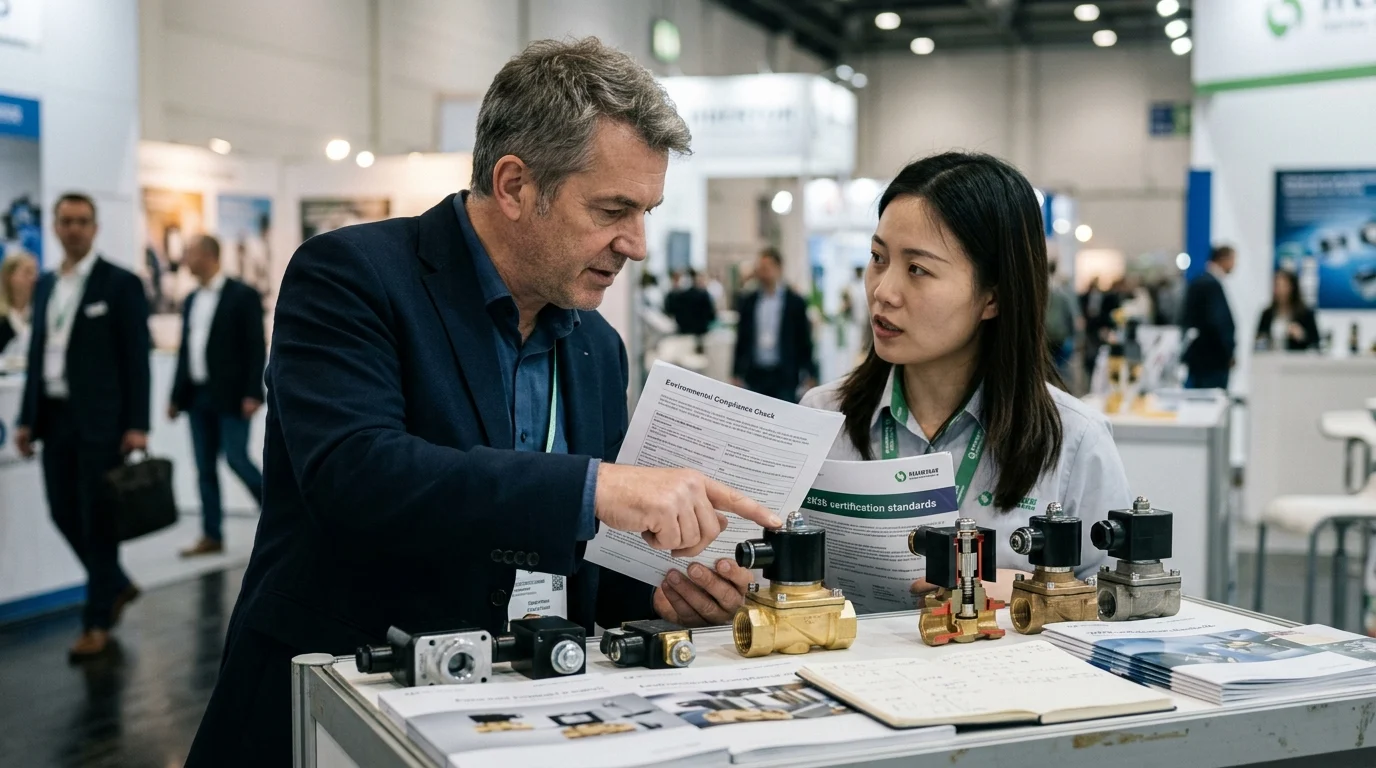
European buyers are changing how they qualify solenoid valve suppliers, especially when sourcing from China for pressure, hydraulic, and industrial automation applications. In 2026, a visible CE mark is no longer enough; procurement teams want proof that the certification matches the valve’s real operating envelope, including pressure limits, fluid classification, materials, and assembly-level risks. This matters because stricter market surveillance and importer liability can turn a weak technical file into customs delays, recalls, or legal exposure. This article explains the certification question behind the purchase order, the regulatory definitions buyers must clarify, and the evidence suppliers should be prepared to provide.
Certification Evidence Buyers Should Request

Securing robust certification evidence requires moving beyond one-page marketing certificates to demanding comprehensive Technical Construction Files (TCF) and valid Declarations of Conformity (DoC). European regulations mandate that manufacturers and importers retain these detailed technical records for a minimum of 10 years after the last unit is placed on the market.
For European buyers importing directly from China, the legal burden of proof effectively falls on the importer of record. This regulatory reality makes the acquisition of granular, verifiable evidence from the supplier a non-negotiable procurement standard before finalizing any vendor agreement.
How to compare CE, RoHS, REACH, ATEX, and PED
Comparing the dominant European directives requires understanding their distinct technical scopes. CE marking for LVD (2014/35/EU) applies to electrical components operating between 50 and 1000V AC, which covers the solenoid’s electromagnetic coil. However, the mechanical valve body requires PED evaluation based on fluid state and pressure.
For explosive environments, ATEX (2014/34/EU) certification is mandatory, requiring distinct testing evidence for Zone 0, Zone 1, or Zone 2 deployments. Environmental directives dictate material composition. When sourcing a high-cycle pneumatic control valve for sorting machinery, buyers must cross-reference the ATEX rating of the coil against the RoHS compliance of the aluminum or stainless steel manifold.
What a certification comparison table should include
To streamline supplier evaluation and prevent miscommunication, procurement engineers should utilize a standardized certification comparison matrix. This ensures all critical thresholds are met before initiating a pilot order or prototype testing phase.
| Certification | European Directive | Key Threshold / Technical Metric | Component Focus |
|---|---|---|---|
| LVD (CE) | 2014/35/EU | 50–1000V AC or 75–1500V DC | Solenoid electromagnetic coil |
| PED (CE) | 2014/68/EU | Maximum allowable pressure (PS) > 0.5 bar | Valve body and pressure boundaries |
| ATEX | 2014/34/EU | Equipment Categories 1, 2, or 3 (Zones 0-2) | Complete valve assembly in hazardous areas |
| RoHS 3 | 2015/863/EU | Pb, Hg, Cr6+ < 0.1% (1000 ppm) | Internal electronics and alloy materials |
| REACH | EC 1907/2006 | SVHC < 0.1% w/w per homogeneous part | All polymers, seals, and lubricants |
How Buyers Should Verify and Decide
Gathering documentation is only the first phase; the critical competency for purchasing teams in 2026 lies in verifying the authenticity of these claims and executing data-driven sourcing decisions. Fraudulent, altered, or expired certificates remain a persistent risk in global supply chains.
A rigorous verification protocol typically adds two to four weeks to the initial supplier onboarding process. However, this upfront investment in due diligence prevents catastrophic supply chain disruptions, legal liabilities, and costly product recalls down the line.
Practical verification steps for purchasing teams
The most practical verification step is querying the European Commission’s NANDO (New Approach Notified and Designated Organisations) database. Purchasing teams must verify that the four-digit Notified Body number printed on the supplier’s CE or ATEX certificate corresponds to an active laboratory authorized to assess that specific directive. A valid laboratory for LVD, for example, may not be accredited for PED.
Furthermore, buyers should demand full laboratory test reports—which often exceed 50 pages of technical data—rather than accepting a single-page summary certificate. Cross-referencing the Bill of Materials (BOM) in the test report against the actual production BOM ensures that the supplier has not substituted critical components, such as replacing a certified FKM O-ring with a non-compliant NBR alternative to reduce manufacturing costs.
When to accept, qualify, or reject a supplier
Decision matrices must be ruthlessly objective to protect the importer.
Key Takeaways
- Ask whether the CE mark is supported by the correct conformity assessment route, not merely whether the supplier can show a CE logo.
- Verify whether the solenoid valve falls under PED 2014/68/EU by checking maximum allowable pressure, internal volume, fluid group, and category thresholds.
- Do not accept coil-level certification as proof of full valve compliance because the pressure body, seals, materials, and assembly must also be covered.
- Request a complete Declaration of Conformity, Technical Construction File, test reports, and material declarations before placing orders for European use.
- Confirm RoHS 3 and REACH declarations at homogeneous-material level, especially where copper alloys may rely on lead exemptions.
- Maintain compliance documentation for at least 10 years because European importers may be required to prove conformity during market surveillance.
Frequently Asked Questions
What certification question are European buyers asking solenoid valve suppliers in 2026?
They are asking whether the CE mark is backed by the correct conformity route, including a European Notified Body when required, and whether the technical file covers the valve’s actual pressure, fluid, temperature, and operating limits.
Is a CE mark alone enough for solenoid valves sold into Europe?
Not always. A CE mark may only reflect LVD or EMC compliance. Buyers must confirm whether the Pressure Equipment Directive applies and whether the valve falls under SEP, Category I, or Category II based on pressure, volume, and fluid type.
When does PED become relevant for a solenoid valve?
PED 2014/68/EU becomes relevant when pressure equipment exceeds 0.5 bar and meets category thresholds based on maximum allowable pressure, volume, and fluid classification. Some categories require third-party conformity assessment rather than self-certification.
What documents should buyers request from Chinese suppliers?
Buyers should request a valid Declaration of Conformity, Technical Construction File, test reports, material declarations, RoHS and REACH statements, and evidence of Notified Body involvement if the product category requires it.
Why is component-level certification not enough?
A certified coil or electrical component does not automatically certify the full valve assembly. The machined body, seals, pressure boundary, materials, and complete operating envelope must also match the declared compliance scope.
Post time: Nov-11-2026