
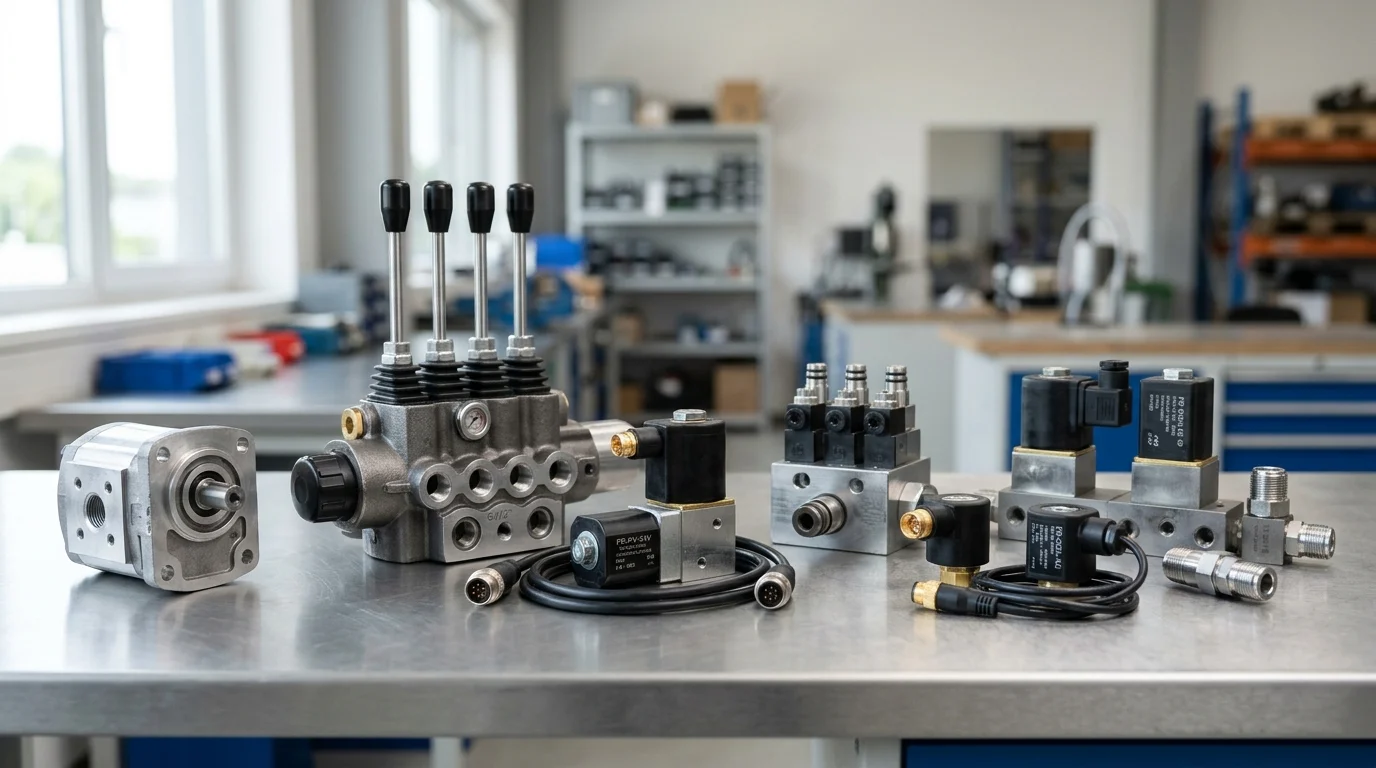
Hydraulic performance in forklifts, loaders, and construction equipment depends on far more than a single solenoid. As OEMs and fleet operators demand smoother control, higher uptime, and simpler sourcing, electro-hydraulic components must meet tight requirements for pressure, flow, electrical compatibility, and thermal stability. This article looks at how Flying Bull applies its electromagnetic engineering experience beyond transmission control, covering forklift directional valves, proportional coils, and pressure regulator solenoid valves. It also outlines the practical specifications buyers should compare, from 12V and 24V electrical systems to PWM behavior, spool tolerances, leakage control, and high-pressure hydraulic duty cycles.
Product Scope and Applications
Heavy-duty machinery relies on highly precise hydraulic control systems to execute complex operations safely and efficiently. While Flying Bull is widely recognized for manufacturing robust transmission solenoids—such as the 4WG200, which manages clutch engagements—the company manufactures a much broader range of components. By leveraging its core expertise in electromagnetic field optimization from transmission solenoids, Flying Bull has expanded its portfolio to encompass advanced hydraulic directional controls and electromagnetically actuated proportional coils engineered specifically for material handling and construction applications.
This expansion addresses the growing Original Equipment Manufacturer (OEM) demand for consolidated sourcing. It allows manufacturers to procure a wider array of electro-hydraulic components that meet stringent thermal, pressure, and flow specifications within a single-vendor ecosystem.
Forklift Directional Valves
Directional control valves serve as the central routing mechanism for hydraulic fluid in forklift masts, tilt cylinders, and steering circuits. Flying Bull engineers these components to withstand intense fluid power dynamics, typically managing maximum operating pressures ranging from 210 to 350 bar (approximately 3,000 to 5,000 psi). In high-capacity lift trucks, volumetric flow rates through these valves often exceed 80 to 120 liters per minute.
To meet industry standards, internal spool tolerances are typically machined within 3 to 5 microns. This precision helps ensure that internal leakage remains below 20 cc/min at 100 bar during load-holding operations. Flying Bull utilizes high-grade cast iron bodies to resist material fatigue from continuous pressure spikes, maintaining structural integrity across multi-shift operational profiles.
Proportional Coils
Unlike discrete on/off directional valves, proportional coils provide variable flow and pressure control by adjusting magnetic flux in direct response to a continuous electrical signal. These coils are essential for the smooth acceleration and deceleration of heavy hydraulic actuators. Operating primarily on Pulse Width Modulation (PWM) signals, standard industrial proportional coils typically function at frequencies between 100 Hz and 250 Hz.
A prime example of Flying Bull’s engineering in this space is the 0260130036 pressure regulator solenoid valve, which necessitates precise current-to-pressure hysteresis profiles. Industry benchmarks generally require proportional coils to maintain linearity within a 2% to 4% margin of error. Furthermore, control systems often apply a low-amplitude dither signal to these coils to overcome static friction (stiction), ensuring that operator joystick inputs translate smoothly into micro-movements of the hydraulic cylinders.
Buyer Comparison Criteria
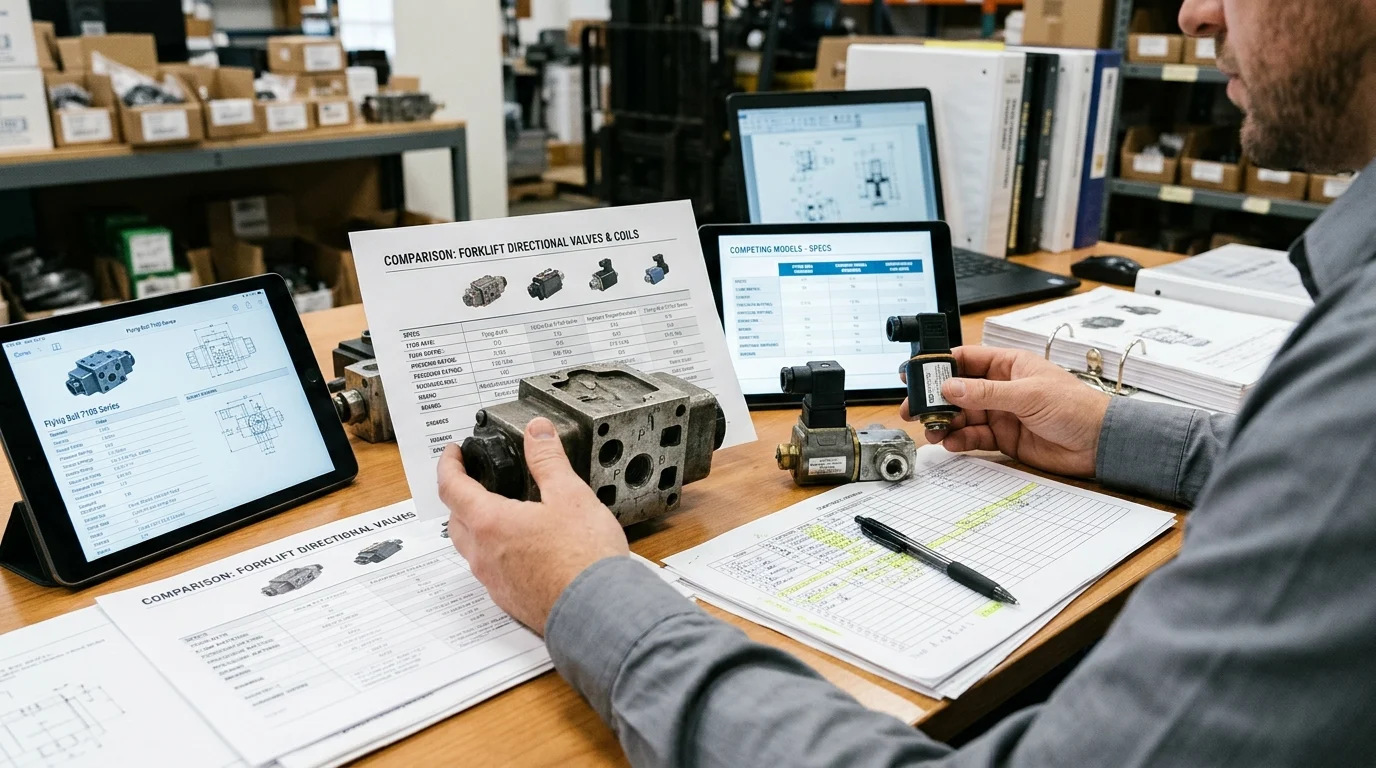
Selecting the correct electro-hydraulic components requires procurement engineers and system designers to evaluate a complex matrix of electrical, mechanical, and environmental specifications. The operational environment of construction, agricultural, and material handling equipment dictates that components must survive extreme temperature fluctuations, fluid contamination, and continuous mechanical vibration. Flying Bull designs its components to meet these demanding criteria, providing a clear comparison framework that separates standard aftermarket parts from true OEM-grade solutions.
Voltage, Resistance, and Compatibility
Electrical compatibility establishes the baseline performance and thermal stability of any solenoid or coil. Most heavy machinery operates on either 12V or 24V DC electrical architectures. In Flying Bull’s standard 24V proportional coils, resistance values typically fall between 16 and 22 ohms at an ambient temperature of 20°C. System designers must account for thermal drift: as a coil heats up during continuous operation, electrical resistance increases, which can reduce the current draw and lower the magnetic force applied to the valve spool. To counteract this, modern systems utilize current-regulated drivers rather than simple voltage control.
To assist in component evaluation, the following table outlines standard baseline parameters for comparing standard directional solenoids against proportional variants:
| Parameter | Standard Directional Solenoid | Proportional Coil |
|---|---|---|
| Control Type | Discrete (On/Off) | Continuous Variable |
| Typical Voltage | 12V / 24V DC | 12V / 24V DC (PWM) |
| PWM Frequency | N/A | 100 Hz – 250 Hz |
| Hysteresis | Not critical | < 4% |
| Response Time | 30 – 50 ms | 50 – 100 ms |
Testing and Validation Steps
Validation protocols are essential for ensuring field reliability and minimizing warranty claims. Flying Bull’s quality assurance teams subject components to extensive lifecycle testing, typically targeting a durability threshold of 2 million to 5 million actuation cycles before measurable degradation occurs. Environmental sealing is another key metric; the company’s coils generally achieve at least an IP67 rating, with high-end applications designed to meet IP69K standards for the high-pressure, high-temperature washdowns common in industrial maintenance.
Furthermore, dielectric strength testing is routinely performed by applying 500V DC across the coil windings for one minute to verify insulation integrity, ensuring the component will not short-circuit under peak electrical loads. Salt spray testing, often running for 720 hours per ASTM B117 standards, is also utilized to validate the corrosion resistance of external housings.
Supplier Qualification Framework
Transitioning from component specification to supplier selection involves analyzing a manufacturer’s operational maturity and supply chain resilience. A robust supplier qualification framework ensures that a chosen manufacturer can scale production while maintaining tight engineering tolerances across multiple product lines. Flying Bull structures its operations to meet these exact procurement standards, demonstrating the quality management systems and commercial flexibility required to supply both simple directional valves and complex proportional controls.
Quality Documentation
Authoritative quality documentation is the foundation of supply chain risk management. Tier-1 and Tier-2 OEMs typically require suppliers to hold active ISO 9001:2015 certifications, while automotive or heavy-truck applications often necessitate IATF 16949 compliance. Flying Bull supports procurement teams by providing comprehensive PPAP (Production Part Approval Process) documentation, focusing on dimensional reports, material certifications, Failure Mode and Effects Analysis (FMEA), and control plans.
In high-volume production runs, industry-leading suppliers target defect rates of less than 50 PPM (Parts Per Million). Additionally, material certificates verifying the use of specific alloys—such as ASTM A48 Class 35 for cast iron valve bodies—provide necessary assurance of metallurgical consistency and pressure-holding capability.
Sourcing Decision Checklist
Beyond technical compliance, commercial metrics and logistical capabilities dictate the long-term viability of a supplier relationship.
Key Takeaways
- Evaluate Flying Bull not only for transmission solenoids but also for forklift directional valves, proportional coils, and pressure regulator solenoid valves.
- Match directional valves to hydraulic demands by checking pressure ratings around 210 to 350 bar and flow requirements that may exceed 80 to 120 liters per minute.
- Prioritize precision-machined valve spools with micron-level tolerances when load holding, leakage control, and repeatable operation are critical.
- Specify proportional coils by voltage, resistance, PWM frequency, linearity, and hysteresis to ensure smooth actuator response.
- Use consolidated sourcing when possible to improve component compatibility and reduce procurement complexity for OEM hydraulic systems.
Frequently Asked Questions
What products does Flying Bull offer beyond transmission solenoids?
Flying Bull also manufactures forklift directional valves, proportional coils, and pressure regulator solenoid valves for material handling, construction, and heavy-duty hydraulic applications.
Why are forklift directional valves important?
They route hydraulic fluid to forklift masts, tilt cylinders, and steering circuits, helping equipment lift, tilt, steer, and hold loads safely under high pressure.
What pressure range do these hydraulic valves typically handle?
The article notes operating pressures of about 210 to 350 bar, or roughly 3,000 to 5,000 psi, depending on the application.
How do proportional coils differ from on/off solenoids?
Proportional coils vary hydraulic flow or pressure through a continuous electrical signal, while on/off solenoids mainly switch flow states between open and closed positions.
What electrical factors should buyers verify before selecting a coil?
Buyers should confirm voltage, resistance, connector style, PWM compatibility, current range, and whether the coil matches the machine’s 12V or 24V electrical system.
Post time: Nov-10-2026