
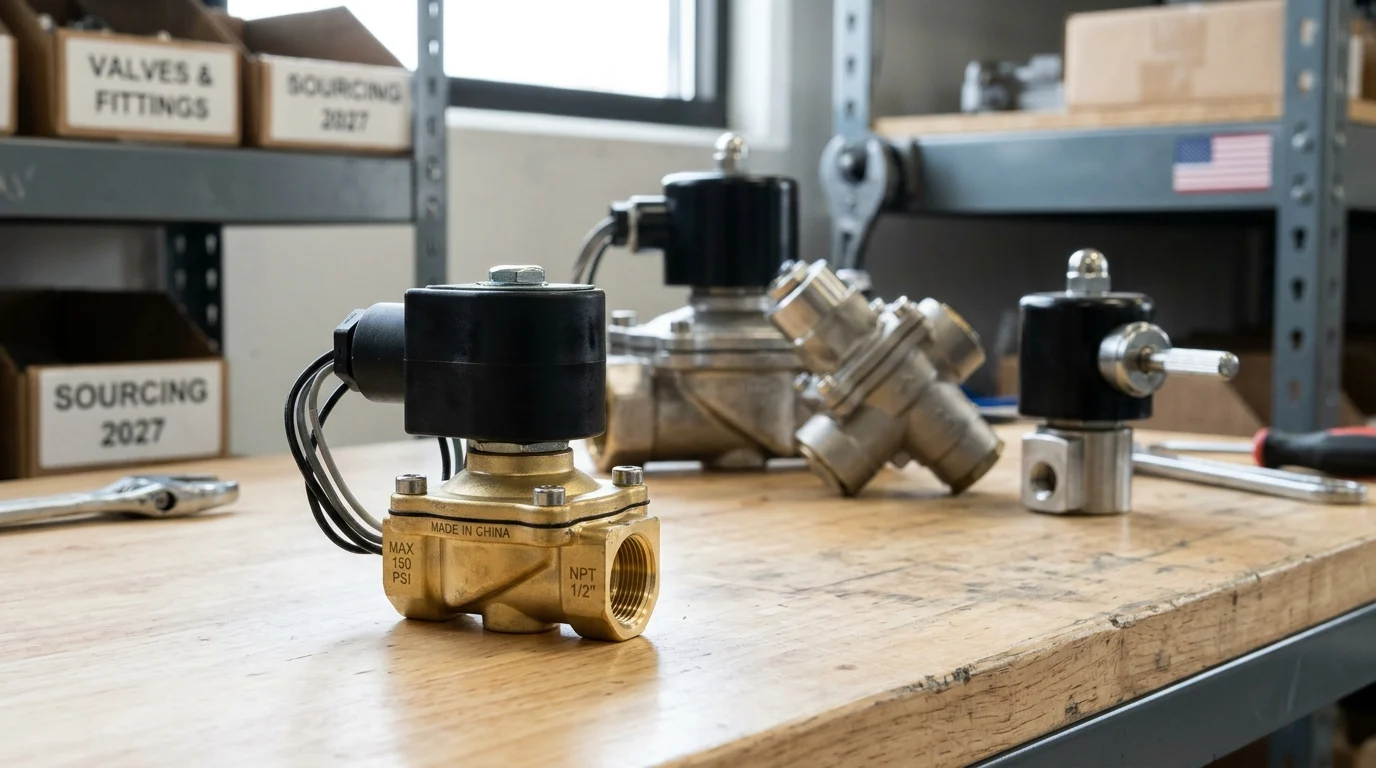
For U.S. importers, a tariff that adds nearly 40% to the duty bill is no longer a side note in purchasing—it is a board-level sourcing variable. Chinese solenoid valves that once looked cost-competitive at the factory gate can become margin killers once Section 301 duties, freight, insurance, and inventory costs are included. As buyers plan for 2027, the smarter question is not whether the tariff might change, but how to build a sourcing model that survives if it does not. This article examines landed-cost math, HTS classification, country-of-origin risk, and practical mitigation options so procurement teams can make decisions based on total cost rather than headline unit price.
Landed Cost and Tariff Exposure
The current 39.5% tariff on Chinese solenoid valves has fundamentally altered the procurement landscape for U.S. manufacturers and distributors. Implemented under Section 301 trade actions, this duty structure combines standard Most Favored Nation (MFN) rates with punitive tariffs. While subject to ongoing United States Trade Representative (USTR) reviews, potential policy shifts, and periodic exclusions, supply chain executives should treat this premium as a baseline metric for risk modeling rather than a temporary anomaly.
Navigating this environment requires a granular understanding of how tariffs interact with freight, insurance, and unit costs, alongside exploring mitigation tactics like bonded warehousing or duty drawback programs. As the industry looks toward 2027, relying on legacy supply chains without assessing total landed costs is an increasingly risky strategy.
Define the true landed-cost baseline
Establishing a true landed-cost baseline requires isolating the exact financial impact of duties at the SKU level. For example, a standard industrial solenoid valve imported from China previously carried a 2.5% MFN duty, turning a $20.00 factory-gate price into a $20.50 base cost before freight. Under the current regime, that same valve incurs a combined 39.5% duty, elevating the base cost to $27.90. Across high-volume orders, this per-unit differential can obliterate profit margins.
Buyers must also factor in the evolving costs of trans-Pacific logistics. Ocean freight rates, while stabilized compared to pandemic peaks, still add roughly $0.15 to $0.45 per unit, depending on valve weight and container utilization. To establish an accurate 2027 baseline, procurement teams must calculate the Total Cost of Ownership (TCO) by integrating these duties, inventory holding costs, and standard logistical expenses.
Verify HTS classification and country of origin
Accurate Harmonized Tariff Schedule (HTS) classification is the cornerstone of tariff exposure management and opens the door to legal tariff engineering. Most industrial solenoid valves fall under HTS heading 8481.80, which covers taps, cocks, valves, and similar appliances. However, misclassification is a frequent and costly error. Specialized heavy-duty components—such as the commercially listed 3871711 excavator brake solenoid valve found on supplier marketplaces—must be rigorously audited to ensure they are not inadvertently categorized under a broader or incorrectly penalized code.
Equally critical is the verification of Country of Origin (COO) rules. To circumvent duties, some suppliers attempt to route Chinese-manufactured sub-components through Southeast Asia for final assembly. U.S. Customs and Border Protection (CBP) enforces the “substantial transformation” rule; merely assembling a Chinese coil onto a Chinese brass body in Vietnam does not change the COO. Buyers must demand complete bill of materials (BOM) transparency to avoid retroactive customs penalties and shipment seizures.
Supplier Country Comparison

Mitigating high tariffs inherently drives procurement teams to explore alternative manufacturing hubs. However, shifting solenoid valve production out of China is complex due to the country’s deeply entrenched machining infrastructure, raw material availability, and specialized labor force. Developing a resilient 2027 strategy requires benchmarking alternative regions against these established capabilities.
While labor arbitrage was once the primary driver of offshore manufacturing, duty avoidance and supply chain resilience now dictate regional selection. Buyers must balance the promise of lower duties against the realities of extended lead times, higher Minimum Order Quantities (MOQs), and developing industrial ecosystems.
Compare China, Mexico, India, Vietnam, and Europe
Evaluating alternative sourcing destinations requires a strict comparison of landed costs, operational constraints, and regional capabilities. Nearshoring to Mexico offers tariff-free imports under the USMCA but often demands much higher volume commitments. Conversely, Southeast Asia offers lower labor costs but relies heavily on imported raw materials.
(Note: Figures below are industry estimates and can vary significantly by supplier and specific component.)
| Sourcing Region | Est. Tariff to US | Avg. Lead Time (Weeks) | Typical MOQ (Units) | Ecosystem Maturity |
|---|---|---|---|---|
| China | 39.5% | 4 – 6 | 500 | Highly Mature, Integrated |
| Mexico | 0% (USMCA) | 2 – 4 | 2,500+ | Developing, Assembly-focused |
| India | 2.5% – 5.0% | 8 – 10 | 1,000 | Growing Machining Capacity |
| Vietnam | 2.5% | 8 – 10 | 1,500 | Reliance on imported metals |
| Europe | 2.0% – 3.5% | 6 – 8 | 250 | Premium, High-Cost Labor |
This data underscores the trade-offs inherent in geographic relocation. While Mexico eliminates Section 301 duties, the necessity for 2,500-unit MOQs can strain cash flow for mid-market distributors. India and Vietnam present attractive duty rates, but the 8-to-10-week ocean transit times necessitate higher safety stock levels, tying up working capital.
Evaluate specifications, materials, and certifications
Transitioning to a new supplier introduces significant quality control risks. Solenoid valves are precision components; a deviation of micrometers in the armature tube or a substandard FKM O-ring can result in catastrophic fluid leaks. When vetting new suppliers outside of China, buyers must audit raw material traceability, ensuring that 304/316 stainless steel or forged brass meets ASTM standards.
Certifications such as ISO 9001, CE, and UL are non-negotiable for U.S. market entry. Furthermore, valves often operate in tandem with sensitive diagnostic equipment. For instance, components like the commercially available 063G1289 hydraulic pressure transmitter operate within a strict 0-250bar range. If a newly sourced valve suffers from pressure drops or erratic actuation, it can compromise the entire hydraulic circuit. Consequently, procurement teams must enforce a strict defect rate threshold of less than 0.5% during the initial production runs with any new international vendor.
2027 Sourcing Strategy
A successful transition to a diversified supply chain cannot be executed overnight. For highly engineered fluid control components, the qualification and onboarding process typically spans 12 to 18 months. Therefore, a robust sourcing strategy for 2027 must be initiated immediately, utilizing a phased approach that minimizes disruption to existing inventory levels.
Strategic sourcing is no longer solely about unit cost reduction; it is about risk mitigation, regulatory compliance, and capital allocation. Procurement leaders must structure their timelines to accommodate tooling investments, rigorous testing, and phased production ramp-ups.
Key Takeaways
- Model the 39.5% duty as a baseline cost in 2027 sourcing plans rather than assuming it will disappear through policy changes or exclusions.
- Build SKU-level landed-cost models that combine duty, freight, insurance, brokerage, inventory carrying costs, and supplier-specific quality risks.
- Verify HTS classification carefully, especially for industrial and heavy-duty solenoid valves that may fall under HTS 8481.80 or related categories.
- Demand country-of-origin evidence and BOM transparency because simple assembly outside China may not satisfy CBP substantial transformation rules.
- Compare alternative sourcing countries on total cost, machining capability, lead time, tooling readiness, and compliance risk instead of labor cost alone.
- Evaluate bonded warehousing, duty drawback, and dual-sourcing strategies to reduce cash-flow pressure and improve resilience against tariff uncertainty.
Frequently Asked Questions
Why should U.S. buyers treat the 39.5% tariff as a planning baseline?
Because the combined MFN and Section 301 duty materially changes landed cost, even if USTR reviews or exclusions continue. For 2027 sourcing models, buyers should assume the tariff remains unless a verified exclusion or policy change applies.
How much can the tariff change the cost of a solenoid valve?
A $20.00 Chinese solenoid valve that once carried a 2.5% duty would rise to about $20.50 before freight. At a 39.5% duty, the duty-loaded base becomes about $27.90, excluding logistics and inventory costs.
What should be included in a true landed-cost calculation?
Include factory price, duty, freight, insurance, brokerage, inventory holding costs, compliance costs, and any rework or inspection expenses. SKU-level total cost of ownership is more reliable than comparing factory quotes alone.
Which HTS classification commonly applies to industrial solenoid valves?
Many industrial solenoid valves fall under HTS heading 8481.80 for taps, cocks, valves, and similar appliances. Buyers should still verify each SKU because design, end use, and component details can affect classification.
Can routing Chinese parts through another country avoid the tariff?
Not automatically. U.S. Customs applies country-of-origin and substantial transformation rules. Simple assembly or repackaging in another country may not change Chinese origin, and incorrect claims can trigger penalties or shipment holds.
Post time: Nov-02-2026