
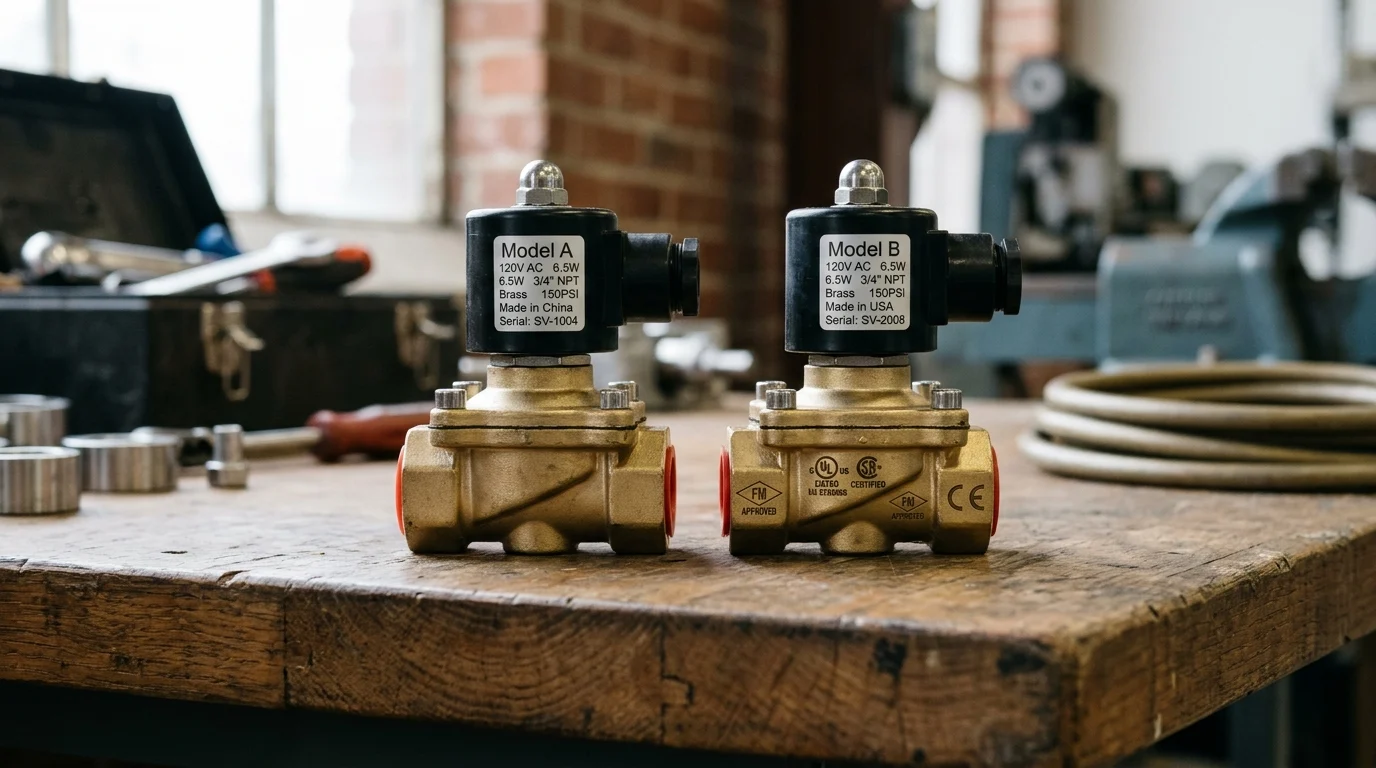
A solenoid valve quote that looks 20% cheaper can quickly become the most expensive option on the table if its approvals do not survive customs, plant audits, or insurer review. For US and EU buyers, the real comparison is not just brass versus stainless steel, voltage, lead time, or unit price; it is whether the valve can legally enter the market and be installed in the intended environment. Certification gaps often hide behind vague claims like “CE compliant” or “designed to UL standards.” This article explains how those gaps appear, what documentation buyers should verify, and why missing approvals can create port delays, testing bills, redesign costs, and liability exposure.
Understanding Certification Gaps
When analyzing international quotes for solenoid valves, procurement teams frequently encounter price disparities that defy standard material and labor cost models. Often, the root cause lies in certification gaps—discrepancies between a manufacturer’s stated compliance and the verifiable regulatory approvals required for legal market entry in the United States and the European Union.
Buyers traditionally fixate on the raw piece-price, evaluating brass or stainless steel bodies and coil voltages, while inadvertently ignoring the complex compliance layer. This oversight transforms seemingly lucrative global sourcing contracts into logistical and legal liabilities.
How Buyers Should Define a Certification Gap
A certification gap occurs when a supplier claims alignment with a standard but lacks the accredited third-party documentation to prove it. For example, a manufacturer might state a solenoid valve is “designed to UL standards” without possessing an actual Underwriters Laboratories (UL) listing, file number, or recognized component mark.
For European imports, these gaps frequently manifest as self-declared CE markings that lack essential backing from a recognized Notified Body, or a reliance on outdated test reports that exceed the standard 3 to 5-year validity periods. Procurement professionals must distinguish between structural capability and legal compliance. A valve may physically perform to technical specifications on a test bench, but without the correct paperwork, it remains legally undeployable in regulated environments.
Hidden Costs of Missing Compliance Documentation
The financial consequences of missing compliance documentation extend far beyond initial procurement savings, creating cascading expenses throughout the supply chain. When uncertified solenoid valves reach US or EU ports, customs authorities and regulatory bodies can initiate immediate holds.
Port demurrage and storage fees accrue rapidly, frequently ranging from $150 to $500 per day per shipping container. If a product requires retroactive certification to clear customs or enter a facility, buyers face extensive engineering delays, substantial third-party testing fees (often exceeding $10,000 to $20,000 per product family), and potential redesign costs. In severe cases involving hazardous or explosive environments, deploying non-compliant valves strips organizations of liability protections, exposing them to severe financial liability and regulatory penalties during industrial failures.
Key Certification Checks for US and EU Buyers
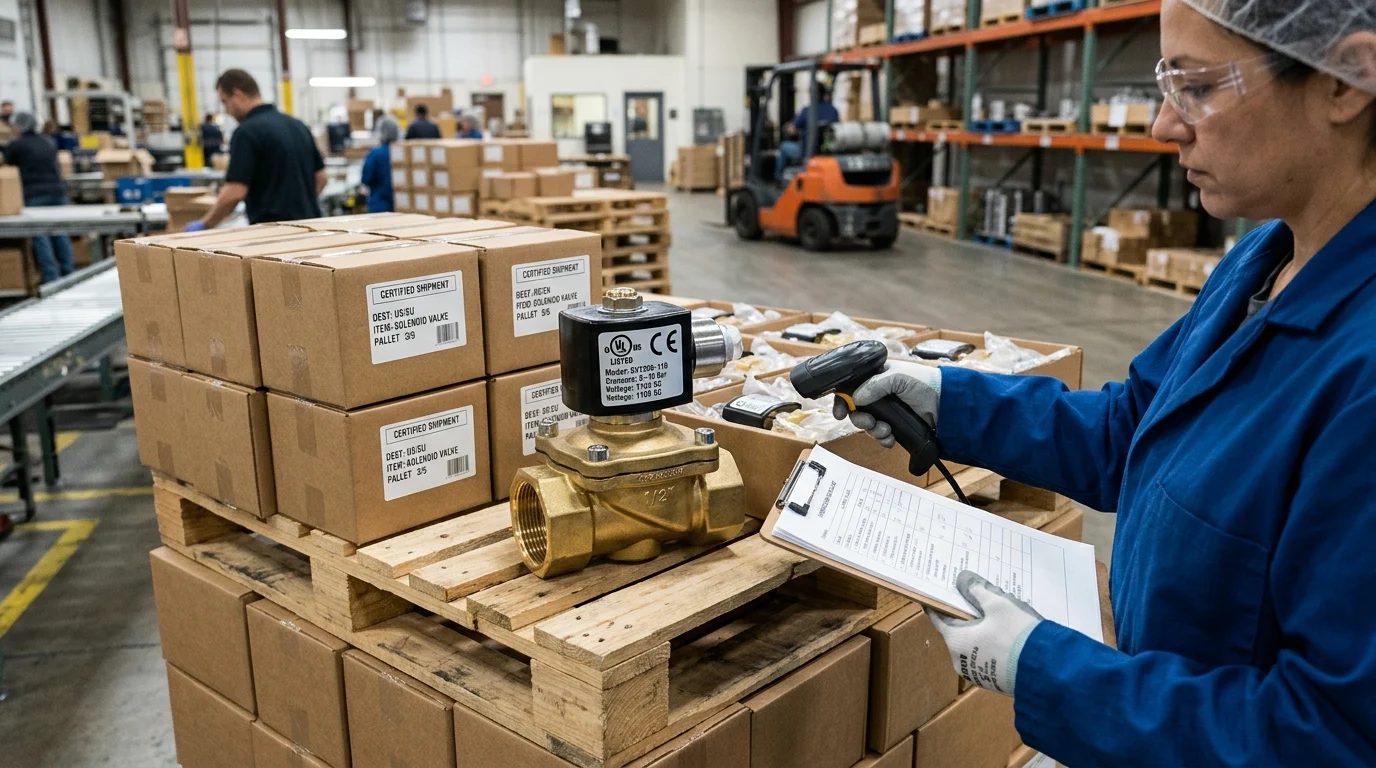
Solenoid valves operate at the critical intersection of electrical networks and pressurized fluid systems, subjecting them to stringent, region-specific regulatory frameworks. Navigating these overlapping requirements demands a precise understanding of the distinct standards governing electrical safety, pressure containment, and hazardous location operation across different continents.
Procurement teams must recognize that a valve perfectly certified for the Asian market may be completely barred from installation in a European or American facility without the proper documentation footprint.
Required Standards: UL, CSA, CE, ATEX, IECEx, PED, and
RoHS
North American markets strictly enforce UL and Canadian Standards Association (CSA) marks for electrical safety, alongside National Electrical Manufacturers Association (NEMA) enclosure ratings to define environmental protection. Conversely, the European Union relies on the CE mark, which is underpinned by specific directives such as the Low Voltage Directive (LVD) and the Pressure Equipment Directive (PED).
For explosive atmospheres, the US utilizes the Class/Division system, while the European Union mandates ATEX certification. Broader international markets often look to the IECEx framework, which, while widely recognized globally, is not legally accepted as a direct substitute for ATEX within the EU. When sourcing specialized industrial components—such as evaluating a 04226-E0061 suction control valve for heavy-duty pump applications—verifying the exact regional standard match is non-negotiable to ensure system compatibility and legal compliance. Furthermore, RoHS compliance is mandatory in the EU and increasingly adopted elsewhere, restricting hazardous substances like lead (Pb) and cadmium to concentrations of less than 1000 ppm and 100 ppm, respectively.
Testing, Documentation, and Market Access Requirements
Securing market access requires more than a physical badge on the valve; it demands comprehensive documentation, specifically the Technical Construction File (TCF). For pressure-retaining components, buyers must demand EN 10204 Type 3.1 material certificates to verify the metallurgical properties of the valve body.
Under the EU’s PED, solenoid valves handling fluids or gases with a maximum allowable pressure exceeding 0.5 bar are subject to strict conformity assessment modules based on their hazard category.
| Certification Area | US Standard / Body | EU Standard / Directive | Key Scope / Threshold |
|---|---|---|---|
| Electrical Safety | UL / CSA | LVD (CE) | Scope: 50V – 1000V AC |
| Pressure Equipment | ASME BPVC | PED (2014/68/EU) | > 0.5 bar maximum pressure |
| Hazardous Locations | Class/Division System | ATEX / IECEx | Zone 0/1/2 classification |
| Material Restrictions | TSCA (Varies by state) | RoHS (2011/65/EU) | Lead (Pb) < 1000 ppm |
How Procurement Teams Can Reduce Certification Risk
Mitigating compliance risks requires integrating certification verification into the earliest phases of the Request for Quotation (RFQ) process, long before purchase orders are issued.
Procurement teams must transition from simply evaluating the raw piece-price to calculating the Total Cost of Compliance (TCC). This shift in methodology protects project timelines and prevents unexpected capital expenditures during the integration phase.
Practical Sourcing Steps to Avoid Delays and Rework
To avoid supply chain disruptions, buyers should mandate the submission of existing compliance certificates and independent test reports alongside initial pricing proposals. If a supplier lacks current certifications for a specific region, procurement must establish clear contractual terms regarding who bears the financial cost and lead time for third-party testing.
For custom solenoid valve designs requiring brand-new UL listings or ATEX certifications, the testing and approval process can easily add 8 to 12 weeks to the initial production timeline. Buyers should also actively audit the manufacturer’s ISO 9001:2015 status, ensuring their quality management system is capable of maintaining rigorous compliance across multi-year production runs. When funding these certifications, Minimum Order Quantities (MOQs) must often exceed 5,000 units to successfully amortize the high upfront costs of regulatory testing.
Decision Framework for Comparing Total Compliance Cost
A robust decision framework evaluates supplier quotes by adding projected compliance normalization costs directly to the base unit
Key Takeaways
- Verify every compliance claim with current third-party documentation before comparing solenoid valve quotes on price alone.
- Treat phrases such as “designed to UL standards” as incomplete unless the supplier provides a valid UL listing, recognized component mark, or file number.
- Budget for compliance risk because customs holds can trigger demurrage and storage costs of about $150 to $500 per container per day.
- Confirm the correct regional standards upfront, including UL, CSA, and NEMA for North America and CE, PED, RoHS, and ATEX for the European Union.
- Avoid retroactive certification whenever possible because third-party testing can exceed $10,000 to $20,000 per product family and may require redesign.
- Match certificates to the exact valve model, voltage, enclosure, pressure rating, and application environment before issuing a purchase order.
Frequently Asked Questions
What is a certification gap in solenoid valve sourcing?
A certification gap exists when a supplier claims compliance with a standard but cannot provide valid third-party documentation, such as a UL file number, CSA mark, CE technical file, ATEX certificate, or current test report.
Why can the cheapest solenoid valve quote become more expensive?
A low unit price may exclude required certifications, testing, or documentation. If valves are held at customs or rejected by a facility, buyers may face demurrage, storage fees, testing costs, redesign delays, and compliance penalties.
Which certifications matter most for US solenoid valve buyers?
US buyers commonly need UL or CSA electrical safety approvals, suitable NEMA enclosure ratings, and hazardous-location approvals where explosive atmospheres are present. The exact requirement depends on the valve application and installation environment.
Which certifications matter most for EU solenoid valve buyers?
EU buyers should verify CE compliance supported by relevant directives such as LVD, PED, RoHS, and ATEX when applicable. A CE mark alone is not enough without the technical file, declaration, and valid supporting test evidence.
How much can missing certification documentation cost?
Port demurrage and storage can reach about $150 to $500 per container per day, while retroactive third-party testing may exceed $10,000 to $20,000 per product family, before redesign or project-delay costs are included.
Post time: Oct-31-2026