
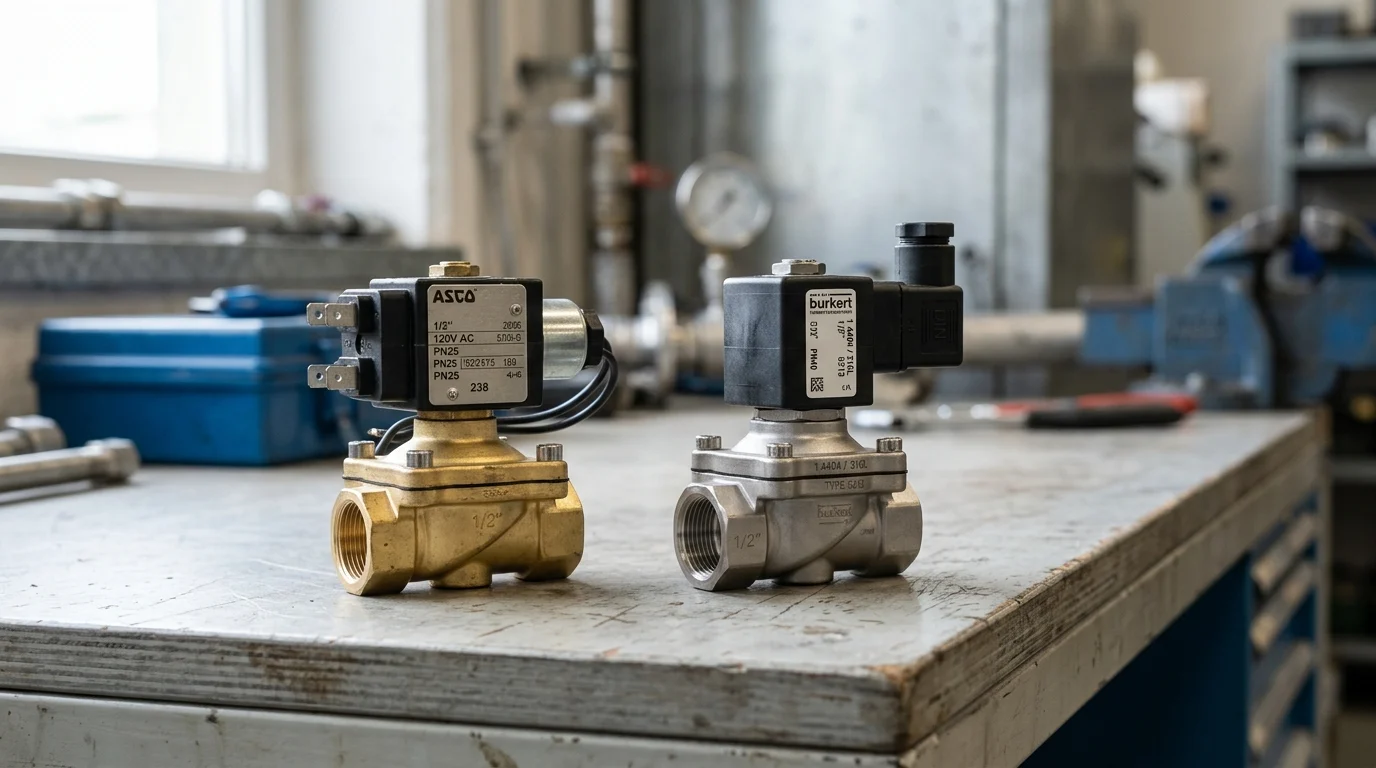
A solenoid valve body may look like a simple metal housing, but its material choice can decide whether a fluid control system runs reliably for years or becomes a recurring maintenance expense. Brass and stainless steel each offer a different ROI profile: brass can minimize upfront cost in clean, moderate-duty service, while stainless steel can prevent costly failures in corrosive, high-purity, or harsh operating environments. The best choice is rarely about strength alone. Pressure rating, seal chemistry, coil temperature class, wetted components, and downtime risk all shape the real economics. This guide compares the practical trade-offs so engineers and buyers can match valve material to application demands with fewer surprises.
Brass vs Stainless Steel Solenoid Valve Basics
Selecting the appropriate material for solenoid valves is a critical engineering decision that dictates both system reliability and lifecycle return on investment (ROI). While the fundamental actuation mechanism remains identical across variants, the valve body material serves as the primary barrier between the ambient environment and the process media. The choice between brass and stainless steel determines chemical compatibility, thermal tolerance, and mechanical endurance, ultimately impacting the overall lifecycle economics of the fluid control loop.
Key Material Properties
Brass, predominantly a copper-zinc alloy (typically utilizing grades like CW617N comprising 58-60% copper and 38-40% zinc), is heavily utilized due to its exceptional machinability and sufficient mechanical integrity for general-purpose applications. Standard industrial brass offers a yield strength of approximately 150 MPa. While brass is non-magnetic, this is only a secondary benefit; the primary magnetic circuit is concentrated within the internal ferrous core and sleeve assembly, making body magnetism less of a factor than often assumed. It is also crucial to note that many brass solenoid valves utilize stainless steel for internal wetted components (such as the plunger tube, spring, and seat). Therefore, fluid compatibility and purity concerns depend on all wetted parts, not solely the external body material. For mildly corrosive or aesthetic-critical environments, nickel-plated brass serves as a cost-effective intermediate option, delaying dezincification and atmospheric tarnishing without the full capital expense of stainless steel.
Conversely, stainless steel variants—most commonly austenitic 304 (CF8) or 316 (CF8M) cast grades—contain 16-18% chromium and 8-10% nickel, providing vastly superior structural strength and chemical inertness. Standard cast 316 (CF8M) and its low-carbon variant 316L (CF3M) routinely specify a minimum yield strength of 205 MPa. (While wrought 316L bar stock may offer slightly lower yield strengths around 170 MPa, cast bodies dominate the valve market). This high strength allows for thinner wall thicknesses in internal valve design while maintaining higher structural safety margins against pressure surges and water hammer effects.
Operating Conditions That Matter
The operational environment strictly dictates material viability, particularly concerning pressure thresholds and thermal extremes. However, commercial pressure ratings (e.g., PN16, PN40) are determined by overall valve design, wall thickness, and seal selection rather than raw yield strength alone. Thus, a stainless steel body does not automatically guarantee a higher pressure rating than an equivalent brass design.
Crucially, the maximum operating temperature for any solenoid valve is almost always dictated by the coil insulation class (e.g., Class F or Class H) and the elastomer seals (such as NBR, EPDM, PTFE, or FFKM), not the body material. Standard brass solenoid valves are typically rated for moderate working pressures and fluid temperatures up to 80°C to 100°C. In contrast, stainless steel valve bodies are engineered for highly demanding conditions. While stainless steel bodies can maintain structural integrity in cryogenic applications down to -196°C or superheated steam environments, the valve assembly as a whole is constrained by its weakest thermal link, requiring specialized high-performance seals and isolated coils to safely operate across extreme temperature gradients.
Material Performance and Cost Comparison

The divergence in value between brass and stainless steel becomes most apparent when comparing long-term degradation in aggressive environments against the initial capital expenditure (CAPEX). A rigorous lifecycle cost analysis must account for both material resilience and the financial impact of unplanned maintenance.
Corrosion Resistance and Durability
Brass is highly susceptible to dezincification when exposed to highly oxygenated water, saltwater, or acidic solutions with a pH below 7.0. This metallurgical degradation selectively leaches zinc from the alloy, leaving a porous, weakened copper structure prone to microscopic leaks and eventual catastrophic rupture. Stainless steel, particularly the 316L grade with its 2-3% molybdenum addition, provides exceptional resistance to pitting and crevice corrosion caused by chlorides and harsh chemical solvents. However, it is important to note that 316L still has strict chloride concentration and temperature limits; exceeding these thresholds requires duplex or super-austenitic stainless steels to prevent failure.
| Property | Standard Brass | 304 Stainless Steel | 316L Stainless Steel |
|---|---|---|---|
| Yield Strength | ~150 MPa | ~205 MPa | ~205 MPa (Cast CF3M) |
| Corrosion Resistance | Moderate (Neutral media) | High (Oxidizing environments) | Very High (Chlorides/Acids) |
| Limiting Temp Factor | Seals & Coil Insulation | Seals & Coil Insulation | Seals & Coil Insulation |
| Machinability | Excellent | Fair | Poor |
Purchase Price and Total Cost
The excellent machinability of standard brass translates directly to lower manufacturing and tooling costs, making it a highly economical initial investment. However, lead-free brass alloys (e.g., CW511L) required for potable-water compliance have lower machinability and cause higher tooling wear than standard CW617N, which narrows the initial CAPEX gap with stainless steel. The equivalent 316 stainless steel valve, burdened by higher raw material costs and difficult machining processes, commands a premium that can easily double or triple the base cost of a standard brass unit. For a facility installing hundreds of valves, this CAPEX difference is substantial.
However, evaluating Total Cost of Ownership (TCO) often flips this dynamic depending on the environment. To determine if the higher CAPEX of stainless steel is justified, engineers should utilize a concrete ROI decision framework. For example, consider a simple payback-period calculation in a corrosive setting: if a $50 brass valve fails every six months, causing $500 in production downtime and replacement labor, upgrading to a $150 stainless steel valve that lasts five years yields a payback period of less than two months. Conversely, in a benign compressed air system where corrosion is a non-issue, spending $150 on a stainless steel valve instead of a $50 brass unit yields a negative ROI, as the brass valve will easily outlast the equipment’s operational lifespan without requiring replacement. The higher upfront cost only yields a superior ROI when it eliminates replacement labor, prevents hazardous media leaks, and ensures uninterrupted production cycles.
How to Choose the Right Valve Material
Specifying the optimal valve material requires a systematic
Key Takeaways
- Choose brass solenoid valves for clean water, air, and neutral media when moderate pressure, moderate temperature, and lower acquisition cost drive ROI.
- Select 304 or 316 stainless steel valves when corrosion resistance, chemical compatibility, sanitation, or harsh ambient exposure is critical to preventing downtime.
- Do not assume stainless steel has a higher pressure rating, because commercial ratings such as PN16 or PN40 depend on valve design, wall thickness, and seals.
- Evaluate coil insulation and elastomer seals first for high-temperature service, since they usually limit the valve assembly before the metal body does.
- Consider nickel-plated brass as a cost-effective middle option for mild corrosion or appearance-sensitive environments, but not for aggressive media.
- Base ROI on lifecycle cost, including replacement frequency, downtime risk, media compatibility, and maintenance—not just the initial valve price.
Frequently Asked Questions
Is stainless steel always better than brass for solenoid valves?
No. Stainless steel is better for corrosive media, harsh environments, and higher hygiene demands, but brass often delivers better ROI in clean water, air, and general-purpose systems where chemical compatibility is not a concern.
When should I choose a brass solenoid valve?
Choose brass for non-corrosive fluids, moderate temperatures, standard industrial pressures, and cost-sensitive applications such as water, compressed air, and neutral oils.
When is stainless steel worth the higher upfront cost?
Stainless steel is usually worth it when the valve handles aggressive chemicals, steam, food-grade fluids, marine exposure, or applications where corrosion-related downtime would exceed the initial price difference.
Does stainless steel automatically mean a higher pressure rating?
No. Pressure rating depends on the full valve design, wall thickness, seals, and construction—not body material alone. Always compare the manufacturer’s rated pressure, not just brass versus stainless steel.
What usually limits solenoid valve temperature performance?
The coil insulation class and seal material usually set the temperature limit. Body material matters, but NBR, EPDM, PTFE, FFKM, and coil design often determine the safe operating range.
Post time: Aug-14-2026