
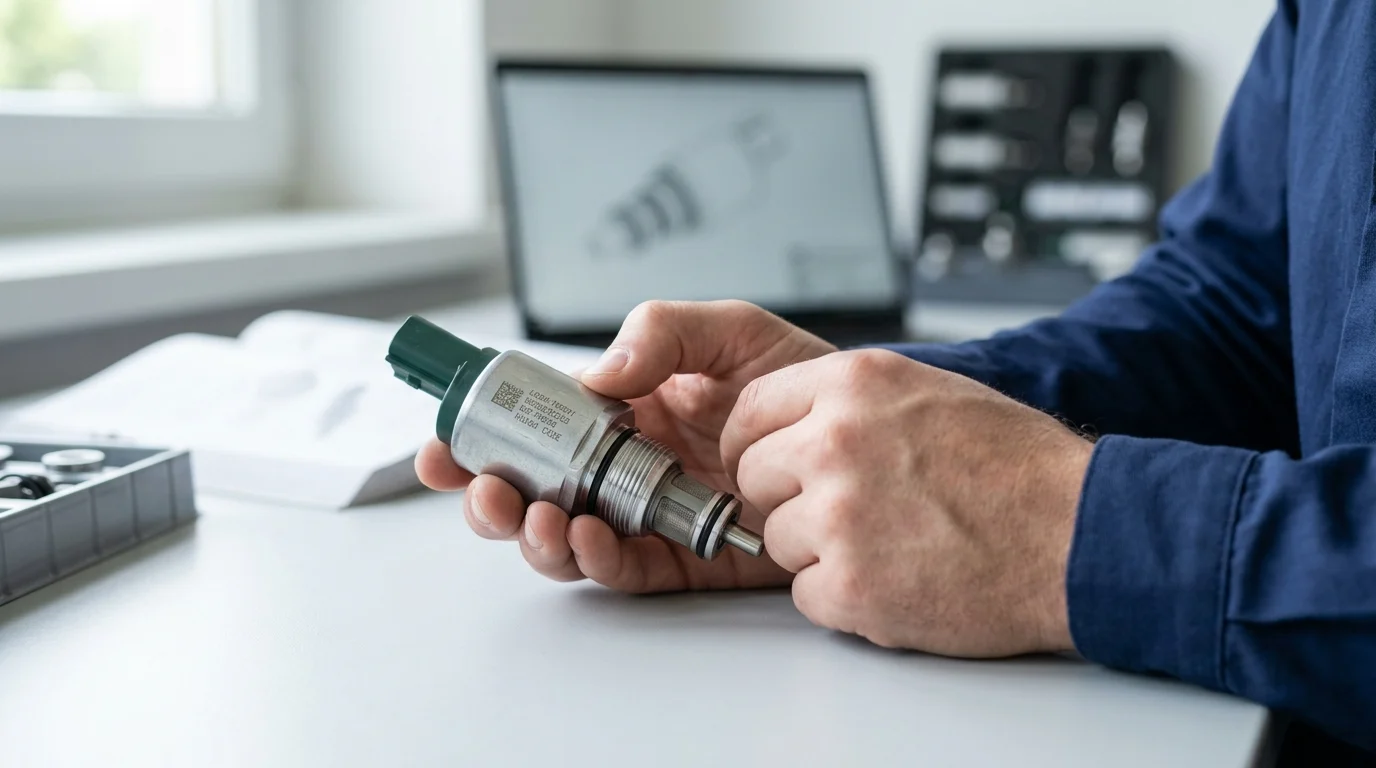
European transmission programs are being reshaped by Euro 7 pressure, hybrid growth, and tighter expectations for efficiency and shift quality. For engineers and sourcing teams, a solenoid valve is not a commodity part—it is a precision control element that directly affects hydraulic response, leakage, durability, and driver comfort. The supplier decision now extends beyond price to include pressure capability, response time, hysteresis control, micrometer-level tolerances, regional production resilience, and realistic annual volume commitments. This article explains what procurement and engineering teams typically evaluate when selecting transmission solenoid partners for DCT, AT, DHT, and advanced hybrid platforms in a fast-changing European supply chain.
Strategic Value of OEM Solenoid Valve Sourcing in Europe
The European automotive landscape is defined by strict emissions regulations, such as the impending Euro 7 standards, and a rapid transition toward complex hybrid and electrified architectures. Within this environment, transmission efficiency remains a critical lever for reducing overall vehicle energy consumption. OEM solenoid valve sourcing is a highly strategic function, as these electromechanical components dictate the hydraulic control precision in dual-clutch transmissions (DCTs), automatic transmissions (ATs), and dedicated hybrid transmissions (DHTs). Because pure battery-electric vehicles (BEVs) generally eliminate traditional transmission valve bodies, overall transmission volumes face downward pressure. However, the rise of multi-speed e-axles and dedicated hybrid transmissions (DHTs) can sustain or even grow solenoid demand, preventing a strictly linear decline in procurement needs. It is important to note the transmission supply chain hierarchy: OEMs frequently source complete valve bodies from Tier 1 suppliers (e.g., ZF, BorgWarner), who then manage the direct solenoid procurement. For hybrid and advanced automatic architectures, these procurement teams require Tier 2 suppliers capable of delivering extreme hydraulic precision while navigating a volatile regional supply chain.
Defining OEM Transmission Solenoid Valve Requirements
Establishing hydraulic and electrical interface specifications for the transmission architecture is the first step in the sourcing process. Engineers primarily specify two categories: proportional valves for continuous pressure or flow regulation, and on/off valves for discrete shifting events. Modern transmission control modules demand exceptional responsiveness to achieve seamless shift comfort and optimized fuel economy. Consequently, evaluators look for solenoids capable of managing system operating pressures that can reach up to 40 bar for discrete on/off applications, while proportional valves typically operate up to 35 bar. These figures reflect distinct design parameters and vary significantly by OEM and specific vehicle platform. Response times must be rapid; depending on the manufacturer’s architecture, on/off valves typically actuate in less than 15 ms, while proportional valves generally target under 25 ms.
Furthermore, precise magnetic force control is required to minimize hysteresis, typically capped at less than 3% of the maximum pressure for proportional variants. The integration of the solenoid into the valve body also demands tight dimensional tolerances, often within micrometers, to prevent internal leakage that could compromise the transmission’s volumetric efficiency.
Key Commercial and Technical Sourcing Factors
Beyond technical specifications, commercial sourcing factors heavily influence supplier selection in the European market. Supply chain resilience has driven a noticeable trend toward nearshoring, with integrators preferring suppliers that maintain regional production facilities within Eastern or Central Europe to mitigate logistics risks. Because the global solenoid supply base is dominated by established German and Japanese Tier 2 incumbents, this nearshoring trend represents a strategic repositioning rather than a simple regional shift. Minimum Order Quantities (MOQs) for custom-engineered transmission solenoids typically range from 50,000 to 250,000 units annually, depending on the vehicle platform’s volume. Additionally, suppliers must demonstrate platform flexibility across shifting hybrid lifecycles to remain competitive.
Lead time is another critical metric. Engineering teams require rapid prototyping phases, with many targeting A-sample deliveries within 12 to 16 weeks of design freeze. Furthermore, a supplier’s ability to seamlessly transition from prototype to high-volume production while maintaining rigorous Production Part Approval Process (PPAP) timelines dictates their viability as a long-term strategic partner.
Increasingly, European sustainability mandates are also standard sourcing criteria. Procurement teams now rigorously evaluate suppliers for REACH compliance, carbon footprint reduction strategies, and the use of recycled materials, making environmental compliance as critical as technical capability in the EU automotive sector.
Specifications and Validation Evidence for Automotive Engineers

For technical buyers, a supplier’s capability is proven not through theoretical design, but through exhaustive validation evidence. The demanding nature of transmission environments—characterized by severe temperature fluctuations, constant vibration, and exposure to aggressive fluids—requires a comprehensive approach to component testing and quality assurance.
Performance, Durability, and Cleanliness Requirements
Performance, durability, and cleanliness represent the triad of operational reliability for transmission solenoids. Engineers demand accelerated life testing data demonstrating durability under high duty-cycle conditions. While specific targets vary by platform, this typically requires a validated cycle life of 10 to 15 million actuations without significant performance degradation. Additionally, components must exhibit verified fluid compatibility with specialized Automatic Transmission Fluids (ATF) across a thermal operating window of -40°C to 140°C.
Technical cleanliness has become a paramount concern, governed by exacting VDA 19 and ISO 16232 standards. To prevent the jamming of tight-clearance spools, rigid particulate limits are enforced. Rather than requiring absolute zero contamination, a standard cleanliness specification relies on statistical particle counts per component or extraction volume. Limits are defined per specific cleanliness plans and vary by customer; for example, a representative OEM hybrid program might strictly limit metallic particles larger than 200 µm and restrict the maximum gravimetric contamination to less than 1.5 mg per assembled valve, though these should not be viewed as universal standards.
The table below outlines illustrative benchmark targets; actual specifications vary significantly depending on the specific OEM program and transmission architecture.
| Specification Metric | Proportional Solenoid Valve | On/Off Solenoid Valve |
|---|---|---|
| Maximum Operating Pressure | Up to 35 bar | Up to 40 bar |
| Target Response Time | < 25 ms | < 15 ms |
| Maximum Hysteresis | < 3% | N/A |
| Validated Cycle Life | 15 million actuations | 10 million actuations |
| Operating Temperature Range | -40°C to +140°C | -40°C to +140°C |
Functional Safety, Traceability, and Compliance Evidence
The integration of solenoid valves into complex mechatronic systems brings them under the purview of rigorous functional safety standards. Clear evidence of ISO 26262 compliance is generally required. While solenoids may operate within higher-ASIL systems (often ASIL B or C), many OEMs delegate component-level safety decomposition to the Tier 1 valve body integrator. This delegation affects evidence requirements, frequently resulting in the valve itself being decomposed to Quality Management (QM) or ASIL A. Suppliers must provide comprehensive Failure Mode and Effects Analysis (FMEA) documentation at both the design and process levels.
Traceability
Supplier Selection, Auditing, and Cost Decisions
When finalizing procurement, European automotive engineers require rigorous validation to ensure suppliers meet stringent continental standards, moving far beyond basic dimensional tolerances.
RFQ Preparation and Supplier Audit Steps
A comprehensive Request for Quotation (RFQ) for transmission valves demands detailed technical documentation. Engineers expect precise PPAP (Production Part Approval Process) timelines, material certifications confirming REACH and RoHS compliance, and Advanced Product Quality Planning (APQP) frameworks.
During the auditing phase, European OEMs typically rely on the VDA 6.3 process audit standard, developed by the German Association of the Automotive Industry. Auditors specifically evaluate:
- Technical Cleanliness: Transmission solenoids are highly sensitive to particulate contamination. Auditors verify manufacturing environments against ISO 16232 standards.
- Component Traceability: Suppliers must demonstrate robust Manufacturing Execution Systems (MES) and automated laser-marking capabilities for individual part tracking.
- Process Capability (Cpk): Critical magnetic and hydraulic dimensions must consistently demonstrate a Cpk > 1.67 to guarantee high-volume production stability.
Balancing Unit Cost, Quality, and Supply Risk
Regarding OEM solenoid valve sourcing: what European automotive engineers look for in a transmission valve supplier is a minimized Total Cost of Ownership (TCO), rather than merely the lowest piece price. Because transmission component failures result in catastrophic warranty claims and recalls, quality remains the dominant cost driver.
Procurement teams must carefully weigh the trade-offs between offshore manufacturing savings and supply chain resilience.
| Decision Factor | Offshore Sourcing | Nearshore/European Sourcing |
|---|---|---|
| Unit Price | Highly competitive | Moderate to high premium |
| Supply Chain Risk | Elevated (transit delays, geopolitics) | Low (shorter lead times, open borders) |
| Audit Accessibility | Requires intensive third-party oversight | Facilitates direct OEM engineering visits |
To mitigate risks when selecting global partners, European OEMs mandate localized buffer warehousing. Furthermore, suppliers must prove financial stability and implement dual-sourcing strategies for critical raw materials, such as copper windings and magnetic steel. This multi-layered approach ensures continuous assembly line operation, insulating the OEM from unforeseen logistical disruptions while maintaining strict cost controls.
Key Takeaways
- Define whether the application needs proportional or on/off solenoids before sourcing, because pressure, response time, and control requirements differ significantly.
- Use realistic benchmark targets such as up to 40 bar for on/off valves, up to 35 bar for proportional valves, and sub-15 ms or sub-25 ms response times depending on valve type.
- Prioritize suppliers that can control hysteresis below 3% of maximum pressure and maintain micrometer-level dimensional consistency to reduce leakage and improve shift quality.
- Assess whether the supplier fits the European transmission supply chain hierarchy, since Tier 1 valve body manufacturers often control direct solenoid procurement.
- Build resilience into sourcing decisions by evaluating nearshored production capacity in Central or Eastern Europe and verifying logistics stability.
- Align supplier capacity with expected platform volumes, as custom transmission solenoid MOQs commonly range from 50,000 to 250,000 units annually.
Frequently Asked Questions
Why are transmission solenoid valves still important as Europe shifts toward electrification?
Although BEVs reduce traditional transmission demand, hybrids, DHTs, DCTs, ATs, and multi-speed e-axles still require precise hydraulic control, sustaining demand for high-performance solenoids.
What pressure ratings do OEM engineers typically evaluate?
On/off transmission solenoids may need to handle up to 40 bar, while proportional valves commonly operate up to 35 bar, depending on the OEM platform and transmission architecture.
What response times are expected for transmission solenoid valves?
Typical targets are under 15 ms for on/off valves and under 25 ms for proportional valves, though exact requirements vary by transmission design and control strategy.
Why does hysteresis matter in proportional solenoid sourcing?
Low hysteresis improves pressure control accuracy and shift smoothness. OEMs often expect hysteresis below 3% of maximum pressure for proportional valve applications.
How do Tier 1 suppliers influence solenoid sourcing?
OEMs often buy complete valve bodies from Tier 1 suppliers such as ZF or BorgWarner, while those Tier 1s manage direct procurement from Tier 2 solenoid manufacturers.
Post time: Aug-13-2026