
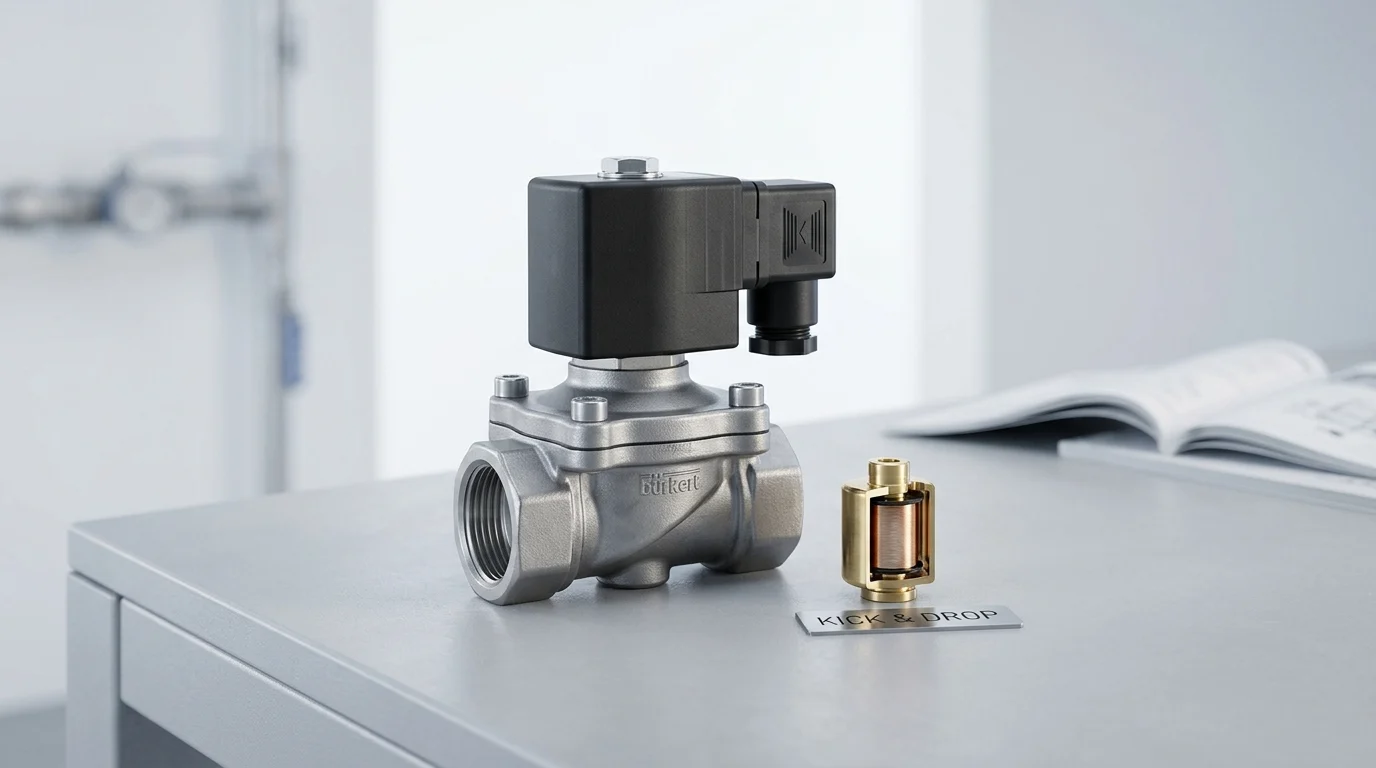
Solenoid valves are often treated as small components, but in large automated systems their cumulative power draw and heat output can become a serious design constraint. Bürkert’s Kick and Drop approach tackles that problem by changing how energy is delivered during actuation: a short high-power pulse opens the valve, then a much lower holding current keeps it in position. The result can be substantial efficiency gains, with energy savings of up to 80% in suitable applications. This article explains how the two-stage coil principle works, where Bürkert applies it, and why reduced heat generation matters for continuous-duty systems, control cabinets, analytical instruments, and sensitive fluid processes.
What Is Kick and Drop Coil Technology
Solenoid valves are foundational components in fluid and gas control systems, yet their traditional operation presents a significant engineering challenge: continuous power consumption and the resulting thermal output. In facilities with hundreds of active valves, standard coils consume significant electrical power and introduce unwanted heat into the process media or control cabinets.
To address this inefficiency, Bürkert developed Kick and Drop coil technology. This innovative design fundamentally alters how electrical energy is deployed during the valve actuation cycle, significantly reducing overall power demands while maintaining robust mechanical performance.
How the Kick and Drop Principle Works
The operational principle of Kick and Drop technology relies on dual-stage power delivery managed by integrated electronics. When a control signal commands the valve to open, the system initiates the kick phase. During this brief window—typically lasting between 300 and 500 ms—the coil receives a high-inrush overexcitation current. This surge provides the necessary magnetic force to overcome the mechanical spring resistance and system pressure, swiftly lifting the armature to open the valve.
Once the armature reaches its fully open position, the magnetic force required to hold it in place drops significantly. The integrated electronics automatically transition into the drop phase, reducing the electrical current to a fraction of the initial surge. By utilizing integrated electronic hold-current reduction within the epoxy-encapsulated housing, the holding power is substantially reduced. This transition allows the valve to remain open indefinitely while consuming much less energy than a conventional solenoid coil.
Where Bürkert Uses This Technology
Bürkert integrates this energy-saving architecture across a wide array of its premium valve series, particularly those designed for high-pressure, large-orifice, or continuous-duty applications. Engineers frequently deploy these coils in servo-assisted brass and stainless steel valves, such as the Type 6281 and Type 6213, which manage water, air, and neutral fluids in demanding industrial environments. Because the coil technology does not alter the underlying mechanical operating principles, these servo-assisted valves still require a minimum pressure differential to function properly. Furthermore, the technology proves highly beneficial in analytical instruments and sensitive fluid circuits where thermal interference must remain at an absolute minimum to prevent fluid expansion or chemical alteration.
How Bürkert Kick and Drop Coils Compare

Evaluating the advantages of Kick and Drop technology requires a direct comparison with conventional solenoid coils. Standard coils rely on a single, continuous current level that must be high enough to both open the valve and keep it open. This static approach leads to continuous power draw and inevitable heat dissipation, which can degrade surrounding components over time.
Key Performance and Efficiency Factors
The disparity in efficiency becomes clear when examining the power lifecycle of both designs. A conventional solenoid valve might draw a continuous 24 watts of power for the entire duration it remains open. In contrast, a comparably sized Kick and Drop coil will utilize the 24 watts only for the initial 500-ms actuation phase, before dropping to a holding consumption of merely 2 to 4 watts. While a drop from 24 W to 2 W mathematically exceeds a 90% reduction, Bürkert typically cites “up to 80%” as a conservative, real-world energy savings benchmark across its broader valve portfolio. The table below illustrates a typical 24 W nominal coil example:
| Specification | Standard Solenoid Coil | Bürkert Kick and Drop Coil |
|---|---|---|
| Initial Actuation Power | 24 W | 24 W (for ~500 ms) |
| Continuous Holding Power | 24 W | 2 W – 4 W |
| Energy Savings | Baseline (0%) | Up to 80% (Typical Benchmark) |
| Thermal Output | High (Continuous heating) | Minimal (Ambient stability) |
| Coil Lifespan | Standard | Extended (due to lower thermal stress) |
Beyond raw energy metrics, this design simplifies system architecture. Because the power reduction is managed internally by the valve, engineers do not need to program complex PWM signals into the central PLC. The valve accepts a standard input—though coils must be ordered in voltage-specific variants, with AC models incorporating internal rectification to enable the dual-stage power delivery. Furthermore, the dramatic reduction in heat generation can eliminate the need for secondary cooling systems in control cabinets, offsetting higher initial valve costs through broader infrastructure savings.
Engineering Trade-Offs for Specifiers
While the operational benefits are substantial, specifiers must navigate specific engineering trade-offs. The primary consideration is the initial capital expenditure. Kick and Drop valves incorporate sophisticated microelectronics directly into the coil housing, which can result in a cost premium and an increased physical coil size over standard solenoid valves.
Additionally, embedding microelectronics introduces a potential single point of failure. A failure in the integrated circuitry can increase replacement costs compared to a standard coil. Furthermore, the integrated switching electronics can introduce electromagnetic interference (EMI). Specifiers must account for this in sensitive environments by utilizing filtered power supplies, shielded cabling, or physical separation from low-voltage analog sensor circuits.
How to Decide If Kick and Drop Technology Fits
Determining whether to specify Kick and Drop coils for a new build or retrofit project requires a holistic view of the system’s operational profile. Engineers must analyze duty cycles, environmental constraints, and long-term operating costs to justify the investment in advanced coil technology.
Selection and Implementation Steps
The first step in the selection process is evaluating the expected duty cycle of the fluid control system. Kick and Drop technology delivers the highest return on investment in applications where valves remain energized for extended periods. If a process requires valves to be open for a majority of the operational shift, the cumulative energy savings rapidly justify the initial premium. Conversely, for high-frequency, rapid-cycling applications where the valve opens and closes every few seconds, the low-power hold state is rarely maintained. In these scenarios, mechanical cycle-life becomes the dominant concern, and subjecting the integrated microelectronics to constant kick-phase inrush currents can increase thermal stress on the circuitry.
When considering retrofits, specifiers must also verify physical
Key Takeaways
- Use Kick and Drop coils in continuous-duty valve applications to cut holding power and potentially reduce energy consumption by up to 80%.
- The kick phase supplies high inrush current for roughly 300 to 500 ms to open the valve reliably against spring force and pressure.
- After actuation, integrated electronics switch to a low hold current, reducing heat generation in control cabinets and near sensitive process media.
- Bürkert applies this technology in premium valve series such as Type 6281 and Type 6213 for water, air, and neutral fluid control.
- Confirm minimum pressure differential requirements when selecting servo-assisted valves, because the coil technology does not change the valve’s mechanical operating principle.
- Consider Kick and Drop designs for analytical instruments and thermally sensitive fluid circuits where reduced coil heating helps protect process stability.
Frequently Asked Questions
What is Kick and Drop coil technology?
It is a two-stage solenoid coil design that applies a short high-power “kick” to open the valve, then switches to a lower-power “drop” current to hold it open.
How much energy can Bürkert Kick and Drop coils save?
Depending on the valve duty cycle and application, Bürkert Kick and Drop coil technology can reduce energy consumption by up to 80% compared with conventional continuously powered coils.
How long does the kick phase last?
The kick phase typically lasts about 300 to 500 ms, providing the magnetic force needed to overcome spring resistance and system pressure during actuation.
Why do Kick and Drop coils generate less heat?
After the valve opens, the electronics reduce the holding current, which lowers power dissipation and minimizes heat transfer into cabinets, components, or process media.
Where is this technology commonly used?
It is used in demanding fluid and gas control applications, including servo-assisted valves such as Bürkert Type 6281 and Type 6213, analytical instruments, and continuous-duty systems.
Post time: Jul-24-2026