
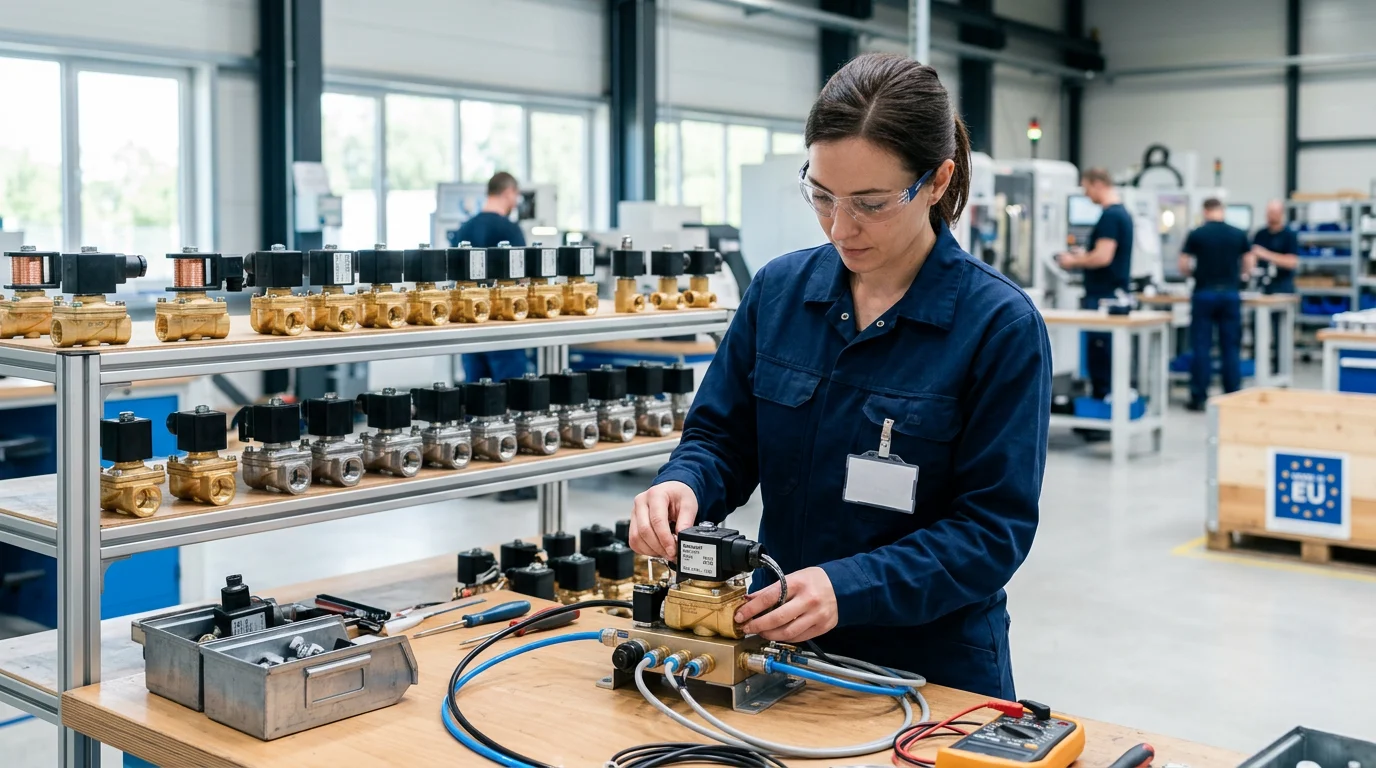
Europe’s solenoid valve demand is no longer being lifted by general industrial recovery alone. It is being shaped by specific automation bottlenecks: German automotive lines replacing legacy pneumatics, Italian utilities and HVAC manufacturers pursuing efficiency, and Eastern European logistics hubs scaling high-speed sorting capacity. With forecasts pointing to a 5.8% CAGR and a potential €1.4 billion market by 2030, buyers are focusing less on basic valve availability and more on response time, power consumption, lifecycle durability, and EU compliance. This article breaks down where demand is emerging, which specifications now matter most, and how suppliers can position themselves for the next wave of industrial automation investment.
EU Solenoid Valve Market Growth Drivers
Based on aggregated 2023-2024 industrial market analyses, the European Union’s solenoid valve sector is expanding at a projected 5.8% Compound Annual Growth Rate (CAGR). While these analyst projections carry inherent forecasting uncertainty, current trajectories place the regional market valuation at an estimated €1.4 billion by 2030. Demand is distinctly regionalized and driven by specific end-users: Germany accounts for an estimated 35% of volume, fueled by automotive OEMs and heavy machinery builders. Italy shows concentrated demand from water utilities and HVAC manufacturers, while Eastern European hubs are scaling e-commerce logistics infrastructure. The primary catalyst is the transition to Industry 4.0. Legacy pneumatic systems often lack the digital interfaces required for IoT integration, forcing facilities to undertake full hardware replacements rather than simple sensor retrofits to achieve automated fluid regulation.
Market Definition and Scope
This sector encompasses electromechanical valves ranging from micro-fluidic diagnostic components to heavy-duty hydraulic actuators. Driven by continental energy mandates, 2024 procurement data indicates a sharp pivot toward energy-efficient architectures. Market leaders now report a baseline requirement for valves with power consumption below 2.0 watts and lifecycle endurance validated up to 50 million cycles. Transitioning from traditional 10W coils to modern 1.5W low-power alternatives allows large-scale facilities to significantly reduce power loads in pneumatic circuits without compromising actuation speed.
Demand from Industrial Automation
High-speed logistics and automated e-commerce fulfillment centers represent dominant demand sources. In these environments, pneumatic control valves must deliver actuation response times strictly under 10 milliseconds to maintain throughput rates that analysts estimate at 5,000 to 8,000 items per hour. To meet these rigorous cycling demands while managing costs, European integrators frequently evaluate a mix of domestic OEMs and imported aftermarket alternatives. For example, components like the 0071372-00 Solenoid Valve Replacement are often sourced from international manufacturers to service existing sorting machines. Integrating these rapid-cycling valves is essential for maximizing operational yield in automated fulfillment hubs.
Product Specifications and Compliance

Balancing fluidic specifications against European regulatory frameworks is critical for deployment. Engineers evaluate flow coefficients (Kv), media compatibility, and operating pressure ranges—spanning from deep vacuum up to 40 bar for standard applications, and occasionally 150 bar for specialized hydraulics. The EU’s complex compliance standards act as a significant competitive moat, heavily favoring established market leaders over new entrants who often struggle with certification overhead and carbon border adjustments.
Direct-Acting vs Pilot-Operated Valves
A fundamental architectural choice lies between direct-acting and pilot-operated configurations. To meet the sub-2W energy targets mentioned earlier, engineers increasingly favor modern pilot-operated models. Direct-acting valves utilize the electromagnetic armature to physically open the orifice, allowing operation at a 0 bar pressure differential but drawing higher current. Conversely, pilot-operated valves leverage the media’s line pressure to assist in actuating the main seal. This requires a minimum pressure differential (typically 0.3 to 0.5 bar) but drastically reduces electrical power consumption, making them ideal for high-flow, low-power applications.
| Specification | Direct-Acting Valves | Pilot-Operated Valves |
|---|---|---|
| Minimum Pressure Differential | 0 bar | 0.3 – 0.5 bar |
| Maximum Flow Rate (Kv) | Low to Medium (up to 3.0 m³/h) | High (exceeding 10.0 m³/h) |
| Power Consumption | Higher (typically 5W – 15W) | Lower (typically 0.5W – 2W) |
| Optimal Application | Vacuum systems, low-pressure loops | High-volume water/gas mains |
CE, RoHS, REACH, ATEX, and Pressure Ratings
Market access is strictly gated by interconnected compliance mandates. Baseline electrical and chemical safety is governed by the CE mark, integrating RoHS 3 (Directive 2015/863) limits on hazardous substances. The REACH regulation mandates full transparency regarding Substances of Very High Concern (SVHC) throughout the supply chain. Operational safety standards apply based on the deployment environment: valves in explosive atmospheres must secure ATEX certification via protection methods like Ex d (flameproof enclosures) or Ex m (encapsulation). Furthermore, compliance with the Pressure Equipment Directive (PED 2014/68/EU) is mandatory for valves handling fluids exceeding 0.5 bar above atmospheric pressure, dictating strict metallurgical and hydrostatic testing based on nominal diameter and maximum allowable pressure.
Supplier Readiness and Sourcing Strategy
The market is currently served by a mix of established European incumbents and specialized international entrants. In 2023-2024, procurement teams at major automotive and logistics firms have shifted their focus toward supply chain resilience. Rather than prioritizing mere unit cost reduction, these buyers demand supplier agility and rigorous quality assurance. According to industry supply chain reports, target lead times have been compressed to 4 to 6 weeks—down from the historical average of 12 weeks—to maintain lean inventory models amidst fluctuating raw material costs and volatile logistics networks.
How Buyers Should Evaluate Suppliers
When assessing potential partners, evaluation must center on verifiable manufacturing tolerances. ISO 9001:2015 certification serves as an absolute baseline, coupled with documented defect rates maintained below industry-standard thresholds. Top-tier suppliers differentiate themselves through comprehensive end-of-line testing capabilities. Required protocols include automated pneumatic or hydrostatic leak testing, dielectric strength verification for solenoid coils, and empirical lifecycle endurance data validating performance over millions of actuations under simulated field conditions.
Final Supplier Selection Guidance
Vendor selection relies on a Total Cost of Ownership (TCO) model that calculates initial unit price, expected maintenance intervals, and Minimum Order Quantity (MOQ) flexibility. To balance cost with regulatory security, European buyers are actively establishing dual-sourcing strategies. This involves pairing international suppliers—who often provide competitive pricing and rapid scaling—with domestic incumbents to hedge against maritime freight delays and guarantee rapid compliance documentation. Procurement teams must verify a supplier’s localized technical support and ability to provide comprehensive material declarations. Ultimately, capturing value in this growing market requires partnering with manufacturers who control their own component fabrication and possess the certified capacity to meet the EU’s stringent energy and hardware demands.
Key Takeaways
- EU solenoid valve demand is projected to grow at a 5.8% CAGR and reach an estimated €1.4 billion by 2030.
- Germany accounts for roughly 35% of EU volume, making automotive OEMs and heavy machinery builders priority customers for suppliers.
- Procurement teams should prioritize valves below 2.0 watts and lifecycle ratings up to 50 million cycles for energy-efficient industrial automation.
- Automated logistics systems require pneumatic control valves with sub-10 millisecond response times to sustain throughput of 5,000 to 8,000 items per hour.
- Pilot-operated valves are increasingly attractive for high-flow applications because they reduce power consumption, although they typically require 0.3 to 0.5 bar minimum pressure differential.
- EU compliance, certification costs, and carbon-related trade requirements create barriers for new entrants and favor suppliers with proven documentation.
Frequently Asked Questions
What is driving EU solenoid valve market growth?
Growth is mainly driven by Industry 4.0 upgrades, automated logistics, energy-efficiency mandates, and replacement of legacy pneumatic systems that lack IoT-ready interfaces.
How fast is the EU solenoid valve market expected to grow?
The market is projected to grow at a 5.8% CAGR, with current forecasts placing EU valuation at about €1.4 billion by 2030.
Which EU countries are creating the most demand?
Germany leads with about 35% of volume, driven by automotive OEMs and machinery builders. Italy shows strong demand from water utilities and HVAC, while Eastern Europe is growing through logistics automation.
Why are low-power solenoid valves becoming more important?
EU buyers increasingly require valves below 2.0 watts to reduce energy loads in pneumatic circuits, especially in facilities running large numbers of high-cycle valves.
What performance matters most in automated fulfillment centers?
Fast response is critical. Pneumatic control valves often need actuation times under 10 milliseconds to support sorting and fulfillment rates of roughly 5,000 to 8,000 items per hour.
Post time: Nov-23-2026