
Introduction
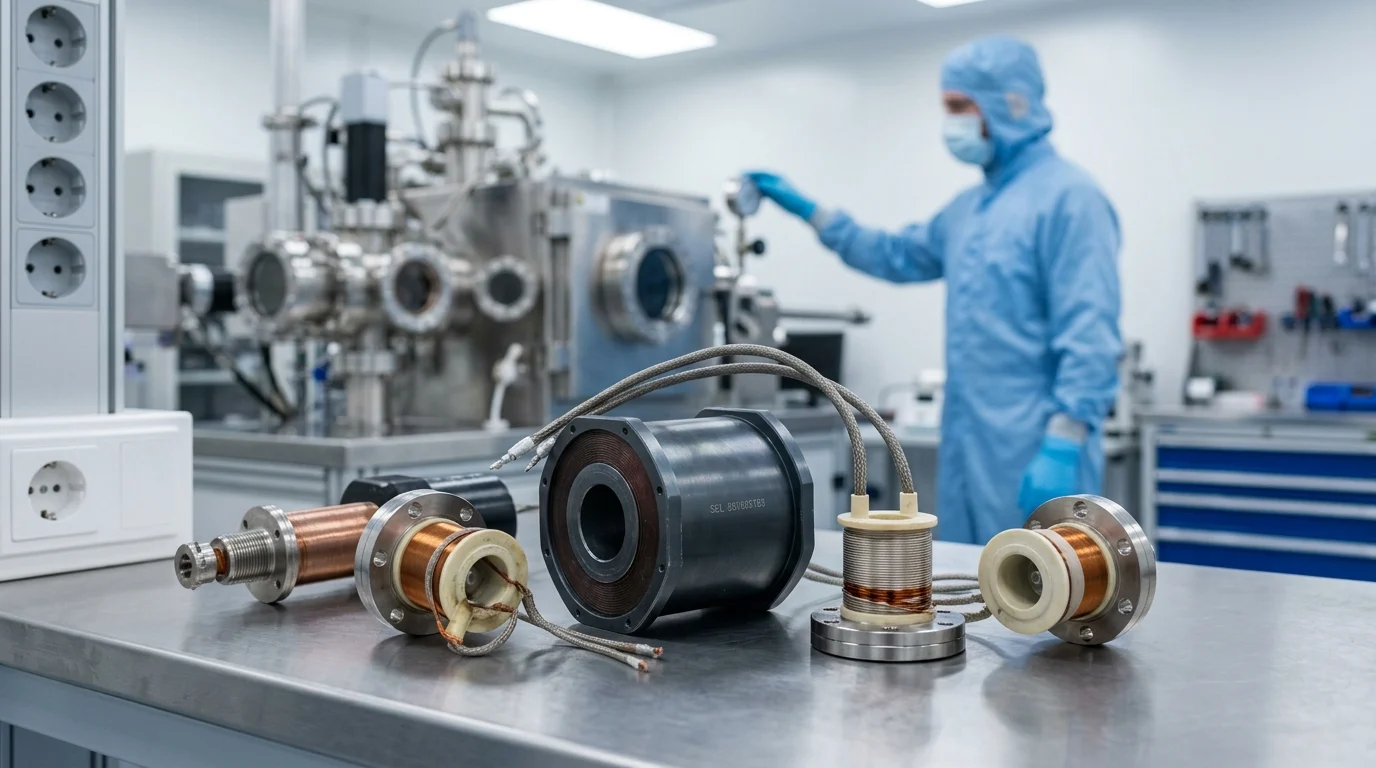
Selecting solenoid coils for vacuum service in semiconductor and thin-film coating tools involves more than matching voltage, force, and duty cycle. In European fabs, coil materials, insulation systems, thermal behavior, and cleaning history can directly affect outgassing, particle generation, and ultimately process yield. This article outlines the key specification criteria for coils used in HV and UHV environments, explains how process conditions such as deposition, etch, and load-lock operation change the requirements, and highlights practical factors engineers should verify with suppliers before approving components for production equipment.
Vacuum Requirements for Solenoid Coils in Semiconductor Applications
Operating solenoid valves and actuators within the strict confines of semiconductor and thin-film coating equipment requires highly specialized electromechanical components. In European fabrication facilities (fabs), where precision and yield are paramount, introducing standard industrial solenoid coils into a vacuum chamber can lead to catastrophic contamination and process failure. Engineers must therefore specify vacuum-compatible coils designed to operate without compromising the controlled environment.
Vacuum level, outgassing, and particle control
The primary challenge in vacuum environments is managing outgassing—the release of trapped gases from materials when exposed to low pressure. For High Vacuum (HV) and Ultra-High Vacuum (UHV) systems, which typically operate at pressures ranging from 10^-7 to 10^-11 mbar, standard plastics and adhesives continuously vaporize. Solenoid coils intended for these zones must demonstrate exceptionally low outgassing rates, often required to be below 1 x 10^-9 mbar L/s per square centimeter. Furthermore, the mechanical operation of the solenoid must not generate particulate matter. Friction between the coil housing and the armature tube must be minimized, and components are often rigorously cleaned and vacuum-baked prior to installation to ensure zero particle shedding.
Semiconductor and thin-film process contexts
Different fabrication processes impose varying demands on internal components. In Physical Vapor Deposition (PVD) and Chemical Vapor Deposition (CVD), coils are frequently exposed to high radiant heat and reactive precursor gases. Atomic Layer Deposition (ALD) processes require even stricter environmental purity, meaning any solenoid coil situated near the reaction chamber must be fully isolated or hermetically sealed. Additionally, components used in etching processes may face exposure to aggressive halogenated plasmas, necessitating robust chemical resistance alongside standard vacuum compatibility. Selecting the right coil architecture ensures that process gases remain uncontaminated and that the solenoid maintains its magnetic flux density despite harsh operational conditions.
Selection Criteria and Compliance for Vacuum Solenoid Coils
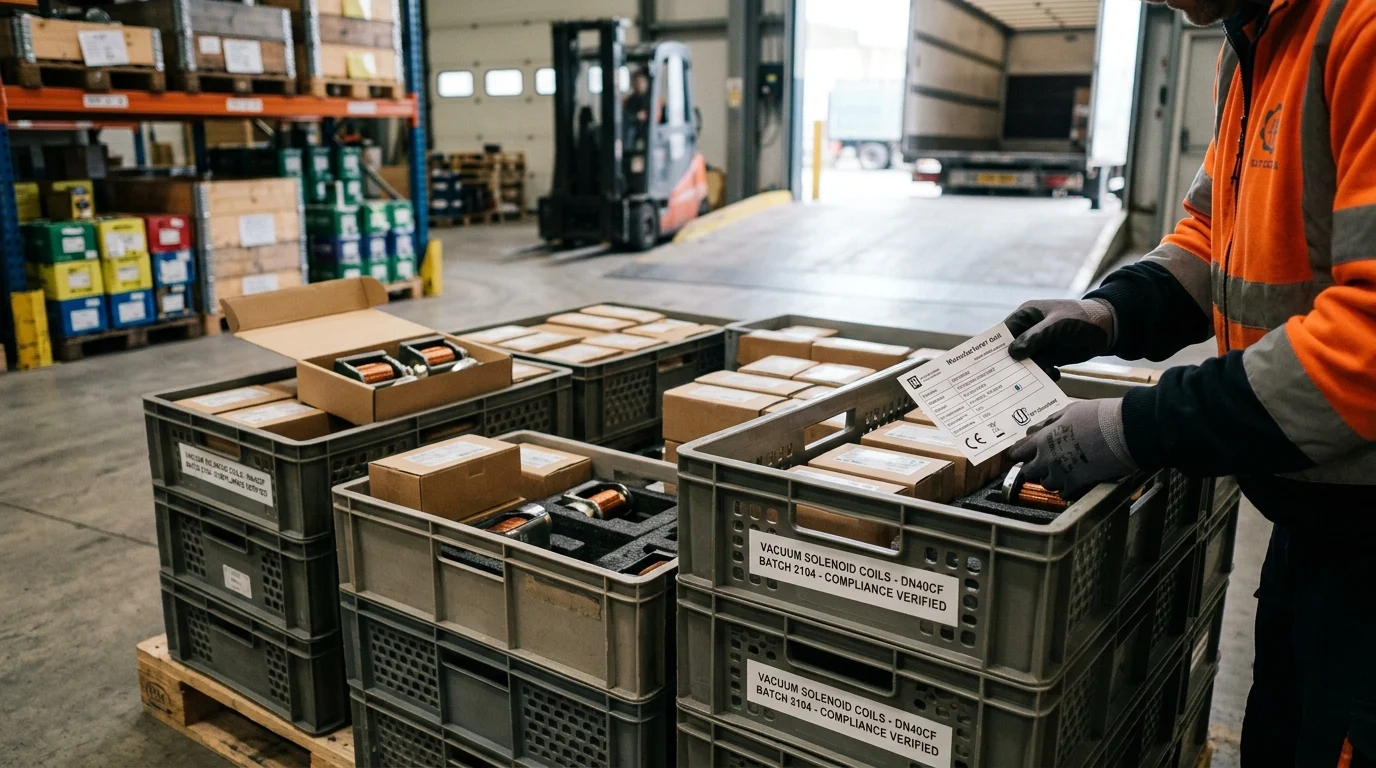
Procuring the right vacuum solenoid coil goes beyond basic dimensional and electrical specifications. Engineers must evaluate material composition, thermal management capabilities, and adherence to stringent European regulatory frameworks to ensure long-term reliability and legal compliance.
Insulation, encapsulation, and thermal performance
Vacuum environments lack air to facilitate convective cooling, meaning solenoid coils must rely entirely on conductive heat transfer to prevent overheating. Consequently, insulation and encapsulation materials are critical. Standard PVC or polyurethane wire coatings are strictly prohibited due to high outgassing and low melting points. Instead, manufacturers utilize polyimide (Kapton) tapes, PTFE, or specialized low-outgassing epoxy resins. Coils are frequently wound with Class H or Class N magnet wire, capable of withstanding continuous operating temperatures of 180°C to 200°C without insulation breakdown.
| Encapsulation Material | Max Operating Temp (°C) | Outgassing Profile | Typical Application |
|---|---|---|---|
| Standard Polyurethane | 130°C | High | Non-vacuum ambient |
| Low-Outgassing Epoxy | 180°C | Low | General HV environments |
| PTFE (Teflon) | 260°C | Very Low | UHV / Corrosive gas |
| Polyimide (Kapton) | 400°C | Ultra Low | Extreme UHV / High Heat |
Compliance and supplier comparison factors
Supplying components to European fabs requires strict adherence to regional directives. Solenoid coils must comply with the Restriction of Hazardous Substances (RoHS) and the Registration, Evaluation, Authorisation and Restriction of Chemicals (REACH) regulations. This ensures that no restricted heavy metals or volatile organic compounds (VOCs) are present in the coil assemblies. When comparing suppliers, European procurement teams look closely at quality control metrics, often demanding defect rates below 50 Parts Per Million (PPM). Additionally, CE marking is mandatory for low-voltage electrical equipment, providing assurance that the coil meets the necessary safety and electromagnetic compatibility standards required for integration into complex semiconductor machinery.
Final Sourcing and Qualification Decision
The final transition from component selection to active supply chain integration requires a rigorous qualification framework. European fabs cannot afford unplanned downtime, making the vetting of solenoid coil suppliers a critical phase in equipment engineering.
Step-by-step supplier qualification process
Validating a vacuum solenoid coil involves a multi-stage testing protocol. First, a prototype undergoes a stringent bake-out process, typically held at 150°C to 200°C for 24 to 48 hours in a vacuum chamber, to force the expulsion of any residual moisture or volatile compounds. Following the bake-out, Residual Gas Analysis (RGA) is performed to scan for specific atomic masses, ensuring no unacceptable hydrocarbon signatures are present. Once thermal and vacuum performance is verified, the coil undergoes lifecycle testing to confirm its magnetic force remains consistent over millions of actuation cycles. Because these validation steps are exhaustive, lead times for custom UHV coils can easily stretch from 12 to 16 weeks, requiring proactive supply chain planning.
Decision criteria for best-fit selection
When finalizing the sourcing decision, buyers must balance technical perfection with commercial viability. Total Cost of Ownership (TCO) is a primary metric, factoring in not just the unit price, but the cost of potential process contamination and replacement labor. Fabs generally prefer suppliers with localized European distribution or manufacturing footprints to mitigate logistical delays and tariff complexities. Minimum Order Quantities (MOQs) also play a decisive role; while standard coils might be available off-the-shelf, specialized low-outgassing UHV variants often carry MOQs of 50 to 100 units to justify the custom material handling and cleanroom assembly requirements. Ultimately, the best-fit supplier is one that offers transparent RGA test data, robust thermal engineering, and a proven track record of compliance within the European semiconductor sector.
Key Takeaways
- The most important conclusions and rationale for Vacuum Environments: Choosing Solenoid Coils for Semiconductor and Thin-Film Coating Processes in European Fabs
- Specs, compliance, and risk checks worth validating before you commit
- Practical next steps and caveats readers can apply immediately
Frequently Asked Questions
Why can’t standard industrial solenoid coils be used inside semiconductor vacuum chambers?
They outgas, shed particles, and overheat in vacuum. Use vacuum-rated coils with low-outgassing materials, clean assembly, and bake-out preparation.
What vacuum level should the coil be specified for?
Match the coil to the chamber class. For HV/UHV fab tools, choose coils proven for about 10^-7 to 10^-11 mbar and verify documented outgassing performance.
Which coil materials are best for European fab vacuum applications?
Prefer polyimide, PTFE, and low-outgassing epoxy with Class H or N magnet wire. Avoid PVC and standard polyurethane insulation in vacuum tools.
How should engineers handle heat when a solenoid coil runs in vacuum?
Since there’s no convective cooling, provide a conductive heat path to the mounting structure, check duty cycle, and select coils rated around 180–200°C if needed.
What compliance documents should European fabs request from coil suppliers?
Ask for RoHS and REACH declarations, CE evidence where applicable, material/outgassing data, and quality metrics such as low PPM defect rates.
Post time: Jun-12-2026