
Introduction
Large-scale battery storage depends on keeping thousands of lithium-ion cells within a narrow temperature range and reacting instantly when conditions drift toward failure. In that control chain, solenoid coils perform a practical but critical job: they actuate valves that route coolant, isolate faulty sections, and release fire-suppression agents when sensors detect abnormal heat or smoke. Understanding how these coils work helps explain why thermal management and fire protection in BESS are as much about fast, reliable fluid control as they are about batteries themselves. The discussion below examines where solenoid coils fit in these systems, what performance demands they face, and why their reliability directly affects safety, uptime, and system resilience.
Why Solenoid Coils Matter in Battery Energy Storage Systems
Battery Energy Storage Systems (BESS) are foundational to grid modernization, often scaling beyond 100 MWh in capacity to stabilize renewable energy fluctuations. However, the immense energy density of lithium-ion batteries introduces significant thermal risks, necessitating robust active cooling and rapid fire suppression mechanisms. At the core of these critical fluid control networks are solenoid coils. These electromagnetic components convert electrical energy into mechanical motion, dictating the flow of coolants and fire retardants with extreme precision.
As BESS installations expand into harsher environments, the reliability of these electro-mechanical actuators becomes a non-negotiable factor. They are the frontline defense in preventing catastrophic thermal runaway, ensuring both the operational continuity of the grid and the physical safety of the surrounding infrastructure.
Function in thermal management
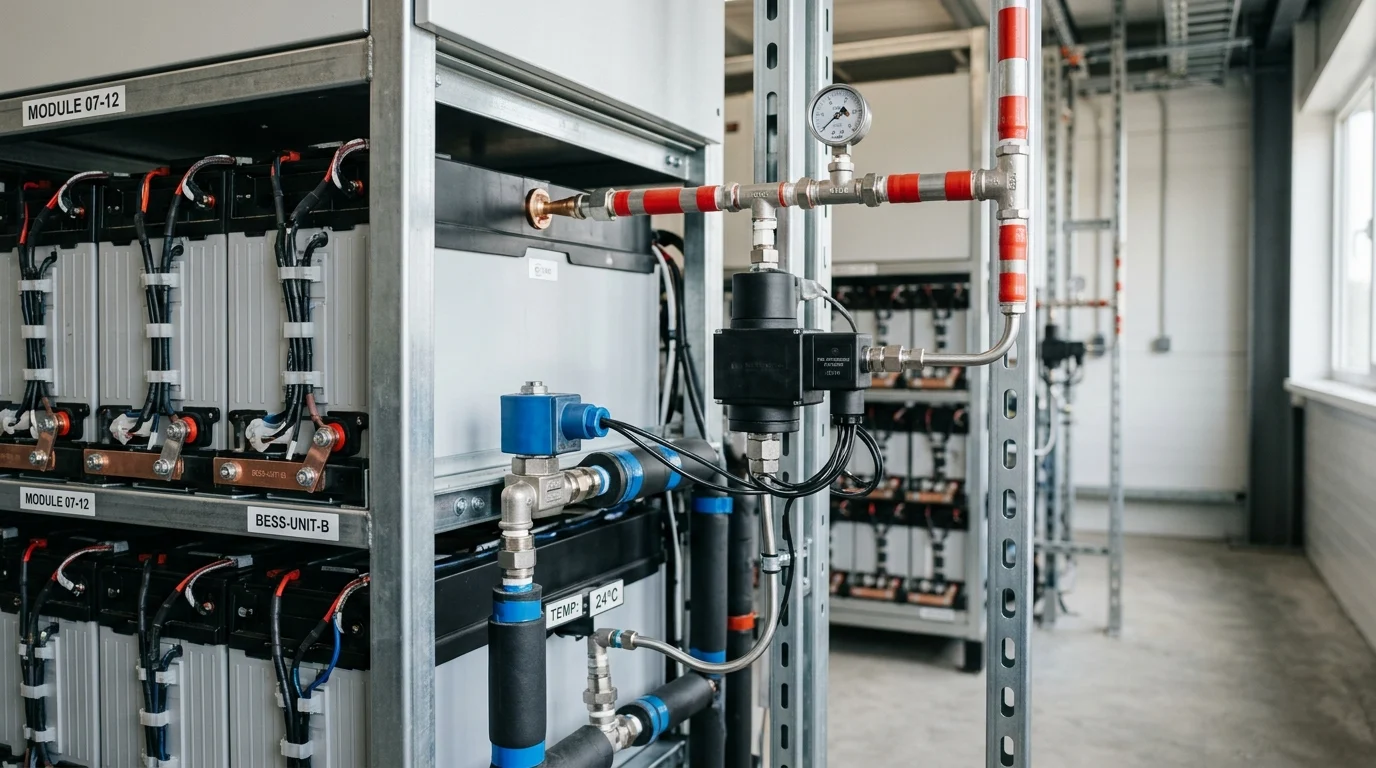
Active thermal management is strictly required to maintain battery cells within their optimal operating window, typically between 15°C and 35°C. Solenoid coils drive the directional and proportional valves within liquid cooling circuits, regulating the flow rate of water-glycol mixtures across battery modules.
When a localized temperature spike is detected by the Battery Management System (BMS), the corresponding solenoid coil is energized to open a valve, immediately increasing coolant flow to the affected rack. The precision of the coil directly impacts the efficiency of the cooling loop, preventing parasitic energy losses while ensuring uniform temperature distribution across thousands of individual cells.
Valve, actuator, and control interfaces
Beyond thermal regulation, solenoid coils are the primary actuation mechanism for BESS fire suppression systems. If thermal runaway occurs, sensors trigger the release of clean agents (such as Novec 1230 or FM-200) or high-pressure water mist. The solenoid coils controlling these release valves must operate flawlessly after months or years of dormancy, typically utilizing 12V, 24V, or 48V DC control interfaces tied directly to emergency safety logic.
Furthermore, modern BESS architectures utilize integrated valve islands and pilot components to manage complex fluid routing. These interfaces must provide deterministic response times, ensuring that isolation valves close and suppression valves open within milliseconds of a detected fault, effectively starving a potential fire of its propagation pathways.
Design, Performance, and Compliance Factors

Engineering solenoid coils for utility-scale storage requires a delicate balance between electrical efficiency, environmental protection, and mechanical longevity. Because BESS containers are frequently deployed in exposed outdoor locations, components must adhere to stringent ingress protection standards, routinely requiring IP67 or IP69K ratings to withstand dust, moisture, and extreme weather.
Additionally, continuous operation in elevated ambient temperatures demands high-grade insulation materials. Utilizing Class H (180°C) or Class N (200°C) copper wire and advanced epoxy encapsulation has become the industry standard to prevent premature coil burnout and ensure compliance with global safety directives.
How to compare key specifications
Evaluating solenoid specifications involves comparing power consumption against actuation force. Standard continuous-duty coils provide reliable operation but exert a constant power draw, which can aggregate to a significant parasitic load in a multi-megawatt facility. Conversely, latching coils or those equipped with smart controllers offer high initial pull-in force followed by a drastically reduced holding current.
| Coil Technology | Typical Power Draw (Holding) | Response Time | Common BESS Application |
|---|---|---|---|
| Standard Continuous Duty | 10 W – 15 W | 20 ms – 50 ms | Primary coolant loop circulation |
| Pulse-Width Modulated (PWM) | 3 W – 5 W | 15 ms – 30 ms | Proportional flow control |
| Magnetic Latching | 0 W (Requires pulse) | 10 ms – 20 ms | Emergency fire suppression release |
Trade-offs in response time, power, and durability
The selection of a specific coil architecture inherently involves trade-offs. Achieving a sub-20 millisecond response time for emergency fire suppression valves requires a high-wattage coil capable of generating a massive initial magnetic flux. However, sustaining that high wattage generates excess heat and drains auxiliary battery reserves.
To resolve this, integrators frequently deploy dual power modules or PWM controllers. These devices deliver a high-voltage spike to break the static friction of the valve actuator, then immediately drop the voltage to a fraction of the nominal rating to hold the valve open. This configuration reduces continuous power consumption by up to 70%, extending the coil’s operational durability and minimizing internal heat generation within the control cabinet.
Supplier Selection for BESS Applications
The rapid expansion of the energy storage market has strained the global supply chain for industrial-grade electromechanical components. BESS integrators must rigorously vet their manufacturing partners to ensure a steady supply of high-reliability solenoid coils, valve islands, and actuators.
A supplier’s ability to maintain strict quality control is paramount, as the acceptable defect rate for safety-critical BESS components is routinely pushed below 50 Parts Per Million (PPM). Partnering with established manufacturers who possess comprehensive in-house testing capabilities ensures that components will perform as specified over a projected 10- to 15-year lifecycle.
Sourcing, testing, and validation steps
The validation of solenoid coils requires exhaustive environmental and electrical testing. Sourcing protocols should mandate thermal cycling tests, typically ranging from -40°C to +85°C, to verify the integrity of the epoxy encapsulation and internal solder joints under extreme expansion and contraction stress. Dielectric strength and vibration resistance testing are equally critical for containerized BESS units subject to transport and operational micro-vibrations.
Companies like Feiniu (Ningbo) Electronic Technology Co., Ltd. exemplify the type of specialized R&D and manufacturing enterprise required for this sector. By focusing on core products such as transmission and pulse solenoid valves, pilot components, and dual power modules, and by maintaining a robust quality management system, such suppliers provide the traceable validation data necessary to secure UL and IEC system-level certifications.
Cost, manufacturability, and serviceability
Commercial viability hinges on balancing unit cost with manufacturability and long-term serviceability. Custom solenoid coils tailored for specific BESS fluid manifolds typically require Minimum Order Quantities (MOQs) ranging from 1,000 to 5,000 units, with production lead times averaging 8 to 12 weeks depending on tooling requirements.
To optimize
Key Takeaways
- The most important conclusions and rationale for Battery Energy Storage Systems (BESS): The Role of Solenoid Coils in Thermal Management and Fire Suppression
- Specs, compliance, and risk checks worth validating before you commit
- Practical next steps and caveats readers can apply immediately
Frequently Asked Questions
What do solenoid coils do in a BESS cooling system?
They actuate valves that direct water-glycol coolant to hotter battery racks. Fast, precise switching helps keep cells within roughly 15°C to 35°C and reduces temperature imbalance.
Why are solenoid coils critical for BESS fire suppression?
They open suppression valves for clean agents or water mist when sensors detect thermal runaway. In BESS, the coil must respond reliably after long idle periods and trigger within milliseconds.
Which coil voltages are common in BESS control circuits?
Typical DC interfaces are 12V, 24V, and 48V. Match the coil voltage to the valve driver, safety logic, and site power architecture to avoid misoperation.
How can I choose between continuous-duty, PWM, and latching coils?
Use continuous-duty for simple always-on cooling valves, PWM for lower holding power and proportional control, and latching coils for emergency release where near-zero holding power is preferred.
What environmental ratings matter for solenoid coils in outdoor BESS containers?
Look for IP67 or IP69K protection, high-temperature insulation like Class H or Class N, and epoxy encapsulation. These features improve resistance to dust, moisture, heat, and vibration.
Post time: Jun-09-2026