
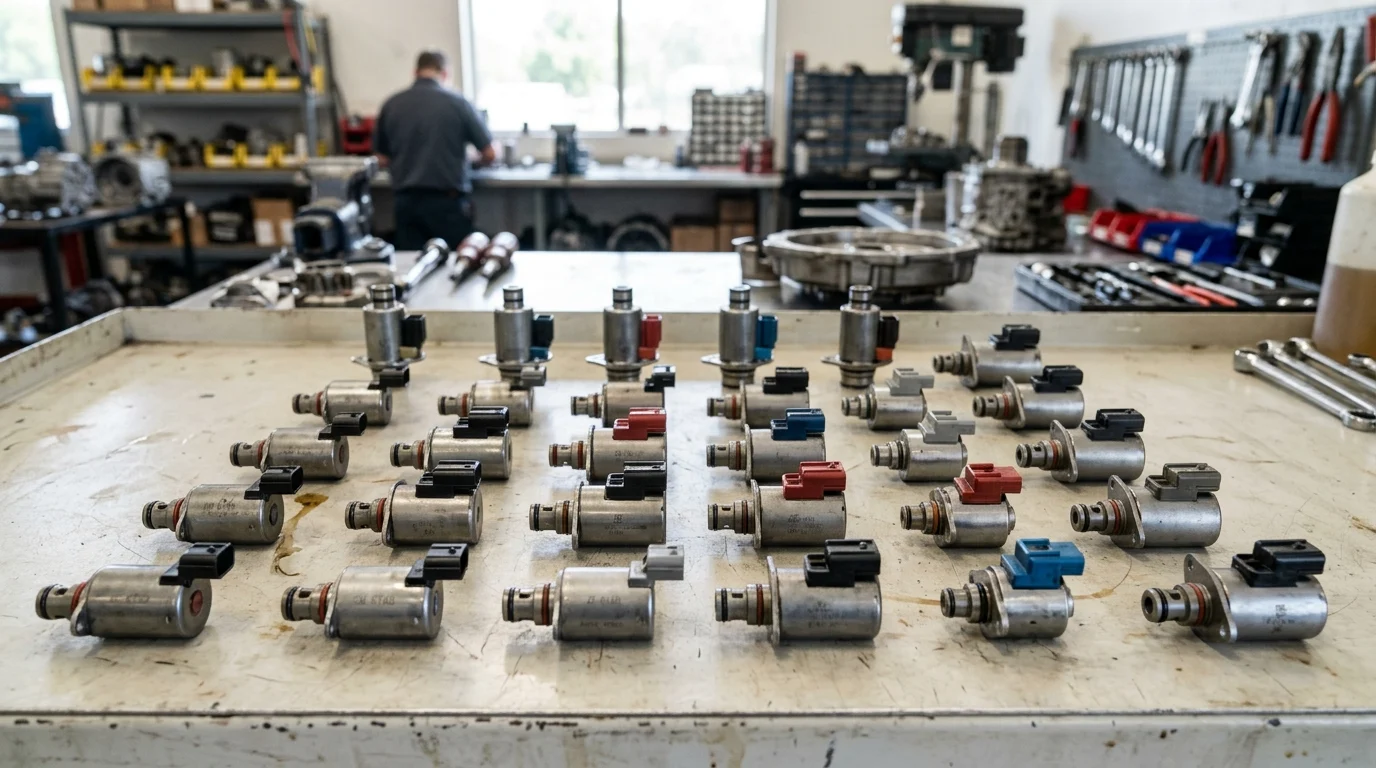
Automatic transmission repair is becoming more component-driven as eight-, nine-, and ten-speed gearboxes move deeper into the US and European vehicle parc. For rebuilders and distributors, the challenge is no longer simply finding a solenoid that fits; it is sourcing units that match OEM hydraulic behavior, electrical response, and platform-specific variations. Flying Bull’s 20+ transmission solenoid valve model families are positioned to support this shift by covering high-volume ZF, Aisin, GM, and Ford applications. This article explains why model coverage, OEM cross-referencing, fail-safe configuration, and performance validation matter when selecting solenoid valves for today’s automatic transmission aftermarket.
Why 20+ Transmission Solenoid Valve Models Matter
The automatic transmission aftermarket in North America and Europe requires highly specialized components to service increasingly complex multi-speed gearboxes. As transmission architectures have evolved to advanced eight-, nine-, and ten-speed configurations, the demand for precise hydraulic control has surged. Modern repair facilities focus on component-level mechatronic rebuilds to reduce consumer costs. Transmission solenoid valves serve as the critical electromechanical interface in this ecosystem, directing transmission fluid to actuate internal clutches with millisecond precision. For rebuilders and distributors, partnering with a supplier like Flying Bull—which maintains a production portfolio of over 20 transmission solenoid valve models—is critical. Rather than representing just 20 discrete SKUs, these models function as comprehensive platform families. Each family maps to specific OEM part numbers and covers hundreds of high-volume vehicle applications, ensuring buyers can source the exact components needed for diverse modern fleets without procurement confusion.
Model Coverage and Application Range
Flying Bull’s extensive application range supports prevalent architectures by cross-referencing direct OEM parts. Representative platforms within the 20+ model matrix include pressure regulators for the ZF 8HP and 9HP series utilized in European luxury sedans. Note that when sourcing specific components like the OEM part number 0501210019, buyers must explicitly verify casting-code variations to prevent misapplication. The lineup also includes linear solenoids for the Aisin AW TF-80SC and TF-81SC found in numerous transverse applications, and shift solenoids for the GM/Ford 6-speed (6R80/6L80/6T40) and 10-speed (10L80/10R80) joint ventures dominating the US light-truck market.
By consolidating procurement through a single manufacturer capable of delivering these validated platform families, aftermarket distributors can streamline supply chain operations. This strategic consolidation simplifies inventory cataloging and ensures consistent hydraulic performance across diverse vehicle platforms, from heavy-duty commercial fleets to compact passenger cars.
Key Definitions Buyers Should Know
Navigating procurement requires understanding how specific electromechanical architectures influence purchasing and warranty decisions. Wholesale buyers must focus on procurement-relevant nuances rather than basic definitions. For example, visually identifying solenoid types when OEM labels are degraded is a critical skill for professional rebuilders.
Buyers must evaluate the internal construction—comprising the electromagnetic coil, armature, and spool valve—and distinguish between normally open (NO) and normally closed (NC) configurations based on port design and resting states. These default states dictate vital fail-safe behaviors during electrical faults, ensuring the transmission defaults to a safe gear ratio rather than locking up entirely. Flying Bull engineers both Pulse Width Modulated (PWM) and Variable Force Solenoids (VFS) units to match these exact OEM fail-safe parameters.
How to Compare Transmission Solenoid Valve Models
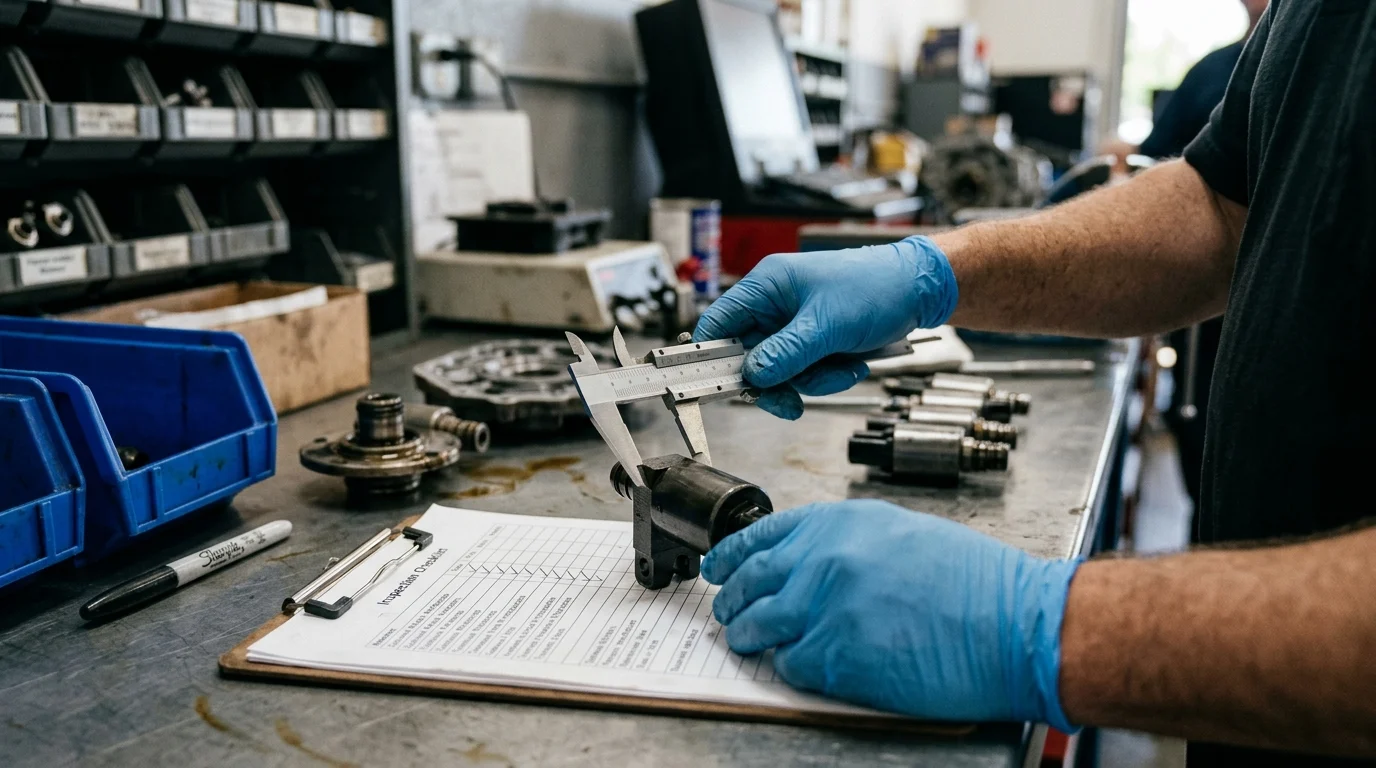
Evaluating aftermarket transmission solenoid valves against OEM benchmarks is a rigorous process that demands deep technical scrutiny. Because the market is susceptible to poorly reverse-engineered components, wholesale buyers must look beyond basic dimensional compatibility.
True equivalency requires assessing how a unit handles known aftermarket weaknesses. These include coil varnish degradation at 150°C, spool valve hysteresis, and hydraulic leakage under severe thermal cycling. Buyers must establish strict comparative baselines, such as side-by-side OEM versus Flying Bull specifications. This ensures replacement parts function seamlessly with the vehicle’s Transmission Control Module (TCM), while also accounting for real-world installation limits and aftermarket risks.
Technical Specifications and Performance Criteria
Technical specifications dictate the exact shifting behavior, adaptive learning capabilities, and longevity of the transmission. Key parameters include coil resistance, response time, and thermal stability under continuous heavy-duty operation. Professional rebuilders must also account for critical aftermarket caveats before installing replacement solenoids. These include mandatory TCM software relearn procedures, strict OEM ATF fluid compatibility requirements, and the dangers of mixing OEM and aftermarket solenoids within the same valve body, which can cause severe hydraulic imbalances. Furthermore, buyers must be aware of TCM software incompatibilities that can trigger false fault codes, and recognize scenarios where OEM solenoids remain mandatory due to proprietary encrypted communication protocols. Failure to address these factors can result in harsh shifting and voided warranties.
Note: The values in the table below are illustrative industry ranges rather than exact specifications for every model.
| Solenoid Type | Typical Coil Resistance | Target Response Time | Operating Temp Range |
|---|---|---|---|
| PWM (Shift Control) | 12.0 – 15.0 Ohms | < 20 ms | -40°C to 150°C |
| VFS (Pressure Control) | 3.5 – 5.5 Ohms | < 15 ms | -40°C to 150°C |
| On/Off (Lock-up) | 20.0 – 25.0 Ohms | < 25 ms | -40°C to 150°C |
Solenoids must maintain these stringent specifications despite severe temperature fluctuations inside the transmission sump. For example, testing indicates that a significant deviation in coil resistance at 120°C can result in shift flares or delayed clutch engagement. These micro-failures directly impact drivability and can cause accelerated wear on internal friction plates.
Production Controls and Validation Standards
Rigorous production controls separate premium aftermarket components from substandard alternatives. Flying Bull adheres strictly to IATF 16949 quality management standards. The company implements automated end-of-line (EOL) testing on specialized hydraulic test benches to verify the flow rate, hysteresis, and leakage parameters of every unit.
Flying Bull’s internal validation protocols subject solenoids to extensive durability testing. Engineers use illustrative internal benchmarks, such as simulating up to 1,000,000-cycle aggressive shift patterns using heated transmission fluid, to gauge longevity. For tier-1 aftermarket suppliers targeting the high-stakes US and EU markets, Flying Bull maintains strict internal quality targets, including an illustrative goal of keeping defect rates below 50 PPM (Parts Per Million). These internal benchmarks are designed to prevent costly transmission teardowns, labor claim disputes, and warranty chargebacks.
How Flying Bull Supports US and EU Buyers
Flying Bull strategically positions its manufacturing and export operations to address the specific regulatory and technical requirements of transmission rebuilders in Western markets.
This strategy integrates high-volume production capabilities with customized supply chain solutions, such as leveraging regional EU and US warehouse partnerships. These partnerships help mitigate global shipping volatility and ensure continuous availability of critical replacement parts.
Key Takeaways
- Use a supplier with 20+ validated solenoid valve model families to simplify sourcing across major US and European automatic transmission platforms.
- Always verify OEM part numbers, transmission codes, and casting-code variations before ordering solenoids for ZF, Aisin, GM, or Ford applications.
- Compare aftermarket solenoids against OEM benchmarks for coil durability, hydraulic leakage, spool response, and thermal-cycle performance.
- Distinguish normally open and normally closed solenoids during procurement because their fail-safe behavior affects transmission operation during electrical faults.
- Consolidating purchases through one technically capable manufacturer can reduce catalog complexity and improve consistency for rebuilders and distributors.
Frequently Asked Questions
Why does a 20+ model solenoid valve portfolio matter for aftermarket buyers?
It helps distributors and rebuilders cover major US and EU transmission platforms without managing excessive suppliers. Each model family can map to multiple OEM numbers and vehicle applications, improving sourcing accuracy and inventory efficiency.
Which transmission platforms are represented in Flying Bull’s solenoid valve range?
The portfolio includes coverage for common platforms such as ZF 8HP and 9HP, Aisin AW TF-80SC and TF-81SC, GM/Ford 6-speed units, and newer 10-speed applications used in light trucks and passenger vehicles.
What should buyers verify before ordering a transmission solenoid valve?
Buyers should confirm the OEM part number, transmission code, casting-code variation, solenoid type, and normally open or normally closed configuration to avoid misapplication and warranty issues.
How do PWM and VFS solenoids differ in procurement terms?
PWM and VFS solenoids control hydraulic pressure differently, so they must match OEM electrical and hydraulic behavior. Buyers should compare response curves, coil specifications, and fail-safe function rather than relying only on physical fit.
Why is OEM cross-referencing important for distributors?
OEM cross-referencing reduces catalog errors, supports faster part identification, and helps match solenoids to high-volume applications. It is especially important when one platform family covers multiple vehicle brands and transmission variants.
Post time: Sep-05-2026