
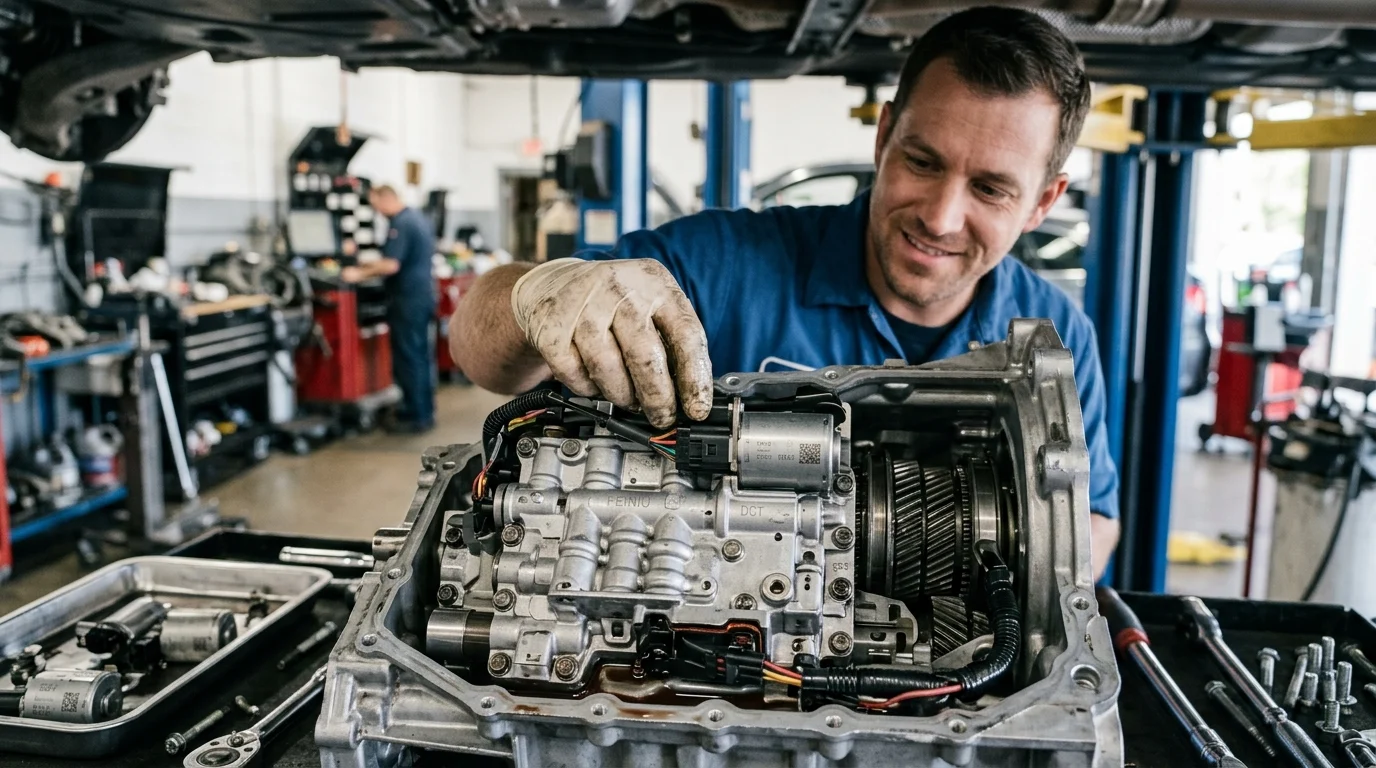
Transmission repair is becoming more complex as North America continues to service large AT and CVT vehicle populations while Europe accelerates toward DCT-heavy drivetrains. For aftermarket distributors and independent workshops, the challenge is no longer just finding a replacement solenoid—it is finding the right precision part for increasingly fragmented transmission platforms. Feiniu’s expanding range of 20+ new automotive transmission solenoid valves is gaining attention because it addresses exact-fit coverage, cost pressure, and quality consistency at the same time. This article examines how AT, CVT, and DCT solenoid requirements differ, why broad catalog coverage matters, and what makes new aftermarket solutions increasingly relevant in the US and EU repair channels.
Transmission Solenoid Basics
Automotive transmission architectures are undergoing a fundamental transformation. While the United States market retains heavy conventional Automatic Transmission (AT) and Continuously Variable Transmission (CVT) usage, the European Union has seen a rapid shift toward highly efficient Dual-Clutch Transmissions (DCT). This transition forces aftermarket distributors to adapt their inventory strategies, balancing legacy AT components with high-pressure, rapid-response DCT parts. At the core of this mechanical evolution lies the transmission solenoid valve, an electro-hydraulic actuator responsible for directing transmission fluid to specific clutch packs and gear sets. As the long-term transition to Electric Vehicles (EVs) threatens future transmission part demand, maintaining the aging internal combustion engine (ICE) fleet has made cost-effective, high-precision aftermarket solenoids increasingly critical.
Feiniu addresses this landscape by engineering a comprehensive portfolio of new aftermarket solenoid valves. By utilizing hardened steel armatures and high-temperature polymers, and offering pricing that significantly undercuts OE list prices while matching OE quality tiers, the company provides vital replacement parts for independent repair facilities. This shift away from unpredictable remanufactured parts and expensive OE options toward reliable, newly manufactured components is a primary driver of Feiniu's growing traction among US and EU distributors.
AT, CVT, and DCT Solenoids Explained
From an application and diagnostic standpoint, solenoids tailored for AT, CVT, and DCT systems perform fundamentally different hydraulic tasks. Traditional AT solenoids primarily operate as on/off or pulse-width modulated (PWM) valves to control planetary gear shifts, making them relatively straightforward to diagnose and replace. In contrast, modern DCT architectures demand solenoids with exceptional flow control and microsecond actuation capabilities to pre-engage the next gear seamlessly, preventing clutch shudder.
While standalone solenoid swaps remain a highly cost-effective solution for specific hydraulic faults, installers face growing practical limitations. Many modern transmissions feature sealed or encrypted mechatronic units that pair the Transmission Control Unit (TCU) to the valve body, complicating individual component replacement without advanced reprogramming and unlocking capabilities.
Why Feiniu Offers 20+ Solenoid Types
The proliferation of proprietary transmission designs across global automakers has fragmented the aftermarket, necessitating a broad catalog of replacement components. Feiniu addresses this complexity by manufacturing over 20 distinct solenoid valve types, covering dominant architectures such as the ZF 8HP, Volkswagen’s DSG series (DQ200/DQ250), and Ford’s PowerShift.
By maintaining this extensive range, distributors can consolidate their supply chains—a major factor in Feiniu's regional adoption. This diverse product line ensures technicians have access to exact-fit solenoids, allowing distributors to streamline procurement across both European and North American markets. Installers must still account for necessary mechatronic reprogramming and software version compatibility during rebuilds; while Feiniu ensures hardware compatibility and provides baseline calibration data, technicians rely on standard third-party diagnostic tools to complete the final TCU adaptation.
Technical and Quality Comparison

The diverse operational demands of modern transmissions necessitate a fundamental upgrade in solenoid engineering, particularly concerning pressure handling, response latency, and thermal resilience. Aftermarket manufacturers must match original equipment (OE) specifications to prevent premature mechatronic failures and maintain drivability.
AT vs CVT vs DCT Solenoid Requirements
From a strict engineering perspective, the operational parameters for solenoids vary drastically depending on the transmission type. DCT systems prioritize rapid actuation metrics, while CVTs require sustained, high-pressure regulation to manipulate steel pushbelts. Note that the pressure ranges and response times below are illustrative industry ranges, not universal OE absolutes, as specific transmission designs vary widely.
| Transmission Type | Typical Pressure Range | Target Response Time | Primary Function |
|---|---|---|---|
| Conventional AT | 0 – 15 bar | 20 – 30 ms | Shift engagement & line pressure |
| CVT | 0 – 60 bar | 15 – 25 ms | Pulley clamping force modulation |
| DCT | 0 – 20 bar | < 10 ms | Rapid dual-clutch actuation |
A solenoid engineered for a standard AT valve body will fail catastrophically if subjected to the high-pressure spikes typical of a CVT hydraulic circuit. Precision engineering of the magnetic circuit and armature is required to ensure the component can withstand these distinct operating environments.
Key Specifications and Validation Tests
To guarantee parity with OE components, rigorous validation testing is mandatory. Feiniu subjects its 20+ solenoid variants to exhaustive lifecycle durability testing, simulating years of aggressive driving through up to 10 million actuation cycles under load.
Key specifications include thermal shock resistance, where components must maintain hydraulic integrity across extreme temperature swings from -40°C to 150°C. Furthermore, internal leakage thresholds are strictly regulated; high-performance DCT solenoids are calibrated to meet stringent fluid bypass limits at operating pressure.
Buyer and Distributor Guidance
Sourcing transmission solenoids for the US and EU aftermarket requires a strategic approach to inventory management and supplier vetting. Distributors must balance the demand for high-turnover parts with the logistical realities of global automotive supply chains, factoring in warranty liability risks for independent repair facilities and the complexities of core return logistics. Additionally, distributors should educate their installer networks on post-installation procedures; replacing these precision components requires technicians to perform TCU adaptation and relearning. This process calibrates clutch engagement points to account for wear and prevents abnormal slippage, ensuring the transmission control unit synchronizes properly with the new hardware.
Practical Sourcing Steps
Effective sourcing begins with analyzing regional transmission failure data to optimize inventory. For example, buyers must differentiate between high-volume failure patterns, such as Ford PowerShift issues prevalent in the US market versus Volkswagen DSG mechatronic wear common in the EU. Additionally, distributors should consider regional material compliance standards, ensuring components adhere to material compliance directives such as REACH and RoHS, which strictly govern the chemical composition of transmission parts.
While traditional OE manufacturers may require massive volume commitments, Feiniu accommodates flexible Minimum Order Quantities (MOQs) tailored to specific SKUs. This flexibility, combined with standard global lead times, allows distributors to maintain lean inventories while reacting swiftly to regional rebuild volumes, further accelerating their market penetration against traditional remanufactured alternatives.
How to Choose the Right Solenoid Supplier
Selecting a reliable solenoid manufacturer extends beyond unit cost.
Key Takeaways
- Stock solenoids by transmission architecture because AT, CVT, and DCT systems have different hydraulic control, response, and calibration requirements.
- Prioritize exact-fit coverage for high-volume platforms such as ZF 8HP, VW DSG DQ200/DQ250, and Ford PowerShift to improve aftermarket availability.
- Use new aftermarket solenoids to reduce the quality variability often associated with remanufactured parts while avoiding high OE list prices.
- Plan for diagnostic and adaptation work after installation because sealed or encrypted mechatronic units may require TCU programming or calibration.
- Distributors can simplify procurement by sourcing from a supplier with 20+ solenoid types across both North American and European vehicle applications.
Frequently Asked Questions
What does a transmission solenoid valve do?
A transmission solenoid valve is an electro-hydraulic actuator that directs transmission fluid to clutch packs and gear sets, helping control shifts, pressure, and drivability in AT, CVT, and DCT systems.
Why are DCT solenoids more demanding than traditional AT solenoids?
DCT solenoids must deliver faster, more precise flow control to pre-engage gears and prevent clutch shudder, while many AT solenoids operate as simpler on/off or PWM valves.
Why does Feiniu offer more than 20 solenoid valve types?
Transmission designs vary widely by automaker and platform, so Feiniu covers major systems such as ZF 8HP, Volkswagen DSG DQ200/DQ250, and Ford PowerShift to help distributors support broader repair demand.
Are new aftermarket solenoids better than remanufactured options?
New aftermarket solenoids can offer more consistent quality than remanufactured parts because they avoid wear-history uncertainty while still providing a lower-cost alternative to OE components.
Do Feiniu solenoids require programming after installation?
Hardware compatibility is only part of the repair. Many modern transmissions require TCU adaptation, mechatronic calibration, or software checks using standard third-party diagnostic tools after installation.
Post time: Sep-02-2026