
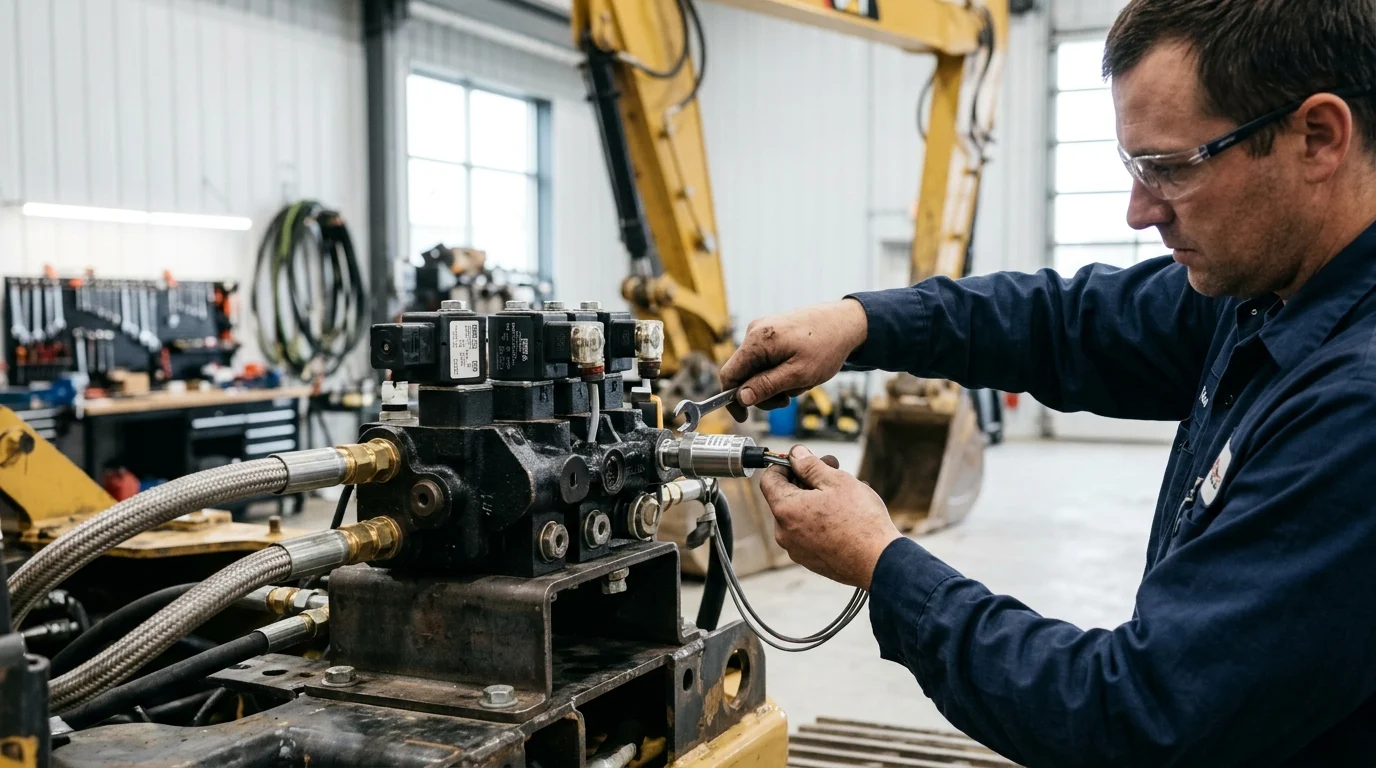
In North American construction, mining, and agricultural equipment, reliability depends on more than rugged steel and high-pressure hydraulics. The real performance gains often come from how precisely electro-hydraulic components communicate. Solenoid valves handle the physical work of directing flow under pressures that can exceed 350 bar, while sensors deliver the real-time feedback needed to control that force safely and efficiently. When these components are engineered in isolation, OEMs face higher risks of latency, hydraulic shock, and premature wear. This article examines how Feiniu’s combined expertise in actuation and sensing helps create synchronized control loops that support uptime, durability, and smarter heavy equipment design.
Solenoid Valves and Sensors in Heavy Equipment
Heavy equipment operating in North America relies on precise electro-hydraulic control architectures. These systems manage massive physical loads under extreme environmental conditions. At their core lie two interdependent components. Solenoid valves execute physical actuation, while sensors provide the closed-loop feedback required for accurate control. Rather than treating these as opposing choices, modern engineering views them as complementary. As an established global manufacturer with a growing footprint supporting North American OEMs, Feiniu leverages dual manufacturing and engineering expertise. This background bridges the historical gap between these component classes, enabling original equipment manufacturers (OEMs) to source highly synchronized actuation and feedback loops.
Key Differences in Function and Application
Solenoid valves function as the primary control elements in fluid power circuits. They direct, stop, and modulate flow. These valves frequently handle hydraulic system pressures exceeding 350 bar (5,075 PSI) and flow rates up to 150 liters per minute. In contrast, sensors—such as pressure transducers, position indicators, and temperature probes—act as the system’s diagnostic network. A high-performance pressure sensor in a modern excavator, for example, must deliver a full-scale accuracy of ±0.5% with response times under 2 milliseconds to prevent system over-pressurization. While valves execute the physical work, sensors dictate the timing and intensity of that work based on real-time operational data.
Why Integrated Expertise Improves Uptime
Procuring valves and sensors from isolated supply chains often forces OEMs to engineer complex integration workarounds. This fragmentation increases the risk of signal latency and mechanical wear. Feiniu’s integrated approach ensures that the electromagnetic characteristics of the valve coil align perfectly with the signal output of the paired sensor. This synchronization significantly reduces hydraulic shock and cavitation. Internal testing and preliminary field data suggest that optimizing this valve-sensor pairing can extend the mean time between failures (MTBF) by up to 25% in high-vibration applications. For mining, construction, and agricultural machinery, this translates to hundreds of hours of recovered uptime annually.
How to Compare Solenoid Valves and Sensors
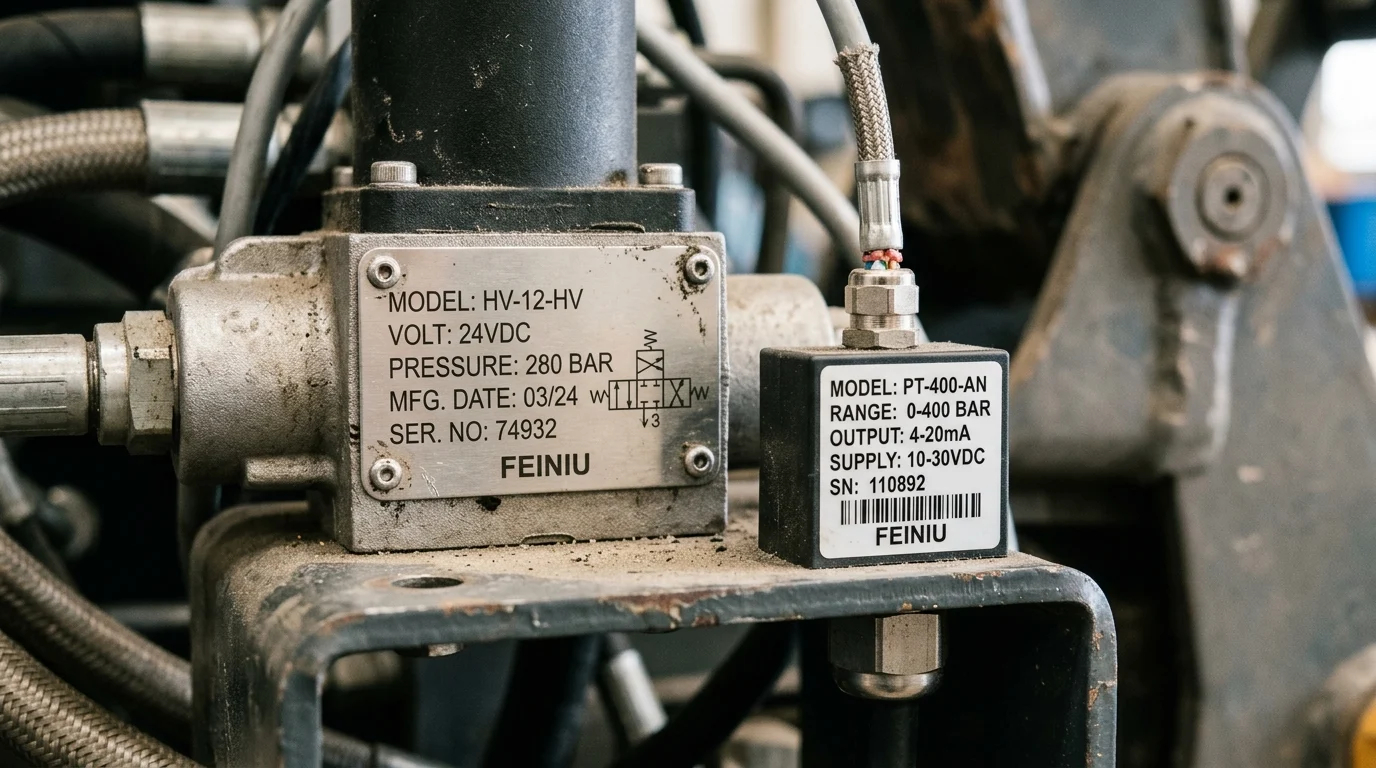
Evaluating electro-hydraulic components requires a stringent assessment of both mechanical durability and electronic stability. Because solenoids and sensors operate under distinct physical principles, the parameters used to qualify them differ significantly, even when they are deployed within the same hydraulic manifold.
Specification Criteria for OEM Evaluation
OEM engineering teams must evaluate actuation and feedback components against distinct operational thresholds. Solenoid valves are primarily assessed on their flow capacity, pressure drop, and cycle life, typically requiring a minimum operational lifespan of 2 to 5 million cycles depending on the application. Sensors are evaluated on resolution, signal drift over time, and electromagnetic interference (EMI) immunity. Crucially, these specifications must be bridged; for instance, a sensor’s response time must precisely match the valve’s switching time to ensure seamless operation.
| Specification Parameter | Solenoid Valve Criteria | Sensor Criteria |
|---|---|---|
| Primary Metric | Operating Pressure (e.g., 0-350 bar) | Accuracy/Resolution (e.g., ±0.25% FS) |
| Electrical Input/Output | 12V/24V DC (±10% tolerance), PWM | 4-20mA, 0-5V, or CAN bus output |
| Durability Focus | Cycle life (2M+ cycles), seal integrity | Shock/Vibration resistance (up to 50G) |
| Environmental Rating | IP67 minimum for coil ingress | IP69K for high-pressure washdown |
By normalizing these specifications during the procurement phase, OEMs can prevent bottlenecks where a highly responsive sensor is mechanically limited by a slow-acting valve.
Compliance, Validation, and North American Requirements
Equipment destined for the North American market must navigate strict regulatory and environmental validation frameworks. Components must routinely comply with SAE J1455 standards for environmental practices in heavy-duty vehicles. This dictates rigorous testing for thermal shock, humidity, and salt spray exposure. Solenoid coils and sensor housings must maintain operational integrity across extreme temperature gradients, typically ranging from -40°C in northern Canadian winters to +125°C near engine compartments in the American Southwest. Furthermore, electrical components must often carry UL or CSA certifications for dielectric strength and short-circuit protection. This ensures that an electrical fault in a 24V sensor circuit does not cascade into a catastrophic hydraulic failure.
Working with Feiniu for Integrated Solutions
Leveraging a supplier with dual expertise in both fluid control and electronic sensing fundamentally alters the supply chain dynamic. Feiniu provides North American OEMs with a consolidated pathway for sourcing critical electro-hydraulic systems, reducing the friction of coordinating multiple specialized vendors. However, OEMs must also weigh considerations such as non-recurring engineering (NRE) costs and the potential risks of single-sourcing critical components.
Engineering and Procurement Evaluation Process
The evaluation process begins with a comprehensive system audit, where Feiniu’s engineering team analyzes the OEM’s hydraulic schematics and electronic control unit (ECU) parameters. This dual-track analysis allows for rapid co-development of matching valves and sensors. From a procurement standpoint, this consolidation offers tangible logistical advantages. Feiniu’s internal metrics indicate that custom prototyping lead times can often be reduced to 4 to 6 weeks, compared to an industry average of 10 to 12 weeks for disjointed component sourcing. Additionally, by bundling valve and sensor production, procurement teams can often negotiate minimum order quantities (MOQs) starting at 500 units per matched set. This optimizes inventory holding costs while maintaining volume pricing benefits.
When to Choose Standalone or Integrated Components
Determining whether to procure standalone components or fully integrated assemblies depends on the machinery’s lifecycle stage and architecture. Standalone components remain highly effective—and often preferable—for legacy platform retrofits or standardized maintenance, repair, and overhaul (MRO) operations where existing ECU programming cannot be easily modified, or where avoiding vendor lock-in is a priority. However, for clean-sheet equipment designs—such as next-generation autonomous tractors or hybrid-electric excavators—integrated solutions offer distinct advantages. In these applications, Feiniu delivers pre-calibrated manifold assemblies where the solenoid and sensor are physically and electronically tuned to one another. Internal time-studies suggest this integrated approach can reduce assembly line installation time by up to 15%. By minimizing the risk of field failures caused by component mismatch, integrated sourcing helps ensure maximum reliability for end-users across North America.
Key Takeaways
- Treat solenoid valves and sensors as complementary parts of one electro-hydraulic control loop rather than separate sourcing decisions.
- Specify solenoid valves for pressure, flow, pressure drop, switching speed, and cycle life, with many heavy-duty applications requiring 2 to 5 million cycles.
- Select sensors with fast response, strong EMI immunity, stable accuracy, and low drift to support reliable closed-loop control in harsh environments.
- Match sensor response time to valve switching time to reduce hydraulic shock, cavitation, and integration-related failure risks.
- Use integrated valve-sensor engineering to improve uptime, with optimized pairings potentially increasing MTBF by up to 25% in high-vibration applications.
Frequently Asked Questions
Why should OEMs integrate solenoid valves and sensors together?
Integrated valve-sensor engineering helps match actuation timing with feedback signals, reducing hydraulic shock, cavitation, latency, and unnecessary wear in heavy equipment.
What role do solenoid valves play in heavy equipment hydraulics?
Solenoid valves direct, stop, or modulate hydraulic flow, often operating at pressures above 350 bar and flow rates up to 150 liters per minute.
What do sensors contribute to electro-hydraulic systems?
Sensors provide real-time feedback on pressure, position, and temperature, enabling closed-loop control, diagnostics, and protection against over-pressurization or unstable operation.
How can valve-sensor synchronization improve reliability?
When sensor response time aligns with valve switching behavior, the system operates more smoothly and may extend mean time between failures by up to 25% in high-vibration applications.
Which specifications should OEMs compare when selecting solenoid valves?
OEMs should evaluate operating pressure, flow capacity, pressure drop, switching time, coil characteristics, environmental sealing, and expected cycle life, often targeting 2 to 5 million cycles.
Post time: Sep-03-2026