

AI clusters are pushing European server farms into a new thermal reality, where a single rack can produce more heat than an entire legacy server room. As operators move from air cooling to direct-to-chip and immersion architectures, the smallest control components become mission-critical. Solenoid coils, which actuate coolant valves in milliseconds, help regulate flow through CDUs, racks, and cold plates based on live thermal demand. This article examines how these coils support precision liquid cooling, why specifications such as voltage, duty cycle, Cv, and glycol compatibility matter, and how better component selection can improve uptime, energy efficiency, and PUE in high-density facilities.
Solenoid Valves in Data Center Liquid Cooling
As European server farms pivot toward high-density artificial intelligence (AI) and machine learning (ML) workloads, traditional air-cooling infrastructure is rapidly reaching its thermal limits. Precision liquid cooling has emerged as the industry standard for managing escalating heat loads, offering superior thermal transfer efficiency and reduced energy consumption. Within these advanced cooling architectures, solenoid valves and their actuating coils serve as critical gatekeepers of fluid dynamics.
These electromechanical components dictate the routing, volume, and velocity of dielectric fluids or water-glycol mixtures throughout the server racks. By converting electrical energy into linear motion, solenoid coils enable automated, instantaneous adjustments to coolant flow based on real-time thermal telemetry from the servers. Without reliable solenoid actuation, even the most sophisticated liquid cooling loops would fail to maintain the stringent temperature bands required for optimal hardware performance.
Why Precision Flow Control Matters
The transition from ambient room cooling to direct-to-chip or immersion cooling requires granular control over thermal management. Modern high-density racks frequently generate between 40 kW and 100 kW of heat per cabinet. At these densities, slight deviations in coolant flow can trigger severe thermal throttling or catastrophic hardware failure within seconds.
Precision flow control ensures that coolant is dynamically routed exactly where it is needed, matching the fluctuating utilization rates of individual CPUs and GPUs. High-performance solenoid coils facilitate rapid actuation, often achieving response times of under 50 milliseconds. This rapid response prevents thermal spikes during sudden computational bursts while minimizing pumping energy during idle periods, directly improving the facility’s Power Usage Effectiveness (PUE).
Key Liquid Cooling Terms to Know
Navigating the liquid cooling landscape requires familiarity with specific industry terminology. The Coolant Distribution Unit (CDU) is the heart of the system, housing the pumps, heat exchangers, and primary control valves that isolate the facility water system from the delicate IT equipment loop.
Operators must also understand the Flow Coefficient (Cv), which measures the valve’s capacity for liquids. A higher Cv indicates greater flow for a given pressure drop. Furthermore, European facilities utilizing economizers or free-cooling loops often rely on Propylene Glycol (PG) mixtures. Maintaining a precise 20% to 30% PG concentration is standard practice to prevent freezing during harsh winters while maintaining adequate specific heat capacity for thermal transfer.
Critical Solenoid Coil Specifications
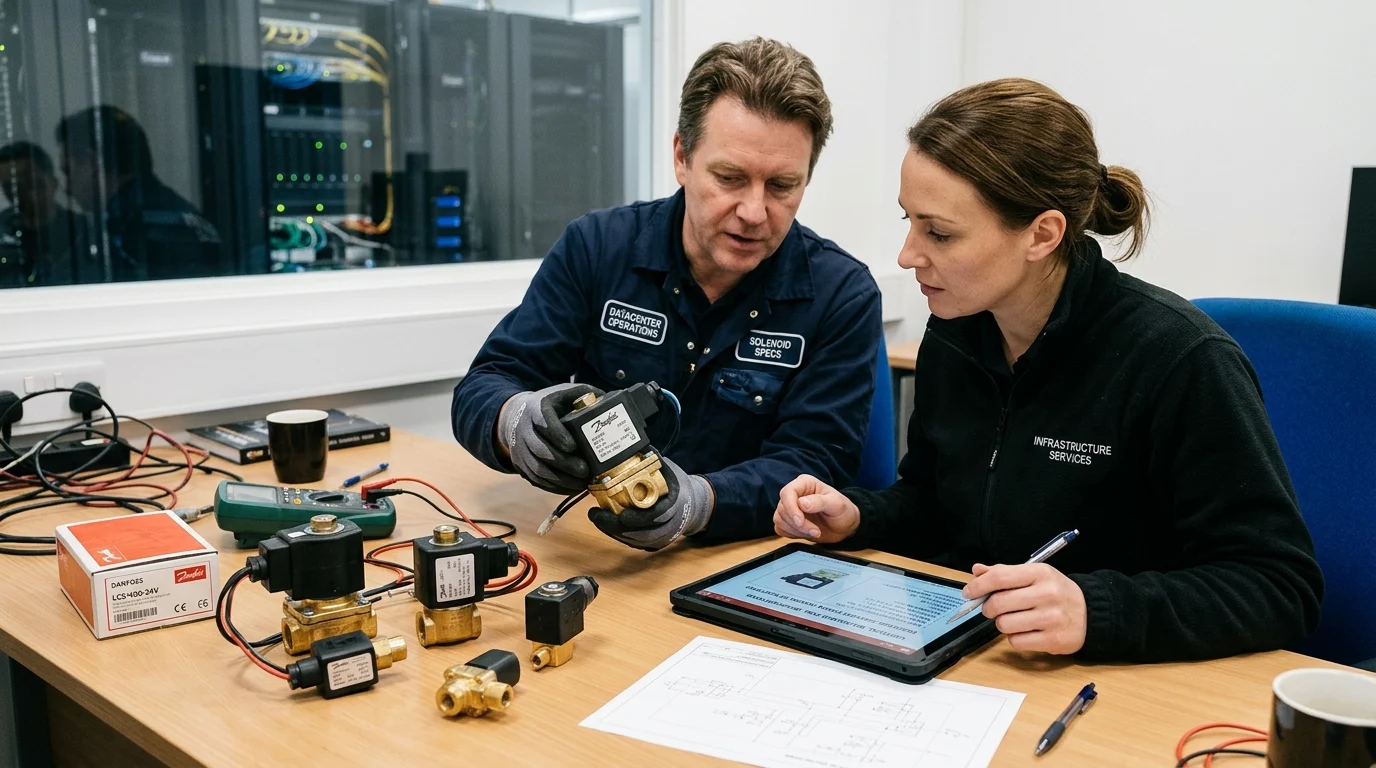
The reliability of a solenoid valve is inextricably linked to the specifications of its electromagnetic coil. In Tier III and Tier IV data centers, where expected uptime ranges from 99.982% to 99.995%, component failure is not an option. Selecting the appropriate coil requires a rigorous evaluation of electrical characteristics, thermal endurance, and mechanical design to ensure continuous operation within the demanding environment of a server farm.
Voltage, Duty Cycle, and Power Consumption
Data center cooling systems typically utilize 24V DC solenoid coils, aligning with standard industrial control logic and offering safer operation near sensitive IT equipment. Because cooling systems run continuously, these coils must carry a 100% ED (Continuous Duty) rating, meaning they can remain energized indefinitely without overheating or degrading.
Power consumption is another critical metric. Highly efficient solenoid coils typically draw between 5W and 15W of power. To withstand the continuous electrical load and ambient heat, coils must feature robust insulation. Class F (rated for up to 155°C) or Class H (rated for up to 180°C) insulation systems are mandatory to prevent short circuits and ensure longevity in enclosed CDU cabinets.
Direct-Acting vs. Pilot-Operated Designs
Cooling architectures utilize two primary types of solenoid valve mechanisms, each suited to different flow and pressure requirements within the facility. Understanding the distinction is vital for specifying the correct coil and valve body combination.
| Specification | Direct-Acting Solenoid Valves | Pilot-Operated Solenoid Valves |
|---|---|---|
| Mechanism | Coil directly lifts the armature to open the valve. | Coil opens a small pilot port; line pressure opens the main valve. |
| Minimum Pressure | 0 bar (works in gravity/low-flow loops). | Typically requires 0.3 to 0.5 bar pressure differential to operate. |
| Flow Capacity (Cv) | Generally lower; suited for branch lines. | High; ideal for main CDU distribution lines. |
| Coil Power Requirement | Higher (must overcome full fluid pressure). | Lower (utilizes system pressure for heavy lifting). |
Direct-acting valves are essential for low-pressure drip or branch lines where pressure drops to near zero. Conversely, pilot-operated designs are favored for main supply lines where high flow rates are required, as they allow smaller, lower-wattage coils to control massive fluid volumes.
Sourcing and Validation for European Operators
Sourcing components for European data centers involves navigating stringent regulatory frameworks and demanding performance expectations. Equipment must comply with CE marking requirements, RoHS (Restriction of Hazardous Substances), and REACH regulations. Partnering with established manufacturers—such as Feiniu (Ningbo) Electronic Technology Co., Ltd., which specializes in the research, development, and manufacturing of high-quality electromagnetic coils and valve assemblies—ensures that these compliance baselines are met alongside rigorous quality management standards.
Supplier Assessment Checklist
A comprehensive supplier assessment is the first line of defense against infrastructure failure. Operators should verify that the manufacturer operates under an active ISO 9001 certified quality management system, ensuring consistent production tolerances and full component traceability.
Key assessment metrics should include a demonstrated defect rate of less than 50 Parts Per Million (PPM). Additionally, buyers must scrutinize the environmental protection ratings of the coils. Given the inherent risks of fluid leaks in liquid cooling loops, coils should carry a minimum ingress protection rating of IP65, with IP67 preferred for critical zones to ensure complete protection against dust and temporary liquid immersion.
Balancing Performance, Reliability, and Cost
Procurement teams must evaluate the Total Cost of Ownership (TCO) rather than focusing solely on upfront unit prices. While a standard off-the-shelf solenoid coil might cost between €10 and €20, a high-reliability, IP67-rated coil with custom waterproof connectors may range from €30 to €50.
Key Takeaways
- Specify solenoid coils that can support rapid actuation, ideally under 50 milliseconds, to protect 40 kW to 100 kW racks from workload-driven thermal spikes.
- Use 24V DC solenoid coils where possible to align cooling valve control with common industrial automation standards and safer data center operation.
- Match valve Cv ratings to expected coolant flow and pressure drop so direct-to-chip or immersion loops can deliver cooling exactly where heat is generated.
- Maintain propylene glycol concentrations around 20% to 30% in European free-cooling loops to balance freeze protection with effective heat transfer.
- Prioritize coil reliability, duty cycle, and thermal endurance in Tier III and Tier IV facilities where uptime expectations reach 99.982% to 99.995%.
Frequently Asked Questions
Why are solenoid coils important in liquid-cooled data centers?
Solenoid coils actuate valves that control coolant routing, volume, and velocity. In high-density server racks, fast and reliable valve response helps prevent thermal spikes, throttling, and equipment failure.
What heat loads do modern high-density racks generate?
AI and ML server racks commonly generate 40 kW to 100 kW of heat per cabinet, which is why precise liquid flow control is becoming essential.
How fast should solenoid valves respond in precision cooling systems?
High-performance solenoid coils can support response times under 50 milliseconds, enabling cooling systems to react quickly to sudden CPU and GPU workload changes.
Why is 24V DC commonly used for solenoid coils in data center cooling?
Many cooling systems use 24V DC because it aligns with industrial control standards and is safer around sensitive IT infrastructure than higher-voltage alternatives.
What is a Coolant Distribution Unit in a liquid cooling system?
A Coolant Distribution Unit, or CDU, houses pumps, heat exchangers, and control valves, separating the facility water loop from the IT equipment cooling loop.
Post time: Jun-24-2026