

The compliance clock is already running for machinery suppliers selling into Europe. From January 2027, the EU’s new machinery rules will tighten expectations for components that influence safety, including solenoid valves, smart sensors, hydraulic controls, and software-enabled assemblies. The change is not only legal; it is technical, extending safety evidence into cybersecurity, firmware control, traceability, and component-level declarations where applicable. For OEMs, distributors, and procurement teams, the risk is clear: a valve or sensor that looks mechanically compliant today may fail tomorrow’s documentation test. This article explains when these components fall in scope, what suppliers must prove, and how buyers can prepare before market access becomes harder.
Why EU Machinery Regulation 2023/1230 Matters
The transition from the European Machinery Directive 2006/42/EC to the new EU Machinery Regulation 2023/1230 represents a fundamental shift in the compliance architecture for industrial automation. Taking full effect on January 14, 2027, the legislation moves from a directive—which required transposition by individual member states—to a regulation, ensuring uniform application across all 27 EU member states. For manufacturers integrating fluid control and sensing technologies, this regulatory overhaul demands immediate supply chain recalibration.
Solenoid valve and sensor suppliers must navigate a tightened regulatory framework that redefines safety components, particularly those incorporating digital and software elements. With the 42-month transition period already underway following the regulation’s publication in July 2023, procurement and engineering teams must begin validating supplier readiness now to prevent future market lockout.
Key Changes from the Machinery Directive
The most critical departure from the legacy directive is the inclusion of cybersecurity and artificial intelligence within the machinery safety mandate. Regulation 2023/1230 explicitly addresses risks stemming from malicious third-party actions and software vulnerabilities. Safety components relying on digital logic, such as smart sensors and programmable valve controllers, must now demonstrate resilience against cyber threats that could compromise physical safety functions.
Furthermore, the regulation introduces the concept of “substantial modification.” If a supplier or integrator pushes a firmware update that alters the performance or safety parameters of a component beyond its original CE conformity assessment, that component must undergo a new conformity procedure. This directly impacts smart solenoid manifolds and IoT-enabled sensors, requiring strict version control and cryptographic firmware signing.
When Solenoid Valves and Sensors Fall in Scope
Determining scope applicability requires analyzing the specific function of a component within the broader machinery architecture. Standard on/off valves may fall outside the regulation if they do not independently execute a critical safety function. However, when components are classified under Annex II as “safety components”—meaning their failure or malfunction endangers persons—they are fully in scope.
This classification frequently captures specialized fluid power components, such as proportional solenoid valves for excavator cutters and high-pressure hydraulic pump controls used in heavy construction machinery. If these valves incorporate electronic safety logic or safety-critical software, suppliers must issue a specific EU Declaration of Conformity for the component itself, distinct from the final machine’s overall certification.
Technical Evidence Suppliers Should Prepare
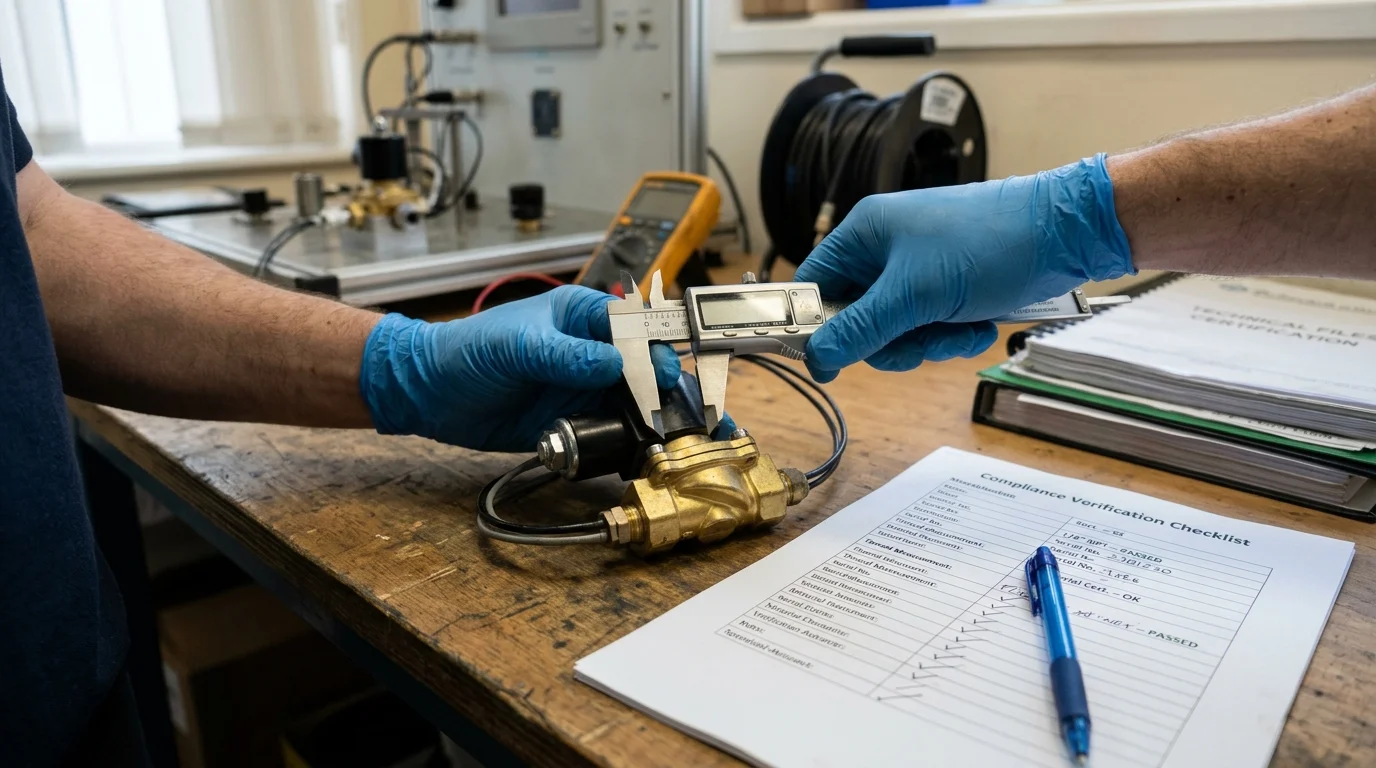
Under the new regulation, the burden of proof shifts heavily toward digital traceability and comprehensive risk documentation. Suppliers must overhaul their technical files to ensure they meet the expanded criteria well before the 2027 enforcement date, moving away from purely mechanical safety paradigms.
Documentation, Risk Assessment, and Traceability
Technical documentation must now integrate cybersecurity risk assessments alongside traditional mechanical and electrical hazard analyses. Suppliers of smart sensors and valves are expected to align with standards such as IEC 62443 to demonstrate that digital interfaces cannot be exploited to override safety relays or pressure relief protocols. Furthermore, source code documentation, testing logs, and software architecture diagrams for safety-related firmware must be retained and made available to market surveillance authorities for 10 years after the component is placed on the market.
The regulation also modernizes traceability and user manuals. Suppliers are now permitted to provide digital operating instructions and EU Declarations of Conformity, significantly reducing paper waste for high-volume component shipments. However, a strict mandate applies: if a customer requests a paper manual at the time of purchase, the supplier must provide it free of charge within six months. Components must also bear a permanent type, batch, or serial number, which may now be provided via a QR code if the component’s physical size is too small for traditional engraving.
Directive vs. Regulation Compliance Checklist
To effectively manage the transition, quality assurance teams should utilize a compliance matrix to identify gaps between their current 2006/42/EC documentation and the new 2023/1230 requirements.
| Compliance Area | Machinery Directive 2006/42/EC | Machinery Regulation 2023/1230 |
|---|---|---|
| Legal Framework | Required national transposition (varied by state) | Direct application across all 27 EU states |
| Documentation | Paper manuals mandatory | Digital allowed (Paper within 6 months if requested) |
| Software Updates | Not explicitly addressed | “Substantial Modification” triggers re-certification |
| Cybersecurity | Excluded from safety scope | Mandatory protection against corruption (e.g., IEC 62443) |
| Safety Components | Focused on physical/mechanical parts | Explicitly includes digital logic and AI/ML software |
How Buyers Should Assess Supplier Readiness
Original Equipment Manufacturers (OEMs) and Tier 1 integrators cannot wait until late 2026 to audit their supply chains. Replacing a non-compliant solenoid valve or sensor supplier involves extensive re-engineering, re-validation, and potentially halting production lines. Buyers must proactively implement rigorous assessment frameworks today.
Gap Analysis and Compliance Review Steps
The first phase of supplier assessment requires a deep dive into functional safety metrics. Buyers should audit the supplier’s ability to provide validated Mean Time to Dangerous Failure (MTTFd) and Diagnostic Coverage (DC) data for all safety-critical valves and sensors. Compliance with ISO 13849-1 (Performance Level) or IEC 61508 (Safety Integrity Level) remains foundational, but auditors must now verify that these metrics account for digital vulnerabilities.
Quantitative quality thresholds must also be scrutinized. For components designated as high-risk safety items under the new regulation, buyers should look for suppliers demonstrating a defect rate strictly below 50 Parts Per Million (PPM). Additionally, buyers must assess the supplier’s software lifecycle management. If a sensor requires periodic firmware updates, the supplier must demonstrate a closed-loop Change Control Board (CCB) process that evaluates every patch against the EU 2023/1230 substantial modification criteria.
Sourcing, Contract, and Risk Criteria
Sourcing contracts negotiated today for lifecycle programs extending past January 2027 must include specific regulatory compliance clauses. Purchase orders and Master Supply Agreements (MSAs) should mandate that the supplier assumes financial liability for redesigns or shipping delays caused by a failure to meet the new EU conformity standards.
Finally, buyers must account for potential bottlenecks at Notified Bodies as the 2027 enforcement deadline approaches, ensuring
Key Takeaways
- EU Machinery Regulation 2023/1230 applies from January 14, 2027, and will be directly enforceable across all 27 EU member states.
- Solenoid valves and sensors may require component-level conformity evidence when their failure could endanger persons or when they perform a defined safety function.
- Smart valves, programmable controllers, and IoT-enabled sensors must address cybersecurity risks as part of machinery safety compliance.
- Firmware updates that alter safety or performance parameters can qualify as substantial modifications and may require a new conformity assessment.
- Suppliers should update technical files now with risk assessments, software version control, traceability records, and cybersecurity documentation before the transition period ends.
- Procurement and engineering teams should verify supplier readiness early to avoid sourcing components that cannot be placed on the EU market after January 2027.
Frequently Asked Questions
When does EU Machinery Regulation 2023/1230 apply?
The regulation applies from January 14, 2027. Because it is an EU regulation rather than a directive, it will apply uniformly across all 27 EU member states without national transposition.
Do all solenoid valves fall under the new regulation?
No. A standard on/off valve may be outside scope if it has no safety function. A valve becomes relevant when its failure could endanger people, especially if it includes electronic logic, software, or safety-related control functions.
When are sensors and valves treated as safety components?
They may be treated as safety components when they perform a function intended to protect persons and their failure or malfunction creates a safety risk. In that case, suppliers may need component-level conformity documentation.
What new evidence should smart valve and sensor suppliers prepare?
Suppliers should prepare updated technical files, risk assessments, cybersecurity evidence, software version control records, traceability data, and EU Declaration of Conformity documentation where the component is in scope.
Why does cybersecurity matter under the Machinery Regulation?
The regulation recognizes that software vulnerabilities or malicious access can compromise physical safety. Smart sensors, programmable valve controllers, and connected manifolds must show protection against digital interference affecting safety functions.
Post time: Nov-04-2026