
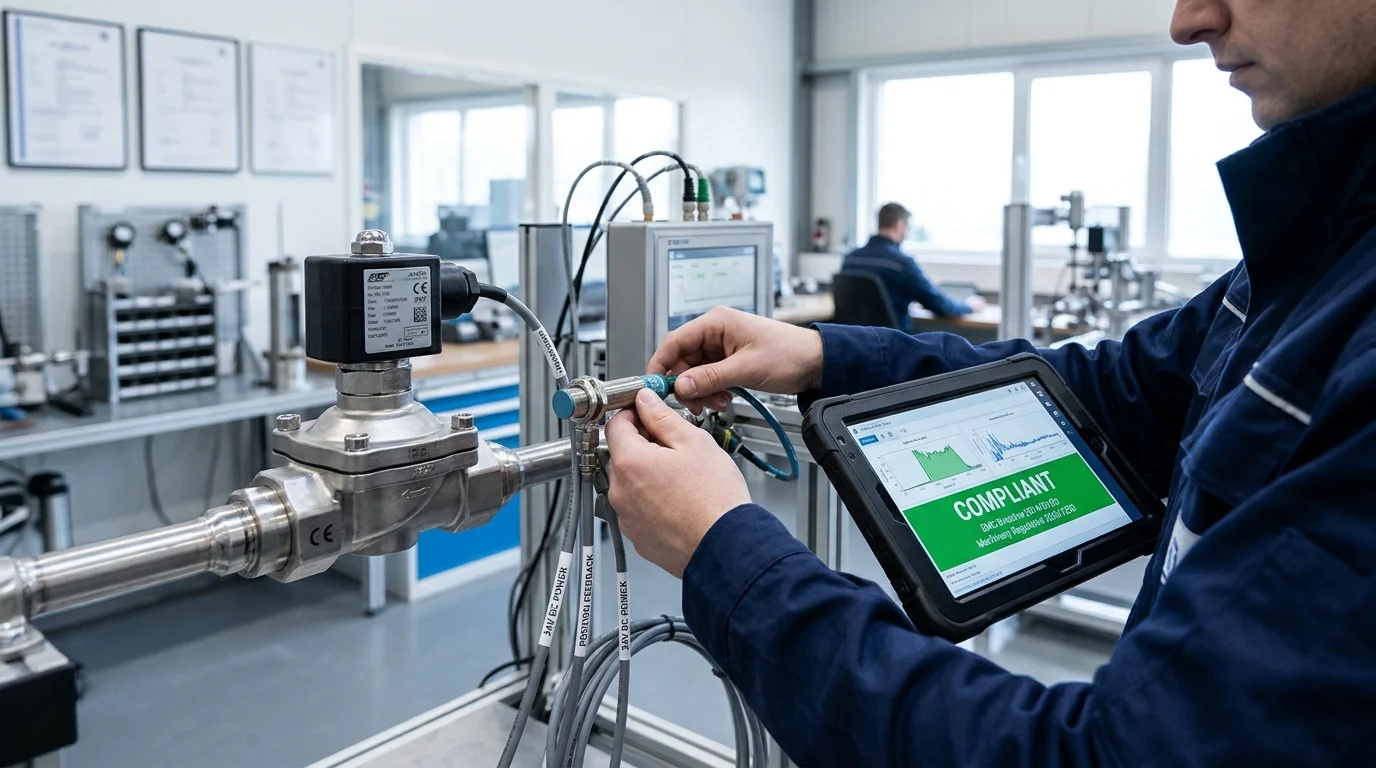
Europe’s machinery compliance rules are entering a more demanding phase, and component suppliers cannot afford to wait until 2027 to react. The new framework applies directly across EU member states and raises expectations for proof, traceability, cybersecurity, software safety, and integration documentation. For suppliers of solenoid valves, transmission valves, pressure controls, and industrial sensors, the key question is no longer whether a component works, but whether its compliance evidence can withstand OEM, customs, and market-surveillance scrutiny. This article explains the practical impact of the January 2027 deadline, how products may be classified, and what documentation suppliers should prepare to protect EU market access.
EU Machinery Regulation 2023/1230: 2027 Timeline and Scope
The transition from the Machinery Directive 2006/42/EC to the new EU Machinery Regulation (EU) 2023/1230 marks a fundamental shift in European industrial compliance. Published in June 2023, the regulation enforces a 42-month transition period, culminating in a mandatory application date of January 14, 2027. Unlike the previous directive, this regulation applies directly across all EU member states, eliminating national transposition variances. However, the practical certainty of the 2027 deadline is complicated by the uncertain status of harmonized standards and the potential for delayed delegated acts, which are still in development and could significantly impact implementation timelines for suppliers.
For manufacturers and integrators of industrial components, the regulatory burden is increasing significantly. The updated legal framework heavily targets digital integration, cybersecurity, and autonomous operations, requiring suppliers of critical automation components to upgrade their conformity assessment procedures well before the final enforcement date.
How Suppliers Should Define Machinery
Under the new framework, the definition of machinery and related products expands to explicitly include software that ensures safety functions, even when supplied independently. Solenoid valves and industrial sensors are typically classified as “partly completed machinery” or “safety components.” It is crucial to distinguish between the two: safety components (particularly those listed under the high-risk categories in Annex III) often require mandatory third-party conformity assessments, whereas partly completed machinery follows different integration and declaration protocols.
Furthermore, the inclusion of artificial intelligence and machine learning in smart sensors triggers new risk assessment obligations absent from the 2006 directive. For these specific connected devices, component manufacturers are expected to prove that their hardware and embedded logic cannot be corrupted in ways that compromise the safety of the overarching machinery. Simple, non-connected electro-pneumatic solenoid valves are unlikely to trigger these AI or machine learning risk assessment obligations.
Market Access Risks
For solenoid valves and sensors, failing to align with the 2027 requirements presents severe market access risks, including customs blockages, mandatory product recalls, and administrative fines. Because penalty structures are determined by individual member states, the exact financial exposure remains uncertain, though enforcement is expected to be rigorous. Industrial components integrated into heavy machinery face intense scrutiny from European market surveillance authorities.
For example, a heavy-duty transmission valve—such as the 0260130036 category used in heavy loaders—needs a valid Declaration of Incorporation (DoI) that satisfies the new regulation’s essential health and safety requirements (EHSRs) if the final machinery is to be sold in the EU after January 2027. Suppliers unable to provide this updated documentation risk being rapidly phased out of European supply chains as original equipment manufacturers (OEMs) mitigate their own compliance exposure.
Compliance Evidence for Solenoid Valve and Sensor Suppliers
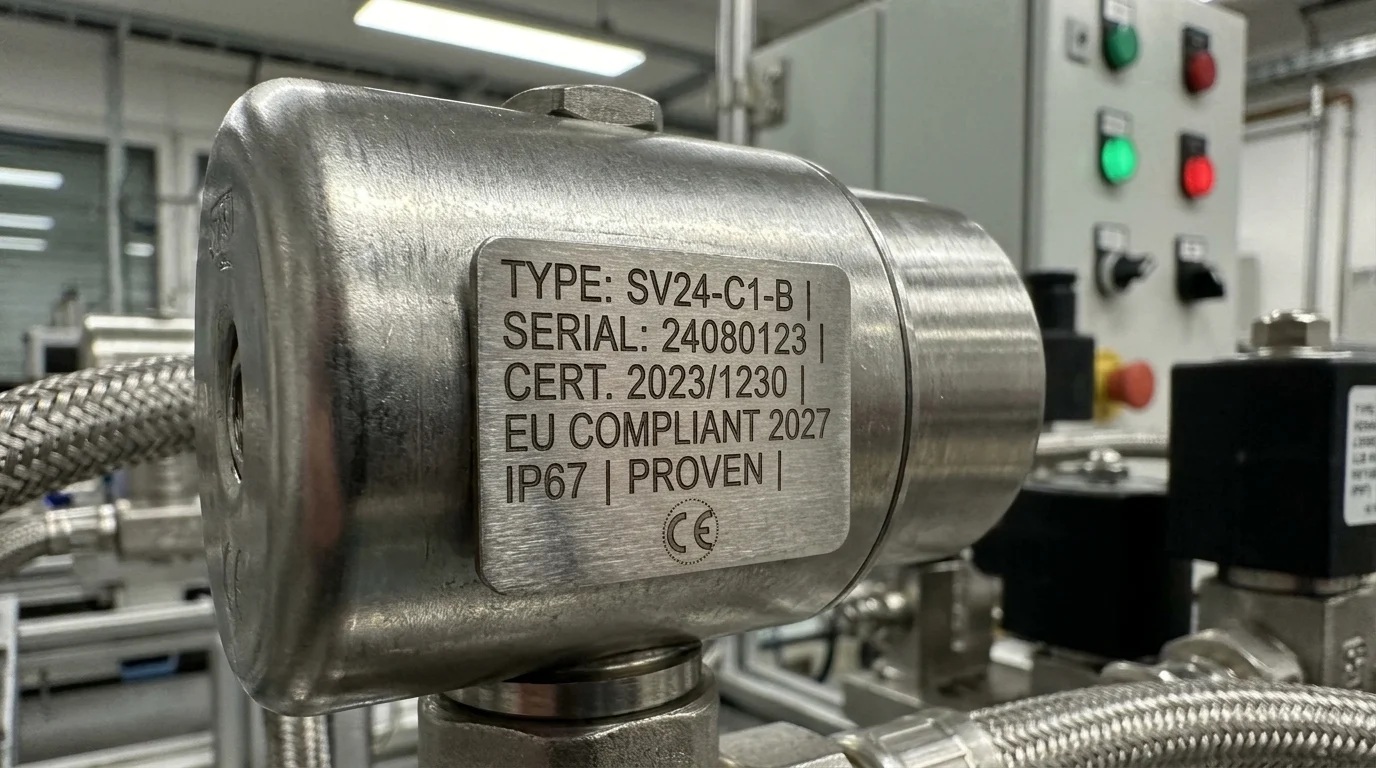
To maintain uninterrupted market access, component manufacturers are required to comprehensively overhaul their documentary evidence. The new regulation mandates that all technical files, risk assessments, and operating instructions be retained for a minimum of 10 years after the partly completed machinery or safety component is placed on the market.
A notable modernization is the introduction of digital-only operating instructions. Suppliers may now provide digital manuals, significantly altering how technical data is distributed to downstream integrators, provided these files remain accessible and downloadable throughout the entire statutory retention period.
Technical File, Risk Assessment, and Conformity Requirements
The technical file for partly completed machinery needs to comply with Part B of Annex IV of the regulation. This requires a comprehensive risk assessment that explicitly accounts for cyber threats and malicious third-party interference—a critical addition for IoT-enabled sensors and digitally actuated valves. Crucially, the regulation distinguishes between general IT cybersecurity and machinery safety-related control system security; suppliers must prove specifically that the component’s safety functions cannot be overridden or compromised via external data connections.
Even for traditional electro-pneumatic components, documentation standards are elevated. A standard 3/2-way, 24V DC poppet valve—such as the 35A-B00-DDAJ-1FM model type—requires exhaustive mean time to dangerous failure (MTTFd) data, B10d values for mechanical wear, and proof of electromagnetic compatibility (EMC). Suppliers are expected to demonstrate that these foundational components maintain safe operational states when integrated into a larger, more complex control system.
CE Evaluation Checklist for Buyers
Procurement and engineering teams should utilize a systematic approach to evaluate supplier compliance before the 2027 deadline. Standardized checklists ensure that no essential health and safety requirements are overlooked during supplier audits.
The following table outlines the critical shifts in CE evaluation criteria and the verification steps buyers need to execute:
| Compliance Element | 2023/1230 Requirement | Impact on Valve/Sensor Suppliers | Buyer Verification Step |
|---|---|---|---|
| Format of Instructions | Digital instructions permitted | Required to provide a permanent URL/QR code on the valve body or packaging. | Verify URL validity and ensure the supplier guarantees 10-year file hosting. |
| Cybersecurity | Mandatory for connected devices | Smart sensors require penetration testing and secure firmware update protocols. | Request penetration test summaries and firmware update logs for IoT sensors. |
| Substantial Modification | Clear legal definition provided | Upgrading a legacy valve’s software may trigger a new CE certification process. | Audit supplier change-management policies for software-driven components. |
| Third-Party Testing | Mandatory for Annex III high-risk items | Safety-critical sensors face potential certification bottlenecks at notified bodies. | Demand proof of early engagement with a Notified Body; industry reports suggest potential certification bottlenecks. |
Readiness Planning for Buyers and Suppliers
Given the complexity of the new essential health and safety requirements, waiting until late 2026 to address compliance is a high-risk strategy. Industry experts recommend that procurement and engineering departments target a completion date for all supplier compliance audits by Q3 2026.
Establishing a firm Q3 2026 deadline creates a critical 6-month buffer. This window allows procurement teams to source, test, and validate alternative components if incumbent suppliers fail to produce the necessary updated Declarations of Incorporation or Conformity.
Step-by-Step Compliance Review
A proactive compliance review begins with a comprehensive supply chain mapping exercise.
Key Takeaways
- Suppliers should treat January 14, 2027 as the hard compliance deadline for EU market access under Regulation 2023/1230.
- Solenoid valves and sensors must be correctly classified as partly completed machinery or safety components before choosing the conformity route.
- Smart sensors with software, connectivity, AI, or machine-learning functions require stronger cybersecurity and safety-risk evidence.
- Technical files, risk assessments, operating instructions, and declarations should be updated and retained for at least 10 years.
- A valid Declaration of Incorporation aligned with the new essential health and safety requirements will be critical for components used in EU-bound machinery.
- Suppliers that cannot provide 2027-ready documentation risk customs blocks, recalls, fines, and exclusion from OEM supply chains.
Frequently Asked Questions
When does the EU Machinery Regulation 2023/1230 become mandatory?
It becomes mandatory on January 14, 2027, after a 42-month transition period from its June 2023 publication.
Why does the new regulation matter for solenoid valve suppliers?
Suppliers may need updated technical files, risk assessments, instructions, and a Declaration of Incorporation to support EU market access after 2027.
Are solenoid valves considered machinery under the regulation?
They are usually treated as partly completed machinery or, in some cases, safety components, depending on their function and integration.
Do smart sensors face additional compliance obligations?
Yes. Sensors using software, AI, machine learning, or connectivity may need stronger evidence that digital functions cannot compromise machinery safety.
What happens if documentation is not updated before 2027?
Products may face customs delays, market surveillance action, recalls, fines, or removal from European OEM supply chains.
Post time: Nov-03-2026