
If the ejector bank on your rice color sorter has a failed position, here is the short version: the 0071372-00 is a threaded-cartridge, high-frequency pneumatic valve that one technician can replace in about 20 minutes with a wrench and a clean cloth — no machine modification, no recalibration, provided the replacement is a true 1:1 equivalent that responds within the 10-millisecond class the sorter controller assumes. I handle export for Flying Bull, the factory that machines this valve, and most of the rice-mill inquiries I receive are not really about the valve — they are about the harvest deadline behind it. So this guide is written the way I answer those emails: identify the valve correctly, swap it fast, verify the line, and make sure you are not back here mid-harvest next year.
- The 0071372-00 (also written 007137200 or TS 400-5000-0071372-00) is the high-frequency ejector valve on many rice color sorters, built on the MAC 400-5000 platform.
- Replacement is a 20-minute threaded-cartridge swap — stop, vent air, unplug, unthread, install, test-fire — with no recalibration needed for a true 1:1 equivalent.
- Rice husk dust and humid air are why these valves die early in mills; fix the filtration or the new valve is on the same clock.
- Keep a small spare stock through harvest; we ship single valves with no minimum order, dispatching within one week of payment.
- After installation, always run the manual eject test plus a short production check before returning to full throughput.
Where This Valve Sits in Your Sorter — and Why Does It Fail Here First?
Inside a rice color sorter, the camera sees every grain, the controller decides which ones are rejects, and the ejector bank — a row of high-frequency solenoid valves — physically blows those grains out of the stream. The 0071372-00 is the valve in that row. It is, by a wide margin, the hardest-working component in the machine: where the camera works in light and the controller works in electrons, this valve works in moving steel, actuating at rates that add up to hundreds of millions of cycles over its service life.
That duty alone would make it a wear item. The rice mill environment makes it a fast-wearing one. Husk dust is fine and abrasive, mill air is often humid, and harvest season means long, uninterrupted runs at full load — exactly the conditions that punish a high-frequency pneumatic valve. I want to be honest about the context here, because it matters for how you read the rest of this guide: rice post-harvest processing is a well-studied chain, and organizations from the IRRI Rice Knowledge Bank to the Food and Agriculture Organization document how much value is won or lost in milling and sorting. A sorter that mis-ejects because of a weak valve is not a nuisance — it is good grain in the reject stream or rejects in your good stream, every minute the line runs.
Before You Order: Which Valve Is Actually on Your Machine?
The first question I ask every mill that writes to us is also the simplest: what does the label say? The 0071372-00 appears in the wild under several number formats, and I have seen mills order the wrong part purely because their manual used one spelling and the supplier’s listing used another. Check the valve body, the machine’s parts manual, or the ejector bank documentation for any of these:
- 0071372-00 — the hyphenated short form, most common on service documents.
- 007137200 — the same number with punctuation stripped.
- 007-1372-00 — an older regrouped hyphenation.
- TS 400-5000-0071372-00 — the full series-qualified string; if your machine specifies the MAC 400-5000 series ejector, this is the valve family you are in.
Two more identification notes from my inbox. First, do not identify by appearance alone: several unrelated pneumatic valves share a similar silhouette, and I have seen confident visual matches turn out to be entirely different valves once the label was found. Second, if the bank contains mixed brands — common on machines that have been serviced by multiple workshops over the years — identify each position individually rather than assuming the whole row is uniform.
If none of these strings appear anywhere, send us a photo of the valve and the machine nameplate — I would rather spend a day confirming the match than have you receive a valve that does not thread in. When the match is confirmed, the replacement on our side is the Flying Bull 0071372-00: a high-strength aluminum alloy body with an alloy steel bore lining, machined 1:1 to the original geometry, with actuation response inside 10 milliseconds.
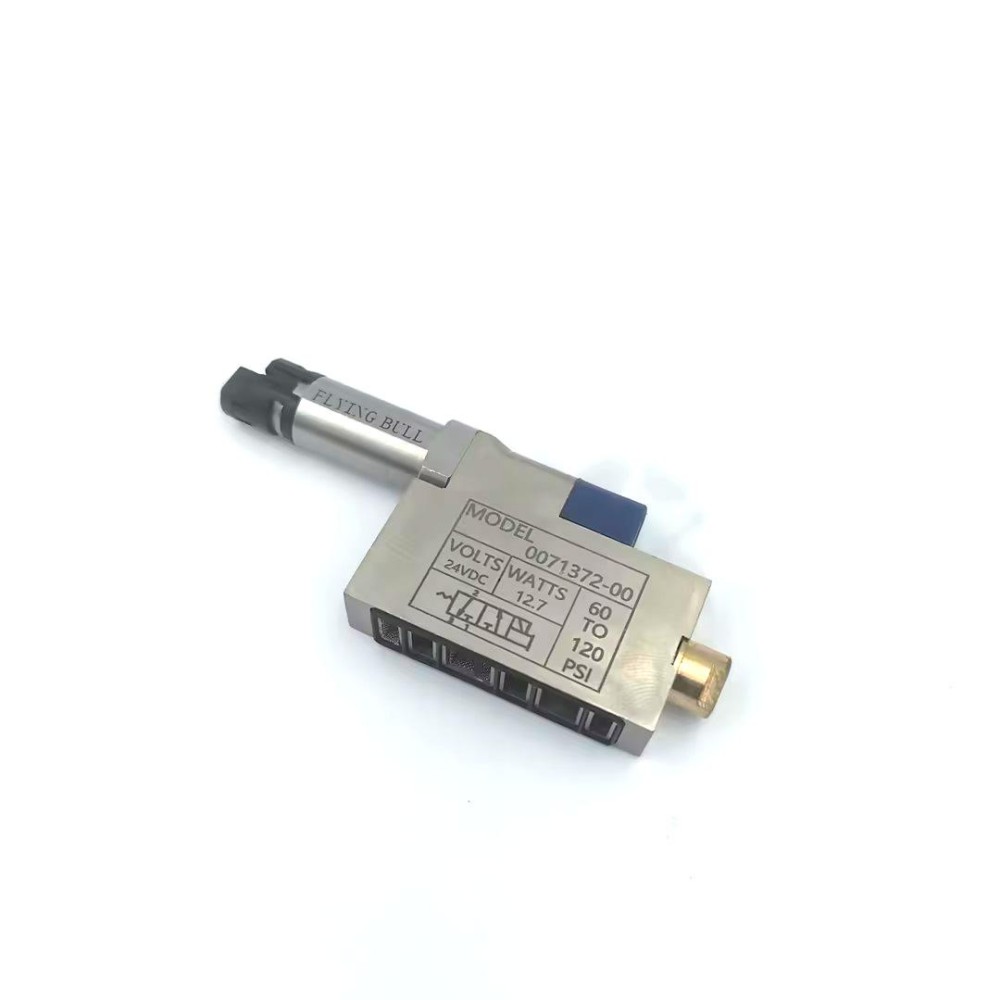
| Specification | What it is on this valve | Why it matters in a rice mill |
|---|---|---|
| Response time | Actuation within 10 ms | The controller’s ejection timing assumes this class; slower valves mis-eject at full belt speed |
| Cycle-life design | Fatigue-rated for hundreds of millions of cycles | Harvest runs are long and uninterrupted; the valve must survive the season |
| Bore lining | Alloy steel lining | The lining is the life-limiting surface under husk-dust exposure |
| Body construction | High-strength aluminum alloy, threaded cartridge | Direct 1:1 swap into the original manifold position |
| Electrical interface | Machine-matched connector | Plugs into the existing harness without adapters or rewiring |
The 20-Minute Swap: How Does the Replacement Actually Go?
I have walked enough mill technicians through this swap to know it is genuinely a one-wrench job — the difficulty is never mechanical, it is discipline about pressure and cleanliness. Here is the procedure exactly as I send it:
- Stop the machine and isolate the air. Switch off the ejector bank supply and vent the line. I insist on this in every instruction I send: never unthread a cartridge under residual pressure.
- Disconnect the electrical connector. Pull the plug by its housing, never by the cable — a yanked cable creates the next fault while you fix this one.
- Unthread the failed valve. Turn it out with the correct wrench, and keep husk dust away from the open port while it is exposed. I keep a clean cloth over the port during the swap; dust blown into an open port is the quiet start of the next failure.
- Install the replacement. Thread the new valve in by hand first — cross-threading is the only real way to botch this job — then torque to the machine builder’s specification and reconnect the plug.
- Test-fire before production. Restore air, run the controller’s manual eject function on that channel, and listen for one crisp actuation. Then run product.
After the Swap: How Do You Confirm the Line Is Truly Back?
A valve that fires is not the same as a line that sorts. Before I would call any replacement finished, I want two confirmations on the record:
The manual eject test. Fire the channel from the service menu and listen: one clean, crisp click, no chatter, no hesitation. This confirms the electrical and mechanical actuation chain.
A short production check. Run product at normal belt speed and watch that position’s ejection. What you are looking for is accuracy at speed, not actuation at rest. A valve that responds late will mis-eject only at full throughput — the single most misdiagnosed pattern I see in mill support cases, Because every bench test passes and the mill still loses good grain.
A note on test duration from our own support cases: run the production check long enough to matter. I ask mills for at least one full product run through the affected channel, because intermittent faults — a marginal connector, a supply that sags only when the whole bank fires — rarely show themselves in a thirty-second look.
If the new valve mis-ejects at speed while a known-good valve in the same position does not, the replacement’s response is off-class and it should come back to us. If mis-ejection stays with the position regardless of which valve is installed, the fault is upstream — driver channel, harness, or local air feed — and a second new valve will not fix it.
Why Do Valves Keep Dying in Your Mill? The Air Question
If you are replacing ejector valves more often than the machine builder’s maintenance schedule suggests, I will say plainly what I say to every mill in that situation: the valves are probably not the problem. The air is.
Rice husk dust plus humidity is a grinding paste at the microscopic scale of a valve’s spool-to-bore clearance. Every unfiltered breath the ejector bank takes wears the bore lining a little, and once the lining wears, internal leakage climbs, response slows, and the valve dies young — whatever brand it was. In our support records, the mills with the longest valve life are not the ones buying the most expensive valves; they are the ones draining filters on schedule and keeping air dry. Our article on common solenoid valve failures and their prevention goes deeper on the failure patterns, and the pneumatic fittings and air-line components on the same machine deserve the same inspection habit as the valves themselves.
When Should You Order? The Seasonal Timing Mistake I See Every Year
There is a pattern in our order book that I wish I could change: rice-mill valve orders spike during harvest, not before it. I understand the logic — budgets get approved when pain is visible — but the logistics work against you. The weeks when your sorter is running longest are the same weeks when every other mill in your region is discovering its own worn valves, when freight lanes are fullest, and when your line has the least slack for a planned stop.
My advice, stated as plainly as I can: do the valve health check in the off-season. Pull the manual eject test position by position in the quiet months, count the weak channels, and order against that count while your line can spare an hour. The mills I see sail through harvest are never the lucky ones — they are the ones who ordered in the slow season. And because a single sample valve from us costs you nothing but a few days of freight, the off-season is also the right time to test-fit our equivalent on one position before the season forces the decision on you.
Stocking for Harvest: How Many Spares Does a Mill Actually Need?
Every mill manager I work with asks this in August, and my answer is shaped by one fact of our business: we hold the 0071372-00 in production stock and dispatch within a week of payment, with no minimum order — a single valve is a normal order for us. That changes the arithmetic. You do not need to guess the whole season’s failures in advance and park capital against them; you need enough on the shelf to cover the highest-risk positions through the peak weeks, then replenish as you use them.
For a single-sorter mill, that typically means a small, deliberate shelf stock rather than zero and rather than a crate. For multi-line mills, a shared spare pool across lines covers the fleet economically, since failures distribute unevenly across positions anyway. What I advise against — from experience, not theory — is the zero-stock position: a failed valve during harvest with a two-week replacement wait is the most expensive version of this purchase there is.
Sourcing the Valve: What Do We Actually Offer a Mill?
Closing with the plain facts about us, since you will want them before ordering. Flying Bull is an ISO 9001-certified factory in Ningbo, China; the 0071372-00 is machined in-house, body and lining, on our own equipment. We ship worldwide — the US, Canada, the EU, the UK, Mexico, Indonesia, and Russia are our regular destinations — from stock, with dispatch within one week of payment and no minimum order quantity. The valve is an aftermarket replacement, not a genuine MAC part, and I state that plainly in every transaction; what you get is 1:1 geometry and interface, 10-millisecond-class response, and an alloy steel lining, at a purchase cost well below the OEM channel. For mills that want to verify before committing, a single sample valve is the normal way we start.
Replacement Readiness Checklist
Questions Rice Mill Engineers Ask Me About the 0071372-00
How do I know my rice sorter uses the 0071372-00 valve?
Check the valve body or the machine’s parts manual for 0071372-00, 007137200, 007-1372-00, or the full TS 400-5000-0071372-00 string. If the machine specifies the MAC 400-5000 series ejector, this is the replacement family. If nothing matches, send us a photo and we will confirm before you order.
Why do ejector valves fail faster in rice mills than in other plants?
Husk dust and humid air. Dust gums the spool and scores the bore lining; moisture accelerates both. With proper filtration this valve class is designed for hundreds of millions of cycles — without it, life drops to a fraction of that.
Can I replace the valve without stopping the whole sorter?
No — always stop the machine and isolate and vent the air first. The swap itself takes about 20 minutes including verification, so a planned stop costs little production.
Is the Flying Bull 0071372-00 a genuine MAC valve?
No, and we say so plainly. It is an aftermarket replacement machined 1:1 to the MAC 400-5000 platform in our own ISO 9001 factory, installing in the original position and responding within 10 milliseconds like the original.
How many spare valves should a rice mill keep?
Enough to cover the highest-risk positions through harvest — for most single-sorter mills, a small shelf stock rather than zero. We ship single pieces with no minimum order within a week of payment, so you can replenish as valves are used instead of over-stocking.
Do I need to recalibrate the sorter after replacing an ejector valve?
Usually not. A true 1:1 replacement with the same response class restores the timing the controller assumes. Always run the manual eject test and a short production check before returning to full throughput.
Sorter down and harvest running? We stock the 0071372-00 and ship single valves worldwide — no minimum order, dispatch within one week of payment.
JY King — Export Sales Director at Flying Bull (Ningbo) Electronic Technology Co., Ltd. 20+ years in solenoid valve, hydraulic cartridge valve & pressure sensor manufacturing, and automotive and engineering machinery parts export. Focus areas: OEM/ODM custom solenoid & sensor solutions, custom mold development, OE matching, global sourcing, and international trade compliance. Connect on Facebook.
Post time: Nov-09-2026