
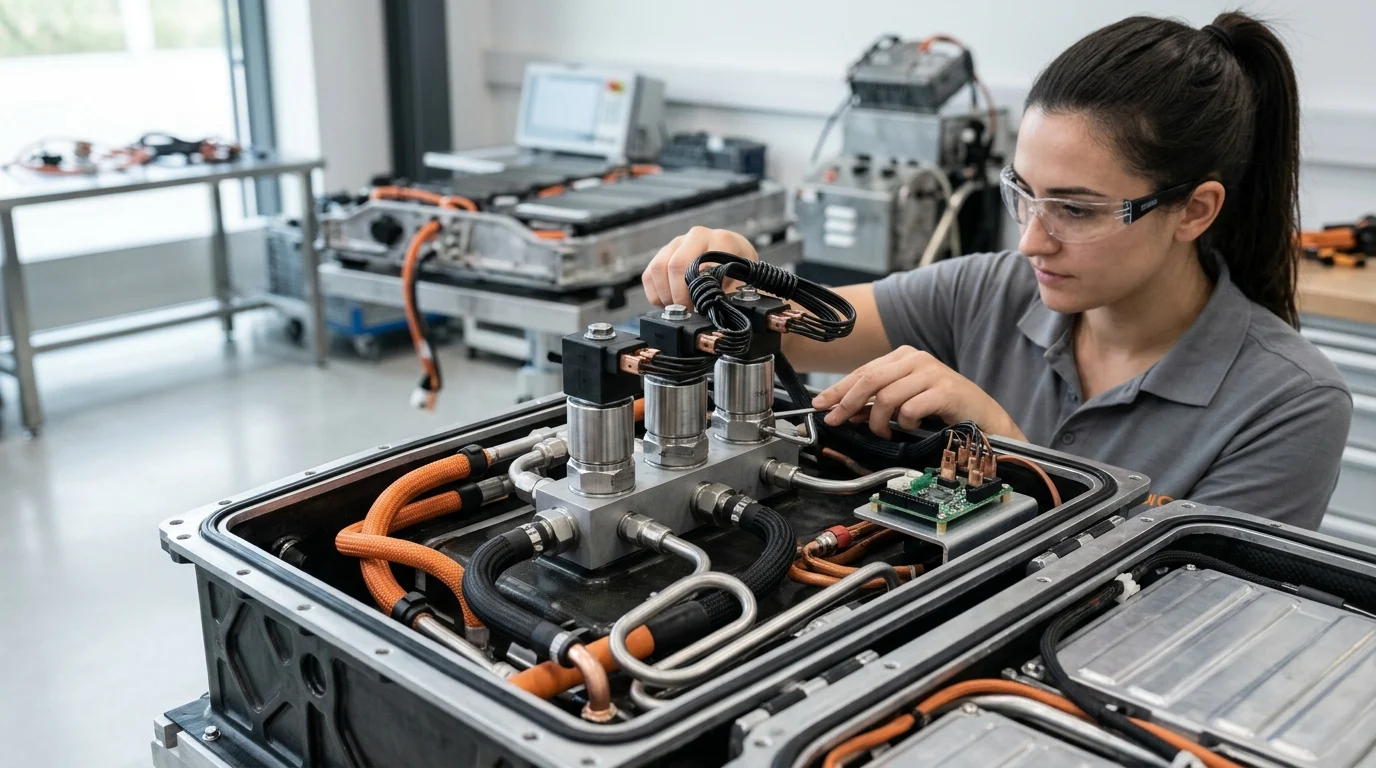
As EV batteries become denser, charge faster, and operate across wider climates, thermal control has become a core efficiency challenge rather than a supporting subsystem. Solenoid valves play a critical role by translating electronic commands into rapid coolant-flow decisions, helping battery thermal management systems direct water-glycol mixtures or dielectric fluids exactly where they are needed. Their value is especially clear during DC fast charging, cold-weather preconditioning, and multi-zone pack cooling, where small delays or inefficient routing can affect range, degradation, and safety. This article examines how these valves improve thermal stability, reduce parasitic energy losses, and what engineers must consider when specifying them for modern EV architectures.
How Solenoid Valves Improve EV Battery Thermal Efficiency
The transition from passive cooling to active liquid thermal management has fundamentally reshaped electric vehicle (EV) battery architectures. As automakers push for higher energy densities and faster charging capabilities, maintaining precise thermal equilibrium is no longer optional. While engineers can choose from several actuation options—including motorized ball valves and rotary valves—solenoid valves serve as highly effective electromechanical actuators in many of these systems, dictating the flow of liquid coolants to mitigate thermal runaway risks and optimize cell performance.
By integrating advanced solenoid technology, Battery Thermal Management Systems (BTMS) can dynamically route water-glycol mixtures or dielectric fluids across battery modules. This active flow control minimizes parasitic energy losses, allowing a greater percentage of battery capacity to be allocated to vehicle propulsion.
Role of Solenoid Valves in Battery Cooling
Solenoid valves function as the primary control gates within the BTMS, converting electrical control signals into mechanical actuation. When the vehicle’s central control unit detects a temperature variance, it energizes the solenoid coil, generating a magnetic field that lifts the internal armature to open or close the valve. This rapid actuation—often occurring in under 50 milliseconds—ensures swift coolant delivery to localized hotspots within the battery pack. However, system designers must also account for solenoid-specific limitations, such as potential water hammer effects from sudden closures or specific pressure constraints compared to slower motorized alternatives.
Furthermore, modern EV architectures utilize multi-zone cooling circuits. Solenoid valves enable the isolation of specific battery modules, allowing the BTMS to direct flow only where it is actively required. This targeted approach reduces the operational load on the primary coolant pump, conserving energy and extending the overall range of the vehicle.
Where Solenoid Valves Improve Thermal Stability
Thermal stability directly correlates with battery degradation rates and charge acceptance. Lithium-ion cells operate most efficiently within a narrow optimal temperature band, typically between 15°C and 35°C. During DC fast charging (DCFC), internal resistance generates massive spikes in heat. While the actual thermal response time of the coolant loop takes longer to manifest, solenoid valves actuate in milliseconds to begin routing maximum coolant flow to the battery pack. This rapid response helps prevent the cells from exceeding critical temperature thresholds that accelerate lithium plating and capacity fade.
In cold-weather environments, the operational paradigm shifts. In one common architectural design—though specific heat-pump and Positive Temperature Coefficient (PTC) strategies vary by OEM—the valves redirect flow from the radiator to a high-voltage heater, warming the battery to its optimal operating window before charging begins. This dual-action capability—switching seamlessly between cooling and heating loops—is what makes solenoid valves indispensable for preserving thermal stability across extreme environmental gradients.
Key Solenoid Valve Specifications for EV Battery Systems
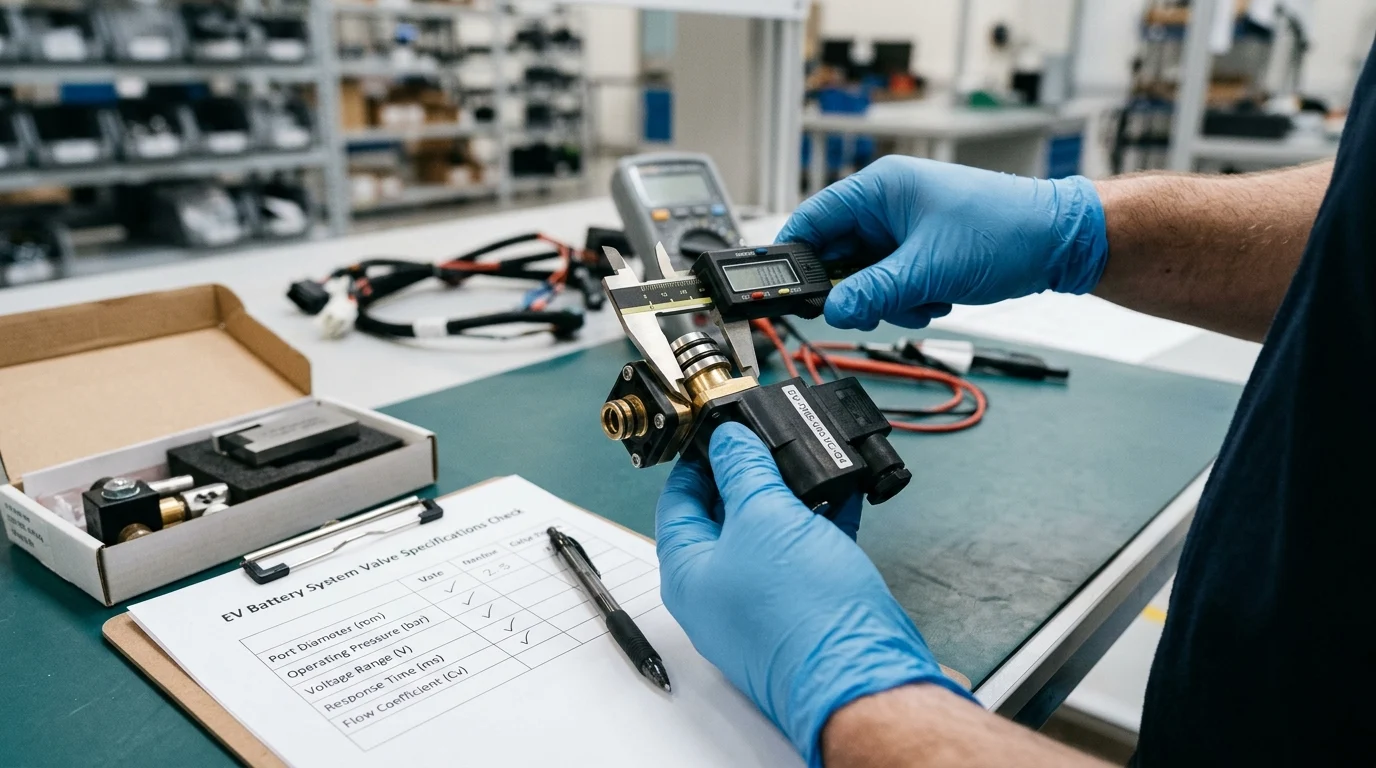
Engineering a highly efficient BTMS requires specifying solenoid valves that align with the vehicle’s fluid dynamics and thermal loads. System architects must evaluate valve types and performance metrics to ensure seamless integration with the broader thermal circuit.
Comparing Two-Way, Three-Way, and Proportional Valves
EV thermal management systems predominantly utilize three configurations of solenoid valves, each serving a distinct hydraulic function. Two-way valves provide fundamental on/off isolation, three-way valves manage flow diversion between parallel circuits, and proportional valves offer continuous, variable flow control based on PWM (pulse-width modulation) signals.
| Valve Configuration | Primary BTMS Function | Typical Pressure Drop (ΔP) | Relative Cost Index |
|---|---|---|---|
| Two-Way (2/2) | Circuit isolation / localized cooling | < 0.2 bar at 15 L/min | Low |
| Three-Way (3/2) | Coolant diversion (e.g., bypass loop) | 0.3 – 0.5 bar at 15 L/min | Medium |
| Proportional | Dynamic flow regulation | Variable (0.1 – 0.8 bar) | High |
Performance Criteria for Valve Selection
Selecting the appropriate solenoid valve extends beyond basic flow configurations. Engineers must scrutinize burst pressure ratings, as automotive coolant loops frequently experience pressure spikes; a minimum burst pressure of 30 bar is often cited as an illustrative benchmark in representative heavy-duty EV specifications. Internal leakage rates are equally critical, with high-performance examples requiring a leakage rate of less than 2 mL/min at 3 bar of differential pressure to prevent unintended thermal bleed between isolated zones.
Power consumption is another primary constraint. Because the valve coil draws energy directly from the vehicle’s low-voltage system, minimizing parasitic draw is essential. Advanced latching solenoids or low-wattage coils that consume less than 10 watts during the holding phase are heavily favored. Furthermore, components must meet stringent environmental protection standards, typically IP67 or IP69K, to survive exposure to road debris, water ingress, and powertrain bay contaminants.
How OEMs and Tier Suppliers Should Select Solenoid Valves
For Tier 1 suppliers and Original Equipment Manufacturers (OEMs), procuring solenoid valves involves rigorous supplier qualification and component validation. The sourcing strategy must balance the immediate demands of production scale with long-term reliability mandates.
Validation Steps That Reduce Sourcing Risk
Sourcing risk is mitigated through comprehensive validation testing that mirrors the harsh realities of the automotive environment. Suppliers must adhere to IATF 16949 quality management standards, and the electronic components of the valve should meet AEC-Q200 stress test qualifications. Thermal shock and cycling tests are mandatory, typically requiring the valve to maintain structural and operational integrity through 1,000 cycles transitioning from -40°C to +85°C.
Mechanical resilience is equally scrutinized. Valves are subjected to intense multi-axis vibration testing in accordance with ISO 16750-3 standards to simulate years of road-induced resonance. OEMs must demand complete PPAP (Production Part Approval Process) documentation from valve manufacturers to verify that these extreme validation thresholds are consistently met during high-volume manufacturing.
Balancing Efficiency, Cost, and Reliability
The final selection phase requires a calculated compromise between component efficiency, unit cost, and lifecycle reliability. To reduce vehicle weight, OEMs are increasingly transitioning from traditional brass or stainless-steel valve bodies to advanced engineered polymers like PPS (Polyphenylene Sulfide).
Key Takeaways
- Use solenoid valves to enable millisecond-level coolant routing, with many designs actuating in under 50 milliseconds to address battery hotspots quickly.
- Design battery thermal circuits to maintain lithium-ion cells near the 15°C to 35°C operating window for better charge acceptance and slower degradation.
- Apply multi-zone cooling with solenoid valves to isolate specific battery modules, reduce unnecessary pump load, and conserve energy for vehicle range.
- Specify valve materials and configurations around the coolant type, whether the system uses water-glycol mixtures or dielectric fluids.
- Account for solenoid-specific constraints such as water hammer, pressure limits, and abrupt closure behavior when integrating valves into EV cooling loops.
- Use valve-controlled flow switching to support both high-load cooling during DC fast charging and battery preheating in cold-weather operation.
Frequently Asked Questions
Why are solenoid valves used in EV battery thermal management systems?
Solenoid valves convert electrical control signals into fast mechanical actuation, allowing coolant to be routed precisely to battery modules that need heating or cooling.
How fast can solenoid valves respond to battery temperature changes?
Many solenoid valves can actuate in under 50 milliseconds, helping the thermal system begin directing coolant toward hotspots quickly during driving or fast charging.
What temperature range is ideal for lithium-ion EV batteries?
Lithium-ion cells typically perform best between 15°C and 35°C, making precise coolant routing important for efficiency, charge acceptance, and battery longevity.
How do solenoid valves help during DC fast charging?
During DC fast charging, battery heat rises rapidly. Solenoid valves help route maximum coolant flow to the pack early, reducing the risk of overheating, lithium plating, and capacity fade.
Can solenoid valves support both battery cooling and heating?
Yes. Depending on system design, they can switch flow between cooling loops, radiators, high-voltage heaters, or other circuits to keep the battery in its optimal operating window.
Post time: Aug-15-2026