
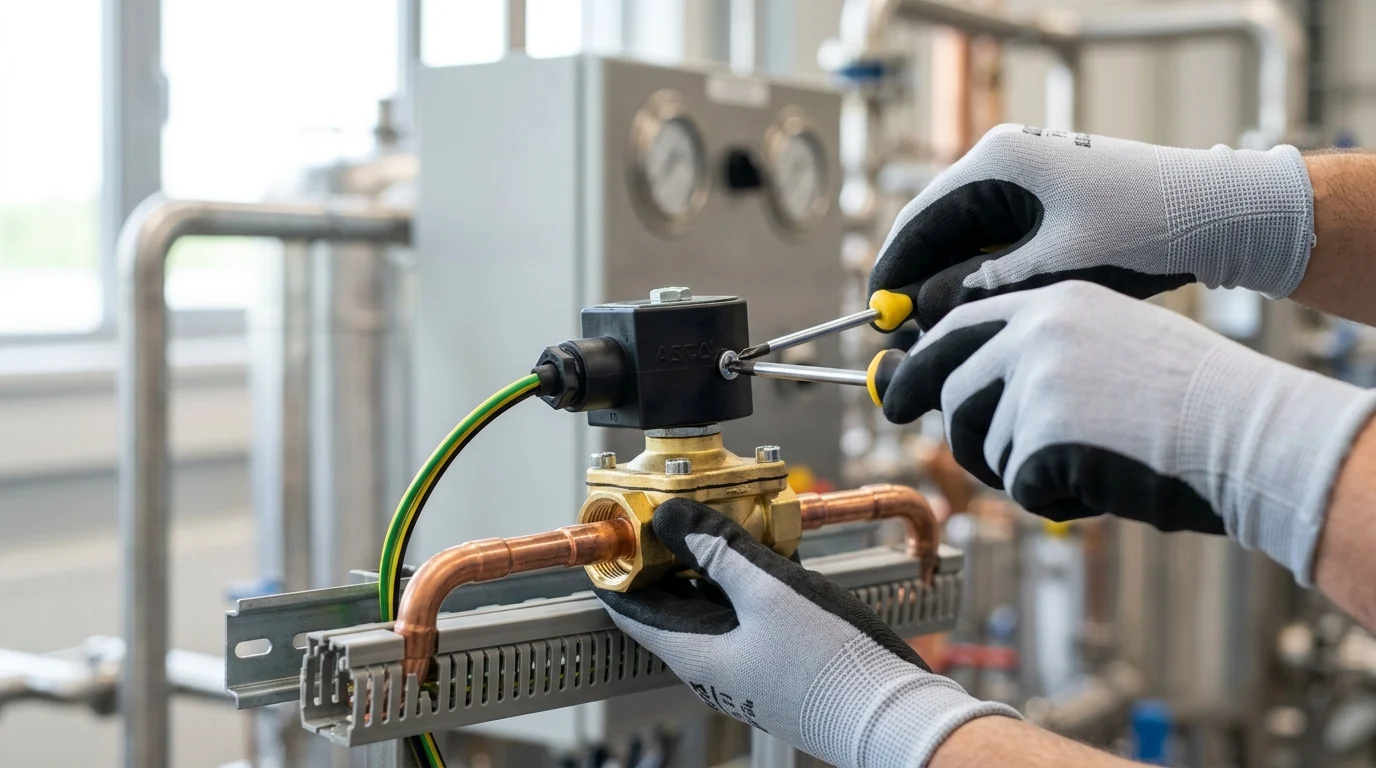
A single sticking solenoid valve can halt a production line, disrupt process stability, and turn a small electromechanical fault into a six-figure downtime event. In continuous industrial operations, where some estimates place unplanned downtime above $250,000 per hour, preventive maintenance cannot be limited to occasional cleaning or reactive coil replacement. It must account for valve criticality, duty cycle, media compatibility, voltage quality, temperature, and contamination risk. This guide explains how to build a practical maintenance schedule that targets the real causes of valve failure—from AC coil overheating and seal degradation to clogged pilot orifices—so teams can extend service life, reduce emergency repairs, and focus effort where reliability matters most.
Preventing Unplanned Downtime
In modern industrial fluid systems, the reliability of solenoid valves directly dictates overall system availability. Unplanned downtime in continuous process industries can incur costs that some industry estimates place at over $250,000 per hour, making the proactive management of these electromechanical components a critical priority. Establishing a rigorous preventive maintenance schedule requires a deep understanding of valve mechanics, operational stressors, and expected wear patterns.
To optimize resources, facilities should adopt a tiered criticality framework—categorizing valves as critical, essential, or non-critical. While critical valves demand rigorous monitoring, run-to-failure or minimal intervention may be economically optimal for redundant or low-impact, non-critical valves.
Common Solenoid Valve Failure Modes
Electromechanical and mechanical anomalies constitute the primary failure modes for solenoid valves. Coil burnout frequently occurs when an AC solenoid armature fails to seat completely, causing the inrush current—often five to ten times the holding current—to persist and generate excessive thermal loads. Unlike AC coils, DC coils lack an inrush current and typically fail under different stressors, such as sustained overvoltage or high ambient temperatures, rather than incomplete armature seating. For coils utilizing Class F insulation, sustained operating temperatures above 155°C will rapidly degrade the dielectric materials, leading to catastrophic short circuits. On the mechanical side, elastomer degradation manifests as swelling or embrittlement, typically resulting from chemical incompatibility or thermal cycling. Furthermore, particulate accumulation within the pilot orifice or armature tube can impede the plunger’s travel, causing erratic switching or complete valve lock-up.
Criticality, Duty Cycle, Media, and Environment Factors
A maintenance schedule must be tailored to the specific operational context of each valve. Duty cycle is a major determinant; valves subjected to high-frequency cycling, such as those exceeding 100 cycles per minute, experience accelerated mechanical wear on the armature spring and dampening rings, necessitating more frequent rebuilds. Media characteristics also dictate maintenance intervals. Fluids with viscosities exceeding 50 cSt typically dictate specific orifice sizing, increased actuation force, or localized heating. Meanwhile, abrasive particulates or aggressive chemicals demand specialized sealing materials like PTFE or FKM, alongside aggressive filtration protocols. Environmental factors, such as ambient temperatures fluctuating outside the typical -10°C to 50°C operating band (though ranges vary by manufacturer and application), or exposure to corrosive marine atmospheres, require engineers to adjust inspection frequencies to mitigate external oxidation and ingress protection (IP) seal failures.
Solenoid Valve Preventive Maintenance Schedule
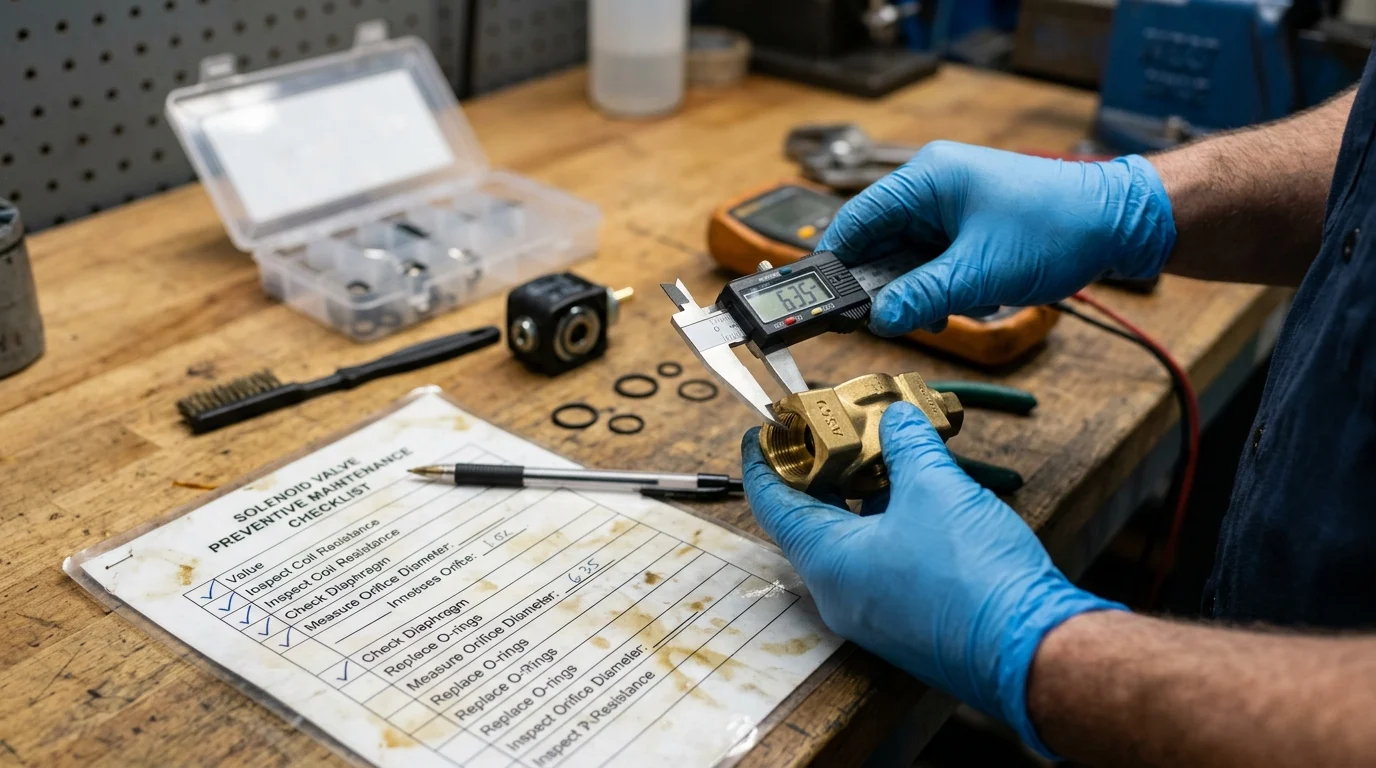
Translating failure analysis into an actionable preventive maintenance schedule requires structured intervals and precise diagnostic criteria. An optimized schedule minimizes intrusive maintenance while maximizing component longevity, relying on both empirical data and standardized testing protocols.
Inspection, Cleaning, and Testing Tasks
Before initiating any maintenance, technicians must strictly adhere to safety prerequisites, including lockout/tagout (LOTO) procedures, complete system de-energization, and safe pressure relief. Routine maintenance tasks must encompass electrical, mechanical, and fluidic diagnostics. Electrical inspections should verify that the supply voltage remains strictly within ±10% of the coil’s nominal rating to prevent undervoltage chatter or overvoltage overheating. Technicians must routinely measure coil resistance with a multimeter, comparing baseline ohmic values against current readings to detect early-stage insulation breakdown. Mechanical tasks involve disassembling the valve body to inspect the diaphragm, O-rings, and armature for scoring or permanent set. The following table serves as an illustrative sample; actual intervals must always align with OEM recommendations and specific operating conditions.
| Maintenance Interval | Target Component | Diagnostic Task / Action |
|---|---|---|
| Monthly (Critical) | Electrical Coil | Measure voltage supply and current draw; inspect for thermal discoloration. |
| Quarterly (Essential) | Valve Body & Ports | Check for external leaks; verify actuation response time (requires an oscilloscope/high-speed logger, or substitute with a basic operational switching check for field crews). |
| Every six months (Essential) | Internal Components | Flush valve body; clean pilot orifices; inspect plunger and core tube for wear. |
| Annually (Non-Critical / All) | Elastomers & Seals | Proactively replace dynamic O-rings and diaphragms using OEM rebuild kits. |
Time-Based vs. Condition-Based Maintenance
Historically, facility managers relied on Time-Based Maintenance (TBM), replacing components according to manufacturer-specified Mean Time Between Failures (MTBF)—a general industry benchmark often projected between 1 million and 20 million cycles depending on the valve architecture. However, modern process control increasingly favors Condition-Based Maintenance (CBM). By implementing non-destructive testing such as infrared thermography, technicians can identify localized coil hotspots before a hard failure occurs. Acoustic emission sensors can detect internal fluid bypass caused by micro-abrasions on the valve seat. Furthermore, continuous monitoring of the solenoid’s current signature can reveal slight deviations in the actuation stroke profile, providing an early warning of armature friction or impending mechanical binding.
Despite its advantages, CBM requires significant capital investment, precise sensor calibration, and specialized analytical expertise. Consequently, condition-based monitoring via current signature analysis is typically cost-effective only for critical automated systems, while traditional time-based maintenance remains the practical norm for most general-purpose solenoid applications.
Repair, Rebuild, or Replace Decisions
Even with rigorous preventive maintenance, components inevitably reach the end of their operational lifecycle. Plant engineers must establish clear, economically sound criteria for determining whether a malfunctioning solenoid valve should be repaired in situ, comprehensively rebuilt, or entirely replaced. It is important to note that many small or low-cost direct-acting solenoid valves are sealed, non-serviceable units intended strictly for replacement rather than rebuilding.
Cost, Compliance, and Spare Parts Considerations
The decision matrix for repair versus replacement hinges on the Total Cost of Ownership (TCO) and the widely adopted industry “50% rule of thumb”: if the cost of OEM rebuild kits and labor exceeds 50% of a new valve’s price, replacement is generally considered the superior economic choice. Supply chain logistics also play a pivotal role; while a standard rebuild kit might be stocked locally, specialized high-pressure or exotic-alloy replacement valves can carry lead times of 8 to 12 weeks, frequently forcing a rebuild decision to bridge the operational gap.
Compliance introduces another strict requirement.
Key Takeaways
- Classify each solenoid valve as critical, essential, or non-critical so maintenance effort matches the operational and financial risk of failure.
- Keep coil supply voltage within ±10% of the nominal rating to reduce chatter, overheating, and premature coil failure.
- Prioritize more frequent inspections for high-duty-cycle valves, especially those operating above 100 cycles per minute.
- Investigate AC valves that fail to seat fully because sustained inrush current can be five to ten times higher than holding current.
- Adjust maintenance intervals for harsh media and environments, including fluids above 50 cSt, abrasive particulates, aggressive chemicals, corrosive atmospheres, and temperatures outside typical operating ranges.
- Always perform lockout/tagout, de-energization, and safe pressure relief before starting solenoid valve maintenance.
Frequently Asked Questions
How often should solenoid valves be inspected?
Inspection frequency should be based on valve criticality, duty cycle, media, and environment. Critical valves need the most rigorous monitoring, while redundant or low-impact valves may justify minimal maintenance or run-to-failure strategies.
What causes solenoid coil burnout?
AC coil burnout often occurs when the armature does not fully seat, allowing inrush current—typically five to ten times holding current—to continue and overheat the coil.
What voltage range is acceptable for solenoid valve coils?
Supply voltage should generally remain within ±10% of the coil’s nominal rating. Undervoltage can cause chatter, while overvoltage can accelerate overheating and insulation breakdown.
Why does media type affect maintenance intervals?
Viscous, abrasive, or chemically aggressive media increase wear, clogging, and seal degradation. High-viscosity fluids may require different orifice sizing, added actuation force, or localized heating.
What safety steps are required before servicing a solenoid valve?
Technicians should follow lockout/tagout procedures, fully de-energize the system, and safely relieve pressure before inspection, cleaning, testing, or disassembly.
Post time: Aug-19-2026