
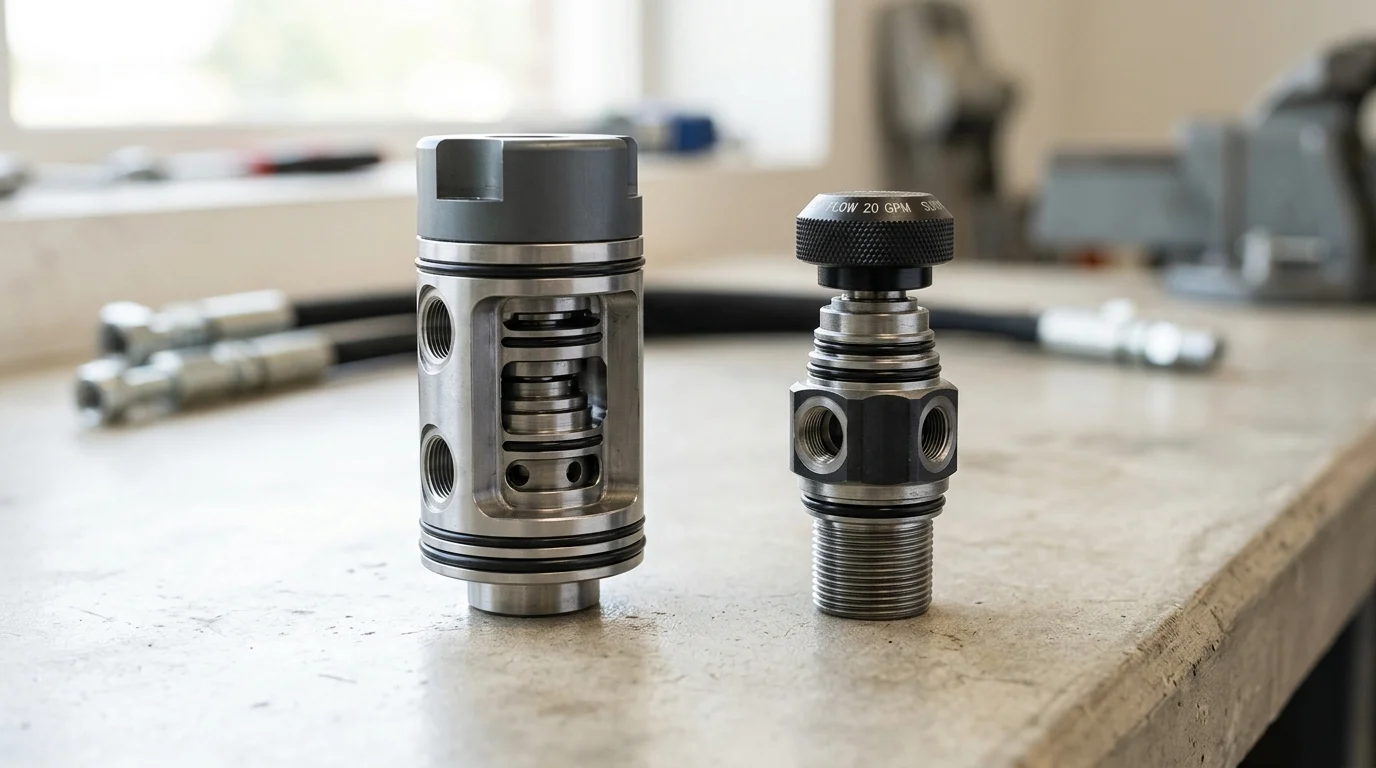
Selecting the right cartridge valve architecture can determine whether a mobile hydraulic system runs efficiently, packages cleanly, and stays reliable under load. Screw-in cartridge valves and slip-in logic elements both mount inside manifold blocks, but they solve different engineering problems. One favors compact, modular control in standardized SAE cavities; the other is built for high-flow circuits where pressure drop and power loss become critical. This article compares how each design works, where the flow and pressure limits typically fall, and which selection criteria matter most for mobile equipment engineers balancing performance, serviceability, and space constraints.
Hydraulic Cartridge Valve Basics
Modern hydraulic systems increasingly rely on integrated manifold blocks to minimize their footprint, eliminate leak-prone plumbing, and centralize control. At the core of these integrated circuits are two primary architectures: slip-in hydraulic cartridge valves (often called logic elements) and screw-in cartridge valves (SICVs). Both designs insert directly into machined cavities within a manifold block, typically operating at standard pressures up to 350 bar (5,000 psi), but they serve distinct operational scales and integration requirements.
How Cartridge Valves Work
Cartridge valves function by regulating fluid power directly within the internal galleries of a manifold block instead of relying on external, line-mounted bodies. A machined cavity intersects with specific fluid passages—typically designated as ports 1, 2, 3, or 4. When the valve is inserted, O-rings and backup rings isolate these ports. In a screw-in cartridge valve, the threaded body secures the component and withstands system pressure. Conversely, slip-in cartridge valves consist of an insert, a control cover, and a spring, relying on the bolted cover to retain the valve and dictate its logic function based on pilot pressure signals.
Key Terms and Valve Types
The terminology surrounding these components is heavily standardized to ensure interoperability. Cavity sizes for SICVs generally follow SAE standards, such as SAE 08, 10, 12, and 16. For example, an SAE 10 cavity is typically rated for nominal flows up to 40 L/min (10.5 GPM). Valve types span the full spectrum of hydraulic control: directional control (solenoid-operated poppet or spool valves), pressure control (relief, reducing, and sequence valves), flow control (needle and proportional valves), and load-holding (counterbalance and check valves). Slip-in valves, adhering to DIN 24342 standards, operate primarily as 2-way directional or pressure control elements, utilizing area ratios between the poppet and pilot to dictate opening characteristics.
Comparison Criteria and Trade-Offs
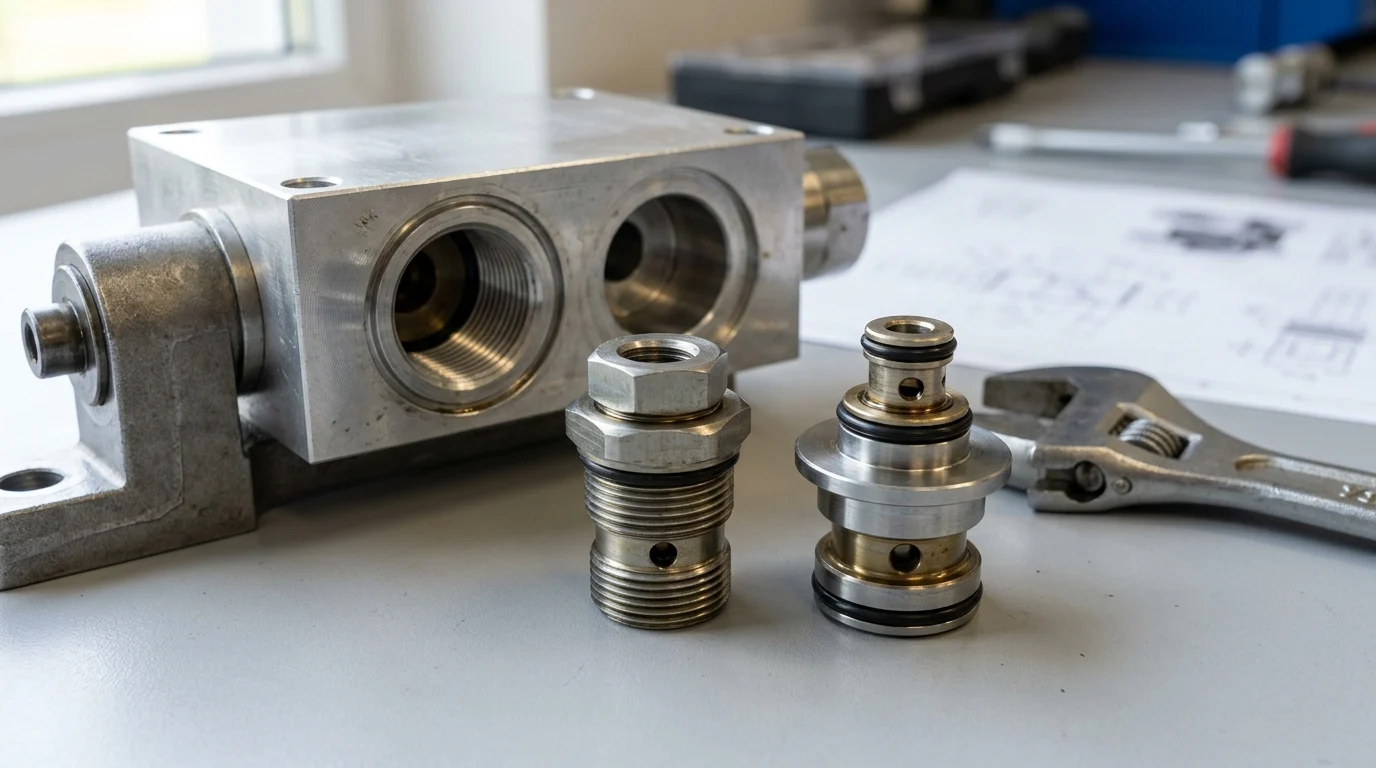
Selecting between slip-in logic elements and screw-in cartridge valves requires a rigorous evaluation of system parameters. Engineers must balance flow capacity and pressure drop against the physical space constraints inherent in mobile machinery.
Performance, Flow, and Pressure Factors
The primary differentiator between slip-in and screw-in architectures is flow capacity. SICVs are predominantly utilized in low- to medium-flow applications. Standard high-performance SICVs cap out around 300 L/min (80 GPM) before pressure drop becomes inefficient. In contrast, slip-in cartridge valves excel in high-flow scenarios, easily managing volumetric flow rates exceeding 3,000 L/min with minimal pressure drop.
| Feature | Screw-In Cartridge Valves (SICV) | Slip-In Cartridge Valves (Logic) |
|---|---|---|
| Typical Max Flow | Up to 300 L/min | Up to 3,000+ L/min |
| Standard Pressures | 210 to 350 bar | 350 to 420 bar |
| Retention Method | Threaded body | Bolted control cover |
| Cavity Standards | SAE (08, 10, 12, 16, 20) | DIN 24342 / ISO 7368 |
| Primary Use Case | Compact mobile equipment | High-flow industrial / heavy mobile |
While both handle high pressures, slip-in elements offer lower hysteresis and faster response times in heavy-duty cycles due to their larger poppet areas and optimized fluid dynamics.
Mobile Equipment Application Considerations
Mobile equipment, such as agricultural tractors, skid steer loaders, and aerial work platforms, imposes strict limitations on weight and envelope size. Here, SICVs dominate the landscape. By consolidating multiple SICVs into a single aluminum or ductile iron manifold, OEMs can reduce total hydraulic system weight by up to 30% compared to traditional stacked (sandwich) or line-mounted valves. Furthermore, the threaded engagement of SICVs provides excellent resistance to the high-frequency vibration and mechanical shock typical of off-highway environments. Because slip-in valves require bulky steel manifolds to accommodate their bolted covers and massive flow galleries, they are generally reserved for the heaviest mobile machinery, such as 50-ton excavators.
Selection Process and Decision Guidance
Specifying the correct cartridge valve architecture demands a systematic approach to manifold design. Engineers must translate machine-level performance goals into precise hydraulic specifications, ensuring the selected components deliver efficient, reliable control without generating excessive heat.
Steps for Matching Valves to System Requirements
The specification process begins with calculating the absolute maximum flow rate and continuous operating pressure for each specific circuit branch. Engineers must then evaluate the acceptable pressure drop (ΔP) across the valve. A standard design rule for mobile manifolds is to restrict total pressure drop to less than 15 bar (217 psi) per circuit to prevent excessive thermal loading on the hydraulic fluid. Next, designers must determine the required response time and duty cycle. For highly dynamic circuits requiring proportional control, engineers must select valves with specialized spools and linear variable differential transformer (LVDT) feedback. Finally, verify the cavity tooling requirements; utilizing common SAE cavities reduces machining costs and ensures multiple sourcing options for aftermarket replacement.
When to Choose Cartridge Valves
The decision ultimately hinges on the intersection of flow demand and spatial constraints. Screw-in cartridge valves are the optimal choice for custom mobile manifolds where space is at a premium, flows remain below the 300 L/min threshold, and circuit complexity requires integrating numerous functions—such as relief, sequence, and proportional directional control—into a single, lightweight block. Conversely, slip-in cartridge valves become necessary when engineering heavy-duty systems that demand uncompromised flow efficiency above 400 L/min, where the physical footprint of the manifold is less critical than minimizing fluid velocity and pressure degradation. Aligning the valve architecture with these fluid power realities ensures maximum machine efficiency and component longevity.
Key Takeaways
- Choose screw-in cartridge valves for compact mobile circuits where standardized SAE cavities and flow rates up to roughly 300 L/min are appropriate.
- Use slip-in cartridge valves when the application demands very high flow, low pressure drop, and capacities that can exceed 3,000 L/min.
- Verify cavity standards early, because SICVs commonly use SAE cavity sizes while slip-in logic elements typically follow DIN 24342 or ISO 7368.
- Evaluate pressure rating, flow capacity, pressure drop, and retention method together rather than selecting a cartridge valve by size alone.
- Reduce leak risk and system footprint by integrating cartridge valves into manifold blocks instead of relying on external line-mounted valve bodies.
Frequently Asked Questions
What is the main difference between slip-in and screw-in cartridge valves?
Screw-in cartridge valves use a threaded body to secure the valve in an SAE cavity, while slip-in cartridge valves use an insert retained by a bolted control cover. Screw-in valves suit compact, low- to medium-flow circuits; slip-in logic elements suit high-flow systems.
When should mobile equipment use screw-in cartridge valves?
Use screw-in cartridge valves when the machine needs compact packaging, modular functions, standardized SAE cavities, and flow rates typically below about 300 L/min. They are common in mobile directional, pressure, flow, and load-holding circuits.
When are slip-in cartridge valves the better choice?
Slip-in cartridge valves are better when the circuit must handle very high flow with low pressure drop, often above the practical range of screw-in valves. They are well suited to large actuators, high-power hydraulic functions, and manifold systems built around DIN or ISO cavities.
Do both valve types operate at high pressure?
Yes. Both are commonly used in high-pressure hydraulic systems. Screw-in cartridge valves are often rated around 210 to 350 bar, while slip-in logic valves may operate around 350 to 420 bar depending on design, size, and manufacturer specifications.
Are cartridge valves more leak-resistant than line-mounted valves?
They can be. Because cartridge valves mount directly into manifold cavities, they reduce external plumbing, fittings, and potential leak points. Proper cavity machining, seal selection, and installation torque are still critical for reliable sealing.
Post time: Sep-23-2026