
Introduction
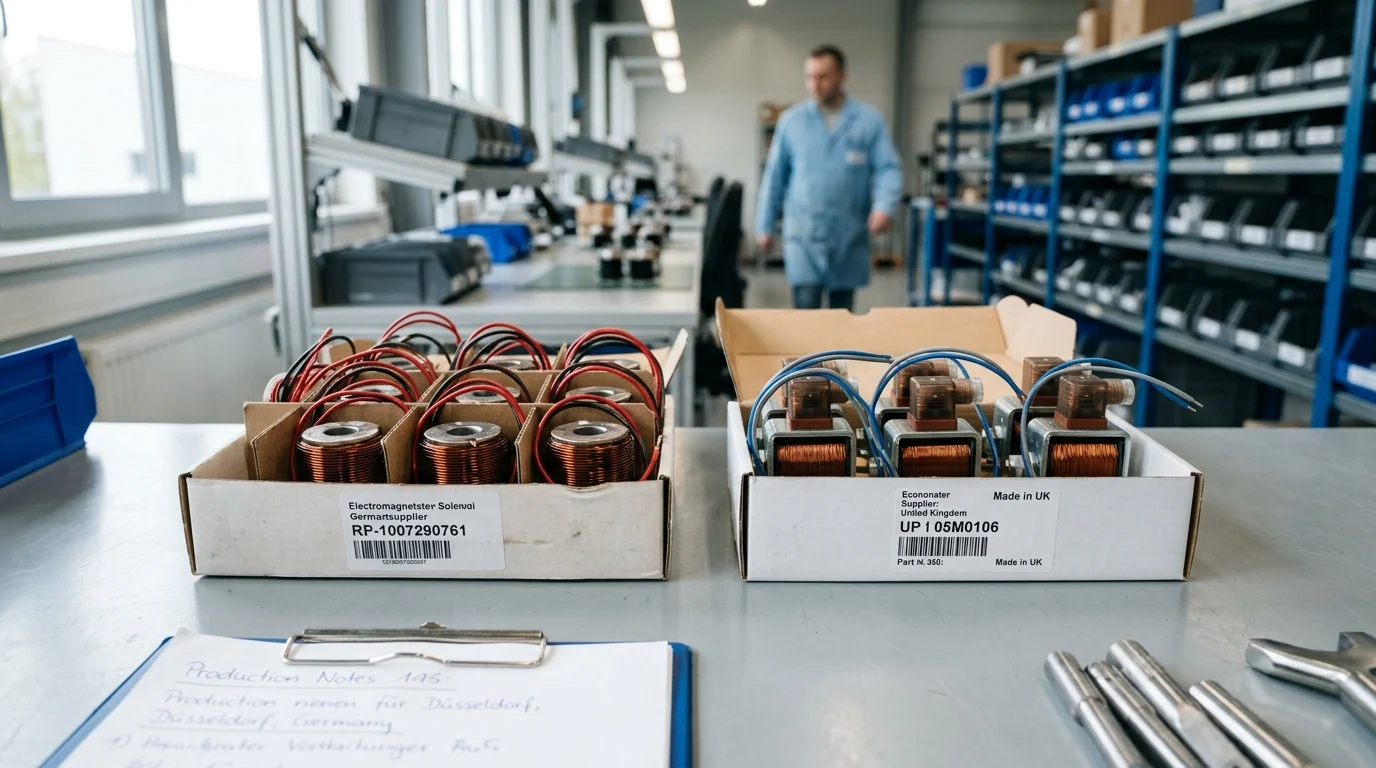
For European manufacturers, Brexit turned solenoid coil sourcing from a cost question into a continuity risk. Customs delays, rules-of-origin checks, and diverging compliance requirements now make single-supplier dependency far harder to justify, especially in automotive, hydraulic, and industrial equipment production. This article explains how dual-sourcing can reduce exposure to border disruption, material shortages, and regulatory uncertainty without sacrificing quality or delivery performance. It also outlines the practical factors that matter most when qualifying parallel suppliers, from technical consistency and certification readiness to inventory planning and lead-time management, so readers can evaluate dual-sourcing as a workable resilience strategy rather than a theoretical safeguard.
Why Dual-Sourcing Improves Supply Chain Resilience for Solenoid Coils
The post-Brexit manufacturing landscape has fundamentally altered how European original equipment manufacturers (OEMs) manage their supply chains. For critical electromechanical components like solenoid coils, relying on a single supplier exposes production lines to unacceptable vulnerabilities. Dual-sourcing has transitioned from a theoretical best practice to an operational necessity, ensuring uninterrupted assembly of automotive systems and heavy engineering machinery.
By maintaining active commercial relationships with at least two qualified suppliers, organizations can insulate themselves from regional economic shocks, border disputes, and localized material shortages. Partnering with established global manufacturers, such as Feiniu (Ningbo) Electronic Technology Co., Ltd., allows European firms to leverage robust quality management systems while stabilizing their inventory flow against unexpected cross-border disruptions.
Key risks affecting European manufacturers
European manufacturers currently face a complex matrix of logistical and regulatory threats. Since the implementation of new customs boundaries and rules of origin, cross-border transit times have fluctuated significantly. Paperwork discrepancies regarding import duties frequently cause unpredictable delays ranging from 4 to 14 days. For components integral to pneumatic and hydraulic systems, such erratic lead times directly threaten lean manufacturing and just-in-time (JIT) production models.
Furthermore, regulatory divergence—such as the dual requirement for CE and UKCA markings—has forced suppliers to adapt their compliance frameworks. Solenoid coils utilized in demanding environments, such as heavy engineering machinery and automotive transmissions, must maintain stringent defect rates, often mandated below 50 Parts Per Million (PPM). A single-source strategy heavily amplifies risk if the primary vendor fails to adapt to these evolving certification requirements or misses critical quality thresholds.
Commercial pressures driving sourcing decisions
Beyond logistical bottlenecks, macroeconomic volatility heavily influences modern procurement strategies. Fluctuations in the cost of core raw materials, particularly copper wire and electrical steel, alongside shifting currency exchange rates, put immense pressure on operational profit margins. Dual-sourcing enables procurement teams to create competitive tension and hedge against sudden price surges from a single vendor.
To optimize these commercial pressures, companies often adopt a strategic volume-split methodology, typically allocating orders in a 70/30 or 60/40 ratio between primary and secondary suppliers. This approach ensures both vendors remain actively engaged in production while offering crucial flexibility in Minimum Order Quantities (MOQs). Securing a secondary supplier willing to accommodate initial MOQs in the range of 500 to 1,000 units provides a critical buffer during sudden demand spikes or primary supplier shortfalls.
How to Compare Dual-Sourcing Options for Solenoid Coils

Evaluating secondary suppliers for solenoid coils demands rigorous benchmarking to ensure seamless interchangeability on the assembly line. A secondary source must not be viewed merely as an emergency backup, but as a fully qualified manufacturing partner capable of matching or exceeding the primary supplier’s technical and operational standards.
Developing a structured comparison framework prevents quality degradation and ensures that both suppliers can seamlessly integrate into the enterprise resource planning (ERP) systems and production schedules.
Technical, quality, and lifecycle evaluation criteria
Technical parity is the foundational requirement when qualifying a new supplier. Solenoid coils must meet precise electromagnetic specifications, including resistance tolerances of ±5% and rigorous thermal endurance standards, such as Class H insulation rated for up to 180°C. Any deviation in the magnetic flux or thermal dissipation can lead to catastrophic failures in the final actuator or valve assembly.
Quality management systems and specialized product portfolios must also be scrutinized. Manufacturers like Feiniu (Ningbo) Electronic Technology Co., Ltd. specialize in a comprehensive range of automotive and engineering machinery components, including transmission solenoids, steam valves, pilot assemblies, and dual-power modules. Assessing a supplier’s core competency in these specific product categories—and verifying their adherence to standards like IATF 16949—ensures they possess the engineering capabilities required to support long-term, defect-free production runs.
Decision framework for supplier comparison
A robust decision framework relies on Total Cost of Ownership (TCO) rather than unit price alone. Procurement teams must weigh landed costs against logistics reliability, factoring in standard ocean freight lead times of 6 to 8 weeks versus nearshore alternatives that may deliver within 1 to 2 weeks.
The following table outlines a standard TCO comparison matrix used to evaluate potential solenoid coil suppliers:
| Evaluation Criteria | Primary Supplier (Local/Nearshore) | Secondary Supplier (Global/Offshore) |
|---|---|---|
| Unit Cost (Base) | €4.50 | €2.80 |
| Standard Lead Time | 2-3 Weeks | 6-8 Weeks |
| Target Defect Rate | < 50 PPM | < 50 PPM |
| Typical MOQ | 500 units | 2,000 units |
| Logistics Risk | Low (Minimal customs friction) | Moderate (Freight & transit variables) |
By quantifying these variables, European manufacturers can strategically assign volume allocations that balance immediate cost efficiency with long-term supply chain security.
Practical Roadmap for Implementing Dual-Sourcing
Transitioning to a dual-sourced supply chain requires careful orchestration to avoid disrupting ongoing manufacturing operations. A phased implementation roadmap safeguards against premature reliance on an untested vendor, ensuring that every component meets strict compliance standards before mass production begins.
Successful execution depends on highly transparent communication with both the incumbent and the incoming supplier, setting clear expectations regarding volume allocations, quality thresholds, and delivery schedules.
Step-by-step process to reduce transition risk
The integration of a secondary solenoid coil supplier should follow a strict, multi-phase validation process to minimize transition risk. The first phase involves comprehensive facility audits and the establishment of Non-Disclosure Agreements (NDAs) to protect proprietary coil winding and overmolding designs. Following this, the Production Part Approval Process (PPAP) is initiated, requiring the new supplier to provide initial samples, material certifications, and Failure Mode and Effects Analysis (FMEA) reports.
Once engineering approves the initial samples, a pilot production run is scheduled. Ordering a controlled test batch—typically between 5,000 and 10,000 units—allows the manufacturer to evaluate the supplier’s real-world tooling performance and logistics reliability under actual production constraints. This entire qualification cycle generally spans 12 to 16 weeks, ensuring that any defects or logistical bottlenecks are identified and resolved before full-scale volume scaling is authorized.
Key Takeaways
- The most important conclusions and rationale for Supply Chain Resilience: Dual-Sourcing Strategies for Solenoid Coils in Post-Brexit European Manufacturing
- Specs, compliance, and risk checks worth validating before you commit
- Practical next steps and caveats readers can apply immediately
Frequently Asked Questions
Why is dual-sourcing important for solenoid coils after Brexit?
It reduces exposure to customs delays, rules-of-origin issues, and supplier disruptions. Using two qualified sources helps keep valve, actuator, and transmission assembly lines running.
What order split works best between primary and secondary suppliers?
A 70/30 or 60/40 split is practical. It keeps the backup supplier production-ready while preserving flexibility if demand spikes or the main source slips.
Which specs should both solenoid coil suppliers match?
Check resistance tolerance within ±5%, Class H insulation up to 180°C, fit/form/function compatibility, and stable magnetic performance under your operating load and duty cycle.
What certifications matter when qualifying a secondary supplier?
Prioritize CE and UKCA readiness for market access, plus IATF 16949 for automotive applications. Also confirm documented traceability and low defect performance for critical assemblies.
How can buyers compare solenoid coil suppliers beyond unit price?
Use total cost of ownership: landed cost, lead time, MOQ, defect rate, tooling support, and customs reliability. A cheaper coil can cost more if delays stop production.
Post time: Jun-08-2026