
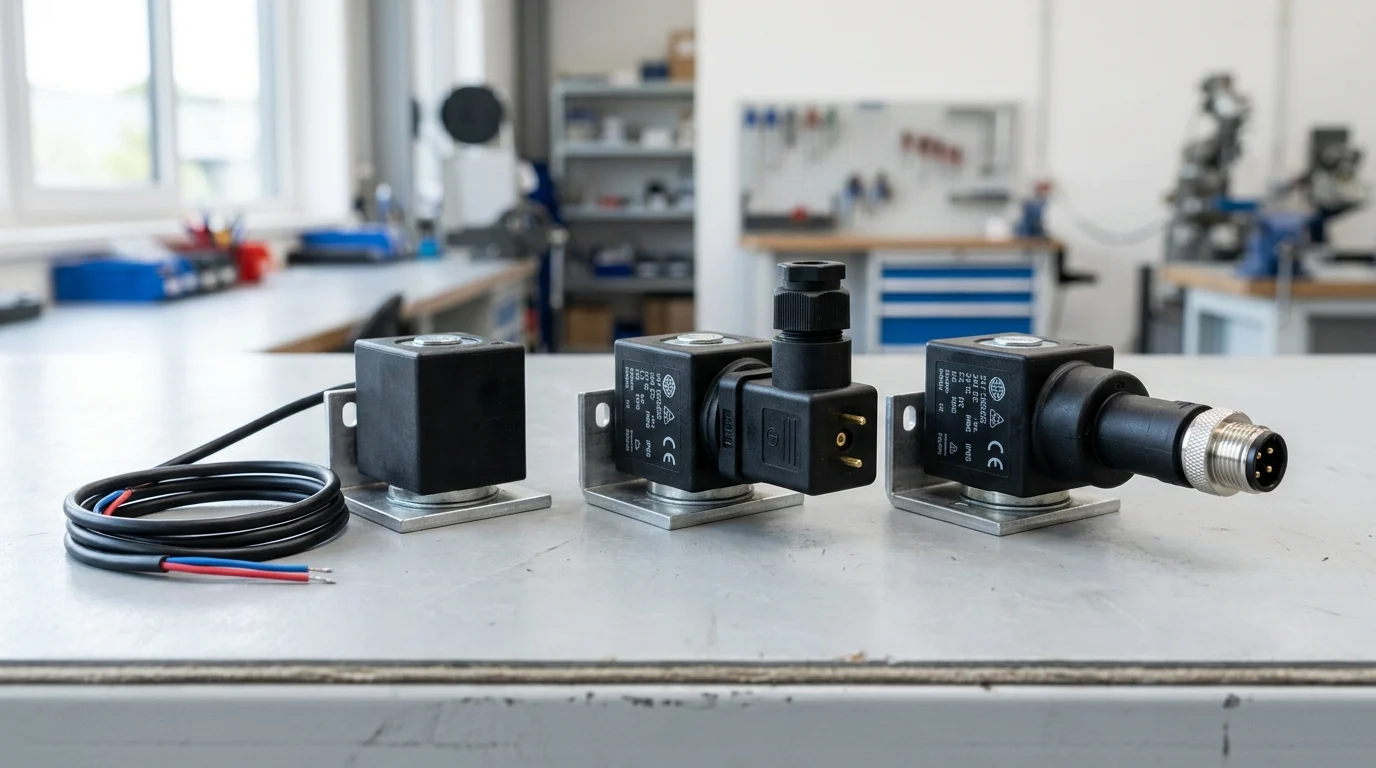
Introduction
In European pneumatic and hydraulic systems, the coil termination method often has a greater impact on uptime than the coil itself. Flying leads, DIN connectors, and M12 connectors each shape installation speed, sealing performance, maintenance effort, and compliance with common regional service practices. This comparison explains where each option fits best, from simple hardwired assemblies to modular machine designs that prioritize fast replacement and reduced downtime. By understanding the tradeoffs in reliability, ingress protection, wiring flexibility, and lifecycle cost, readers can make more confident choices for new equipment builds and retrofit projects.
Why Coil Termination Style Matters
In the design and deployment of solenoid-driven pneumatic and hydraulic systems across Europe, the method of coil termination is frequently overshadowed by core valve specifications. However, termination styles directly dictate field reliability, integration speed, and overall system longevity. While a high-quality solenoid coil might boast an operational lifespan exceeding 50,000 hours, premature failures in industrial environments are overwhelmingly traced to the termination point rather than internal winding degradation.
Choosing between flying leads, DIN connectors, and M12 interfaces is not merely a matter of component availability; it is a strategic engineering decision. This choice impacts electrical safety, ingress protection, and the total cost of maintenance for European industrial machinery.
Installation practices and service expectations
European machinery directives and localized installation practices heavily favor modular, plug-and-play architectures. Facilities increasingly prioritize rapid field serviceability to mitigate expensive production downtime. Hardwired setups, once common, require specialized electrical personnel to safely disconnect and splice wires during a valve replacement, which can complicate compliance with local safety protocols.
Transitioning from hardwired flying lead connections to quick-disconnect standard interfaces can reduce component swap times from an average of 15 minutes to under 2 minutes. Across a facility with hundreds of automated valves, this drastically lowers maintenance labor costs over the equipment’s lifecycle and ensures that machine builders meet the stringent serviceability expectations of modern European end-users.
Operating assumptions and application context
Operating assumptions must account for the specific thermal and mechanical stresses of the application context. Industrial environments often expose solenoid coils to temperature fluctuations ranging from -20°C to +80°C, alongside continuous mechanical vibration profiles up to 5G. The termination must maintain electrical continuity and environmental sealing under these fluctuating conditions.
Furthermore, the application context dictates the regulatory baseline. For instance, applications adhering to DIN EN 175301-803 standards assume a baseline level of protection suitable for general factory automation. Conversely, specialized contexts like mobile machinery or chemical processing demand interfaces capable of withstanding aggressive fluid exposure and extreme physical shock, shifting the operational assumptions toward highly ruggedized or overmolded connection styles.
Comparing Flying Leads, DIN Connectors, and M12
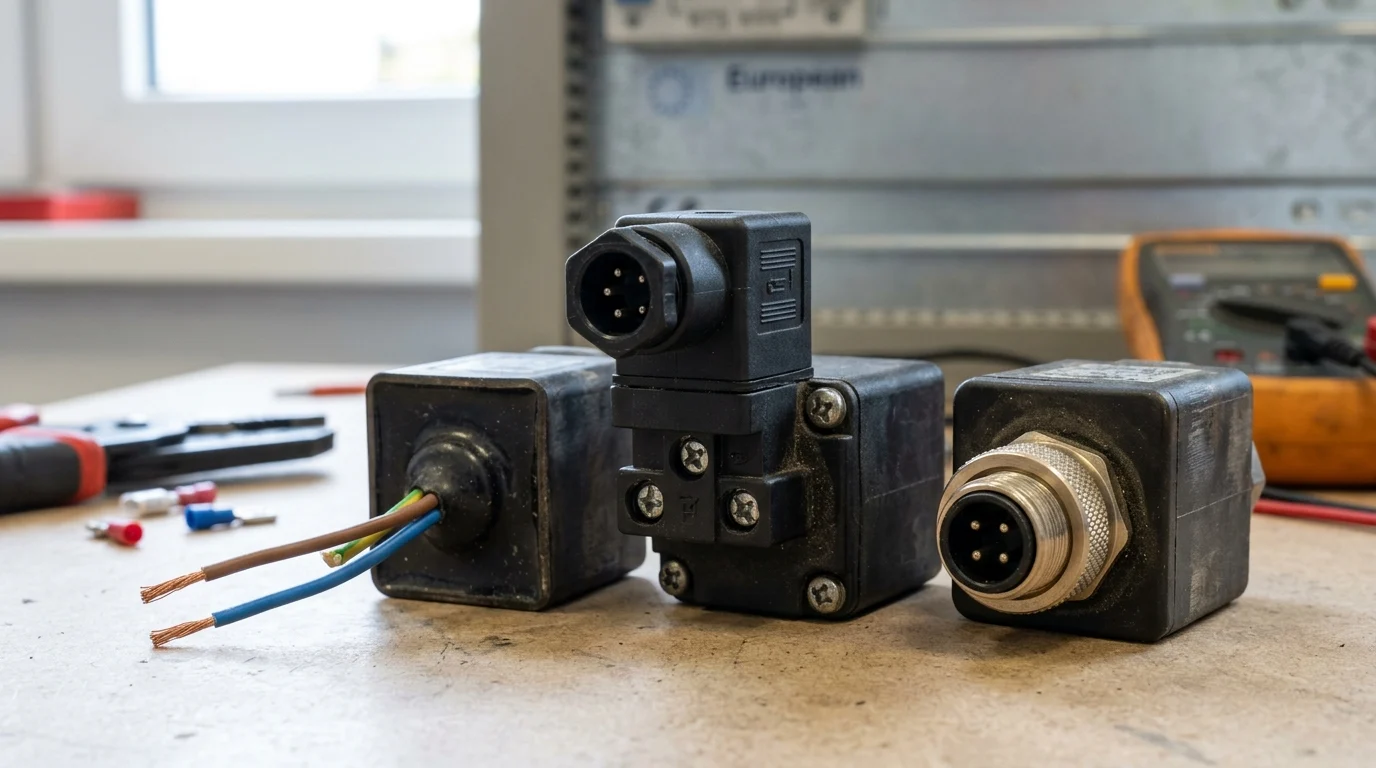
Selecting the optimal termination requires a comparative analysis of the three dominant styles in the European market: flying leads, DIN connectors, and M12 circular connectors. Each offers distinct advantages regarding cost, ingress protection, and integration footprint.
| Feature | Flying Leads | DIN EN 175301-803 | M12 (IEC 61076-2-101) |
|---|---|---|---|
| Standard Voltage Limit | Application specific | Up to 250V AC/DC | Typically 24V DC |
| Current Capacity | Wire gauge dependent | 10A to 16A | Up to 4A per pin |
| Typical IP Rating | IP65 (splice dependent) | IP65 to IP67 | IP67 to IP69K |
| Field Serviceability | Poor (requires splicing) | Excellent | Excellent |
Interface characteristics and application limits
Interface characteristics strictly define the application limits for each style. Flying leads offer the lowest initial component cost—often saving €1 to €3 per unit compared to connectorized alternatives—and provide unmatched flexibility for routing in highly constrained spaces. However, they lack a standardized interface, complicating field replacement and limiting their use in modular machine designs.
DIN connectors, available primarily in Form A, B, and C, represent the historical standard for European fluid power. They robustly handle up to 250V AC/DC and support current loads between 10A and 16A, making them ideal for high-power actuation. In contrast, M12 connectors utilize standardized A-coding and are optimized for modern 24V DC control architectures and digital fieldbus networks. While limited to handling up to 4A per pin safely, M12 interfaces offer a highly compact footprint perfect for dense valve islands.
Ingress protection, wiring, and maintenance factors
Ingress protection and wiring integrity are paramount for preventing moisture-induced short circuits. Flying leads rely entirely on the quality of the manufacturer’s epoxy potting and the installer’s field splice; while the coil itself may achieve IP67, the wire splice remains a critical weak point susceptible to corrosion.
DIN connectors reliably achieve IP65 to IP67 ratings, provided the installer utilizes the correct profile gasket and applies the specified tightening torque of 0.4 to 0.5 Nm to the retaining screw. Over-tightening can deform the seal, while under-tightening permits fluid ingress. M12 connectors inherently provide superior sealing, routinely achieving IP67 or even IP69K ratings when mated with factory-overmolded cordsets. This makes M12 the preferred choice for strict European food, beverage, and pharmaceutical washdown environments where aggressive cleaning agents are deployed.
How to Select the Right Coil Termination

Engineering and procurement teams must align termination selection with broader project requirements, balancing initial capital expenditure against the total cost of ownership. Partnering with versatile manufacturers, such as Feiniu (Ningbo) Electronic Technology Co., Ltd., which produces a comprehensive range of solenoid valves, coils, and terminal components, allows OEMs to source multiple termination styles under a unified quality management system.
By evaluating supply chain realities alongside technical specifications, organizations can standardize their designs for the European market without sacrificing performance or inflating maintenance budgets.
Compliance, sourcing, and lifecycle considerations
Compliance with European directives, including CE marking, RoHS, and REACH, is non-negotiable for regional installations. Standardized connectors like DIN and M12 inherently reduce supply chain friction by ensuring multi-source availability and cross-vendor compatibility. This standardization protects OEMs against component obsolescence and localized shortages.
When evaluating lifecycle costs, procurement must consider volume thresholds and Minimum Order Quantities (MOQs). Custom flying lead configurations often require MOQs exceeding 1,000 units to justify specific cable lengths, wire gauges, and automated stripping requirements. Conversely, standardized DIN and M12 coils are widely available as commercial off-the-shelf (COTS) components. This allows for leaner inventory management, lower holding costs, and rapid procurement of replacement parts for facility maintenance teams.
Step-by-step selection process
A systematic selection process ensures optimal performance and cost-efficiency for European deployments. First, evaluate the electrical parameters: high-voltage AC applications or heavy-duty hydraulics generally necessitate DIN connectors, whereas modern 24V DC PLC-driven pneumatics align perfectly with M12 interfaces.
Second, assess
Key Takeaways
- The most important conclusions and rationale for A Comparison of Coil Termination Styles: Flying Leads, DIN Connectors, and M12 Connectors for European Installations
- Specs, compliance, and risk checks worth validating before you commit
- Practical next steps and caveats readers can apply immediately
Frequently Asked Questions
When should I choose flying leads for a solenoid coil?
Use flying leads when cost and routing flexibility matter most, especially in tight spaces or fixed installations where frequent coil replacement is unlikely.
Why are DIN connectors common in European valve installations?
DIN connectors are widely used because they support up to 250V AC/DC, offer fast replacement, and fit established European fluid power standards and service practices.
Is M12 better than DIN for washdown or harsh environments?
Often yes. M12 typically provides IP67 to IP69K sealing and strong vibration resistance, making it a better fit for wet, mobile, or high-shock applications.
Which termination style is fastest to service in the field?
DIN and M12 are both much faster than flying leads. Quick-disconnect designs can reduce coil swap time from about 15 minutes to under 2 minutes.
Can I use M12 for any solenoid coil voltage and current?
No. M12 is usually best for 24V DC systems and lower current loads, typically up to 4A per pin, so verify the coil’s electrical requirements first.
Post time: Apr-28-2026