
Introduction
For European OEMs, material traceability in solenoid coils is not a paperwork formality but a practical control for safety, compliance, and warranty risk. Mill certificates and full batch documentation give buyers verified proof of the chemical, mechanical, and production history behind copper wire, bobbins, steel housings, and potting materials used in each coil. This article explains why EN 10204 Type 3.1 certificates and end-to-end batch records are increasingly expected, what information they must contain, and how traceability helps manufacturers isolate defects, support audits, and meet the performance demands of automotive, industrial automation, and heavy equipment applications.
Why Material Traceability Matters for Solenoid Coils
European Original Equipment Manufacturers (OEMs) in the automotive, industrial automation, and heavy machinery sectors operate under stringent liability and performance frameworks. Due to directives such as the European Machinery Directive (2006/42/EC) and strict functional safety standards like ISO 26262, standard quality assurances are no longer sufficient. For critical electromechanical components like solenoid coils, European buyers increasingly mandate comprehensive material traceability. This specifically requires EN 10204 Type 3.1 mill certificates and complete batch documentation delivered with every shipment.
This rigorous approach ensures that every coil, valve island, and actuator component meets exact metallurgical and chemical specifications before integration into larger, high-stakes systems. By enforcing full traceability, OEMs can rapidly isolate manufacturing anomalies, defend against warranty claims, and guarantee the long-term reliability of their automated fluid control systems.
Key definitions and scope
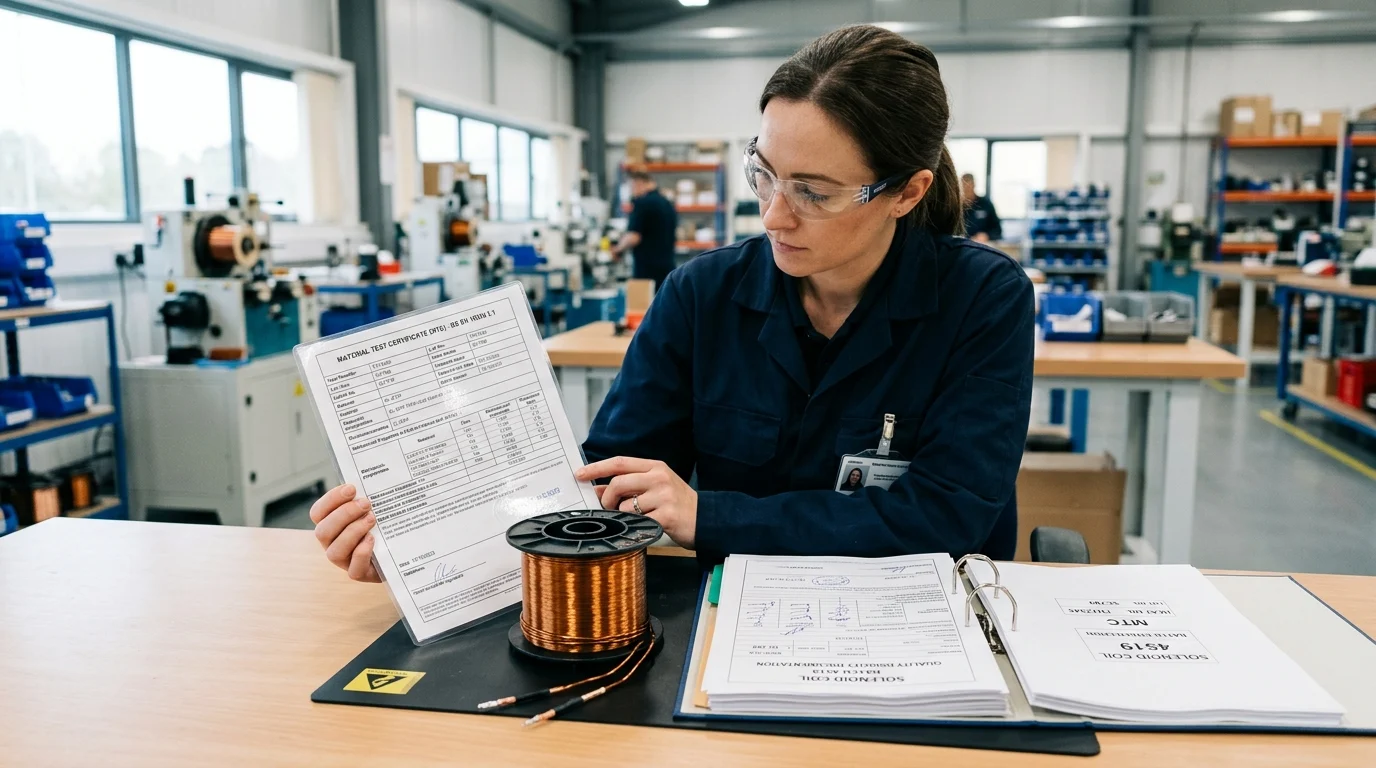
Material traceability in solenoid coil manufacturing encompasses the unbroken documentation chain from raw material extraction to the final assembled component. For a standard heavy-duty solenoid coil, the tracking scope includes the enameled copper wire (magnet wire), the polymeric bobbin material (typically PA66 or PPS with specific glass-fiber reinforcement ratios), the magnetic steel housing, and the epoxy potting compound.
Full batch traceability requires that a finished part’s serial or lot number can be queried to reveal the exact production date, the specific machine operators involved, and the precise raw material lots utilized. This systematic tracking isolates variables, ensuring that a single coil’s electrical parameters correlate directly with the certified properties of its constituent materials, such as the copper purity levels and the exact micron thickness of the insulation enamel.
Risks of weak traceability
Without granular traceability, OEMs face severe operational and financial vulnerabilities. Solenoid coils frequently operate in harsh environments, requiring Class H (180°C) or Class N (200°C) insulation systems to survive continuous duty cycles. If a supplier inadvertently substitutes unverified copper wire or a lower-grade epoxy resin, the coil risks premature thermal degradation, leading to short circuits or complete valve failure.
In the automotive and engineering machinery sectors, a single field failure traced to substandard, undocumented materials can trigger recall campaigns costing upwards of €500,000 per incident. Furthermore, failing to provide an unbroken chain of custody exposes OEMs to compliance violations under IATF 16949 standards. This lack of transparency often results in lost contracts and pushes defect rates far beyond the strict sub-50 Parts Per Million (PPM) threshold demanded by top-tier European buyers.
Core Documentation and Verification Requirements
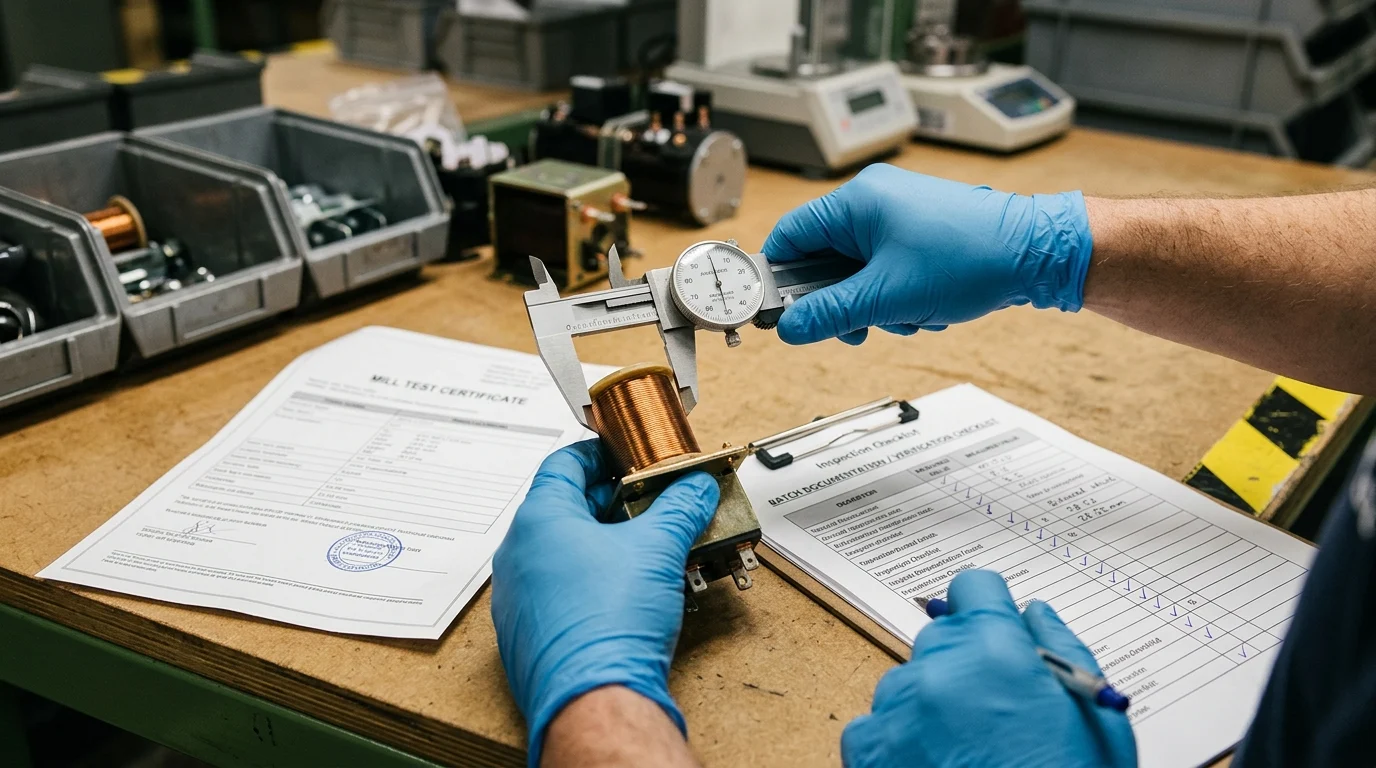
To satisfy European OEM requirements, solenoid coil manufacturers must implement a highly structured documentation architecture. This framework relies on standardized metallurgical testing and rigid internal quality control logs. Relying on basic, self-declared certificates of conformity is inadequate; modern OEMs demand objective, laboratory-validated data that proves material compliance at both a molecular and structural level.
Material, process, and inspection records
The cornerstone of this documentation is the EN 10204 mill certificate. For critical magnetic components, European buyers stipulate Type 3.1 certificates, which require the material manufacturer’s authorized inspection representative—independent of the manufacturing department—to validate the test results. These certificates must detail exact chemical compositions, such as the maximum allowable carbon content in the magnetic steel (often restricted to under 0.04% to ensure optimal magnetic permeability).
Process records must also capture exact manufacturing parameters, such as the tension applied during winding (typically maintained between 150 and 300 grams depending on wire gauge) and the precise curing profile of the potting compound (e.g., 120 minutes at 130°C). Inspection records complete the package, detailing dielectric strength tests (frequently exceeding 1,500V AC for one minute) and resistance measurements to confirm full alignment with the approved design.
Verification methods and control points
Verification relies on establishing strict control points throughout the production lifecycle. Incoming Quality Control (IQC) serves as the primary gatekeeper, physically matching incoming raw material lot numbers against the provided mill certificates before releasing inventory to the floor. In-Process Quality Control (IPQC) stations then log environmental data and machine parameters into an Enterprise Resource Planning (ERP) system.
| Certificate Type | Issuer | Independence Level | Typical Application for Solenoid Coils |
|---|---|---|---|
| EN 10204 Type 2.1 | Manufacturer | None (Declaration only) | Non-critical packaging materials |
| EN 10204 Type 2.2 | Manufacturer | None (Non-specific tests) | Standard polymer bobbins |
| EN 10204 Type 3.1 | Manufacturer | Independent Inspector | Enameled copper wire, magnetic steel |
| EN 10204 Type 3.2 | Manufacturer & Buyer | Third-Party Inspector | Highly critical aerospace/nuclear coils |
Advanced manufacturers utilize barcode or RFID routing to enforce these control points. If an operator attempts to load an unauthorized spool of copper wire onto a winding machine, the ERP system triggers an immediate machine lockout. European automotive standards generally mandate that these digital verification records be retained for a minimum of 15 years, ensuring long-term accountability for every solenoid coil deployed in the field.
How Buyers Should Evaluate Supplier Traceability

Procurement engineering and supplier quality teams must rigorously evaluate a solenoid coil manufacturer’s traceability infrastructure before awarding high-volume contracts. Assessing a supplier requires moving beyond initial product samples to interrogate the underlying digital and physical systems that guarantee long-term batch consistency. Capable manufacturers will treat traceability as an integrated operational standard rather than a burdensome administrative add-on.
Audit steps and document review
The most effective audit mechanism for evaluating a supplier’s traceability is the “mock recall” exercise. During an on-site or virtual audit, the buyer selects a random finished solenoid coil or valve actuator from the shipping dock and requests its complete material history.
A highly capable supplier should utilize their ERP system to trace the finished lot number back to the original EN 10204 Type 3.1 mill certificates.
Key Takeaways
- The most important conclusions and rationale for Material Traceability for Solenoid Coils: Why European OEMs Demand Mill Certificates and Full Batch Documentation
- Specs, compliance, and risk checks worth validating before you commit
- Practical next steps and caveats readers can apply immediately
Frequently Asked Questions
What documents do European OEMs typically require for solenoid coil traceability?
Usually EN 10204 Type 3.1 mill certificates, raw material lot records, process logs, inspection results, and shipment-level batch documentation linked to the coil lot or serial number.
Why is an EN 10204 Type 3.1 certificate important for solenoid coils?
It provides independently validated material test results from the mill, helping OEMs confirm chemical composition and material compliance before coils enter safety-critical assemblies.
Which solenoid coil materials should be fully traceable?
At minimum: magnet wire, bobbin resin such as PA66 or PPS, magnetic steel housing, and epoxy potting compound, each tied to the finished coil batch.
How does full batch documentation reduce OEM risk?
It lets buyers isolate defects fast, support warranty investigations, and limit recalls by tracing a failure back to a specific material lot, process step, or production date.
What internal controls should a solenoid coil supplier use to support traceability?
Use IQC lot verification, ERP-linked batch records, logged winding and curing parameters, and final test records like resistance and dielectric strength tied to each shipment lot.
Post time: Apr-23-2026