
Introduction
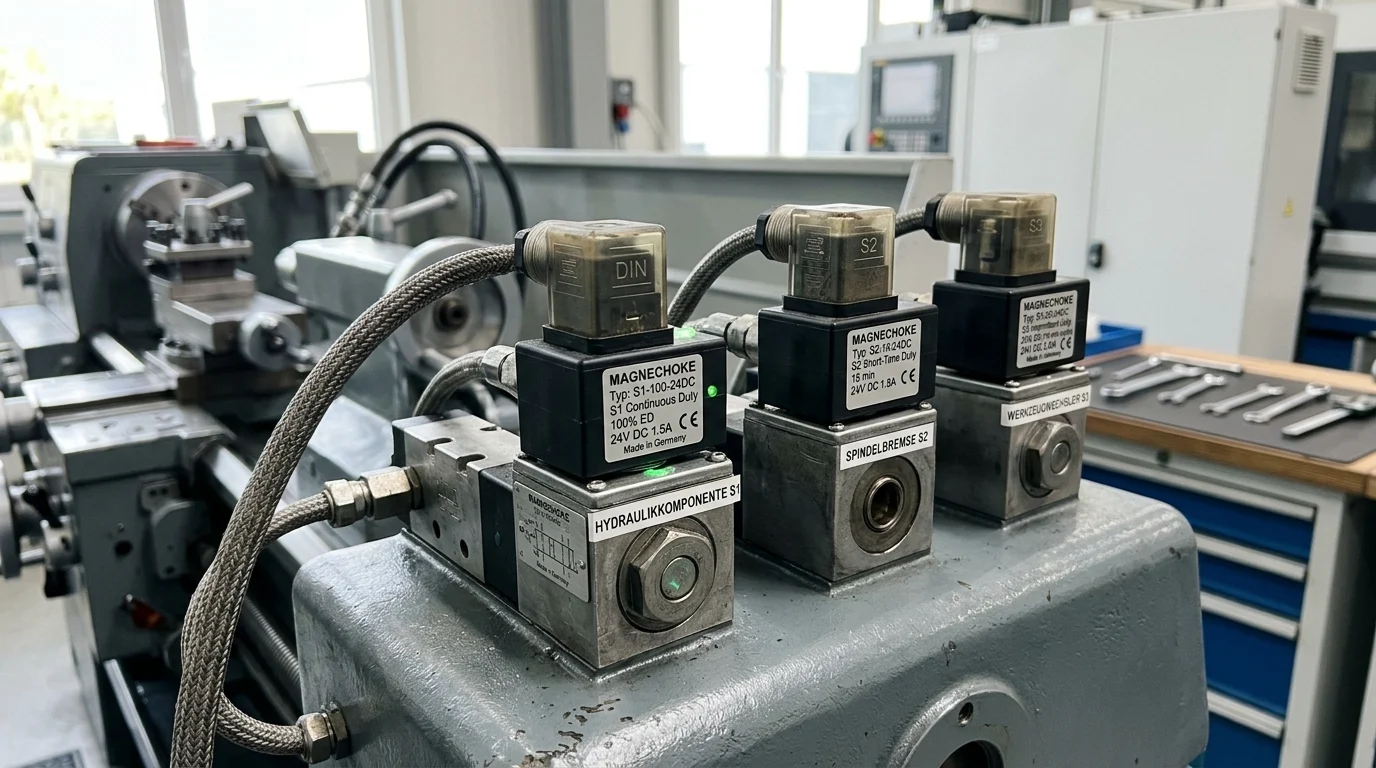
Choosing a solenoid coil for a machine tool is not just a matter of voltage and force; its duty cycle determines how long it can stay energized without overheating or failing early. In European equipment, these limits are commonly defined by DIN VDE 0580 through the S1, S2, and S3 classes. Understanding what each class permits helps engineers match coils to continuous holding, short-time actuation, or intermittent switching tasks. The sections that follow explain how these ratings work, how thermal behavior affects selection, and where each duty class fits in typical pneumatic, hydraulic, and clamping applications on European machine tools.
Duty cycle classes for solenoid coils
In European machine tool engineering, the dependability of electromechanical actuation relies heavily on precise component specification. Solenoid coils, which drive pneumatic valves, hydraulic spools, and mechanical clamping systems, must be matched to the operational rhythm of the machine. The governing standard for these components in European markets is typically DIN VDE 0580, which categorizes solenoid operation into distinct duty cycle classes. Understanding these classifications is critical for optimizing performance, minimizing spatial footprint, and preventing catastrophic thermal failures in high-throughput CNC environments.
S1, S2, and S3 definitions
The DIN VDE 0580 standard defines duty cycles—often denoted as ED (Einschaltdauer)—to standardize how manufacturers rate solenoid thermal limits. Class S1 designates continuous duty, meaning the solenoid coil is energized for 100% of the operational time. Under S1 conditions, the coil reaches a constant thermal equilibrium without exceeding its maximum permissible temperature.
Class S2 represents short-time duty. In this mode, the solenoid is energized for a specified, brief duration (commonly 10, 30, or 60 minutes) and must remain de-energized long enough for the coil to return to ambient temperature. This class allows engineers to apply higher power for greater initial actuation force, provided the strict time limit is observed.
Class S3 defines intermittent periodic duty, expressed as a percentage ratio of the energized time to the total cycle time. Standard S3 ratings include 15%, 25%, 40%, and 60% ED. Crucially, VDE 0580 assumes a standard reference cycle time of 10 minutes unless otherwise specified. Therefore, an S3 40% rating implies a maximum continuous energized period of 4 minutes, followed by a mandatory 6-minute cooling phase.
Thermal effects of duty cycle selection
The primary limiting factor in any solenoid coil design is heat dissipation. As electrical current flows through the copper windings, the coil experiences Joule heating. The resistance of copper wire increases by approximately 0.39% per degree Celsius, which subsequently reduces the current draw and the resulting magnetic force over time. If a duty cycle is improperly specified, the coil will fail to shed heat fast enough, leading to thermal runaway.
European machine tools frequently utilize Class F or Class H insulation systems, which tolerate maximum internal temperatures of 155°C and 180°C, respectively. Driving an S3-rated coil in an S1 continuous application will rapidly push internal temperatures past these thresholds. This causes the enamel insulation on the magnet wire to degrade, resulting in inter-turn short circuits, complete coil burnout, and costly machine downtime. Conversely, applying an S1 coil in a highly intermittent S3 application leaves significant magnetic force potential unutilized, resulting in an inefficient mechanism.
Choosing the right duty cycle class
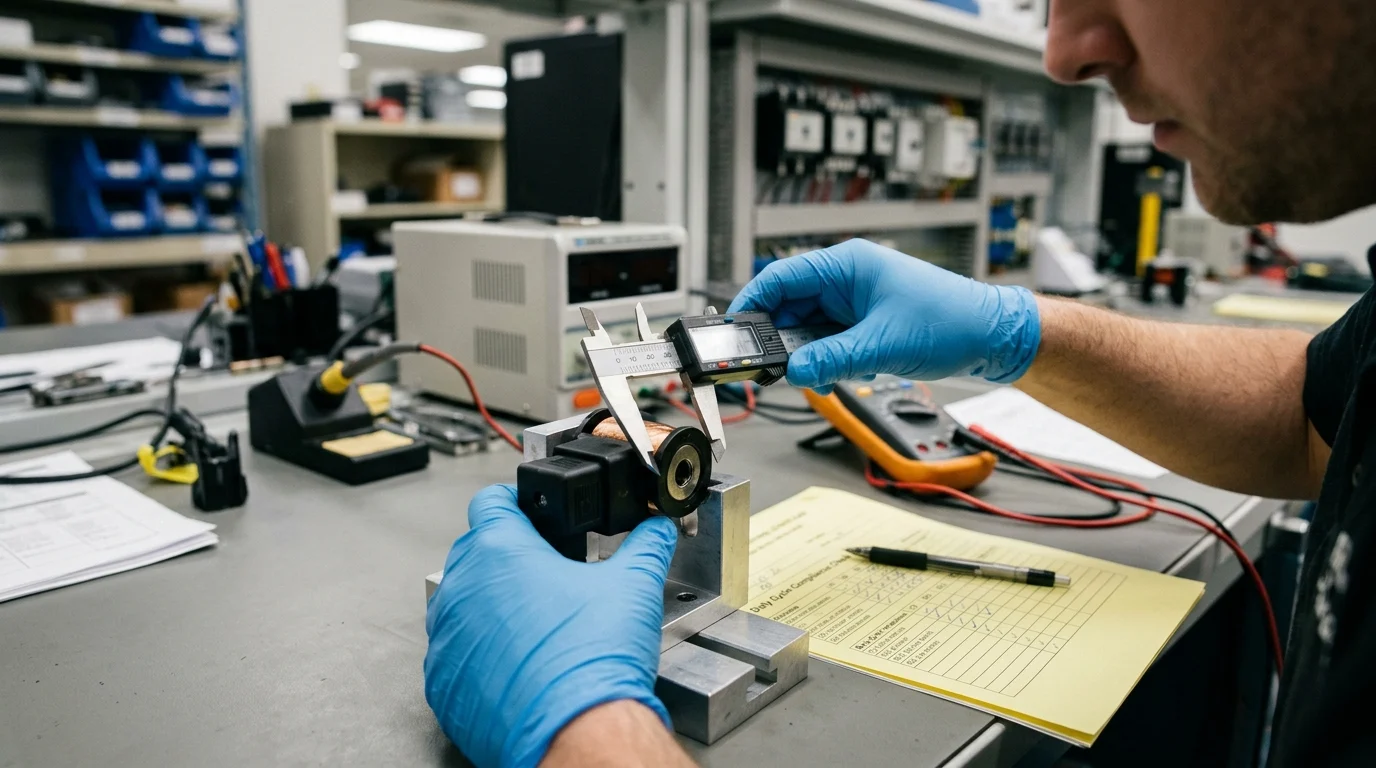
Selecting the correct duty cycle class requires a holistic view of the machine tool’s operational parameters. Engineers must balance the required mechanical force, the physical volume available within the machine chassis, and the thermal constraints of the operating environment. A rigorous selection process ensures that the solenoid delivers consistent actuation without over-specifying component size or risking premature failure.
Selection steps for engineering applications
The selection process begins with an exact calculation of the actuation profile. Engineers must determine the maximum continuous ON time and the minimum OFF time during the machine’s most aggressive production cycle. The duty cycle percentage is calculated by dividing the ON time by the total cycle time (ON + OFF) and multiplying by 100. If the calculated cycle time exceeds the standard 10-minute window, the standard S3 percentage ratings no longer apply directly, and an S1 or custom S2 rating must be evaluated.
Environmental factors profoundly influence this calculation. Solenoids housed in IP65 or IP67 enclosures lack convective airflow, severely bottlenecking heat dissipation. In such restricted cases, an S3 40% coil might behave thermally like an S1 coil, necessitating a derating of the duty cycle or the integration of active cooling measures.
| Duty Cycle Class | Typical ED % | Reference Cycle Time | Common Machine Tool Application | Coil Size for Equivalent Force |
|---|---|---|---|---|
| S1 (Continuous) | 100% | N/A | Safety interlocks, continuous fluid valves | Largest (100% baseline) |
| S2 (Short-Time) | N/A | 10 to 60 mins | Heavy material clamping, emergency brakes | Medium (approx. 70-80%) |
| S3 (Intermittent) | 15% to 60% | 10 minutes | Tool changers, indexing tables, ejectors | Smallest (approx. 40-60%) |
Common specification mistakes
A frequent error in European machine tool design is the over-specification of S1 continuous duty coils as a conservative safeguard. While this prevents thermal burnout, S1 coils require significantly more copper and iron to generate the same magnetic flux as a comparable S3 coil. This results in components that are 30% to 50% larger and heavier, which is highly detrimental in modern, compact CNC centers where spatial economy and weight reduction on moving axes are paramount.
Another critical oversight is ignoring the absolute time limits of the S3 classification. A common mistake is calculating a 25% duty cycle based on a 1-hour total cycle (15 minutes ON, 45 minutes OFF) and selecting a standard S3 25% coil. Because the standard S3 reference time is only 10 minutes, the coil’s thermal mass is designed for a maximum of 2.5 minutes ON. Operating it for 15 minutes continuously will cause immediate thermal failure, despite the mathematical ratio being correct.
Finally, engineers often fail to account for ambient temperature creep within enclosed machine cabinets. While a coil may be rated for 40% ED at a standard 20°C ambient temperature, CNC control cabinets frequently reach 50°C to 60°C during peak operation. This elevated baseline significantly reduces the thermal headroom of the insulation system, often requiring a shift from an S3 to an S1 specification to survive the harsher thermal environment.
Key Takeaways
- The most important conclusions and rationale for A Guide to Solenoid Coil Duty Cycle Classes: S1, S2, S3 and Their Application in European Machine Tools
- Specs, compliance, and risk checks worth validating before you commit
- Practical next steps and caveats readers can apply immediately
Frequently Asked Questions
What does S1 duty mean for a solenoid coil?
S1 means continuous duty: the coil can stay energized 100% of the time without exceeding its rated temperature under specified conditions.
When should I use an S2 solenoid coil?
Use S2 for short, defined energizing periods such as 10, 30, or 60 minutes, followed by enough OFF time for the coil to cool to ambient.
How is S3 duty cycle calculated for machine tool solenoids?
Calculate ED% as ON time divided by total cycle time, multiplied by 100. Under DIN VDE 0580, S3 typically assumes a 10-minute reference cycle.
Can an S3 40% coil run continuously in a CNC machine?
No. S3 40% usually means up to 4 minutes ON and 6 minutes OFF in a 10-minute cycle. Continuous use risks overheating and coil failure.
Do sealed IP65 or IP67 enclosures affect solenoid duty selection?
Yes. Limited airflow reduces cooling, so coils may need duty derating or active cooling, especially in compact European machine tool enclosures.
Post time: May-16-2026