
Introduction
In European food processing lines, solenoid coil mechanisms must do more than switch reliably under speed, heat, and washdown conditions—they must also avoid introducing contamination into products or contact surfaces. Choosing the right food-grade lubricant affects valve response, wear, maintenance intervals, and compliance with EU hygiene expectations for incidental food contact. This article explains where lubrication matters inside solenoid-driven assemblies, which failure modes are most often linked to poor lubricant selection, and how appropriate formulations help balance safety, uptime, and component life in demanding production environments.
Why Food-Grade Lubrication Matters for Solenoid Coil Mechanisms
Solenoid coil mechanisms serve as critical electromechanical actuators across European food processing lines, controlling everything from fluid dispensing and ingredient mixing to pneumatic sorting and packaging. Proper lubrication is essential to ensure these components operate reliably under demanding conditions without compromising the strict food safety standards mandated by European authorities.
Hygiene risks, uptime impact, and contamination paths
The intersection of moving solenoid components and open food processing zones presents significant hygiene risks. If standard industrial lubricants leak into the production stream, facilities face severe regulatory penalties, product recalls, and irreparable brand damage. Contamination paths typically involve aerosolization during pneumatic exhaust cycles or direct drip from overhead valve manifolds onto conveyor systems. Using specialized food-grade lubricants mitigates these risks by adhering to the strict 10 parts per million (ppm) limit for allowable incidental food contact. Furthermore, improper lubrication directly impacts equipment uptime; a single sticking solenoid valve can halt an entire packaging line, costing modern processing facilities an average of €5,000 to €15,000 per hour in lost production, wasted raw materials, and emergency maintenance labor.
Lubrication points and common failure modes
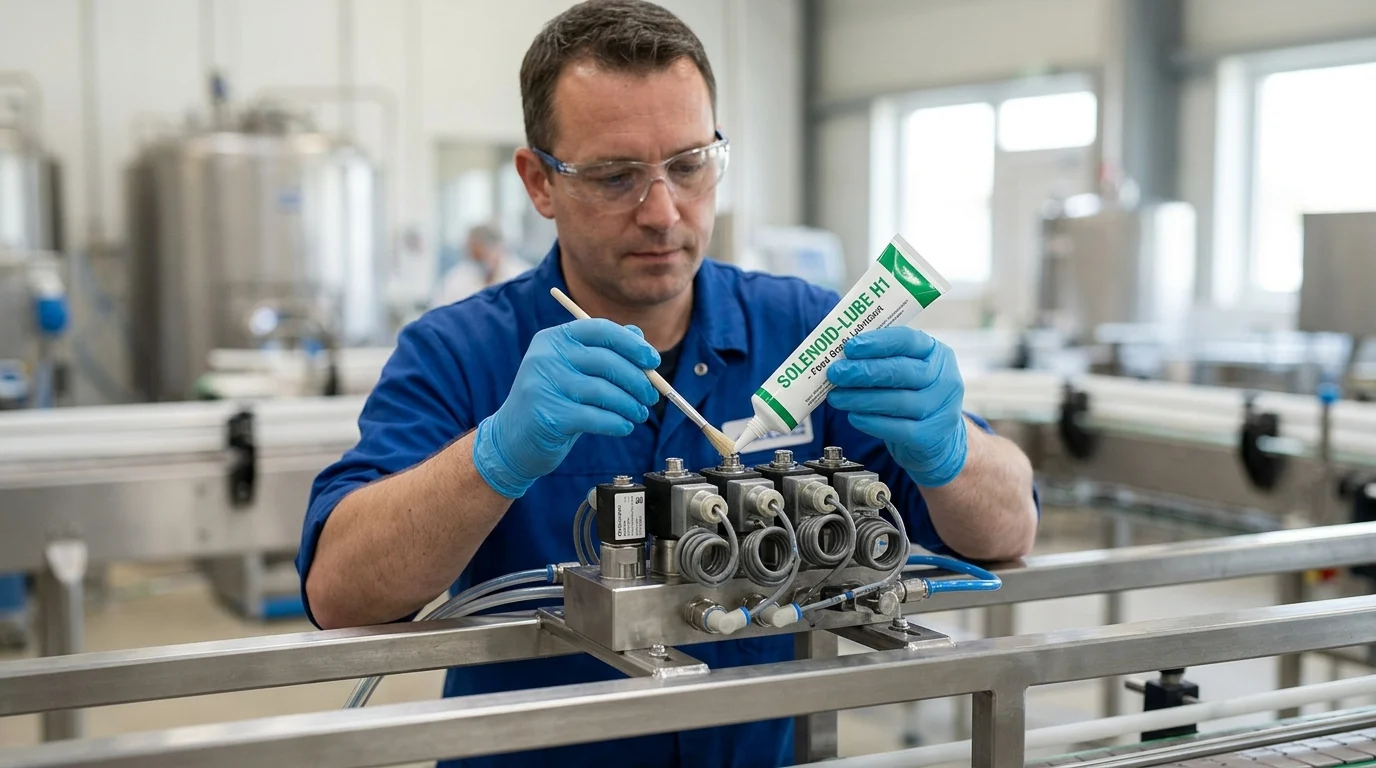
Within a solenoid valve assembly, lubrication is primarily required at the tight interface between the magnetic plunger (armature) and the core tube, as well as on return springs, dynamic seals, and pilot assemblies. Common failure modes arise when inadequate or degraded lubricants cause “stiction”—a condition where the plunger hesitates, seizes, or fails to seat properly. This mechanical resistance forces the solenoid coil to draw excessive inrush current for prolonged periods, rapidly leading to thermal overload, insulation breakdown, and ultimately, coil burnout. In high-cycle applications, such as high-speed bottling lines operating at over 200 cycles per minute, friction-induced wear can disrupt the magnetic field alignment and reduce the lifecycle of a solenoid mechanism by up to 60% if the correct food-grade grease or oil is absent.
Technical and Compliance Criteria for Food-Grade Lubrication
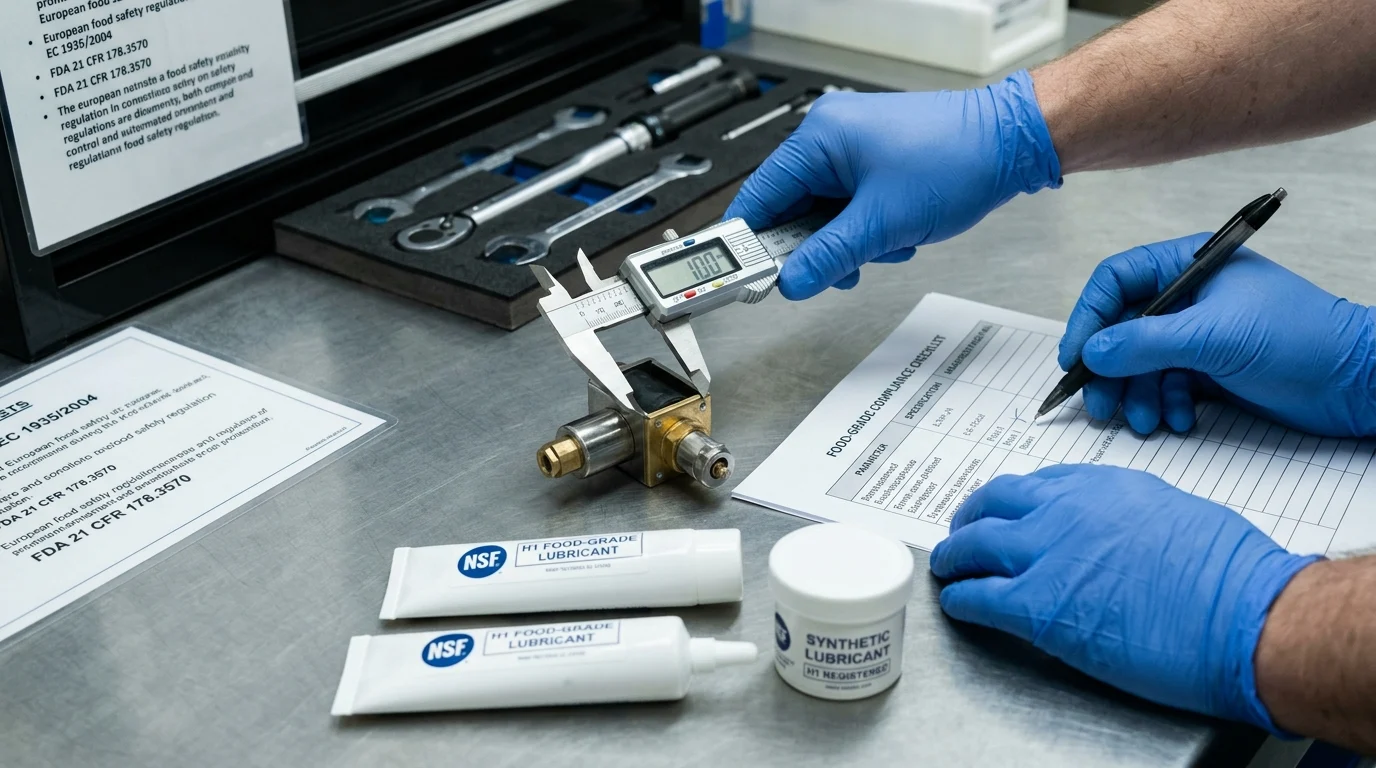
Selecting the appropriate food-grade lubricant requires balancing strict European food safety directives with the demanding electromechanical and thermodynamic requirements of modern solenoid coils. Engineers must match the chemical properties of the lubricant to the operational environment.
Lubricant chemistry, temperature stability, and material compatibility
Solenoid mechanisms experience rapid and frequent temperature fluctuations due to resistive heating within the electromagnetic coil and the varying temperatures of the media being controlled, such as chilled water or hot steam. Therefore, lubricant chemistry must offer exceptional thermal stability and oxidation resistance. Polyalphaolefins (PAO) and Perfluoropolyethers (PFPE) are the dominant synthetic base oils used in these applications. A standard PAO food-grade grease typically operates effectively between -40°C and 150°C, making it suitable for general processing. In contrast, premium PFPE lubricants can withstand continuous exposure to 250°C without carbonizing, making them ideal for steam valve applications. Material compatibility is equally critical; the lubricant must have a low swelling index (typically under 5%) when interacting with elastomeric seals like FKM, EPDM, or NBR to prevent internal valve leakage.
| Base Oil Type | Typical Temp Range | Seal Compatibility | Cost Profile | Application Focus |
|---|---|---|---|---|
| White Oil (Mineral) | -10°C to 90°C | Good with NBR | Low | Low-cycle, basic pneumatic valves |
| PAO (Synthetic) | -40°C to 150°C | Broad (Verify EPDM) | Medium | High-cycle, general food processing |
| PFPE (Synthetic) | -30°C to 250°C | Excellent (All elastomers) | High | Steam valves, extreme thermal cycling |
Food-processing requirements and certification standards
In the highly regulated European market, compliance extends far beyond simply utilizing an NSF H1 registered product. Processing facilities and OEMs must adhere to the European Hygienic Engineering and Design Group (EHEDG) design guidelines. Furthermore, premium food-grade lubricants often require ISO 21469 certification, which mandates that the lubricant is manufactured, packaged, and stored in a demonstrably hygienic environment. Solenoid manufacturers and food processors must also ensure full compliance with EC 1935/2004 regarding materials and articles intended to come into contact with food. Utilizing lubricants that meet these rigorous regional standards ensures seamless audit readiness, prevents cross-contamination, and keeps the production defect rate related to lubricant toxicity at absolute zero.
Implementation and Supplier Selection

Transitioning to high-performance food-grade lubrication involves strict operational protocols on the factory floor and strategic partnerships with reliable, quality-focused component manufacturers.
Lubrication procedures, inspection, storage, and change control
The implementation process begins with establishing precise application procedures. Solenoid armatures require highly controlled micro-lubrication; applying excessive grease can cause hydraulic lock within the guide tube, slowing valve response times. Typically, an application volume of just 0.05 to 0.1 grams is optimal for standard pneumatic directional control valves. Routine inspection protocols should utilize UV-traceable food-grade lubricants, allowing maintenance teams to easily detect micro-leaks during standard washdowns using ultraviolet lamps. Additionally, storage and change control are strictly regulated. Food-grade lubricants must be stored in dedicated, climate-controlled areas to maintain their typical 24 to 36-month shelf life. Facilities must implement color-coded grease guns and dispensing equipment to prevent any accidental cross-contamination with non-food-grade industrial fluids.
Supplier evaluation, service support, and total cost considerations
Sourcing solenoid components and their associated lubrication solutions requires rigorous supplier evaluation. Processors should look for partners with robust quality management systems, such as ISO 9001, who can provide comprehensive material documentation and batch traceability. Companies like Feiniu (Flying Bull Electronics Co., Ltd.) demonstrate the necessary focus on R&D and manufacturing excellence required for critical components, offering a wide range of solenoid valves, pulse valves, steam valves, and dual-power modules suitable for demanding industrial environments. When evaluating the total cost of ownership (TCO), the initial premium paid for high-tier food-grade synthetic lubricants—often 20% to 40% higher than conventional mineral options—is quickly justified. This strategic investment drastically reduces coil burnout rates, extends component life from an average of 5 million to over 20 million cycles, and minimizes the financial risk of catastrophic food safety recalls.
Key Takeaways
- The most important conclusions and rationale for Food-Grade Lubrication for Solenoid Coil Mechanisms: Ensuring Safety in European Food Processing Lines
- Specs, compliance, and risk checks worth validating before you commit
- Practical next steps and caveats readers can apply immediately
Frequently Asked Questions
Why is food-grade lubrication important for solenoid coil mechanisms in food processing lines?
It reduces wear, prevents sticking, and lowers contamination risk if incidental contact occurs. It also helps avoid downtime from valve failure and protects compliance with European food safety standards.
Where should lubricant be applied in a solenoid valve assembly?
Focus on the plunger-to-core tube interface, return springs, dynamic seals, and pilot assemblies. Use only the minimum amount needed to avoid migration into the product zone.
Which lubricant types are best for European food-processing solenoids?
PAO works well for most high-cycle applications, while PFPE is best for steam valves and extreme temperatures. Choose a product with seal compatibility for FKM, EPDM, or NBR.
What certifications or standards should food-grade lubricants meet?
Look for NSF H1, ISO 21469, and compliance with EC 1935/2004. EHEDG design guidance is also important for equipment used in European food plants.
How can improper lubrication damage a solenoid coil?
Poor lubrication can cause stiction, making the coil draw excess current longer than normal. That can lead to overheating, insulation damage, and eventual coil burnout.
Post time: May-11-2026