
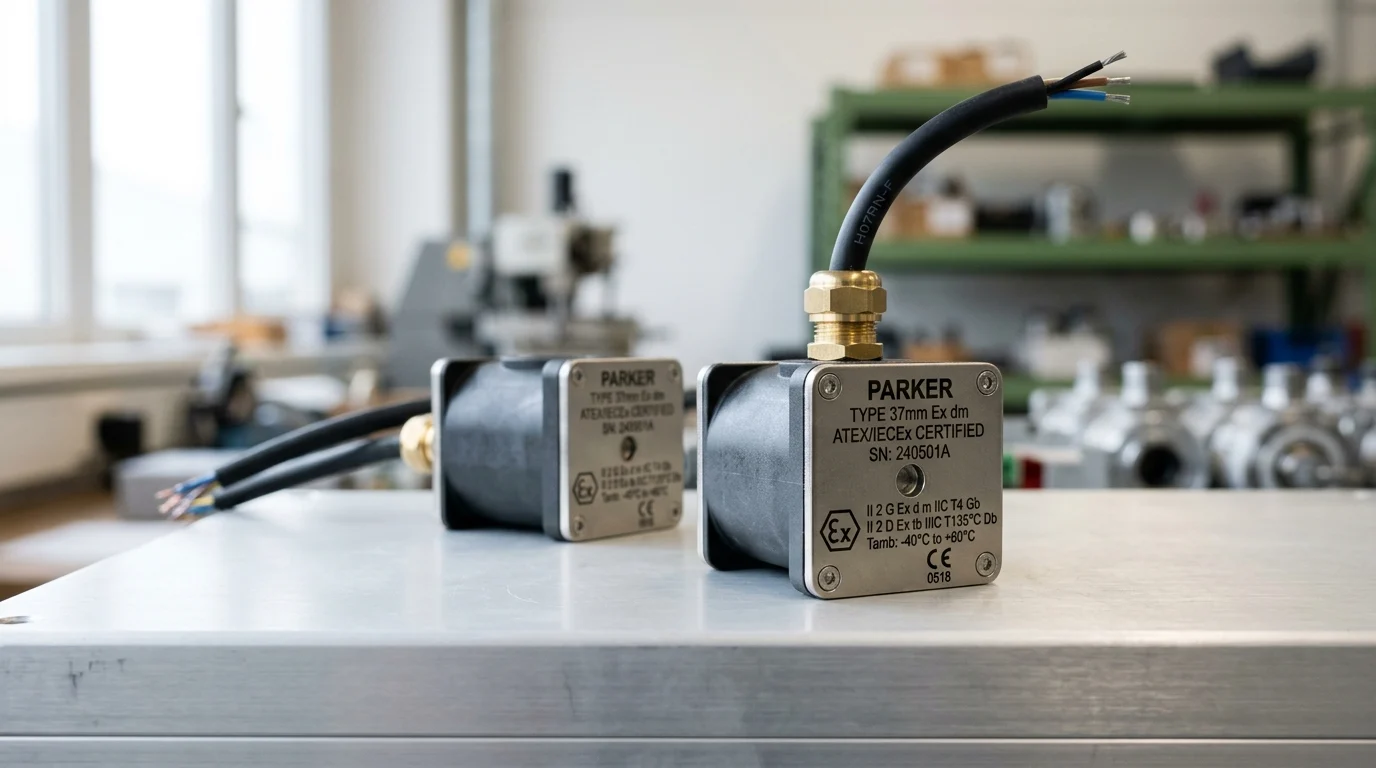
Hazardous-area automation leaves little room for compromise: a solenoid coil must switch reliably while preventing sparks, hot surfaces, or internal faults from becoming ignition sources. Parker Hannifin’s compact 37 mm certified coil addresses that challenge for European and international installations by combining flameproof and encapsulated protection concepts in a space-efficient package. This article explains how the legacy Ex dm approach maps to today’s Ex db mb terminology, where the coil is typically applied, and why certification details such as ATEX, IECEx, temperature class, and approved valve combinations matter. For engineers and specifiers, these distinctions can determine whether a valve assembly is compliant, durable, and safe in volatile operating environments.
Understanding Parker’s 37 mm ATEX and IECEx Certified Coil
The deployment of electrical equipment in potentially explosive atmospheres requires adherence to international safety standards. Parker Hannifin’s 37 mm Ex dm certified coil represents a proven, advanced solution in solenoid valve actuation for hazardous European and global environments. Designed to mitigate ignition risks without compromising operational efficiency, this component meets compact footprint requirements while maintaining strict industrial safety standards. As industrial automation expands into volatile sectors, precision-engineered components are required to operate safely under extreme conditions. The 37 mm form factor provides a practical, compliant solution for space-constrained manifolds.
Key definitions and protection concepts
The legacy “Ex dm” designation (formally marked as Ex db mb under current ATEX/IECEx nomenclature) indicates a dual-protection methodology combining flameproof (Ex db) and encapsulation (Ex mb) concepts. On a system level, the flameproof (Ex db) rating typically applies to the complete valve-and-coil assembly or the specific armature tube housing. It is critical to note that pairing the coil with a non-matching valve body can void the certification unless specifically tested and listed as a combination. This ensures that any internal ignition within that cavity is mechanically contained and cooled before it can ignite the surrounding atmosphere. Simultaneously, encapsulation (Ex mb) surrounds the electrical windings and connections in a specialized, thermally conductive resin to prevent direct contact with explosive gases or combustible dust. Operating at optimized power levels for both alternating and direct current applications, this combined protection concept extends the operational lifespan of the coil by shielding sensitive copper windings from corrosive ambient moisture and airborne contaminants.
Where the Ex dm coil is used
Industries processing volatile hydrocarbons, combustible dusts, or reactive chemicals rely heavily on these certified coils to maintain automated control systems safely. Typical deployments include offshore oil platforms, downstream chemical processing plants, agricultural grain silos, and pharmaceutical production facilities where solenoid valves control complex fluid and gas flows. The Parker 37 mm Ex dm coil is engineered to withstand severe environmental extremes, functioning reliably across a broad ambient temperature range (typically from -40°C to +65°C). However, the exact ambient temperature range and IP ratings may vary depending on the coil’s power rating, duty cycle, or specific product variant. Furthermore, surface temperature limits must remain within the stated Temperature Class (T-code) under all operating conditions to ensure safety. This thermal tolerance ensures continuous operation in both freezing arctic installations and high-heat industrial sectors, reducing the need for costly climate-control enclosures.
Comparing Certification, Compliance, and Performance
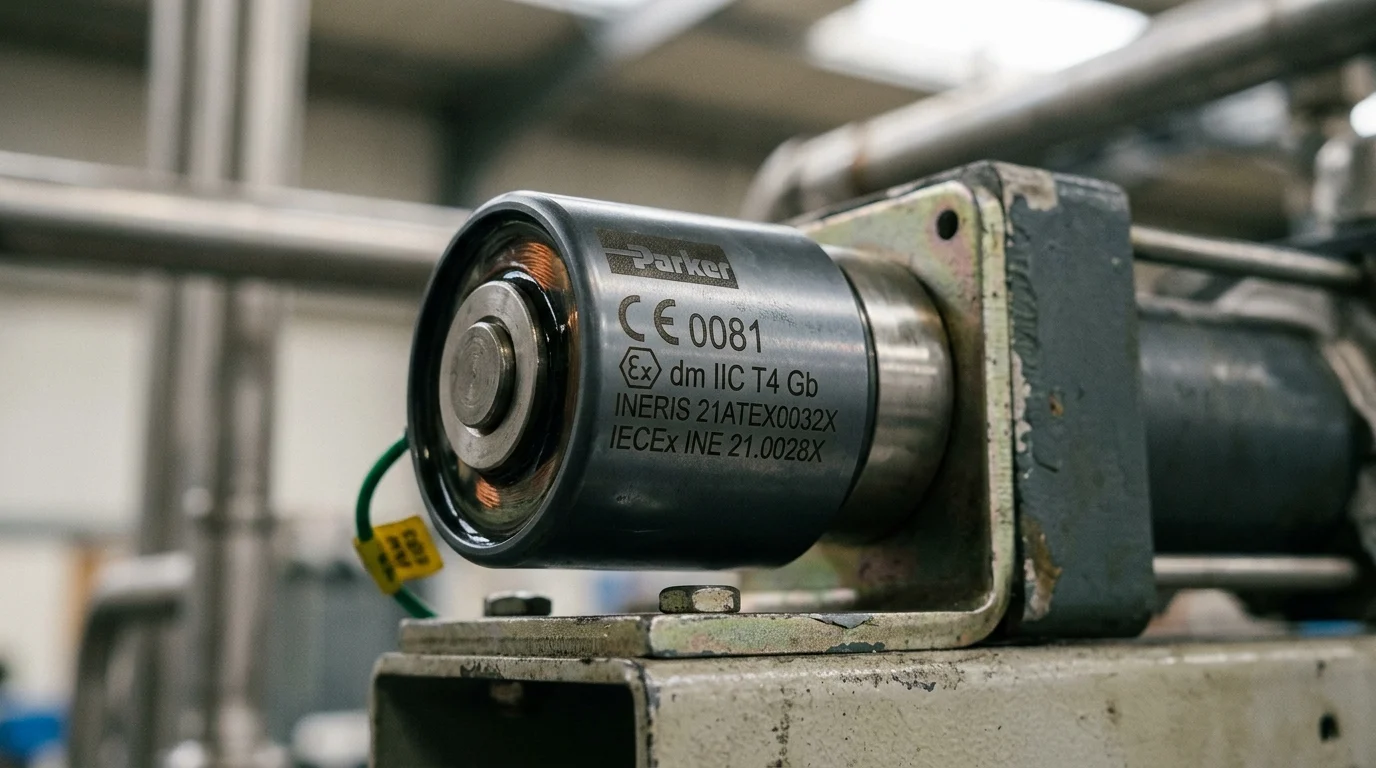
Evaluating hazardous area coils requires comparing different regulatory frameworks and performance baselines. The ATEX Directive (2014/34/EU) is a mandatory legal obligation for equipment intended for use in explosive atmospheres within the European Union. In contrast, the IECEx system is a voluntary international certification scheme designed to facilitate global trade by providing a standardized, globally recognized pathway for compliance. While ATEX is legally required in Europe, IECEx is often accepted in regions without their own specific statutory frameworks. By understanding these certification schemes alongside operational performance metrics—such as the component’s Mean Time Between Failures (MTBF)—engineers and procurement specialists can distinguish between varying levels of compliance and reliability, which is essential for ensuring facility safety and passing insurance audits.
Certification scope and technical specifications
Parker’s 37 mm Ex dm coil is engineered to meet requirements for Gas Zones 1 and 2, as well as Dust Zones 21 and 22. This versatility allows facilities to standardize on a single coil type across multiple plant areas, simplifying inventory management. Standard technical specifications include ingress protection ratings of IP66/IP67, ensuring the internal electronics remain completely isolated from heavy seas, powerful water jets, and fine particulate matter.
| Specification Parameter | Technical Detail* | Operational Benefit |
|---|---|---|
| Coil Width | 37 mm | Enables high-density manifold mounting |
| Protection Concept | Ex db mb | Dual-layer ignition prevention |
| Hazardous Zones | 1, 2 (Gas) / 21, 22 (Dust) | Broad cross-industry applicability |
| Equipment Protection Level (EPL) | Gb / Db | Certified for high-protection environments |
| Temperature Class (T-code) | T4, T5, or T6 (variant dependent) | Ensures surface temps stay below ignition thresholds |
| Ingress Protection | IP66 / IP67 | Withstands high-pressure washdowns |
| Temperature Range | -40°C to +65°C | Reliable in extreme climates |
| Voltage Tolerance | ±10% of nominal rating | Protects against grid fluctuations |
*Note: These are typical values. Always confirm exact T-codes, temperature ranges, and voltage tolerances with the official Parker datasheet for your specific variant.
Compliance evidence buyers should verify
Procurement and engineering teams must verify compliance documentation before integrating these components into infrastructure. Buyers should formally request the EU-Type Examination Certificate issued by a recognized Notified Body, alongside the manufacturer’s official Declaration of Conformity. Physical inspection of the coil upon receipt should display clear, indelible ATEX and IECEx traceability markings. Buyers must distinguish between these requirements: the CE mark accompanied by the Notified Body identification number is specific to ATEX, whereas IECEx compliance is indicated by its own distinct logo and certificate number. Conflating these during physical inspection could cause compliance verification failures during audits. While under Directive 2014/34/EU the obligation to retain compliance records for 10 years generally rests with the manufacturer or their authorized representative, end-user facilities are still advised to keep copies of certificates on hand to demonstrate continuous safety diligence.
Specifying and Sourcing the Right Coil
Successfully integrating Parker’s 37 mm Ex dm coil into an industrial fluid control system requires careful alignment of electrical, mechanical, and logistical parameters. Navigating the procurement process effectively ensures project timelines remain intact while meeting all safety standards. A proactive approach to specifying these hazardous area components minimizes integration bottlenecks and prevents costly operational downtime during facility commissioning.
Procurement and implementation steps
The procurement phase demands meticulous attention to specific project requirements, particularly concerning connection types and supply chain lead times.
Key Takeaways
- Use ATEX-certified coils for EU hazardous-area installations because ATEX Directive 2014/34/EU is a legal requirement for explosive atmospheres.
- Specify IECEx certification when equipment may be deployed internationally, as it provides a widely recognized compliance pathway outside Europe.
- Verify the complete coil-and-valve combination before installation, because using an unapproved valve body can void the hazardous-area certification.
- Confirm the exact ambient temperature range, IP rating, duty cycle, and T-code for the selected coil variant before approving it for service.
- Consider the 37 mm form factor for space-constrained manifolds where certified solenoid actuation is required without enlarging the control assembly.
Frequently Asked Questions
What does Ex dm mean on Parker’s 37 mm coil?
Ex dm is a legacy marking for a dual protection concept now commonly identified as Ex db mb. It combines flameproof protection with encapsulated electrical windings to reduce ignition risk in explosive gas or dust atmospheres.
Is ATEX certification the same as IECEx certification?
No. ATEX is a mandatory legal requirement for equipment used in explosive atmospheres within the EU, while IECEx is an international certification scheme that supports broader global acceptance and standardized compliance.
Where are 37 mm hazardous-area coils typically used?
They are commonly used in offshore oil and gas, chemical processing, grain handling, pharmaceutical production, and other facilities where solenoid valves operate near flammable gases, vapors, or combustible dusts.
Can the certified coil be fitted to any valve body?
No. Certification may only apply to tested and approved coil-and-valve combinations. Pairing the coil with an unlisted or incompatible valve body can invalidate hazardous-area approval.
What temperature range can the coil support?
Parker’s 37 mm Ex dm coil is typically designed for harsh environments, often from -40°C to +65°C. Exact limits depend on the product variant, duty cycle, power rating, IP rating, and approved temperature class.
Post time: Jul-24-2026