
Introduction
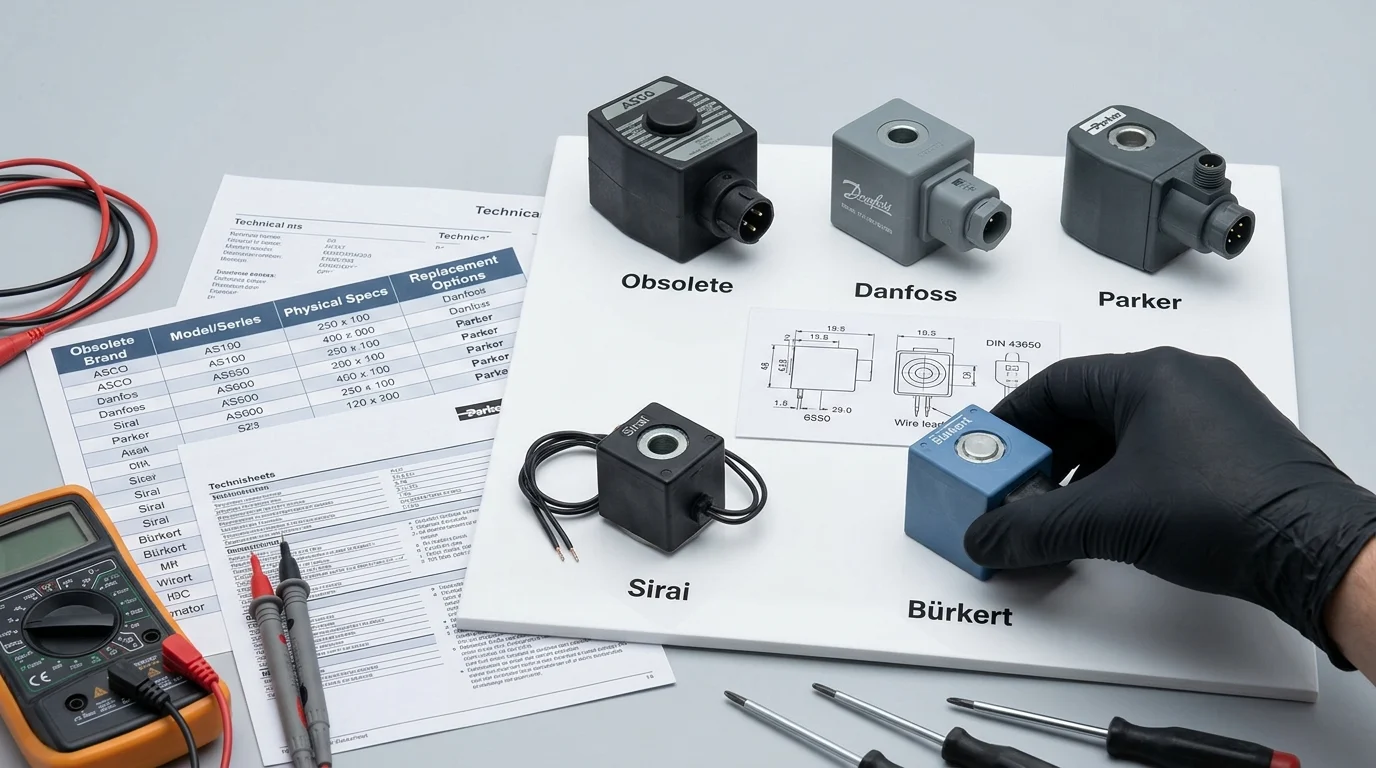
When a legacy solenoid coil from ASCO, Sirai, or Parker becomes obsolete, the challenge is rarely just sourcing a part—it is preserving valve performance without redesigning the assembly. This guide explains how to evaluate compatible replacement coils for true drop-in interchangeability, with attention to critical factors such as bore diameter, overall dimensions, voltage, insulation class, connector format, and operating environment. By the end, readers will understand how to reduce downtime, avoid unnecessary full-valve replacement, and make more confident maintenance or purchasing decisions when original European coil models are no longer available.
Coil Interchangeability Basics
Industrial fluid control systems rely heavily on precision solenoid valves to manage the flow of liquids and gases. When legacy European brands such as ASCO, Sirai, or Parker phase out specific coil models, maintenance teams and procurement officers face significant operational risks. Finding a compatible, high-quality alternative is critical to preventing the forced, expensive replacement of entire valve bodies.
Defining interchangeability for obsolete European coils
In the context of solenoid coils, interchangeability means achieving a direct drop-in replacement that requires zero modifications to the existing valve manifold or armature tube. The most critical factor for successful interchangeability is the component’s physical geometry. The internal bore diameter of the replacement coil must match the obsolete unit with strict dimensional tolerances—typically within ±0.1 mm—to ensure proper magnetic flux transfer and prevent mechanical binding. Furthermore, the overall height and width of the overmolded casing must align with the original spatial constraints. This is especially important in densely packed multi-valve installations where clearance is limited.
Why buyers consider compatible replacements
Procurement managers and engineers pursue compatible replacements primarily due to the severe supply chain constraints associated with obsolete parts. Legacy European coils often face extended lead times as they approach end-of-life, sometimes stretching from 16 to 24 weeks—if they are available at all. By transitioning to specialized coil manufacturers, industrial facilities can reliably reduce lead times to a standard two to four weeks. Additionally, compatible alternatives typically offer a 30% to 50% cost reduction compared to tracking down rare, discontinued OEM stock. Specialized manufacturers also tend to offer more flexible Minimum Order Quantities (MOQs), allowing buyers to procure 50 to 100 units instead of the 500-unit minimums often demanded for legacy OEM production runs.
Key Specifications to Match

Replacing a discontinued coil requires more than just verifying physical dimensions. The electrical and environmental specifications must mirror or exceed the original component to ensure safe, reliable actuation under continuous duty cycles and harsh ambient conditions.
Technical parameters to verify first
The primary technical parameters to verify include supply voltage, power consumption (wattage), and electrical resistance. A mismatch in power consumption can lead to insufficient magnetic lifting force or excessive heat generation, potentially damaging the valve. Engineers must also carefully verify the insulation class. Upgrading from standard Class F (155°C) to Class H (180°C) insulation provides an additional thermal safety margin, prolonging the coil’s lifespan. Environmental protection is equally critical. The replacement coil must maintain an equivalent or superior Ingress Protection rating, such as moving from a legacy IP65 standard to a fully sealed IP67 enclosure to resist moisture and dust in industrial environments. Finally, electrical resistance tolerances should remain within ±10% at an ambient temperature of 20°C to guarantee consistent electromagnetic performance.
Using comparison tables to evaluate alternatives
Utilizing a structured comparison table simplifies the evaluation of alternative coils against obsolete ASCO, Sirai, or Parker models. This side-by-side analysis ensures no critical specification is overlooked during the cross-referencing process.
| Specification | Legacy European OEM (Typical) | High-Quality Compatible Alternative |
|---|---|---|
| Internal Bore Diameter | 14.2 mm | 14.2 mm (Tolerance ±0.05 mm) |
| Power Consumption (DC) | 18 Watts | 15 – 18 Watts |
| Insulation Thermal Class | Class F (155°C) | Class H (180°C) |
| Ingress Protection | IP65 | IP65 / IP67 |
| Standard Lead Time | 16 – 24 Weeks (or Obsolete) | 2 – 4 Weeks |
By mapping these parameters, engineers can confidently approve alternatives that deliver an identical mechanical fit while often providing modernized electrical efficiency and superior thermal endurance.
Validation and Supplier Approval
Identifying a matching specification is only the first phase of the transition. Validating the alternative coil and officially approving the new manufacturing supplier are crucial steps to mitigate operational risks. A systematic validation approach ensures the replacement performs flawlessly over its intended lifecycle.
Low-risk replacement process
Implementing a low-risk replacement process begins with rigorous prototype testing. Before mass deployment across a facility, the compatible coil should undergo a continuous cycling test of at least 100,000 cycles to verify mechanical durability and magnetic consistency. Additionally, a 72-hour continuous energization heat rise test is highly recommended to confirm that the coil’s operating temperature stabilizes well below the maximum threshold of its insulation class—for example, maintaining a temperature rise below 115°C under constant load. Field testing a small pilot batch on non-critical fluid lines further validates performance under actual pressure and ambient conditions, ensuring the replacement coil safely actuates the legacy valve without triggering system faults.
Comparing suppliers and manufacturing capability
Supplier capability is just as important as the product specification. When replacing renowned brands, buyers must evaluate alternative manufacturers based on their quality management systems and production technology. Leading manufacturers, such as those specializing in automotive and engineering machinery components, utilize automated winding, precise wire tensioning, and advanced epoxy encapsulation processes to maintain strict quality control. Buyers should look for suppliers operating under ISO 9001 or IATF 16949 standards, demonstrating manufacturing defect rates strictly below 50 Parts Per Million (PPM). Assessing a supplier’s core competencies—from raw material selection for the bobbin to the final overmolding process—ensures the delivered replacement coils will match the reliability of the original European components while providing long-term supply chain stability.
Key Takeaways
- The most important conclusions and rationale for Coil Interchangeability Guide: Replacing Obsolete European Brands (ASCO, Sirai, Parker) with Compatible Alternatives
- Specs, compliance, and risk checks worth validating before you commit
- Practical next steps and caveats readers can apply immediately
Frequently Asked Questions
What makes a coil truly interchangeable with obsolete ASCO, Sirai, or Parker models?
It must match the original bore diameter, height, width, voltage, wattage, and connector style so it installs as a true drop-in replacement without modifying the valve or manifold.
Which specs should I verify first before ordering a replacement coil?
Check bore diameter, supply voltage, power consumption, resistance, insulation class, and IP rating first. These directly affect fit, magnetic performance, heat, and environmental reliability.
Can I upgrade to a higher insulation class or IP rating?
Yes, if the coil still matches the original mechanical and electrical requirements. Moving from Class F to Class H or from IP65 to IP67 can improve durability in harsh service.
Why choose a compatible alternative instead of replacing the whole valve?
A matched replacement coil avoids changing the valve body, reduces downtime, and usually lowers cost. It also helps when original European OEM coils are obsolete or have long lead times.
How should I validate a new coil supplier before full deployment?
Start with a sample or pilot batch, confirm dimensions and resistance, then test continuous-duty operation and temperature rise on the actual valve. Approve the supplier only after successful field results.
Post time: Jun-02-2026