
Introduction
In European high-speed packaging lines, solenoid coil selection is a reliability and performance decision, not just a catalog choice. When valves and actuators switch thousands of times per minute, coil sizing, insulation class, voltage tolerance, thermal behavior, and connector standard directly affect response time, service life, and unplanned stoppages. This article explains how to evaluate rapid-cycling demands in practical terms, including duty cycle, switching frequency, heat rise, and compatibility with common European machine and power requirements. It also helps readers connect electrical specifications to line throughput, maintenance intervals, and total cost of ownership before moving into detailed selection criteria.
Specifying Solenoid Coils for Rapid-Cycling Applications
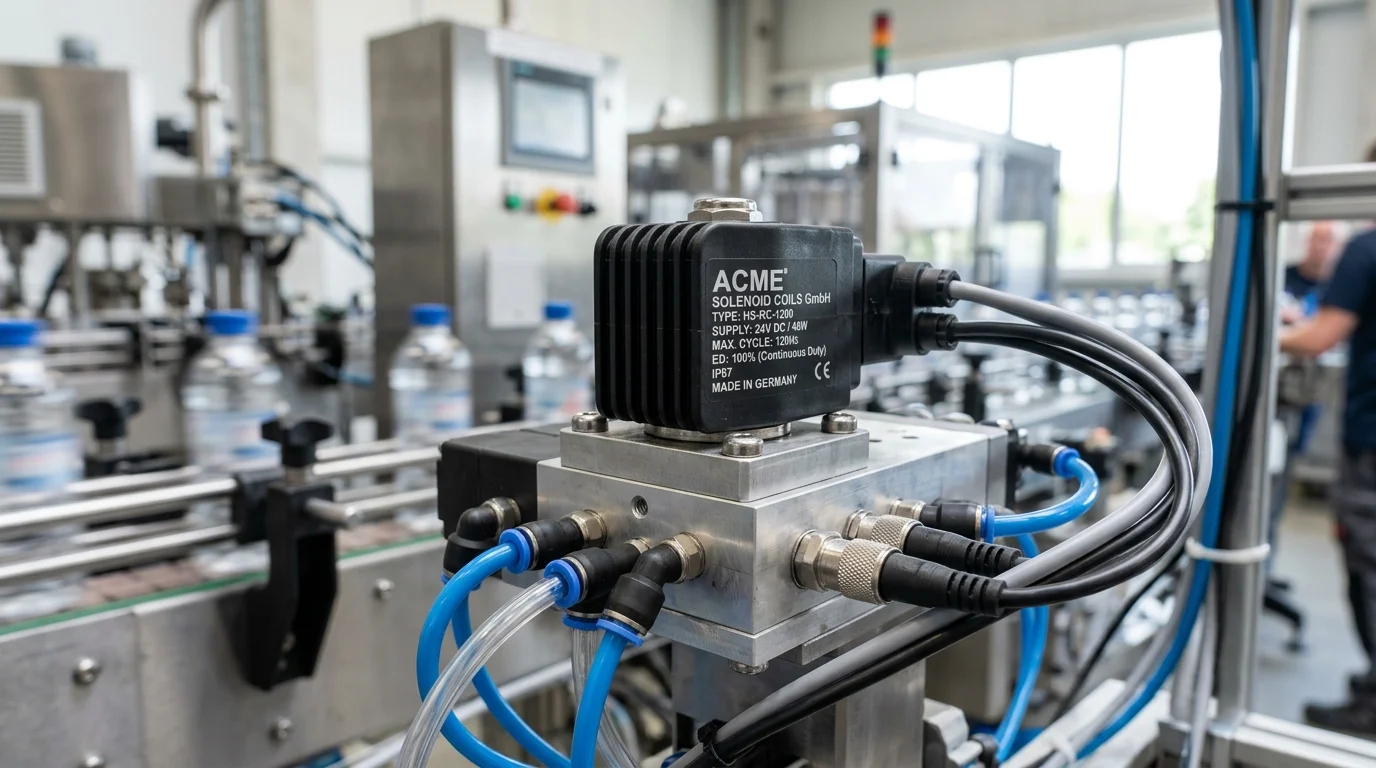
High-speed packaging lines across Europe—such as horizontal flow wrappers, rotary cartoners, and advanced blister machines—rely on precision actuation to maintain throughput rates that frequently exceed 500 units per minute. In these demanding environments, the solenoid coil acts as the critical interface between electronic control systems and pneumatic or mechanical actuation. Specifying the correct coil for rapid-cycling applications requires rigorous analysis of electromechanical dynamics, as standard industrial coils will rapidly degrade under the thermal and mechanical stresses of high-frequency switching. The cost of downtime in European high-volume Fast-Moving Consumer Goods (FMCG) packaging can easily exceed €10,000 per hour, making coil reliability paramount.
Throughput, duty cycle, and operating definitions
Rapid-cycling applications are typically defined by switching frequencies exceeding 30 to 50 Hz, translating to operating rates of up to 3,000 cycles per minute in automated sorting or rejection mechanisms. At these speeds, the duty cycle—expressed as the ratio of energized time to total cycle time—dictates the thermal load. Engineers must specify coils rated for 100% ED (continuous duty) even in intermittent applications if the off-time is less than 10 milliseconds, as this is insufficient for thermal dissipation. Furthermore, European packaging environments often require IP65 or IP69K ingress protection against aggressive chemical washdown procedures. This heavy encapsulation restricts convective cooling, necessitating optimized coil potting materials with thermal conductivities exceeding 0.8 W/m·K.
Failure modes and performance metrics
The primary failure modes in high-speed solenoid coils include thermal degradation of the copper wire enamel, mechanical fatigue of the bobbin structure, and core tube wear due to armature impact. Performance metrics must account for response time consistency; a shift in actuation time of just 5 to 10 milliseconds can cause catastrophic jamming in synchronous packaging lines. To mitigate these risks, engineers evaluate the Mean Time Between Failures (MTBF). For rapid-cycling pneumatics, a baseline MTBF of 50 million to 100 million cycles is the industry standard. Advanced diagnostic metrics, such as real-time current profile monitoring via IO-Link interfaces, are increasingly utilized to detect increases in armature friction before complete coil burnout occurs.
Key Electrical, Thermal, and Mechanical Criteria
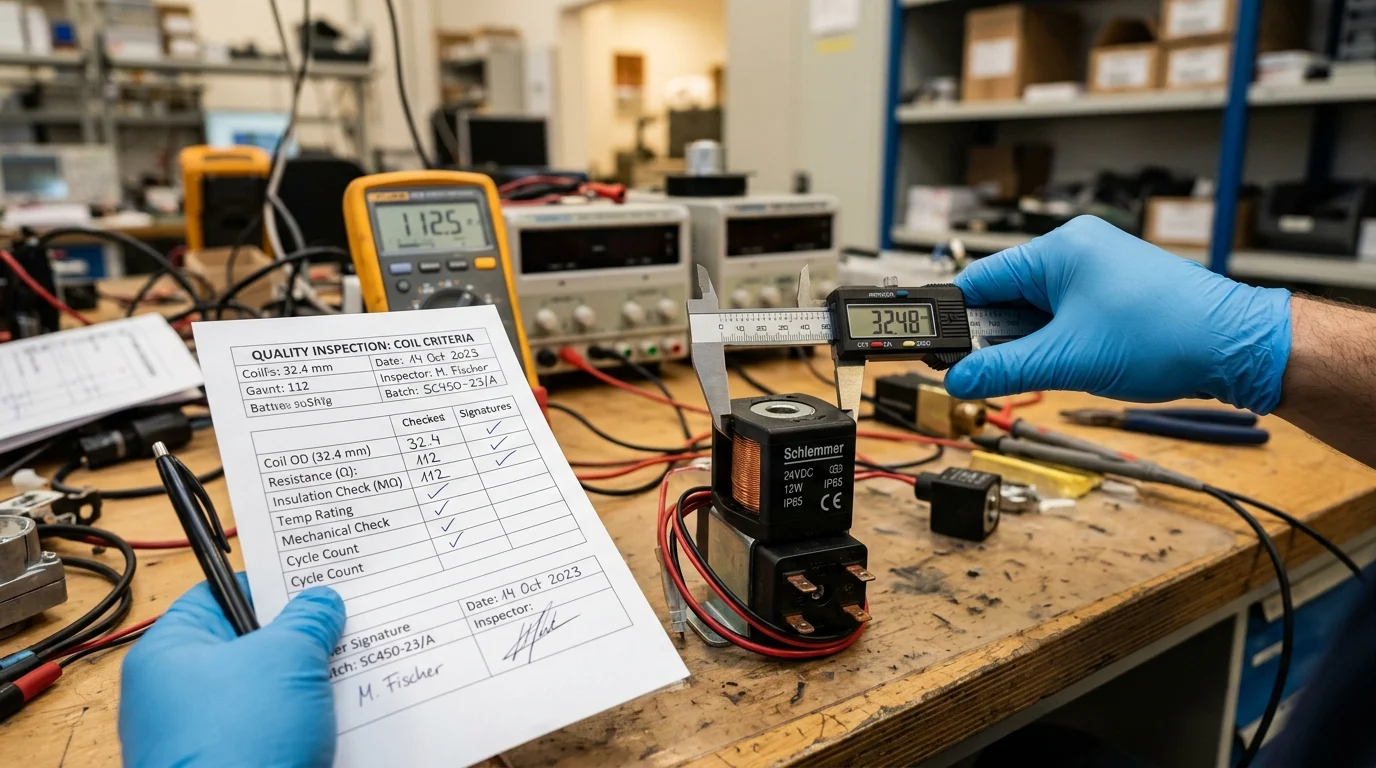
Selecting the optimal solenoid coil necessitates a precise balance between magnetic flux generation, electrical efficiency, and thermal dissipation. In high-speed packaging equipment, the coil must generate sufficient initial force to overcome mechanical inertia and return-spring tension almost instantaneously—typically within 8 to 12 milliseconds—while avoiding excessive heat accumulation.
Voltage, inrush, holding, and insulation
Operating voltage selection directly impacts both actuation speed and thermal performance. While standard 24 VDC systems are ubiquitous in European automation, rapid-cycling applications frequently utilize “hit-and-hold” (overexcitation) control strategies via Pulse Width Modulation (PWM). In this configuration, a coil may be pulsed with a full 24 VDC or even 48 VDC for 10 to 20 milliseconds to achieve rapid armature movement before the control system drops the holding voltage to 25% of the nominal value (e.g., 6 VDC). This technique reduces holding power consumption by up to 75%, drastically lowering internal temperatures. Consequently, specifying the correct insulation class is paramount. Class F (rated to 155°C) is typically the minimum requirement for continuous operation, though Class H (180°C) is preferred for enclosed, high-density valve manifolds where ambient temperatures can easily exceed 60°C.
AC vs DC coil comparison points
Historically, alternating current (AC) coils were favored for rapid actuation due to their high initial inrush current, which naturally provides a strong peak pull force. However, direct current (DC) coils have become the definitive standard in modern European packaging machinery due to the prevalence of sophisticated solid-state PLCs and the elimination of AC shading-ring fatigue. The following table highlights the critical differences when specifying for rapid-cycling applications:
| Specification Parameter | AC Solenoid Coils | DC Solenoid Coils |
|---|---|---|
| Inrush Current | High (typically 2-3x holding) | Constant (requires PWM for hit-and-hold) |
| Actuation Speed | Fast (10-15 ms) | Moderate to Fast (15-25 ms standard) |
| Failure Mode on Jam | Coil burnout (high sustained current) | No current spike; thermal stability maintained |
| Cycle Life Expectancy | Lower (due to mechanical shading ring) | High (>50 million cycles) |
| Control Integration | Requires relays or triacs | Direct PLC / Solid-state compatible |
Validation, Sourcing, and Approval
Beyond electromechanical specifications, the successful deployment of solenoid coils in European packaging lines requires rigorous validation and strategic supplier integration. Procurement engineering teams must ensure that the selected components not only meet technical performance criteria but also align with regional regulatory frameworks and complex supply chain requirements.
Testing, compliance, and documentation
Regulatory compliance is non-negotiable for equipment deployed within the European Economic Area. Solenoid coils must carry the CE mark, demonstrating adherence to the Low Voltage Directive (LVD 2014/35/EU) for applicable voltage ranges, as well as the Electromagnetic Compatibility (EMC) Directive. Furthermore, winding wire and potting materials must strictly comply with RoHS 3 and REACH regulations regarding hazardous substances. Validation testing protocols for rapid-cycling coils should include continuous dielectric strength testing—typically applying 1,500 V AC for 60 seconds to verify insulation integrity—and accelerated life testing (ALT) under maximum thermal load. Documentation, including full material traceability and thermal rise test reports, must be maintained in the technical file for auditing purposes.
Lead time, supplier capability, and approval decisions
Evaluating supplier capability is a critical phase in the approval process. Engineering and procurement teams must assess lead times to ensure they align with production schedules and maintenance demands, ultimately driving reliable final approval decisions for high-speed packaging operations.
Key Takeaways
- The most important conclusions and rationale for How to Specify Solenoid Coils for Rapid Cycling Applications in European High-Speed Packaging Lines
- Specs, compliance, and risk checks worth validating before you commit
- Practical next steps and caveats readers can apply immediately
Frequently Asked Questions
What duty rating should a solenoid coil have for rapid cycling packaging lines?
Use a 100% ED continuous-duty coil when switching is above 30–50 Hz or off-time is under 10 ms, since brief pauses do not allow enough cooling.
Why are DC coils usually preferred over AC coils in European high-speed packaging machines?
DC coils integrate better with PLCs, support PWM hit-and-hold control, avoid shading-ring fatigue, and typically deliver longer cycle life in fast, repetitive applications.
Which insulation class is suitable for enclosed high-speed valve manifolds?
Class F is the minimum for continuous operation, but Class H is the safer choice when manifolds are enclosed and ambient temperatures can rise above 60°C.
How can heat be reduced without slowing solenoid response?
Specify PWM hit-and-hold control: apply full voltage for 10–20 ms to pull in quickly, then drop to about 25% holding voltage to cut coil heating.
What ingress protection should coils have on washdown packaging lines?
Choose IP65 or IP69K coils for lines exposed to chemical washdown, and confirm the potting material has good thermal conductivity to manage trapped heat.
Post time: Jun-02-2026