
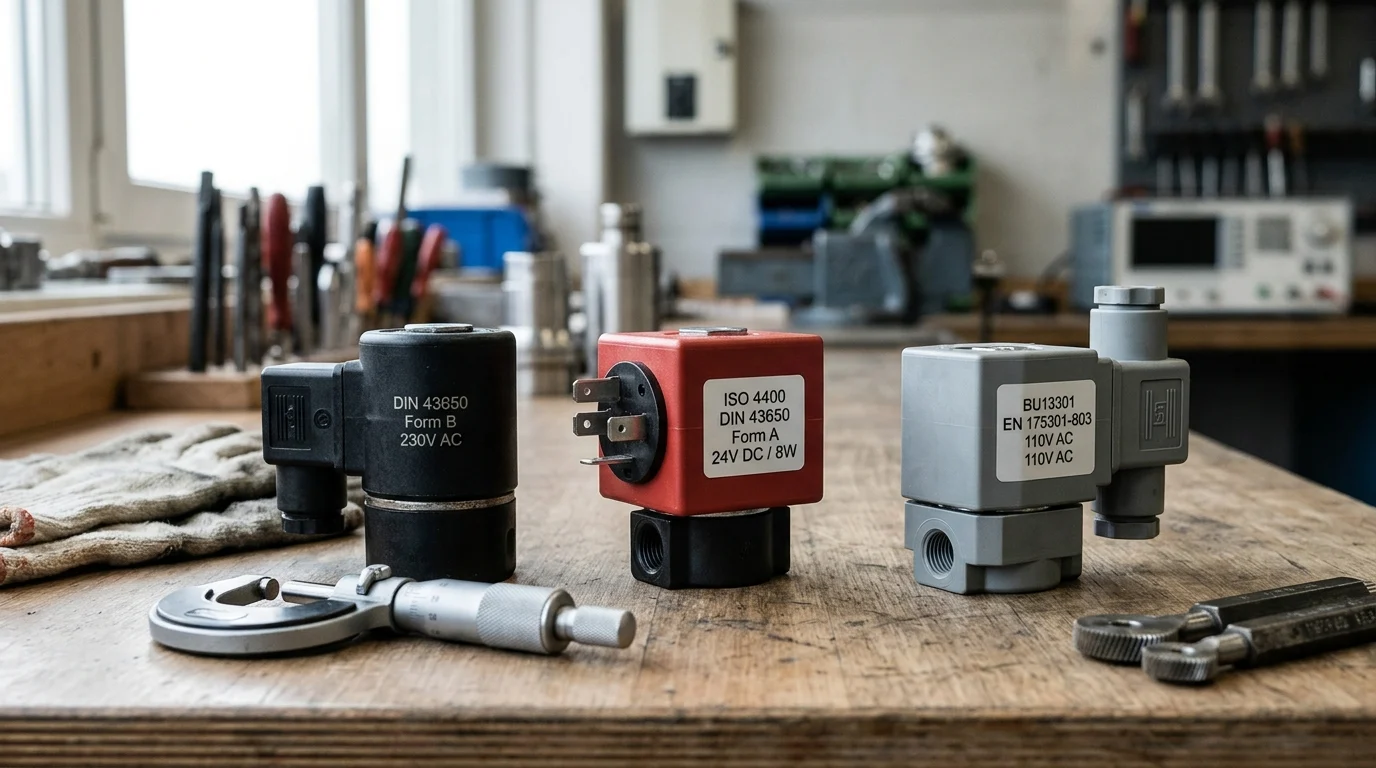
A replacement solenoid coil may look like a simple plug-in part, but in European valve systems, visual similarity can be misleading. DIN, EN, and ISO references often describe connector forms—not complete coil performance, leaving critical details such as voltage, wattage, thermal class, stem fit, and magnetic behavior outside the standard. For maintenance engineers and procurement teams, that distinction can determine whether a repair restores production or triggers overheating, downtime, warranty disputes, or safety noncompliance. This article explains how legacy DIN 43650, EN 175301-803, and ISO 4400 relate to one another, where interchangeability is valid, and what checks are essential before approving a substitute coil.
Why Coil Interchangeability Matters in European Valve Standards
Solenoid valves are foundational components in European industrial automation, controlling fluid and gas flow across countless applications. The electromagnetic coil, which actuates the internal valve mechanism, is often the most frequently replaced part due to continuous electrical wear or environmental thermal stress. Understanding the complex landscape of European valve standards is essential for engineers and procurement professionals seeking reliable replacement parts without compromising system integrity.
Historically, the German Institute for Standardization (DIN) set the benchmark for these electromechanical components. However, modern facilities must now work with harmonized European Norms (EN) and International Organization for Standardization (ISO) frameworks. It is important to note that EN 175301-803 is the direct successor to the legacy DIN 43650 standard. Furthermore, standards like ISO 4400 (which corresponds specifically to the Form A connector family) and related EN standards specify only the external connector geometry. They do not define internal coil electrical or magnetic specifications, meaning readers should not expect a single, universal “ISO coil specification.” Grasping these nuances ensures continuous operation, minimizes downtime, and prevents costly damage to pneumatic and hydraulic control systems.
Benefits for Procurement and Maintenance
Standardizing replacement components yields measurable operational advantages, significantly reducing downtime in complex facilities that manage hundreds of automated fluid control loops. When procurement teams successfully identify cross-compatible coils under standards like EN 175301-803, they can consolidate supplier networks and streamline purchasing workflows.
Facilities that proactively use interchangeable parts frequently report substantial inventory cost savings. Instead of stocking proprietary OEM coils for every distinct valve brand on the factory floor, maintenance departments can maintain a strategic, consolidated reserve of standardized equivalents. This agile approach can reduce emergency procurement lead times from several weeks for niche components down to just a few days through localized industrial distribution channels.
Risks of Assuming Coils Are Interchangeable
Despite the strong visual similarities among European standardized coils, assuming universal plug-and-play compatibility carries severe operational hazards. Matching an EN 175301-803 plug guarantees electrical connection, but it does not guarantee internal magnetic interchangeability. Even if the connector form, voltage, and power ratings match, interchangeability is not guaranteed because OEM-specific coil encapsulation, thermal classes, mounting hardware, and magnetic circuit designs can differ significantly.
Furthermore, using non-OEM coils may void manufacturer warranties or violate critical safety requirements. It is vital to distinguish between the CE mark—which is a mandatory conformity marking for products sold within the European Economic Area—and rigorous safety certifications like ATEX or UL, which are strictly required for hazardous or explosive environments.
For example, installing a coil designed for a 14.5mm armature tube onto a 13mm stem might seem like an easy fit, but the resulting air gap severely disrupts the magnetic field. This inefficiency causes the coil to draw excessive current to compensate for the lost magnetic force, leading to rapid overheating. In such scenarios, thermal degradation can cause the substitute coil’s internal copper windings to fail prematurely. This not only destroys the replacement part but can also trigger localized electrical faults or unexpected valve closures that halt entire production lines.
How to Compare DIN, EN, and ISO Coil Specifications
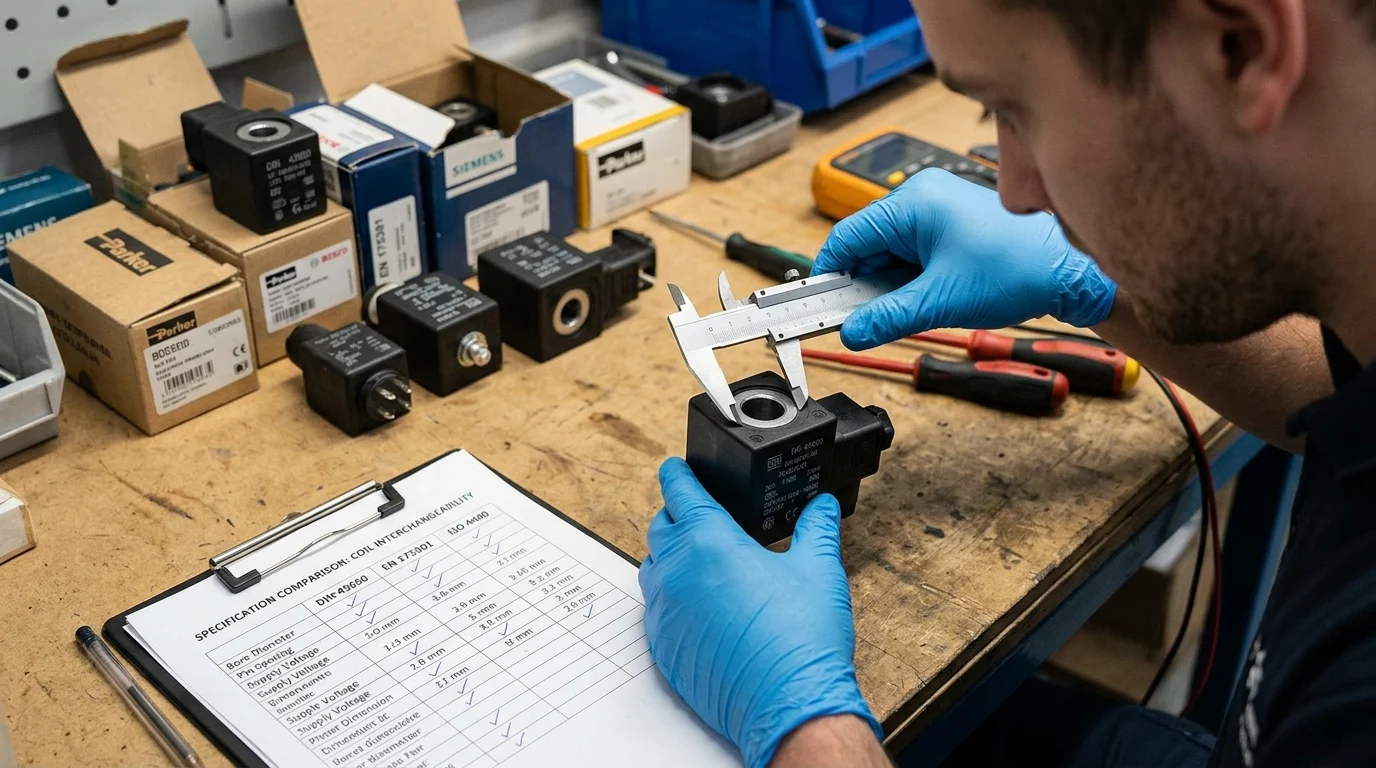
Accurately matching a replacement coil requires a detailed, side-by-side comparison of mechanical dimensions and electrical ratings as defined by regional and international regulatory bodies. The shift from legacy DIN standards to harmonized EN and ISO specifications has successfully standardized physical connector geometries, but the internal coil parameters remain highly variable depending on the specific valve application.
Engineers must isolate the core variables that dictate electromechanical performance. A systematic evaluation of these intersecting parameters prevents the installation of a coil that underperforms, chatters under pressure, or fails prematurely under continuous industrial use.
Key Electrical and Mechanical Parameters
The most critical mechanical parameter is the internal diameter of the coil bore, which must mate seamlessly with the valve’s armature tube. Even a clearance discrepancy as minor as 0.5mm can drastically reduce the magnetic pulling force required to lift the internal plunger against high fluid pressures. Additionally, the overall height and external width of the coil housing must be verified to ensure clearance against adjacent components in tightly packed, multi-station valve manifolds. Environmental factors are equally crucial; engineers must verify the insulation class (e.g., Class F or H), IP rating for dust and moisture ingress, and how ambient and media temperatures influence coil sizing and resistance.
Connector interfaces are categorized by European standards to ensure safe, watertight electrical coupling. When sourcing parts, note that Form B connectors have two distinct pin spacings: 11 mm for the widely used “Industrial” standard and 10 mm for the true DIN specification. The table below outlines the primary connector forms utilized across DIN, EN, and ISO frameworks:
| Connector Type | Pin Spacing | Standard Compliance | Typical Application |
|---|---|---|---|
| Form A | 18 mm | EN 175301-803-A, ISO 4400 | Heavy-duty hydraulics, high-power pneumatics |
| Form B | 11 mm (Ind) / 10 mm (DIN) | EN 175301-803-B | Micro-pneumatics, compact manifolds |
| Form C | 9.4 mm / 8 mm | EN 175301-803-C | Miniature valves, low-power instrumentation |
Connector Forms, Voltage, Power Rating, and Duty Cycle
Beyond physical dimensions, specific electrical specifications govern the coil’s operational lifespan and safety profile. Voltage ratings must match the control system’s output exactly, whether operating on 24V DC, 110V AC, or 230V AC. Substituting an AC coil for a DC coil, or vice versa, is strictly prohibited due to differences in internal shading rings and inrush current behaviors. For DC coils, polarity requirements and the need for appropriate surge suppression or flyback diodes must be observed to protect control circuits. Standard European industrial coils typically permit a voltage tolerance of ±10%; exceeding this threshold accelerates thermal aging.
Power consumption, measured in Watts (W) for DC circuits or Volt-Amperes (VA) for AC circuits, dictates the total magnetic force generated.
Practical Steps to Verify Coil Compatibility
Ensuring the successful application of coil interchangeability in European valve standards requires a systematic approach. By strictly adhering to DIN, EN, and ISO specifications for seamless replacement, operators can prevent system failures and maintain industrial safety.
Maintenance Team Verification Checklist
To guarantee safe and functional coil interchangeability, maintenance personnel must evaluate several critical parameters before installation:
- Electrical Specifications: Verify voltage (AC/DC) and power consumption (Watts/VA). Mismatches can lead to immediate coil burnout or sluggish valve operation.
- Dimensional Tolerances: Measure the internal diameter and length of the coil armature. Standards such as ISO 15218 dictate specific pneumatic valve interfaces that must align perfectly.
- Connection Standards: Confirm the plug type. The widely utilized DIN EN 175301-803 (formerly DIN 43650) defines standardized electrical connectors, typically categorized into Forms A, B, and C.
- Ingress Protection: Check the IP rating according to EN 60529 (e.g., IP65 or IP67) to ensure adequate resistance to dust and moisture in the target environment.
OEM vs. Equivalent Replacement Decisions
When navigating DIN, EN, and ISO specifications for seamless replacement, procurement teams often weigh Original Equipment Manufacturer (OEM) parts against third-party equivalents.
OEM coils guarantee exact specification matches and preserve existing valve warranties, making them the lowest-risk option for critical infrastructure. Conversely, equivalent aftermarket replacements can significantly reduce operational costs and mitigate supply chain delays.
If selecting an equivalent, buyers must rigorously verify compliance with essential European directives. For instance, coils deployed in explosive atmospheres must hold formal ATEX Directive 2014/34/EU certification. Furthermore, all replacement coils must carry the CE mark to confirm adherence to the Low Voltage Directive (LVD) and Electromagnetic Compatibility (EMC) standards. Purchasing equivalent coils without these verifiable European certifications introduces severe liability and operational risks.
Key Takeaways
- Treat EN 175301-803 as the modern successor to DIN 43650, but use it to verify connector geometry rather than full coil compatibility.
- Do not assume interchangeability from appearance alone; confirm voltage, wattage, thermal class, mounting hardware, and magnetic circuit requirements before replacement.
- Use ISO 4400 mainly as a Form A connector reference, because it does not define a universal internal solenoid coil standard.
- Avoid fitting coils to mismatched armature tubes, since even a 14.5 mm coil on a 13 mm stem can create an air gap that causes overheating and premature failure.
- Check warranty terms and required certifications such as ATEX or UL before using non-OEM coils in hazardous, regulated, or safety-critical installations.
- Consolidate approved interchangeable coils in inventory to reduce emergency lead times and lower the cost of stocking brand-specific spare parts.
Frequently Asked Questions
Does EN 175301-803 replace DIN 43650?
Yes. EN 175301-803 is the harmonized successor to the legacy DIN 43650 connector standard commonly used on solenoid valve coils in Europe.
Does a matching connector make two valve coils interchangeable?
No. A matching EN 175301-803 or ISO 4400 connector confirms external geometry only; voltage, power, thermal class, magnetic design, and mounting dimensions must also match.
What does ISO 4400 specify for solenoid valve coils?
ISO 4400 corresponds mainly to the Form A connector family and defines connector interface geometry, not a universal internal coil specification.
Why can a visually similar replacement coil fail?
Small differences in armature tube diameter, air gap, encapsulation, or magnetic circuit design can increase current draw, cause overheating, and damage the copper windings.
Can non-OEM coils void warranties?
Yes. Using a non-OEM or uncertified coil may void the valve manufacturer’s warranty and can create compliance issues in regulated or safety-critical applications.
Post time: Jul-14-2026