
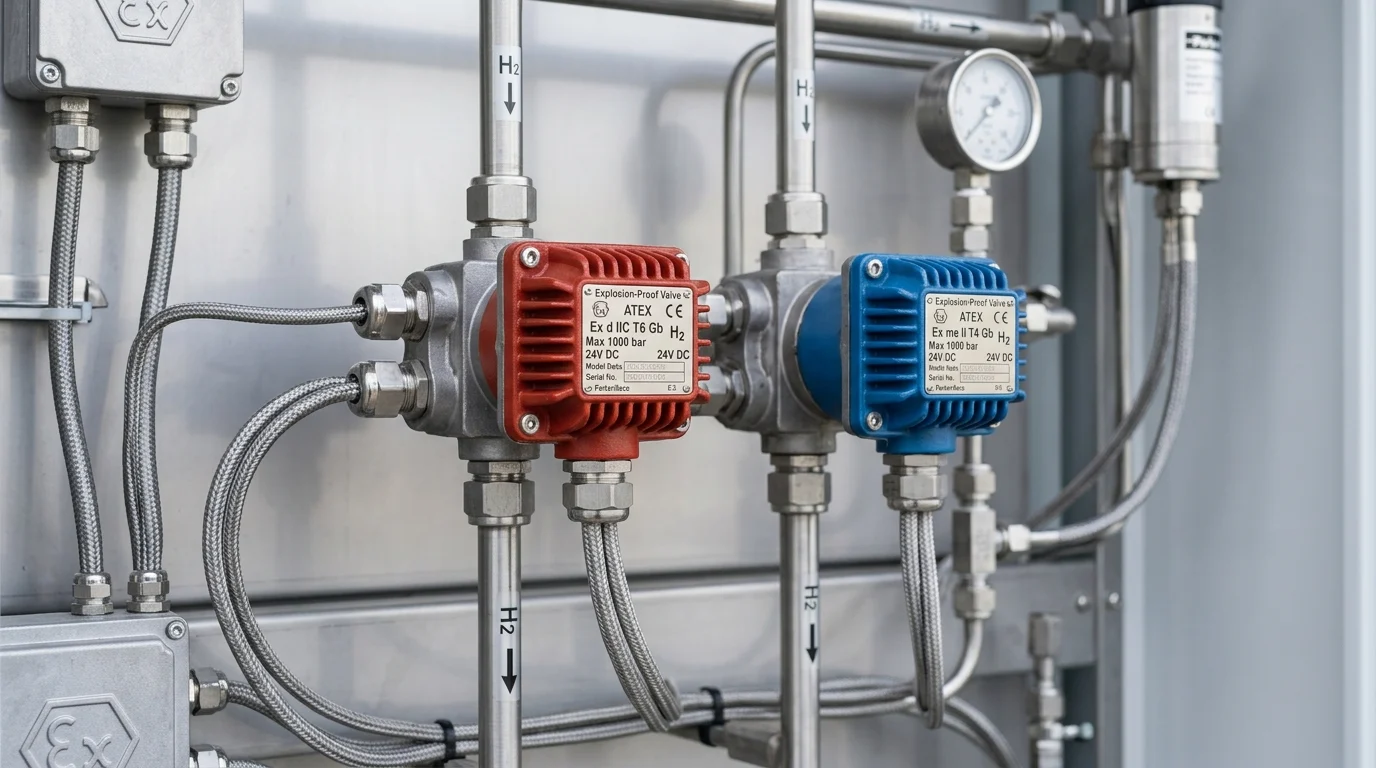
As Europe accelerates hydrogen mobility, every dispenser, storage bank, and shutdown line depends on components that can operate safely under extreme pressure and ignition risk. Hydrogen stations routinely manage 350 bar and 700 bar fueling, with cascade systems that may exceed 900 bar, while rapid fills can expose valves to pre-cooled gas near -40°C. In that environment, a solenoid valve is not just an on-off device; it is a safety-critical assembly where materials, sealing, coil protection, and certification must work together. This article explains the standards, hazardous-area concepts, and coil selection criteria that engineers should evaluate before specifying valves for hydrogen refueling infrastructure.
Explosion-Proof Solenoid Valves in Hydrogen Refueling Stations
The rapid expansion of hydrogen refueling stations across Europe demands highly specialized fluid control components capable of handling extreme operational stresses. In these facilities, hydrogen is typically dispensed following specific protocols—such as SAE J2601 for fueling, SAE J2600 for connection devices, and ISO 19885-1—at pressures of 350 bar for commercial heavy-duty vehicles and up to 700 bar for passenger cars. Depending on the station’s cascade storage design, system pressures can frequently exceed 900 bar. Managing this highly pressurized gas requires hazardous-area (colloquially referred to as “explosion-proof”) solenoid valves to regulate flow, control dispensing lines, and execute rapid emergency shutdowns. The structural integrity and electrical safety of these valves are paramount, as the high-pressure environment creates substantial risks of leakage and ignition. Furthermore, to prevent vehicle tanks from overheating during rapid filling, hydrogen is often pre-cooled to -40°C, adding severe thermal stress to the valve components.
Why Solenoid Valve Safety Matters
Hydrogen possesses an extremely wide flammability range of 4% to 75% by volume in air, coupled with a minimum ignition energy of approximately 0.017 millijoules—a representative value highlighting its extreme volatility. This means even a microscopic electrical spark can trigger a catastrophic explosion. Ex-protected solenoid valves mitigate this risk through a dual approach: the mechanical body robustly contains the high-pressure gas, while the electrical coil is isolated to prevent ignition. Crucially, the valve must be certified as a complete assembly under ATEX/IECEx, rather than simply combining a certified coil and a separately certified body, because thermal data and physical interfaces must be assessed together. To avoid dangerous gas accumulations within the enclosed station housing, internal seat leakage rates are minimized, strictly adhering to ISO 19880-1 requirements or specific manufacturer limits rather than relying on generalized helium leak-testing benchmarks that may mislead system designers.
Key Valve and Coil Terms
Rather than viewing components in isolation, station designers must approach valve and coil integration as cohesive design guidance. The valve body, which interacts directly with the hydrogen media, must be evaluated for material compatibility. It is typically constructed from high-grade 316L stainless steel—chosen for its dense microstructure that resists hydrogen embrittlement—and evaluated against standards like ISO 11114-4. It is paired with specialized elastomer seals (such as specific EPDM or FKM compounds) formulated to minimize gas permeation. The solenoid coil actuates the valve and must align with the harmonized EN/IEC 60079 series standards for hazardous areas. While “explosion-proof” technically denotes “Ex d” flameproof enclosures (EN 60079-1), other valid protection concepts include “Ex m” encapsulation in resin (EN 60079-18) or “Ex e” increased safety (EN 60079-7). All designs rest on general requirements from EN 60079-0 and utilize Ingress Protection ratings, such as IP67, to ensure reliable operation in exposed outdoor environments.
European Safety Standards and Certifications
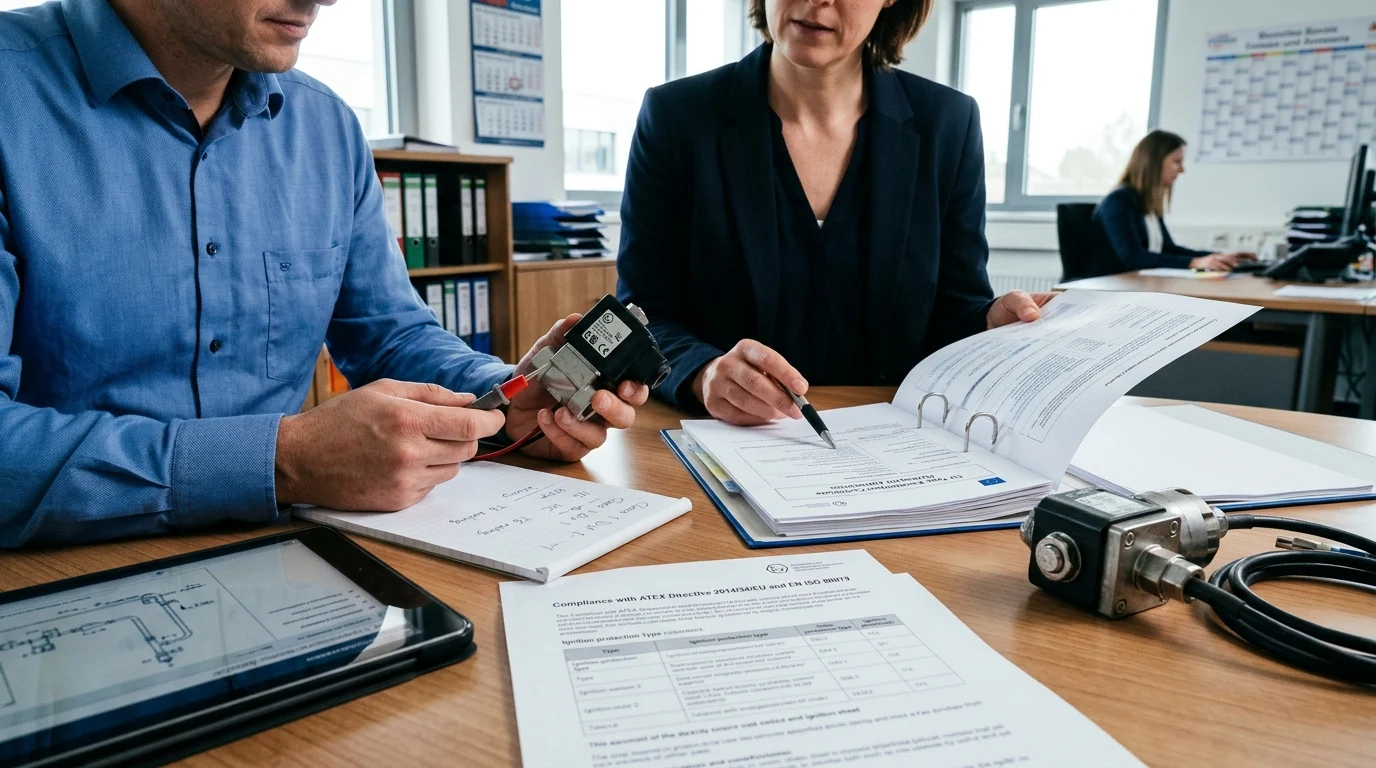
Deploying hydrogen refueling infrastructure within the European Union requires strict adherence to a complex framework of safety regulations. Regulators mandate that all electrical and mechanical components operating in potentially explosive atmospheres undergo rigorous third-party testing and certification before installation. For hazardous-area solenoid valves, compliance is a multi-layered legal obligation spanning electrical safety, mechanical pressure containment, and system-level operational integration.
ATEX, IECEx, EN ISO 19880-1, and PED Requirements
The primary regulatory framework governing equipment in hazardous environments across Europe is the ATEX Directive 2014/34/EU. Hydrogen refueling stations typically classify their dispensing areas as Zone 1 (where explosive atmospheres are likely to occur) or Zone 2 (where they are unlikely but possible). Consequently, solenoid valves must meet Category 2G or 3G equipment standards, respectively. While ATEX is legally mandatory for Europe, leading manufacturers simultaneously pursue IECEx certification—a voluntary international scheme supporting global market access.
Beyond electrical explosion protection, the Pressure Equipment Directive (PED) 2014/68/EU governs mechanical integrity. PED applicability is not based solely on a 0.5 bar pressure threshold; it depends on the product of pressure and volume (PS × V), the fluid group (hydrogen is a dangerous fluid), and the assigned equipment category. Consequently, small-volume instrumentation valves may fall outside the PED scope entirely or into lower categories, meaning the PS × V assessment must be performed for each specific valve assembly. Furthermore, EN ISO 19880-1 dictates system-level safety for gaseous hydrogen stations, specifying that critical isolation valves must endure a minimum lifecycle of 100,000 actuation cycles without failure.
Certification Scope Comparison
Navigating these overlapping European and international regulations requires a clear understanding of their distinct scopes. Manufacturers and operators must ensure that the complete electromechanical assembly achieves the appropriate, complementary certifications for its operational zone.
| Standard / Directive | Primary Focus Area | Key Applicability & Quantitative Metric |
|---|---|---|
| ATEX 2014/34/EU | Explosion Protection | Mandatory for Zone 1 (Category 2G) and Zone 2 (Category 3G). |
| IECEx | Global Protection | Voluntary international certification supporting global market access. |
| PED 2014/68/EU | Mechanical Safety | Depends on pressure × volume, fluid group, and specific category. |
| EN ISO 19880-1 | Station Integration | Mandates endurance testing, demanding >100,000 safe operational cycles. |
Selecting Explosion-Proof Solenoid Valve Coils
In hydrogen applications, selecting the appropriate Ex-protected coil is a critical engineering decision that directly impacts station reliability, energy efficiency, and safety compliance.
Key Coil Selection Criteria
Several stringent technical parameters govern coil selection. First is the Temperature Class (T-Class), which is determined by the coil’s maximum surface temperature under fault conditions within its installed environment, rather than solely by the gas’s auto-ignition point. Hydrogen’s auto-ignition temperature is approximately 560°C. While a T1 classification permits a maximum surface temperature of 450°C, engineers frequently specify T4 (135°C maximum) or T6 (85°C maximum) coils. These conservative choices provide an extra margin of safety and minimize localized heat generation that could degrade adjacent seals or sensitive components. Second, voltage and power consumption must be optimized. Standard 24V DC control systems frequently utilize efficient coil designs drawing a typical 9W to 15W, though actual specifications vary by manufacturer and station requirements.
Key Takeaways
- Select solenoid valves rated for the station’s full pressure profile, including 350 bar, 700 bar, and potential cascade pressures above 900 bar.
- Specify ATEX or IECEx certification for the complete valve assembly, because coil heating, interfaces, and mechanical construction must be evaluated together.
- Use hydrogen-compatible valve bodies and seals, such as evaluated 316L stainless steel and suitable EPDM or FKM compounds, to reduce embrittlement and permeation risks.
- Match coil protection to the hazardous-area design using EN/IEC 60079 concepts such as Ex d, Ex m, or Ex e rather than treating “explosion-proof” as one universal category.
- Account for -40°C pre-cooled hydrogen when selecting valves, since thermal cycling can affect sealing performance, actuation reliability, and material durability.
- Define leakage performance using ISO 19880-1 or manufacturer-specific hydrogen limits instead of relying only on generalized helium leak-test assumptions.
Frequently Asked Questions
Why do hydrogen refueling stations need hazardous-area solenoid valves?
Hydrogen is flammable at 4% to 75% concentration in air and can ignite with about 0.017 mJ. Hazardous-area solenoid valves reduce ignition risk while controlling high-pressure flow and supporting emergency shutdown functions.
What pressures must valves handle in European hydrogen stations?
Stations commonly dispense at 350 bar for heavy-duty vehicles and up to 700 bar for passenger cars. Depending on cascade storage architecture, upstream system pressures can exceed 900 bar, so valve pressure ratings must match the full operating envelope.
Is a certified coil enough for ATEX or IECEx compliance?
No. The valve should be certified as a complete assembly, not built from separately certified parts. Coil temperature rise, interfaces, sealing, and mechanical integration must be assessed together for hazardous-area compliance.
Which explosion-protection concepts apply to solenoid coils?
Common options include Ex d flameproof enclosures under EN 60079-1, Ex m encapsulation under EN 60079-18, and Ex e increased safety under EN 60079-7. All rely on general requirements in EN 60079-0.
Why is 316L stainless steel commonly used for hydrogen valve bodies?
316L stainless steel is often selected because its material structure offers better resistance to hydrogen embrittlement. It should still be evaluated for hydrogen compatibility using relevant standards such as ISO 11114-4.
Post time: Jul-14-2026