
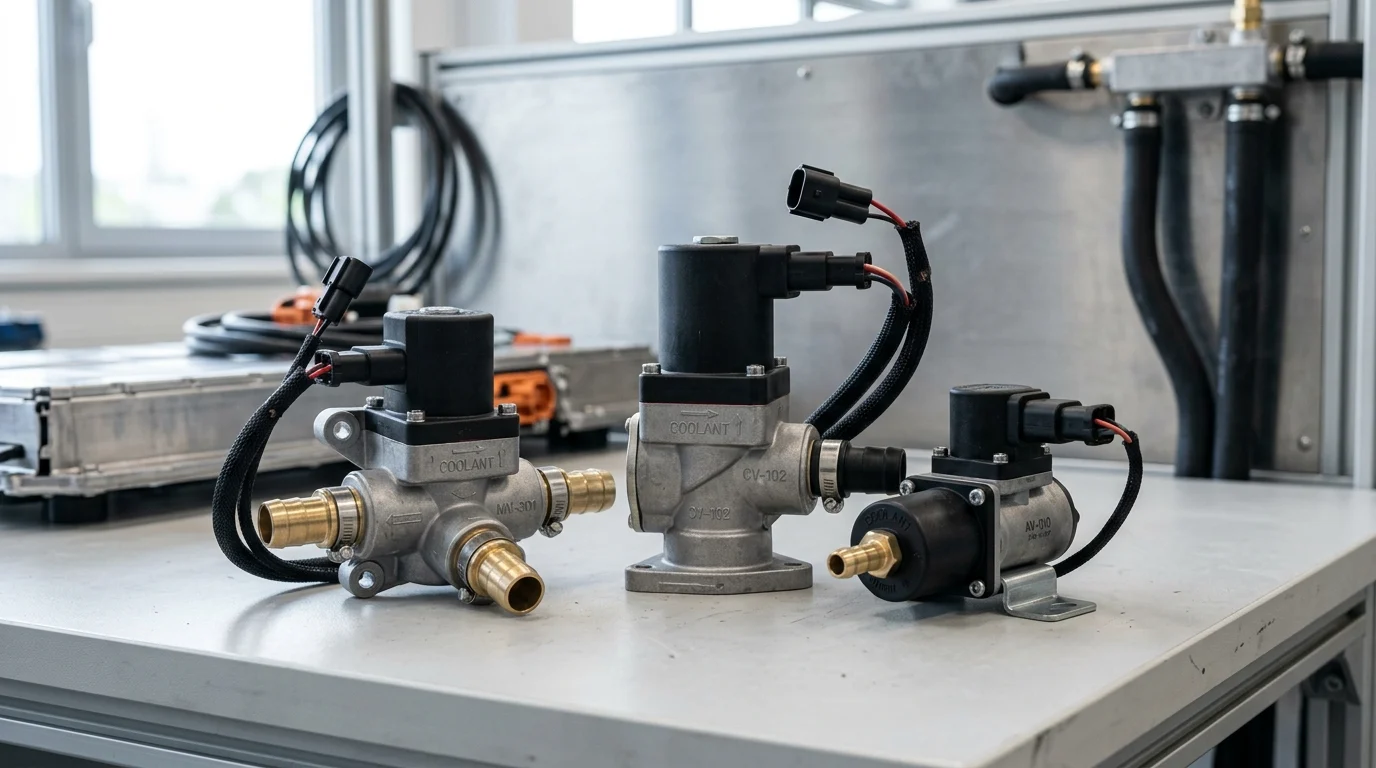
European EV platforms are pushing thermal systems harder than ever: batteries must stay near their ideal temperature window, fast charging creates intense heat loads, and winter cold starts can challenge coolant circulation within seconds. In this environment, coolant solenoid valves are not minor plumbing components; they are precision control devices that determine where heat is removed, reused, or isolated. This article examines how these valves support battery safety, inverter and motor cooling, and integrated HVAC strategies, while also addressing the specification trade-offs that matter to vehicle engineers—response time, pressure drop, Kv value, electrical efficiency, temperature tolerance, and compact packaging for increasingly dense EV architectures.
Role of Coolant Solenoid Valves in EV Thermal Management
Maintaining the traction battery within its optimal operating window of 15°C to 35°C is a primary challenge in electric vehicle thermal management. Deviations from this range pose safety-critical thermal risks, severely degrading driving range and triggering charging throttling. To address these challenges—particularly under European-specific conditions such as cold-start Nordic climates and high-speed Autobahn charging heat loads—advanced thermal architectures rely on coolant solenoid valves. These critical control mechanisms direct water-glycol mixtures to high-voltage components requiring immediate thermal intervention, ensuring vehicle safety and performance amidst stringent EU-platform packaging constraints.
Key Thermal Management Functions
At the core of electric vehicle thermal management, solenoid valves perform essential tasks such as isolating specific fluid loops, redirecting flow during fast-charging events, and bypassing heat exchangers when ambient temperatures fluctuate. These valves must actuate rapidly to mitigate overheating risks.
In certain high-performance European electric vehicles, thermal runaway prevention strategies target full actuation response times of under 50 milliseconds. While not a universal mandate, this rapid response serves as an architecture-specific goal to ensure instantaneous flow adjustment when vehicle sensors detect sudden, critical temperature spikes in the battery cells or power electronics.
Common EV Cooling Circuit Applications
Coolant solenoid valves are deployed across multiple distinct fluid loops within the vehicle architecture. The primary applications include the battery thermal management system, the electric motor and inverter cooling circuit, and the cabin HVAC system.
Modern electric vehicles often integrate these previously separate loops into centralized thermal management modules, utilizing multi-way solenoid valves to harvest waste heat from the drivetrain and redirect it to warm the passenger cabin. These integrated circuits typically operate under dynamic system pressures ranging from 1.5 to 3.0 bar, requiring valves capable of sealing against variable backpressure while maintaining consistent, predictable flow rates.
Selection Criteria and Valve Specifications

Designing an efficient thermal management system requires rigorous evaluation of valve specifications to ensure they meet the stringent efficiency and packaging requirements of European automotive manufacturers. The selection process must balance hydraulic performance with electrical efficiency; excessive electrical load from auxiliary components like solenoid valves directly reduces the vehicle’s driving range, making low-power operation a critical design priority.
Technical Parameters to Compare
Engineers must evaluate several critical technical parameters when specifying coolant valves. Flow coefficient (Kv value) and pressure drop are primary considerations, as they directly dictate the sizing and energy demands of the electric water pump. Furthermore, weight reduction targets in specific European electric vehicle architectures often aim to limit individual valve mass to under 300 grams, though this serves as an OEM-specific example rather than an industry-wide standard.
Components must also withstand harsh environmental conditions and extreme temperature gradients, with typical temperature tolerance requirements spanning from -40°C during winter cold-soaks to 120°C near high-load drivetrain components. The table below outlines illustrative specification ranges for standard and high-performance applications. Note that the adoption of 48V valves is highly architecture-dependent and still emerging. This adoption is contingent on the vehicle’s broader electrical architecture—specifically the availability of a 48V mild-hybrid bus versus a legacy 12V supply—preventing these categories from serving as formal industry tiers.
| Parameter | Standard EV Coolant Valve | High-Performance EV Valve |
|---|---|---|
| Operating Voltage | 12V DC | 12V or 48V DC |
| Holding Power | 8W – 12W | < 5W (with latching mechanism) |
| Weight | 250g – 350g | < 200g |
| Cycle Life | 500,000 cycles | > 1,000,000 cycles |
| Internal Leakage | < 5 cc/min | < 1 cc/min |
Normally Closed, Normally Open, and Proportional Valves
The choice between normally closed (NC), normally open (NO), and proportional valves depends entirely on the specific fail-safe requirements of the cooling circuit. While NC valves are often used for auxiliary heating loops and NO valves for primary battery cooling loops to ensure fundamental cooling capacity during electrical failures, fail-safe philosophy is highly OEM- and architecture-specific. For instance, some battery loops require NC isolation for pump-fault scenarios, while others mandate de-energized bypass paths.
Proportional valves are increasingly dominating advanced thermal architectures. By utilizing a pulse-width modulation (PWM) signal—with frequencies such as 1kHz serving as common OEM-specific targets—proportional valves provide seamless 0-100% flow modulation. This allows the vehicle’s central control unit to fine-tune coolant delivery based on real-time thermal loads, optimizing energy use rather than relying on binary on/off states. However, engineers must weigh these benefits against genuine trade-offs, including higher component costs, greater controller complexity, and increased electromagnetic interference (EMI) sensitivity. These PWM-driven valves must pass rigorous OEM electromagnetic compatibility (EMC) validation, with dither frequencies and shielding requirements varying significantly by platform.
Sourcing and Implementation Considerations
As European automakers scale up electric vehicle production to meet ambitious emissions targets, the procurement of thermal management components has become a strategic priority. Sourcing coolant solenoid valves requires navigating complex regulatory landscapes, stringent quality mandates, and evolving supply chain dynamics to ensure uninterrupted assembly line operations.
Compliance, Quality, and Logistics Factors
Automotive suppliers must strictly adhere to industry standards, most notably the IATF 16949 quality management certification, which functions as a strict requirement for Tier 1 and Tier 2 suppliers operating in Europe. Environmental compliance, including RoHS and REACH directives, is also mandatory for all materials used in valve construction, such as EPDM seals and specialized engineered polymers.
Quality expectations in this sector are exceptionally high, with European OEMs typically demanding defect rates of less than 1 Part Per Million (PPM). Logistically, localized manufacturing or robust warehousing strategies within the European Union are increasingly necessary to mitigate supply chain disruptions. Custom valve tooling and initial production runs frequently require lead times of 12 to 16 weeks, which can severely impact European automotive logistics—such as just-in-sequence assembly lines and limited buffer stock at EU plants—leaving manufacturers vulnerable to cross-border supply shocks.
Practical Selection Process for Engineering and Procurement
For engineering and procurement teams, the practical selection process involves a comprehensive total cost of ownership analysis.
Key Takeaways
- Specify coolant solenoid valves to help maintain the traction battery within the 15°C to 35°C operating window for safer performance and more consistent charging.
- Evaluate Kv value and pressure drop early because valve hydraulic losses directly affect electric water pump sizing and overall thermal system efficiency.
- Design valves for dynamic coolant pressures of about 1.5 to 3.0 bar in integrated EV thermal modules to ensure stable sealing and predictable flow control.
- Account for European climate extremes by selecting valves rated for typical temperature exposure from -40°C cold-soak conditions to 120°C near high-load drivetrain components.
- Use low-power, lightweight valve designs where possible because auxiliary electrical load and component mass can reduce EV range and complicate compact platform packaging.
- Consider fast-response solenoid valves for safety-critical architectures where rapid flow redirection may be needed during fast charging or sudden battery temperature spikes.
Frequently Asked Questions
Why are coolant solenoid valves important in electric vehicles?
They control coolant flow to the battery, inverter, motor, and HVAC circuits, helping keep critical components within safe temperature limits and supporting range, fast charging, and vehicle reliability.
What temperature range should an EV battery typically maintain?
The article highlights 15°C to 35°C as the optimal traction battery operating window. Moving outside this range can reduce driving range, slow charging, or increase thermal safety risks.
How fast should EV coolant solenoid valves actuate?
Some high-performance EV architectures target full valve actuation in under 50 milliseconds to respond quickly to sudden thermal spikes, though this is not a universal industry requirement.
Where are coolant solenoid valves used in an EV thermal system?
Common locations include the battery thermal management loop, motor and inverter cooling circuit, and cabin HVAC system. Integrated thermal modules may use multi-way valves to share heat between these circuits.
What pressure range do EV coolant circuits typically operate under?
Integrated EV cooling circuits often operate dynamically between 1.5 and 3.0 bar, so valves must seal reliably against variable backpressure while maintaining predictable coolant flow.
Post time: Jul-20-2026