
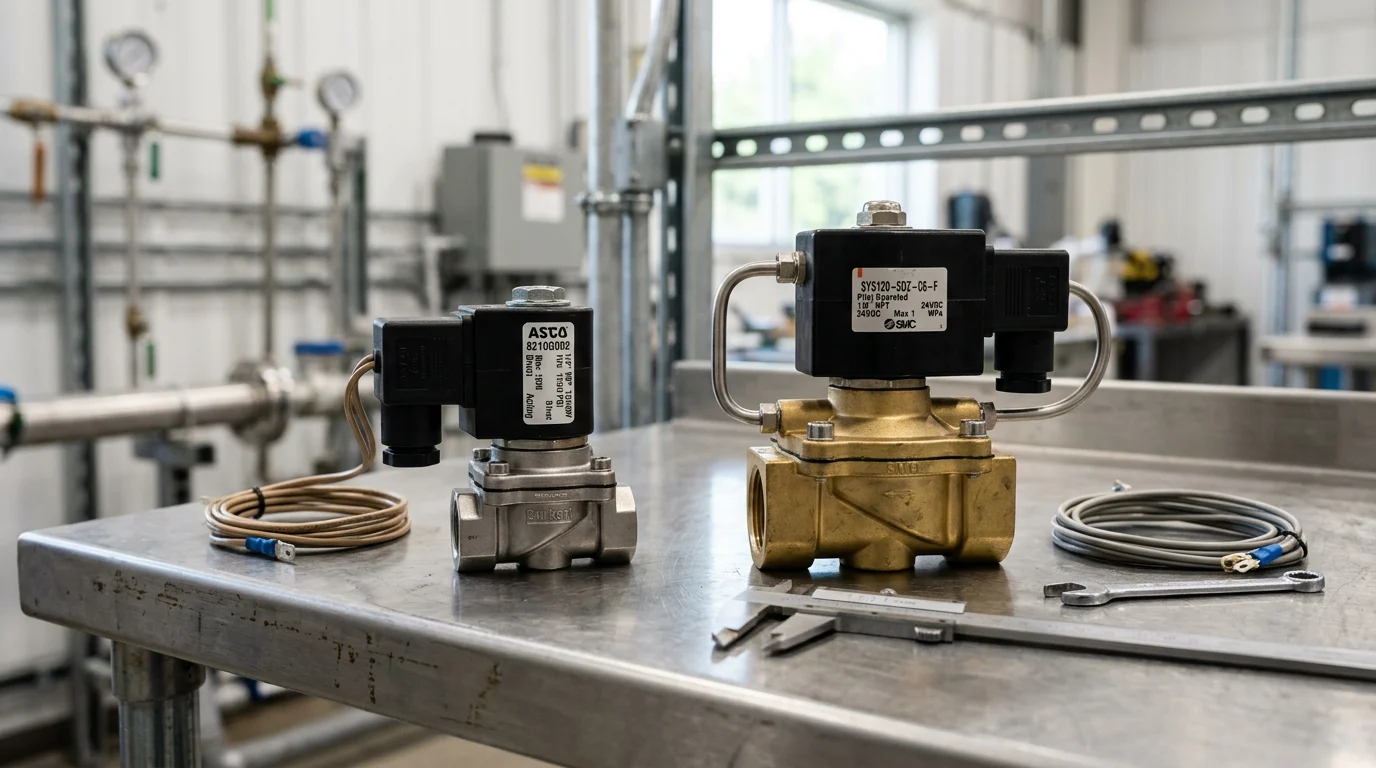
A solenoid valve may look like a small component on a piping or pneumatic schematic, but the wrong selection can create oversized coils, unstable flow, nuisance failures, or unsafe shutdown behavior. For plant engineers, the practical choice often comes down to how the valve generates opening force: direct magnetic lift or pressure-assisted pilot operation. That distinction affects minimum pressure differential, flow capacity, response behavior, maintenance workload, and total cost of ownership. This guide compares the two architectures in application terms, including where direct-acting valves are safer and simpler, where pilot-operated valves deliver better flow efficiency, and when assisted-lift or externally piloted designs deserve consideration.
Direct-Acting vs Pilot-Operated Solenoid Valves
Solenoid valves serve as the primary electro-mechanical interface for fluid control in industrial environments. For plant engineers, specifying the correct valve architecture is critical for maintaining process stability, minimizing energy consumption, and extending operational lifecycles. The fundamental choice between direct-acting and pilot-operated (also known as internally piloted) mechanisms dictates how the valve interacts with system pressure and electrical inputs. By analyzing the structural differences between these two designs, engineers can align valve capabilities with the exact pneumatic or hydraulic demands of their facility.
Operating Principle Differences
Direct-acting solenoid valves function entirely independently of line pressure. When the solenoid coil is energized, it generates a magnetic flux that directly lifts the ferromagnetic armature (plunger), overcoming the return spring tension to open the valve orifice. Because the coil must provide 100% of the mechanical work required to break the fluid seal against the maximum line pressure, these valves are typically limited to smaller orifice sizes and lower flow rates.
Conversely, pilot-operated valves utilize the fluid's pressure differential to actuate the main seal. The solenoid coil only opens a miniature pilot orifice, which vents pressure from the top of an internal diaphragm or piston. The resulting pressure imbalance forces the incoming line pressure to lift the main seal, allowing full fluid flow with minimal electrical input.
It is also worth noting two common alternatives: externally piloted valves, which use a separate control fluid source to actuate the main valve, and semi-direct (assisted-lift) valves, which mechanically couple the plunger to the diaphragm. These variants can operate at low or zero pressure differentials without requiring a fully direct-acting design.
Why Selection Matters for Plant Engineers
Understanding these mechanical distinctions is vital because misapplication directly impacts total cost of ownership (TCO) and operational reliability. A critical consideration is how failure modes differ between architectures. In pilot-operated valves, a diaphragm or piston rupture can cause unintended flow states, whereas direct-acting armature failure is typically more predictable—an essential factor when specifying safety shut-off loops.
Lifecycle costs and maintainability also vary significantly. Direct-acting valves generally have fewer wear parts and a lower upfront cost. In contrast, pilot-operated valves require routine maintenance of the diaphragm, piston, and pilot orifice, along with strict upstream filtration, which must be factored into long-term maintenance planning. By carefully matching the valve type to the application, engineers avoid the excessive energy consumption of oversized direct-acting coils or the stalling of pilot-operated valves in low-pressure loops.
Key Specifications to Compare
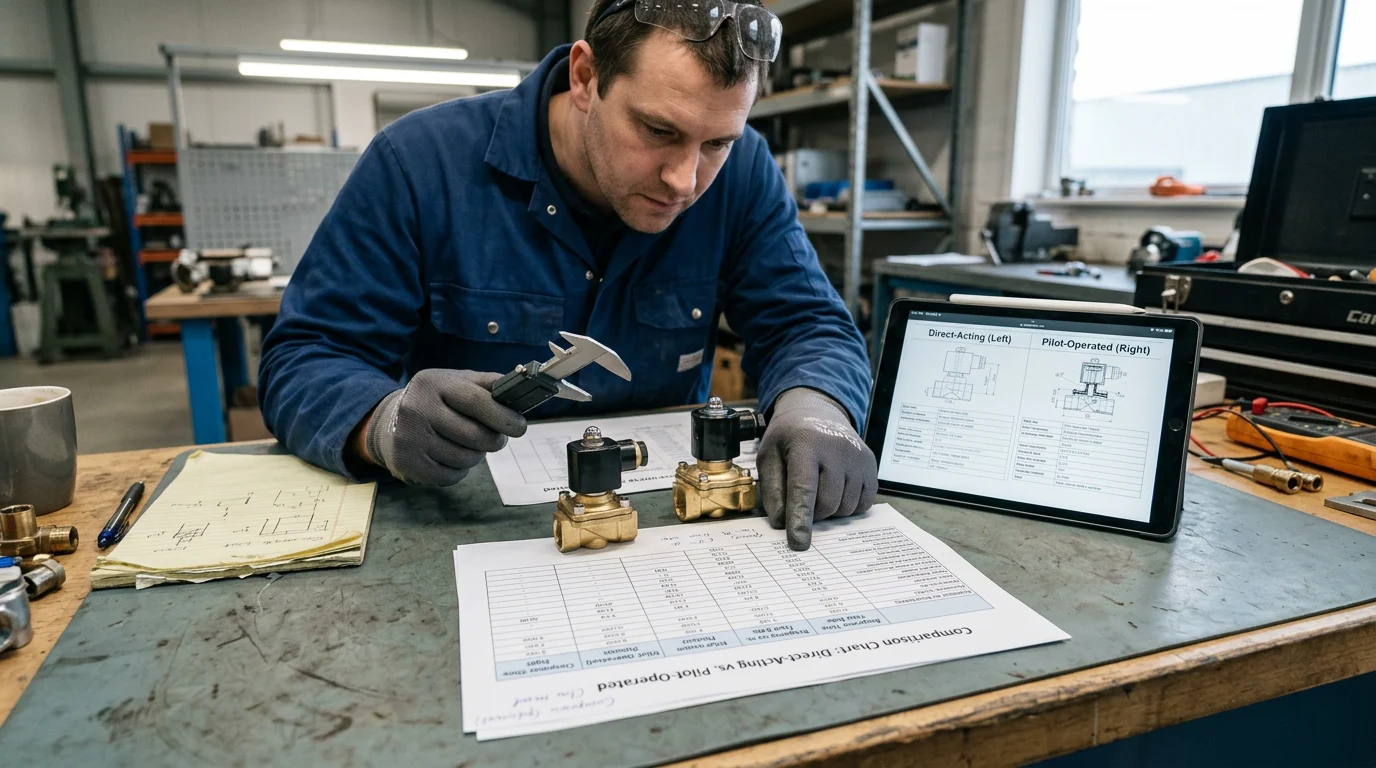
Comparing technical specifications ensures the chosen valve architecture aligns with the process demands. Engineers must evaluate how pressure dynamics, flow coefficients (Cv), and fluid characteristics interact with the valve's internal geometry before finalizing a procurement specification.
Pressure Differential, Flow, and Response Time
The most critical specification distinguishing these valves is the minimum operating pressure differential (MOPD). Direct-acting and semi-direct valves boast an MOPD of 0 bar, meaning they can control flow in gravity-fed systems or closed loops with zero pressure drop. However, direct-acting flow capacity is inherently restricted by the coil's magnetic pulling force. Pilot-operated valves require a minimum pressure drop to actuate the main diaphragm but offer significantly higher flow capacities for equivalent pipe sizes.
Response time also varies drastically depending on the internal mechanism. Direct-acting valves actuate almost instantaneously, whereas pilot-operated and semi-direct models require a brief delay to equalize internal chamber pressures.
| Specification | Direct-Acting Valves | Pilot-Operated Valves | Semi-Direct Valves |
|---|---|---|---|
| Min. Pressure Differential | 0 bar (0 psi) | 0.3 – 1.0 bar (~4.5 – ~15 psi) | 0 bar (0 psi) |
| Response Time | 5 – 25 ms | 15 – 150 ms | 15 – 150 ms |
| Power Consumption | High (15W – 50W+) | Low (2W – 10W) | Moderate to High |
| Flow Capacity (Cv) | Low to Moderate | Moderate to High | Moderate to High |
| Typical Orifice Sizes | Under 3/8 inch | Up to 2 inches or larger | Up to 2 inches or larger |
Note: Response-time and power-consumption ranges in this table are illustrative orders of magnitude only. Actual values vary significantly by manufacturer, orifice size, and service function.
Fluid Compatibility, Contamination, and Wear
Fluid cleanliness directly influences the longevity and reliability of solenoid valves. Direct-acting designs are generally more robust against minor particulate matter because they lack microscopic internal channels; the main orifice is relatively large and clears debris easily.
Pilot-operated valves are highly susceptible to contamination. Particulate matter can often bridge and clog a typical internal pilot bleed hole. When this occurs, the pressure above the diaphragm cannot equalize, causing the valve to lock permanently in either the open or closed position. Plant engineers must specify upstream filtration sized according to the specific pilot-orifice tolerance provided in the valve datasheet, rather than relying on a universal mesh size, to prevent premature failure.
Practical Selection Process
A systematic selection process prevents costly downtime and eliminates guesswork from valve specification. Engineers must rigorously map out the fluid circuit's parameters before committing to an actuation mechanism, ensuring all environmental and operational extremes are accounted for.
Verify Process Data and Operating Conditions
To streamline procurement, follow a step-by-step decision workflow:
Step 1: Confirm the pressure envelope. Verify the Minimum Operating Pressure Differential (MOPD) and the Maximum Safe Working Pressure (MSWP) under worst-case scenarios. If a system routinely experiences rapid pressure equalization or operates under vacuum conditions, internally pilot-operated valves may fail to actuate due to a lack of positive pressure differential. In these cases, direct-acting, externally piloted, or semi-direct models are required.
Step 2: Define flow (Cv) and valve configuration. Determine the required flow rate and whether the system needs a normally-open or normally-closed configuration, as this impacts the fail-safe state during a power loss or system fault.
Step 3: Assess media cleanliness and viscosity. High-viscosity fluids can impede the movement of a pilot diaphragm or piston.
Key Takeaways
- Select direct-acting solenoid valves for zero-pressure-differential applications such as gravity-fed systems, vacuum service, and closed loops.
- Use pilot-operated solenoid valves when a stable pressure differential is available and the application requires higher flow with lower electrical power.
- Always verify the valve’s minimum operating pressure differential before procurement, because pilot-operated designs can stall in low-pressure circuits.
- Factor maintenance into total cost of ownership, since pilot-operated valves depend on clean pilot orifices, intact diaphragms, and effective upstream filtration.
- Consider semi-direct or externally piloted alternatives when the application needs higher flow but cannot guarantee the pressure conditions required by internally piloted valves.
Frequently Asked Questions
When should I choose a direct-acting solenoid valve?
Choose direct-acting valves for low-flow circuits, small orifices, vacuum or gravity-fed lines, closed loops, and applications with zero or very low pressure differential. They are also useful where predictable fail-safe behavior and simpler maintenance are priorities.
When is a pilot-operated solenoid valve the better choice?
Use pilot-operated valves when the process has a reliable pressure differential and requires higher flow through a larger orifice with lower coil power. They are common in compressed air, water, and other systems where line pressure can assist valve actuation.
What does minimum operating pressure differential mean?
Minimum operating pressure differential is the pressure drop required for a valve to open or close correctly. Direct-acting and semi-direct valves can operate at 0 bar differential, while pilot-operated valves usually need a minimum differential to move the main diaphragm or piston.
Why can pilot-operated valves fail in low-pressure systems?
Pilot-operated valves depend on process pressure to lift the main seal. If the pressure differential is too low, the pilot stage may open but the main diaphragm or piston may not move, causing sluggish operation, partial opening, or failure to actuate.
Which valve type is easier to maintain?
Direct-acting valves are generally simpler because they have fewer wear components. Pilot-operated valves require more attention to diaphragms, pistons, pilot orifices, and upstream filtration, especially in dirty or scale-prone fluid systems.
Post time: Aug-18-2026