
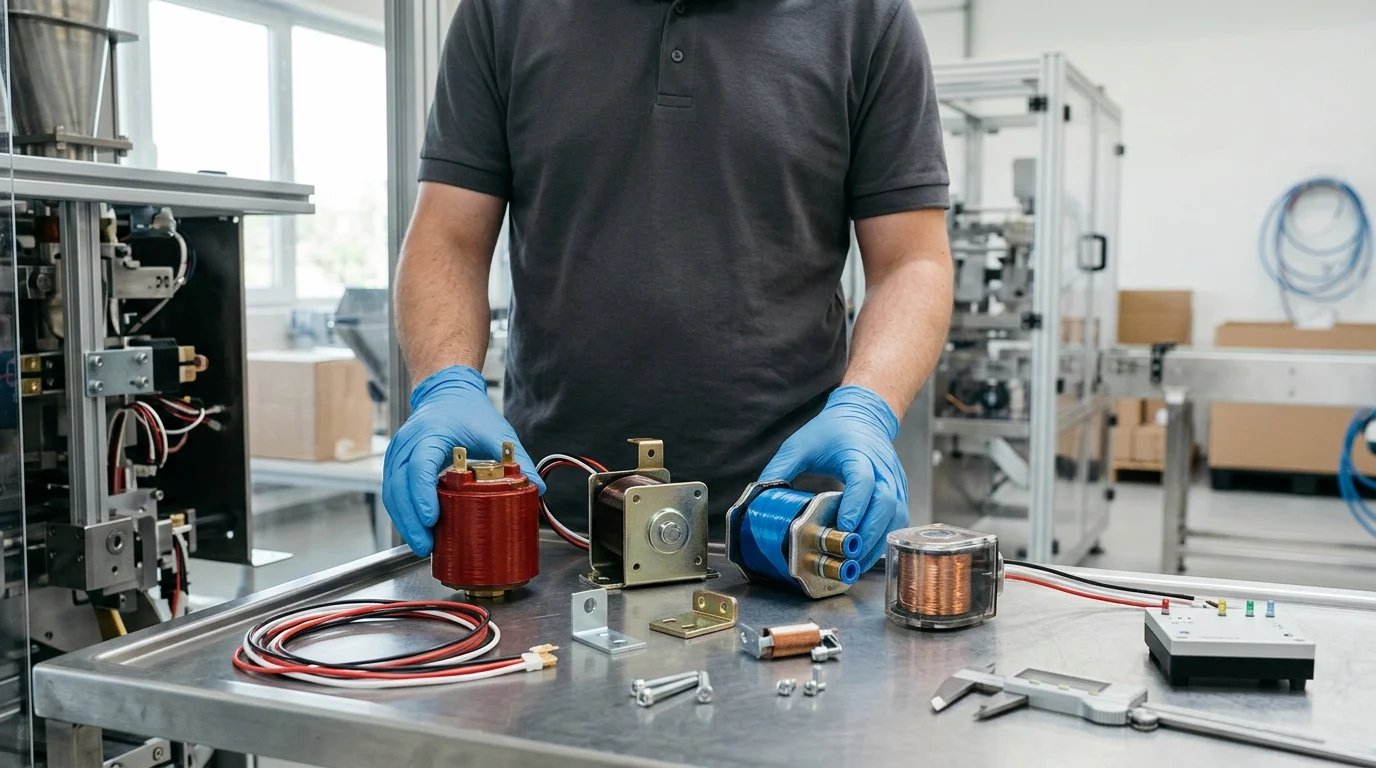
In high-throughput food packaging, milliseconds decide whether a bag is cleanly sealed or rejected. Modern FFS equipment can run at 120 to 200 bags per minute, leaving little room for sluggish pneumatic actuation, coil overheating, or valve timing drift. The solenoid coil may be a small component, but it directly affects dosing accuracy, film movement, jaw closure, and ultimately OEE. This article explains how to evaluate high-speed coil performance for demanding packaging lines, with attention to response time, thermal class, operating frequency, ingress protection, and the real production risks that appear when standard components are pushed beyond their limits.
Why High-Speed Solenoid Coils Matter in Food Packaging
Form-Fill-Seal (FFS) lines are the backbone of modern food packaging, demanding both precision and speed. At the heart of these automated systems are high-speed solenoid coils, which control the pneumatic valves responsible for mechanical actuation. In high-throughput environments processing 120 to 200 bags per minute, the reliability of these components dictates overall equipment effectiveness (OEE), as even minor inconsistencies compound into significant operational losses.
Upgrading to specialized high-speed coils allows facilities to minimize latency and optimize pneumatic airflow. Without robust solenoid coils driving directional control valves, programmable logic controllers (PLCs) cannot achieve the precise synchronization required for rapid, uninterrupted packaging cycles.
Critical FFS Functions They Support
Critical FFS functions rely heavily on the rapid energization and de-energization of solenoid coils. These components govern the exact timing of product dosing, film-pulling belts, and transverse sealing jaws. When energized, the coil generates a concentrated magnetic field to move the valve armature instantly, directing compressed air through complex pneumatic manifolds with minimal pressure drop.
In vertical form-fill-seal (VFFS) machines, actuation must synchronize perfectly with gravity-fed product drops. Efficient coil operation ensures the sealing jaws close exactly after the product clears the seal zone, preventing entrapment and guaranteeing a hermetic seal that maintains food safety.
Performance Risks to Define Before Buying
Procurement teams must identify performance risks before specifying coils. The primary risk is thermal degradation; coils cycling at high frequencies generate intense internal heat, which can lead to insulation breakdown, short circuits, and premature failure.
Another critical risk is actuation latency. In a machine operating at 150 cycles per minute, a valve response delay of merely 15 to 20 milliseconds can result in a 2 to 3 millimeter misalignment of the film cut. Such deviations lead to unsealed packages and costly downtime, making it essential to define operational thresholds early in the purchasing process.
Key Solenoid Coil Specifications to Compare
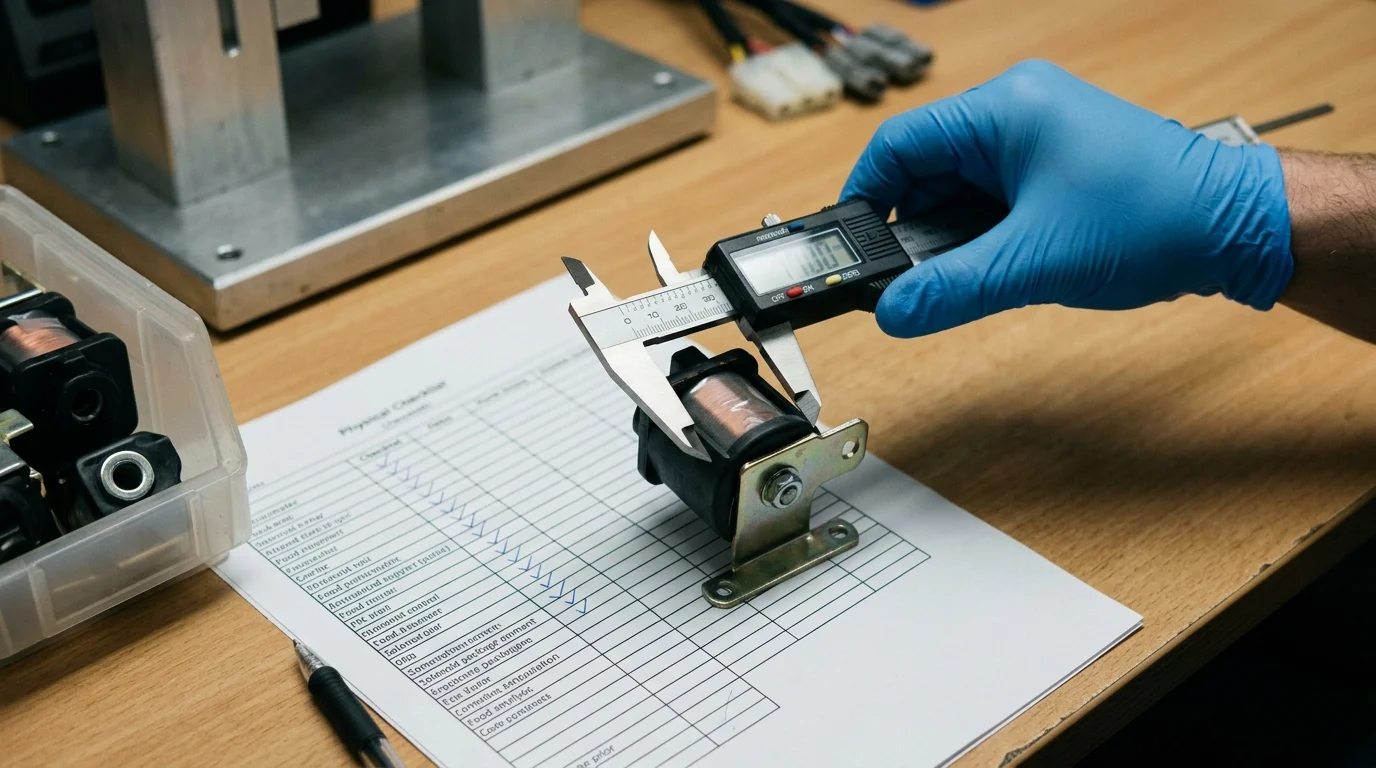
Selecting the correct solenoid coil requires comparing technical specifications directly against FFS line demands. Standard coils often suffer from magnetic saturation and lack the thermal durability necessary for sustained high-speed food packaging.
Engineers must evaluate electrical, thermal, and mechanical parameters to ensure seamless integration with modern automated systems. The table below highlights critical differences between standard and high-speed configurations.
| Specification | Standard Solenoid Coil | High-Speed FFS Solenoid Coil |
|---|---|---|
| Response Time | 30 – 50 ms | 5 – 15 ms |
| Operating Frequency | Up to 10 Hz | 50 – 100 Hz |
| Insulation Rating | Class B (130°C) | Class F (155°C) or Class H (180°C) |
| Ingress Protection | IP54 | IP65 / IP67 (Washdown ready) |
Electrical and Thermal Requirements
Electrical and thermal requirements dictate coil lifespan in continuous operations. High-speed FFS lines require Class F (155°C) or Class H (180°C) insulation to withstand the extreme heat generated by rapid, repetitive actuation during multi-shift operations.
Power consumption is equally critical. Advanced designs utilize dual-power modules that provide a high inrush current before dropping the holding current by up to 50% to minimize heat generation. Because food packaging environments undergo aggressive sanitation, coils must also feature an IP65 or IP67 rating to protect internal windings from moisture and caustic cleaning chemicals.
Duty Cycle and Response Time
Duty cycle and response time are non-negotiable for packaging synchronization. FFS machinery requires coils rated for a 100% continuous duty cycle (100% ED), meaning they can remain energized indefinitely without exceeding their thermal limits.
For high-speed applications, engineers target response times between 5 and 15 milliseconds. Achieving this involves optimizing the inductance-to-resistance ratio and utilizing specialized core materials. Slower response times introduce severe variability into the pneumatic circuit, causing inconsistent seal pressure, irregular bag lengths, and potential mechanical jams across production batches.
How to Source and Validate Solenoid Coils
Sourcing high-performance solenoid coils requires evaluating the manufacturer’s engineering capabilities. Specialized manufacturers, such as Feiniu (Ningbo) Electronic Technology, focus on precision electromagnetic components—including pulse valves and dual-power modules—and maintain stringent quality management systems to ensure reliable performance.
Navigating procurement involves establishing clear validation protocols and understanding long-term lifecycle costs. Reliable supply chains prioritize manageable lead times and responsive technical support for custom integration.
Prototype Testing and Validation Steps
Prototype testing is critical before committing to high-volume procurement, which often involves Minimum Order Quantities (MOQs) of 500 to 1,000 units for custom configurations. Engineers subject prototype coils to accelerated life testing on custom test benches, simulating the exact pneumatic load, pressure differentials, and electrical frequencies of the target FFS line.
A high-quality coil should demonstrate a life expectancy exceeding 20 million cycles without response time degradation. Validation must include dielectric withstand testing—applying 1500V AC for one minute—to ensure insulation integrity, alongside thermal cycling to simulate ambient temperature fluctuations on the factory floor.
Lifecycle Cost and Supplier Quality Systems
Evaluating total lifecycle cost requires looking past the initial unit price. While a standard replacement coil might occupy a cost band of $15 to $30, a catastrophic failure during a peak production run incurs thousands of dollars in unexpected machine downtime, wasted packaging material, and compromised food products.
Procurement teams must prioritize suppliers with robust quality systems, ensuring batch-to-batch consistency in wire tension to achieve defect rates below 50 parts per million (PPM). Investing in a highly engineered coil drastically reduces total cost of ownership by maximizing uptime, extending maintenance intervals, and increasing overall output yield.
Key Takeaways
- Specify high-speed coils with 5 to 15 ms response times when FFS lines operate near 120 to 200 bags per minute.
- Use Class F or Class H insulation to reduce thermal degradation during continuous high-frequency actuation.
- Define allowable valve latency early, because a 15 to 20 ms delay at 150 cycles per minute can create 2 to 3 mm film misalignment.
- Select IP65 or IP67 coil designs for food packaging areas exposed to washdown, moisture, or product dust.
- Match coil electrical, thermal, and mechanical specifications to PLC timing, pneumatic valve demands, and actual line speed rather than relying on standard coils.
Frequently Asked Questions
Why do FFS machines need high-speed solenoid coils?
They control pneumatic valves for dosing, film pull, and sealing. On lines running 120 to 200 bags per minute, faster coil response helps keep actuation synchronized and prevents defects from compounding into downtime.
What response time is suitable for high-speed FFS applications?
High-speed FFS coils typically target 5 to 15 ms response times, compared with 30 to 50 ms for standard coils. Faster response supports accurate sealing and cutting at high cycle rates.
How can coil latency affect package quality?
At around 150 cycles per minute, a 15 to 20 ms valve delay can cause 2 to 3 mm film misalignment, leading to poor seals, bad cuts, rejected packs, and unplanned stoppages.
Which insulation class should be specified for continuous FFS operation?
Class F insulation rated to 155°C or Class H rated to 180°C is recommended for high-frequency, multi-shift operation because rapid cycling generates significant internal coil heat.
Why is ingress protection important in food packaging machinery?
Food packaging environments often involve dust, moisture, and washdown routines. IP65 or IP67 coils are better suited than IP54 units where hygiene cleaning and liquid exposure are expected.
Post time: Jun-29-2026