

For manufacturers in the US and EU, the solenoid valve is no longer a low-cost part buried inside a machine; it is a performance-critical link between digital control and physical motion. As automation systems become faster, denser, and more regulated, sourcing decisions increasingly affect uptime, energy use, validation timelines, and total cost of ownership. This article examines how suppliers such as Ningbo Feiniu are moving from transactional OEM production toward deeper automation partnerships built on precision fluid control, co-engineered manifolds, rapid prototyping, and compliance-aware collaboration. The result is a more strategic model for manufacturers that need reliable valves capable of supporting demanding duty cycles, tight response windows, and high-volume industrial output.
From OEM Component Supplier to Automation Partner
The industrial landscape across the United States and the European Union increasingly demands fluid control systems that offer more than basic actuation. Historically, Western manufacturers viewed overseas component suppliers strictly through the lens of cost arbitrage. Today, the complexity of modern industrial automation necessitates a symbiotic relationship where technical expertise flows in both directions. As automated systems become denser and more integrated, the role of manufacturers like Ningbo Feiniu has evolved from supplying standard Original Equipment Manufacturer (OEM) parts to acting as strategic automation partners.
This transition is driven by the necessity for precision solenoid valves capable of sustaining continuous duty cycles in demanding environments, often managing operating pressures exceeding 1.0 MPa (145 psi) with response times under 10 milliseconds. By bridging the gap between raw component manufacturing and system-level automation engineering, specialized suppliers enable Western OEMs to achieve higher throughput and greater operational efficiency in their end products.
What This Shift Means for Manufacturers
For US and EU manufacturers, this paradigm shift translates into streamlined supply chains and accelerated product development. Rather than sourcing commoditized valves and attempting to retrofit them into complex pneumatic or hydraulic circuits, engineers now collaborate directly with automation partners during the initial design phase. This co-engineering approach utilizes advanced Computational Fluid Dynamics (CFD) and rapid prototyping, which can reduce development lead times by an estimated 15% to 35% in specific custom manifold projects, minimizing iterative design flaws. However, this integrated approach often requires a longer initial supplier qualification cycle and clear intellectual property (IP) protection agreements before joint development begins.
By leveraging a partner’s deep fluidic expertise early in the product lifecycle, system integrators can optimize flow rates, reduce power consumption, and ensure seamless integration into higher-level Programmable Logic Controller (PLC) architectures. The result is a shift from reactive troubleshooting to proactive system optimization, fundamentally lowering the total cost of ownership.
Where Precision Solenoid Valves Add Value
Precision solenoid valves serve as the critical interface between electronic control and physical actuation, adding measurable value across diverse sectors including medical diagnostics, packaging machinery, and semiconductor fabrication. In these high-stakes applications, strict adherence to low parts-per-million (PPM) defect rates is required. By utilizing advanced solenoid configurations and low-friction armatures, modern valves deliver exceptional repeatability and minimal leak rates over extended operational lifespans.
The advantages of transitioning to precision automation valves become apparent when evaluating core performance metrics against traditional components (results vary by specific product line and test standard):
| Valve Characteristic | Traditional OEM Solenoid Valve | Precision Automation Valve |
|---|---|---|
| Response Time | 30 – 50 ms | < 10 ms |
| Expected Lifecycle | 1 – 5 million cycles | 20 – 50 million cycles |
| Power Consumption | 5.0 – 10.0 W | 0.5 – 2.0 W |
| Architecture | Standard catalog configuration | Co-engineered custom manifolds |
Technical and Compliance Evaluation
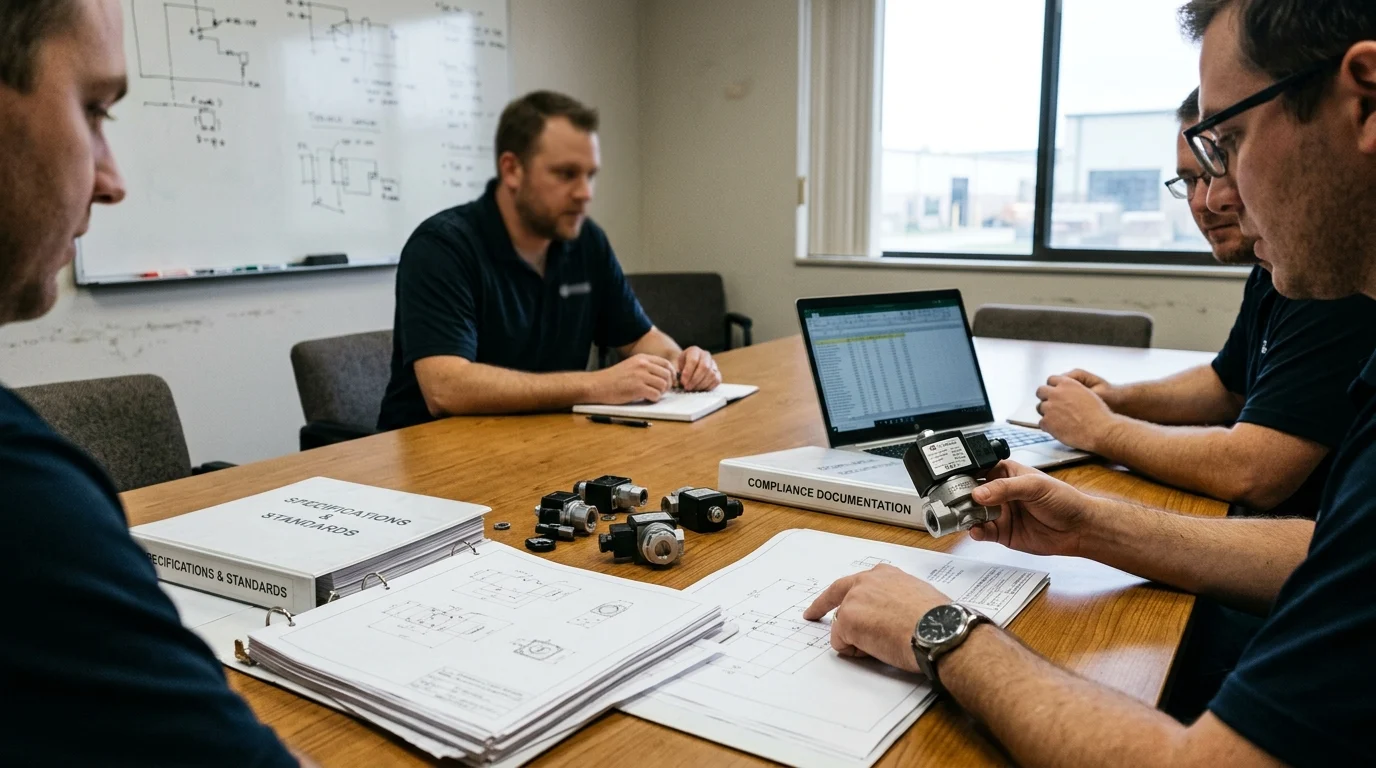
Integrating fluid control components into highly regulated US and EU supply chains mandates a thorough evaluation of both technical specifications and regulatory compliance. System engineers must verify that solenoid valves can withstand harsh industrial conditions while maintaining exact flow characteristics without degradation over time.
Automation partners distinguish themselves through their ability to consistently meet stringent performance metrics. This includes maintaining critical leak rates below 0.1 ml/min for sensitive gas chromatography applications, and achieving ingress protection ratings of IP65 or IP67 to survive aggressive washdown environments in food processing facilities.
Valve Performance, Materials, and Reliability
The operational reliability of a precision solenoid valve is inextricably linked to its material science and internal geometry. Ningbo Feiniu utilizes specialized elastomeric seal materials—including FKM, EPDM, and NBR—paired with robust valve bodies machined from 316L stainless steel or forged brass. This material selection ensures broad compatibility with aggressive media and supports stability across extreme ambient temperatures ranging from -20°C to 150°C.
Performance evaluations prioritize flow coefficient (Cv) optimization relative to the internal orifice size, which typically ranges from 0.5 mm for micro-fluidics up to 50 mm for high-flow industrial applications. By minimizing internal friction and optimizing the magnetic circuit for superior heat dissipation, these precision valves can achieve operational lifespans of 20 to 30 million cycles under standard test conditions, thereby drastically reducing maintenance downtime in high-throughput automated facilities. It is worth noting, however, that custom co-engineering for such high-cycle applications is not always cost-effective for lower-volume or less demanding legacy systems.
Certifications, Traceability, and Testing
Penetrating Western markets requires strict adherence to international safety and environmental standards. A genuine automation partner provides end-to-end traceability for all components, backed by ISO 9001 certified quality management systems. Solenoid valves destined for the European Union must comply strictly with CE, RoHS, and REACH directives, ensuring the absence of hazardous substances and guaranteeing electromagnetic compatibility (EMC) within complex machinery.
For the United States market, UL or CSA recognized components are frequently mandated by industrial safety boards. Furthermore, advanced suppliers differentiate themselves by implementing 100% end-of-line pneumatic and electrical testing. Utilizing automated test benches, they verify dielectric strength, coil resistance, and exact actuation thresholds, ensuring that only shipments meeting strict statistical process control (SPC) standards reach the OEM’s assembly line.
Evaluating Ningbo Feiniu as a Partner
Selecting a supplier for critical fluidic components involves assessing their capacity to align with dynamic production schedules and volatile market demands. Evaluating a manufacturer like Ningbo Feiniu requires looking beyond baseline unit costs to analyze their overall supply chain resilience, engineering agility, and logistical maturity.
A robust international partnership mitigates geopolitical and logistical risks, offering predictable and stable inventory flows. Established automation partners maintain highly controlled production schedules, often keeping standard component lead times within a tight 4 to 6-week window, even amid global supply chain fluctuations.
Sourcing, Logistics, and Customization Support
An effective automation partner offers highly flexible sourcing models tailored to the specific operational rhythms of US and EU OEMs.
Key Takeaways
- Involve a precision solenoid valve partner early in the design phase to optimize flow rates, power consumption, and PLC integration before tooling is finalized.
- Use co-engineering, CFD, and rapid prototyping for custom manifold projects to potentially reduce development lead times by 15% to 35%.
- Prioritize valves with response times under 10 milliseconds when designing high-throughput automation systems that require fast and repeatable actuation.
- Evaluate lifecycle and energy performance carefully, because precision automation valves may deliver 20–50 million cycles while consuming only 0.5–2.0 W.
- Plan for a longer supplier qualification cycle and put IP protection agreements in place before launching joint development with an overseas automation partner.
Frequently Asked Questions
Why are US and EU manufacturers looking beyond standard OEM solenoid valves?
Modern automation requires faster response, longer lifecycles, lower power use, and tighter integration with PLC-controlled systems than many standard catalog valves can provide.
How can co-engineering with a valve supplier reduce development time?
Early collaboration using tools such as CFD and rapid prototyping can reduce lead times by an estimated 15% to 35% in some custom manifold projects.
What performance targets matter most for precision solenoid valves?
Key metrics include response times under 10 milliseconds, operating pressures above 1.0 MPa, low leak rates, low PPM defects, and lifecycles up to 20–50 million cycles.
Which industries benefit most from precision solenoid valves?
Medical diagnostics, packaging machinery, semiconductor fabrication, and other high-throughput automation sectors benefit from repeatable actuation, compact manifolds, and reliable fluid control.
What should manufacturers verify before starting joint development?
They should complete supplier qualification, confirm applicable compliance requirements, define test standards, and establish clear intellectual property protection agreements.
Post time: Aug-28-2026