
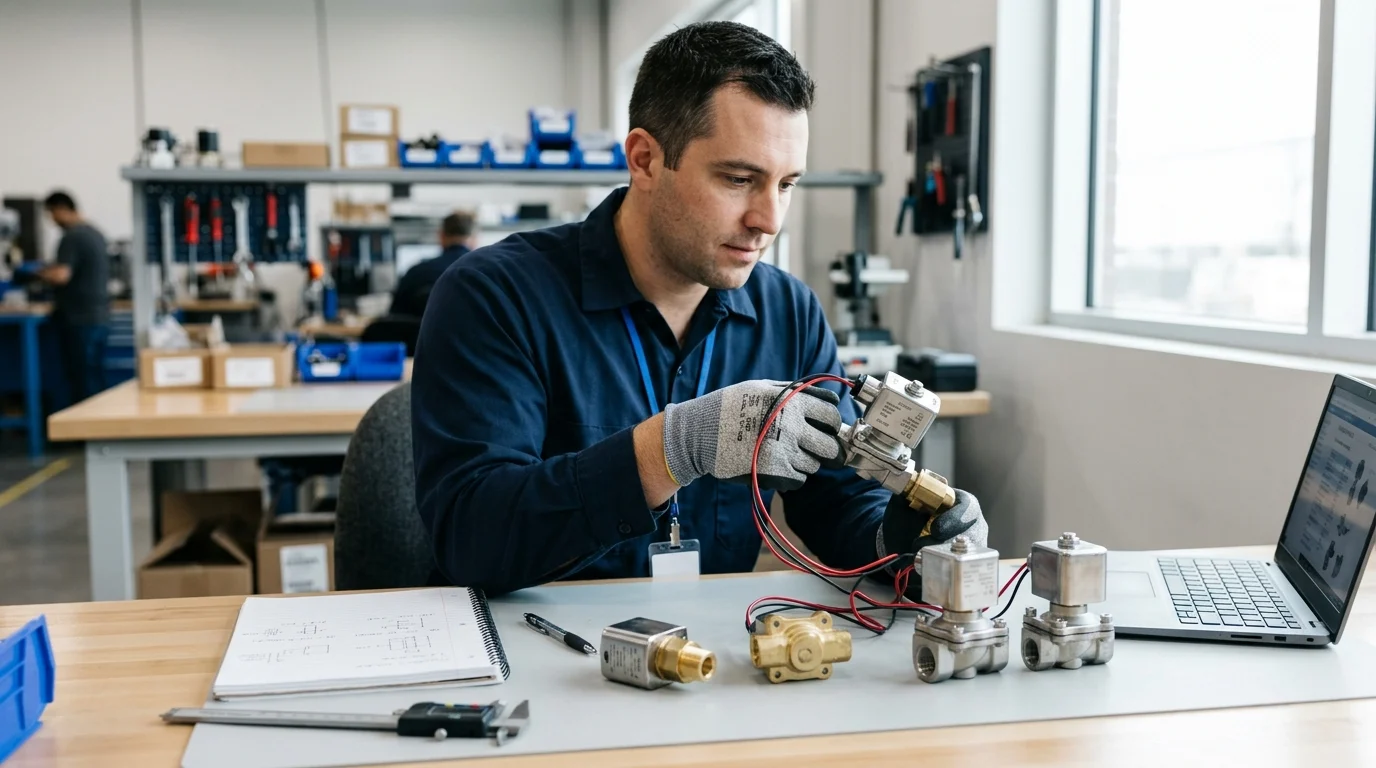
A solenoid valve that looks correct on a datasheet can still fail in the field if its pressure differential, elastomer, coil rating, or connector standard is wrong for the machine. For US and European OEMs, sourcing is not just a purchasing task; it is an engineering risk-control process tied to uptime, compliance, and lifecycle cost. This guide breaks the decision into a practical workflow, from defining fluidic and electrical limits to evaluating supplier quality and supply-chain fit. By treating specifications, testing, and RFQs as connected steps, equipment builders can reduce redesigns, avoid premature failures, and select valves that support reliable production over the full machine lifecycle.
OEM Solenoid Valve Sourcing Basics
OEM equipment builders across the US and Europe rely on precision fluid control components to support machine reliability targets. Sourcing solenoid valves requires navigating a complex landscape of electromechanical specifications, material compatibility, and supplier capabilities. By following a structured, five-step workflow—from defining specifications to integrating the supply chain—OEMs can ensure that the selected valves align perfectly with the operational demands of the final machinery.
Key Definitions and Application Limits
Step 1: Define core mechanical and fluidic limits. Before evaluating flow coefficient (Cv) or materials, OEMs must define fundamental criteria: port configuration (e.g., 2-way, 3-way, or 5-way), valve function (normally open versus normally closed), and power consumption limits. Next, engineers must evaluate operation types. Direct-acting valves operate independently of line pressure, making them suitable for closed-loop systems with zero pressure differential. In contrast, pilot-operated valves utilize line pressure to assist in opening or closing the main orifice, requiring a minimum operating pressure differential (MOPD) of typically 0.3 to 0.5 bar. Equipment builders must also evaluate the flow coefficient (Cv), which dictates the volume of fluid passing through the valve at a 1 psi pressure drop, to prevent undersizing that leads to cavitation or oversizing that causes sluggish response times. Wetted materials, such as 316L stainless steel for corrosive media or standard brass for neutral fluids, must be paired with appropriate elastomers like NBR, EPDM, or FKM to prevent chemical degradation. Additionally, engineers must define critical mechanical and electrical interfaces during this phase, specifying port thread types (e.g., NPT, BSPP, metric), manifold versus inline mounting styles, and coil connector standards (such as DIN 43650, Deutsch, or flying leads).
Performance, Quality, and Lifecycle Requirements
Step 2: Outline lifecycle and performance expectations. Reliability metrics define the true cost of OEM components. High-cycle applications, such as packaging machinery, automated sorting, or medical ventilators, demand valves engineered for extended lifespans, which can range from hundreds of thousands to tens of millions of cycles depending on the valve type and application. Coil insulation is another critical parameter; specifying Class F insulation allows continuous operation at ambient and media temperatures up to 155°C, whereas Class H is mandatory for extreme industrial environments reaching 180°C. Evaluating the Mean Time Between Failures (MTBF) alongside ingress protection ratings—such as IP65 for standard dust and water resistance, or IP67 for temporary submersion—ensures the valve will withstand harsh industrial washdowns or heavy particulate exposure without premature electrical failure.
Step-by-Step Supplier Qualification Process

Establishing a resilient supply chain necessitates a rigorous supplier qualification protocol. For OEM equipment builders, this process transcends basic unit cost analysis, focusing instead on mitigating engineering risks, establishing dual-source qualification strategies, and verifying repeatable manufacturing quality.
Translate Application Needs into Specifications
Step 3: Convert demands into a comprehensive Request for Quotation (RFQ). This document must explicitly detail fluid media, ambient and media temperature ranges, maximum allowable pressure, and electrical constraints to shortlist suppliers. For instance, OEM specifications must clearly state acceptable voltage fluctuations, typically demanding continuous operation at ±10% of the nominal voltage (e.g., 24VDC) without coil burnout or failure to open.
| Specification Parameter | Typical OEM Requirement | Critical Tolerance / Limit |
|---|---|---|
| Operating Voltage | 24VDC or 120VAC | ±10% continuous fluctuation |
| Response Time | 10 to 50 milliseconds | Application-driven maximum limit (e.g., < 20 ms) |
| Leakage Rate (Gas) | Bubble-tight (ANSI Class VI) | < 0.1 ml/min at max pressure |
| Coil Duty Cycle | 100% Continuous (Energized Duty) | Max temperature rise < 80°C |
Validate Samples, Testing, and Documentation
Step 4: Execute rigorous sample validation. Once initial specifications are aligned, engineers must execute testing through First Article Inspection (FAI) and accelerated life testing. While automotive applications may require formal Level 3 Production Part Approval Process (PPAP) submissions, non-automotive OEMs typically require FAI reports, material certifications, ISO 9001/13485 audits, or custom inspection plans. During validation, OEMs typically mandate a strict Acceptable Quality Limit (AQL), often requiring an AQL of 0.65 or lower for critical functional defects such as internal leakage or coil shorts. Environmental stress screening, such as thermal cycling between -20°C and +80°C, verifies that elastomeric seals maintain their structural integrity and compression set under extreme operational shifts. Burst pressure testing, usually conducted at 3 to 4 times the maximum operating pressure, is also critical to validate the mechanical safety margins of the valve body.
Choosing Regional vs. Global Suppliers
Step 5: Select regional or global suppliers and integrate the supply chain. The geographic footprint of a supplier significantly impacts supply chain agility, compliance overhead, and overall unit economics. Equipment builders must weigh the advantages of localized engineering support against the cost benefits typically associated with global manufacturing hubs, while implementing safety stock strategies for long-lead-time components and establishing clear engineering change order (ECO) handling protocols.
Compliance, Certification, and Traceability
Regulatory compliance dictates market access for OEM machinery. European and US markets require specific certifications for electromechanical components, such as UL listed coils, CE marking, and RoHS compliance for electronic subassemblies. While the EU Low Voltage Directive (LVD) allows self-declaration for some components, industrial OEM equipment often falls outside this pathway, requiring adherence to the Pressure Equipment Directive (PED), Electromagnetic Compatibility (EMC) Directive, and ATEX/IECEx for explosive atmospheres. For fluid control in food and beverage or medical equipment, traceability is typically mandatory. Suppliers must guarantee material compliance; for example, adhering to NSF/ANSI 372 standards is required for potable water to ensure a maximum weighted average lead content of ≤0.25%, whereas food-contact or medical applications more commonly require NSF/ANSI 51, 3-A Sanitary, or FDA material compliance. Regional suppliers often hold an advantage in maintaining seamless audit trails for these stringent certifications, though tier-1 global suppliers frequently maintain equivalent, highly rigorous quality systems and traceability standards.
Landed Cost, Lead Time, Inventory, and Warranty
Evaluating landed cost requires a holistic Total Cost of Ownership (TCO) analysis that accounts for freight, tariffs, and inventory holding costs.
Key Takeaways
- Define valve function, port configuration, pressure limits, Cv, materials, and electrical interfaces before contacting suppliers.
- Use direct-acting valves for zero-pressure-differential systems and pilot-operated valves only where minimum pressure differential, typically 0.3 to 0.5 bar, is available.
- Match wetted materials and elastomers to the fluid media, such as 316L stainless steel for corrosive fluids and NBR, EPDM, or FKM for chemical compatibility.
- Specify lifecycle metrics, MTBF, insulation class, and IP rating to avoid premature failure in high-cycle or harsh operating environments.
- Build the RFQ around application data, quality requirements, certifications, and supply-chain expectations rather than relying on unit price alone.
Frequently Asked Questions
What specifications should OEMs define before requesting solenoid valve quotes?
Start with valve type, port configuration, normally open or closed function, pressure range, Cv, media, temperature limits, wetted materials, elastomers, electrical voltage, coil connector, and mounting style.
When should I choose a direct-acting solenoid valve?
Choose direct-acting valves when the application has zero or very low pressure differential, such as closed-loop systems, because they do not rely on line pressure to open or close.
What is the difference between direct-acting and pilot-operated valves?
Direct-acting valves operate independently of line pressure, while pilot-operated valves use pressure differential to move the main orifice and often require about 0.3 to 0.5 bar minimum operating pressure.
Why is Cv important in solenoid valve sourcing?
Cv indicates flow capacity at a 1 psi pressure drop. Undersizing can create cavitation or pressure loss, while oversizing may slow response and reduce control accuracy.
Which materials are commonly used for solenoid valve compatibility?
316L stainless steel is often selected for corrosive media, brass for neutral fluids, and elastomers such as NBR, EPDM, or FKM are matched to chemical and temperature requirements.
Post time: Aug-25-2026