
Battery temperature is now a defining factor in EV performance, affecting everything from fast-charging speed to winter range and long-term cell health. As platforms move toward higher power densities and 800V architectures, thermal systems must do more than simply circulate coolant—they must direct it precisely, quickly, and efficiently. Solenoid valves are becoming essential actuators in this shift, enabling targeted cooling during DC fast charging, localized heating in cold starts, and smarter isolation of inactive coolant loops. This article explains how these compact flow-control components support the 15°C to 35°C battery operating window, reduce parasitic pump loads, and help engineers design more efficient battery thermal management systems.
How Solenoid Valves Improve EV Efficiency
Modern electric vehicle (EV) architectures demand highly sophisticated thermal management to maximize range, ensure safety, and prolong battery life. Unlike internal combustion engines, which generate abundant waste heat, EV powertrains require precise, active thermal regulation to maintain battery cells within their optimal operating window of 15°C to 35°C.
To achieve this, engineers rely on complex battery thermal management systems (BTMS) that circulate liquid coolant through multiple vehicle zones. Solenoid valves serve as the critical electromechanical actuators within these systems, actively directing, isolating, and proportioning coolant flow based on real-time thermal demands.
Role of solenoid valves in EV battery systems
Within an EV battery system, solenoid valves act as the primary flow control gates. While alternative actuation technologies like motorized ball valves or rotary smart actuators offer high flow capacities, solenoid valves are often optimal in specific EV architectures due to their rapid response times, compact packaging, and cost-effective scalability. They are strategically positioned to manage the distribution of water-glycol coolant between the battery pack, power electronics, electric motors, and the cabin HVAC system. Depending on the vehicle’s thermal architecture, these valves can operate as simple two-way shut-off devices, three-way diverters, or proportional flow regulators.
When the battery requires active cooling during DC fast charging, the vehicle control unit (VCU) commands the solenoid valves to open the loop connecting the battery chiller to the pack. Conversely, during cold ambient starts, the valves re-route coolant to bypass the radiator and pass through a high-voltage positive temperature coefficient (PTC) heater, accelerating the battery warm-up process. This dynamic routing ensures that thermal energy is utilized precisely where it is needed, minimizing waste.
Key areas where efficiency gains occur
The integration of advanced solenoid valves yields direct improvements in overall vehicle efficiency, primarily through the reduction of parasitic loads. In legacy systems, centralized water pumps often run continuously, pushing coolant through unnecessary loops. By deploying multi-way solenoid valves to isolate inactive thermal circuits, engineers can reduce pump hydraulic work, lowering pump energy consumption by up to 15% to 20% during steady-state driving in representative OEM benchmarks.
Efficiency gains are also prominent in cold-weather scenarios. By utilizing solenoid valves to instantly decouple the battery loop from the broader powertrain cooling circuit, the BTMS can achieve targeted, rapid heating. This minimizes the duration the PTC heater must remain active, conserving high-voltage battery capacity. In sub-zero conditions, this localized thermal management strategy can recover an estimated 5% to 8% of the vehicle’s effective driving range, according to standard industry test protocols.
Critical Solenoid Valve Specifications
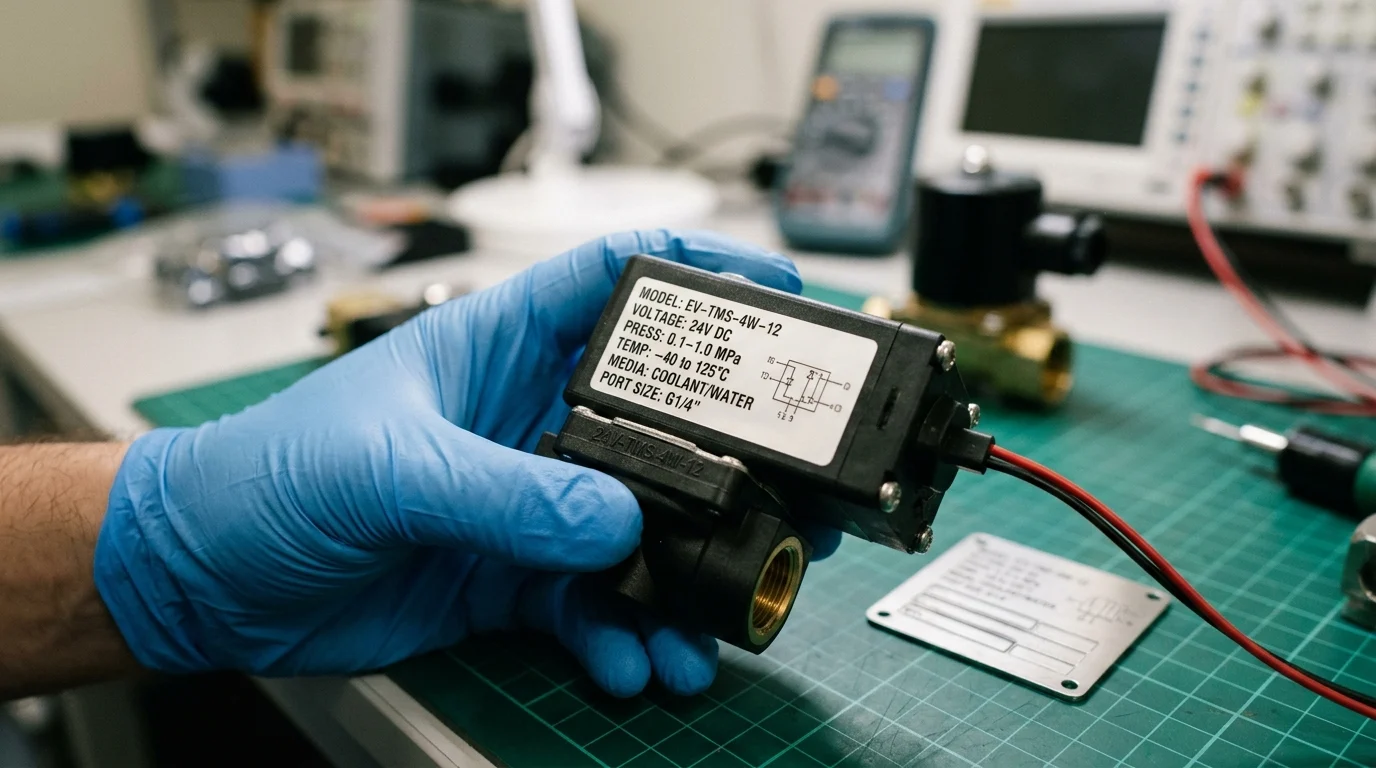
Specifying the correct solenoid valve requires balancing hydraulic capabilities with strict electrical and packaging constraints. As EV architectures migrate toward 800V systems, the resulting higher power densities and extreme fast-charging heat rejection requirements place greater demands on the BTMS. This pushes nominal operating pressures from legacy 1.0 bar systems up to 2.5 or even 3.0 bar to manage the increased thermal load.
Engineers must evaluate a matrix of performance specifications—and choose between direct-acting valves for immediate, low-flow control or pilot-operated types for high-pressure, high-flow loops—to ensure the valve not only survives the harsh under-hood environment but also operates with minimal energy penalty.
Key comparison points for engineers
When evaluating solenoid valves for EV applications, thermal engineers must compare several critical parameters that dictate both performance and longevity. The shift from standard automotive valves to high-performance, EV-specific designs is marked by tighter tolerances, lower power consumption, and significantly higher cycle life requirements. The following representative benchmarks illustrate these targets:
| Specification | Standard Automotive Valve | High-Performance EV Valve |
|---|---|---|
| Operating Pressure Range | 0.5 – 1.5 bar | 1.5 – 3.5 bar |
| Holding Power (Continuous) | 12W – 15W | <8W (Often PWM controlled) |
| Cycle Life Expectancy | 500,000 cycles | 2,000,000+ cycles |
| Internal Leakage (at 2 bar) | <5 cc/min | <1 cc/min |
| Response Time | 80 – 100 ms | 30 – 50 ms |
This comparative data highlights the necessity for specialized components. High-performance valves utilize advanced magnetic circuit designs and low-friction polymer coatings on the armature to achieve superior metrics, directly supporting the efficiency and safety goals of the modern EV.
Pressure drop, leakage, response time, and coil power
Minimizing pressure drop (ΔP) is essential, as excessive flow restriction forces the electric water pump to draw more current, negating the efficiency benefits of the valve.
Similarly, leakage rates must be strictly controlled to prevent unintended thermal bleed between heating and cooling loops. Even minor internal leakage can lead to gradual temperature drift in the battery pack, forcing the compressor to cycle on unnecessarily. Furthermore, rapid response times are vital for fail-safe operations, allowing the system to instantly isolate the battery loop in the event of thermal runaway.
Finally, coil power optimization is necessary to reduce the continuous parasitic draw on the low-voltage (12V/48V) system. Modern EV solenoid valves frequently employ Pulse Width Modulation (PWM) control, requiring an initial inrush current to actuate the valve, but dropping to a minimal holding power to maintain the open position.
Selecting and Validating EV Solenoid Valves
The transition from prototype to production requires passing an exhaustive suite of validation tests. Because solenoid valves are integral to the vehicle’s thermal safety architecture, they must comply with stringent automotive standards, including ISO 26262 for functional safety.
Validation protocols simulate the entire lifecycle of the vehicle, subjecting the components to extreme environmental, electrical, and chemical stresses to guarantee high reliability in the field, often targeting strict Failure In Time (FIT) rates or high Mean Time Between Failures (MTBF) rather than unrealistic zero-defect claims.
Validation steps for thermal and electrical performance
Thermal and electrical validation steps are designed to push the solenoid valve beyond its intended operating limits. Thermal shock testing typically requires the valve to endure rapid temperature transitions from -40°C to +85°C for over 1,000 cycles without mechanical binding or seal degradation.
Key Takeaways
- Design EV battery thermal systems to keep cells within the 15°C to 35°C operating window for better safety, range, and battery life.
- Use multi-way solenoid valves to isolate inactive coolant circuits and reduce pump energy consumption by up to 15% to 20% during steady-state driving.
- Route coolant through a battery chiller during DC fast charging to remove heat quickly and protect charging performance.
- In sub-zero conditions, use solenoid valves to decouple the battery loop and focus PTC heater output where it is needed most, helping recover 5% to 8% of effective range.
- Specify solenoid valves for higher-pressure EV architectures, as newer systems may move from legacy 1.0 bar designs toward 2.5 to 3.0 bar operation.
- Match valve type to the thermal function: two-way valves for shut-off, three-way valves for diversion, and proportional valves for variable coolant control.
Frequently Asked Questions
Why are solenoid valves important in EV battery thermal management?
They act as fast, compact flow-control gates that route coolant between the battery pack, chiller, heater, power electronics, motor, and cabin HVAC. This helps keep battery cells in the ideal 15°C to 35°C range.
How do solenoid valves improve EV driving range?
By isolating inactive coolant loops, solenoid valves reduce unnecessary pump work. In cold conditions, they can also focus heating on the battery, cutting PTC heater runtime and helping recover an estimated 5% to 8% of effective range.
What types of solenoid valves are used in EV cooling systems?
EV thermal systems may use two-way shut-off valves, three-way diverter valves, or proportional solenoid valves, depending on whether the system needs simple isolation, coolant routing, or variable flow control.
How do solenoid valves help during DC fast charging?
Fast charging generates significant battery heat. The vehicle control unit can open solenoid valves to connect the battery pack to the chiller loop, allowing coolant to remove heat quickly and maintain safe charging performance.
Why do EVs need more precise thermal control than combustion vehicles?
EVs do not have abundant engine waste heat, so battery temperature must be actively managed. Precise coolant routing helps protect cell life, safety, charging speed, and efficiency across changing driving and weather conditions.
Post time: Aug-22-2026