
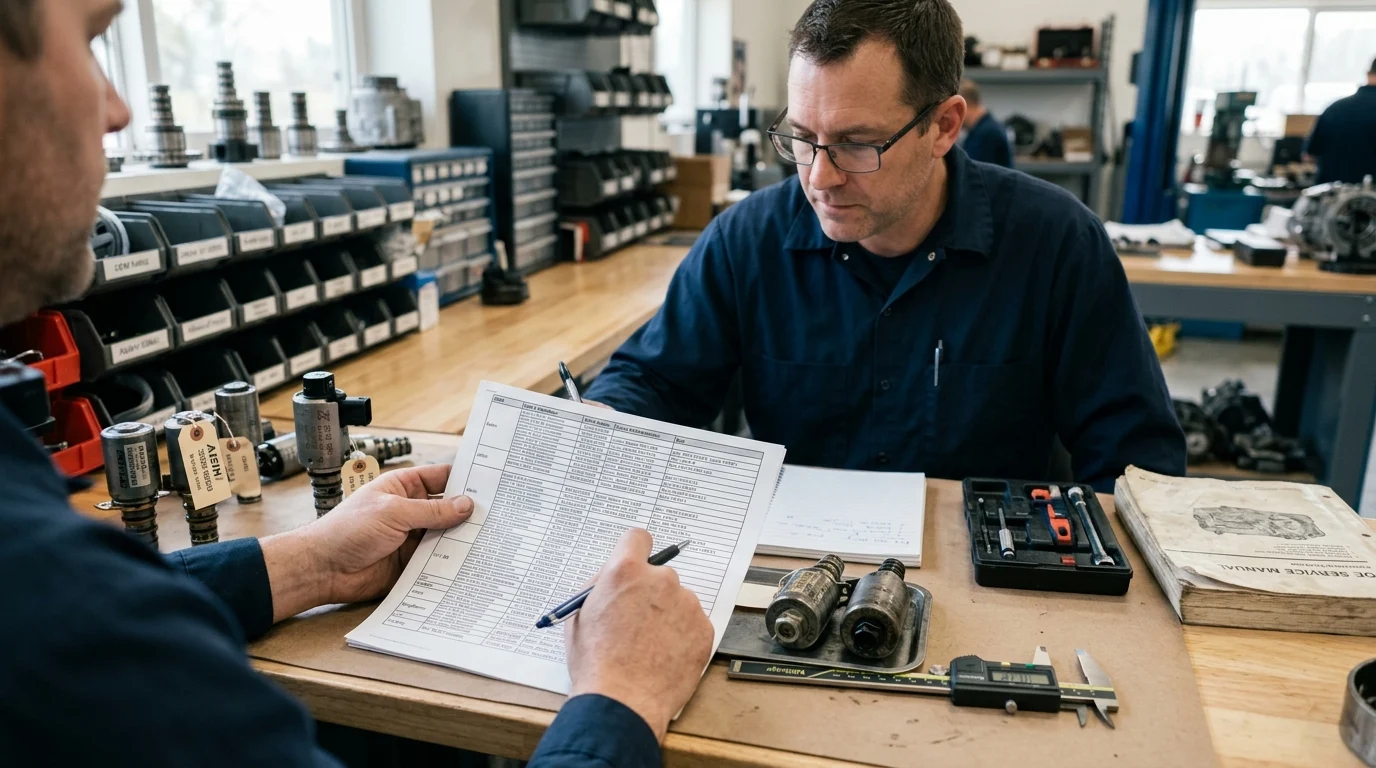
A transmission solenoid that looks correct on the bench can still be wrong inside the valve body. For US and EU rebuilders working with ZF, Aisin, GM, Ford, and other modern automatic transmissions, part-number cross-referencing is now a technical risk-control process, not just a catalog search. Small differences in coil resistance, pressure-control strategy, flow calibration, or supersession history can create shift complaints, TCM codes, and expensive warranty comebacks. This guide explains how to compare OEM numbers, superseded references, and aftermarket interchanges using practical data points that help rebuilders protect inventory accuracy, reduce bay-time losses, and install solenoid valves with greater confidence.
Why OEM Transmission Solenoid Cross-Referencing Matters
For transmission rebuilders operating in the United States and the European Union, the accurate identification of OEM transmission solenoid valves is a critical operational bottleneck. Modern automatic transmissions, such as the ZF 8HP or Aisin AWF8F35, utilize complex mechatronic units where solenoid calibration directly impacts shift quality, torque converter lock-up, and hydraulic line pressure.
As global supply chains become increasingly fragmented, rebuilders face an increasing number of mechatronic components that look identical on the outside but function differently on the inside. Establishing a standardized cross-referencing protocol is a vital safeguard against inventory obsolescence and costly transmission comebacks.
Key Commercial Risks of Incorrect Solenoid Matching
Failing to cross-reference solenoids correctly introduces severe commercial liabilities into a rebuilding operation. Installing a valve with an incorrect flow curve or resistance value will often trigger transmission control module (TCM) fault codes, resulting in harsh engagements, slipping clutches, or premature friction material degradation.
The financial penalty for an incorrect solenoid match is substantial. As a general industry rule of thumb, a typical transmission comeback caused by improper pressure control solenoid matching can cost a facility an estimated $1,200 to $2,500 in non-billable warranty labor, replacement synthetic ATF, and bay tie-up time. Furthermore, repeated diagnostic failures severely damage a rebuilder’s reputation in competitive B2B wholesale markets, where fleet managers demand high reliability.
Core Terms: OEM Number, Supersession, and Interchange
Navigating parts databases requires a clear understanding of industry terminology to avoid procurement errors. The ‘OEM Number’ represents the exact original factory designation stamped on the unit during initial vehicle assembly. Because manufacturers constantly refine hydraulic designs, rebuilders must also track ‘Supersessions.’
A supersession occurs when the manufacturer updates the part design or supplier, replacing the old number with a new one that is backward-compatible. Industry estimates suggest that roughly 30% of late-model transmission solenoids undergo at least one part number supersession during a standard 10-year vehicle production lifecycle. Finally, ‘Interchange’ refers to aftermarket or cross-manufacturer equivalents. For a concrete example, an original ZF 8HP green pressure control solenoid (OEM #0501328323) might be superseded by a newer revision to address wear issues. An aftermarket equivalent must explicitly cross-reference this exact ZF number chain rather than relying on a generic “ZF 8HP” label, ensuring the specific flow characteristics match the original application.
Data Points for Accurate Solenoid Valve Comparison
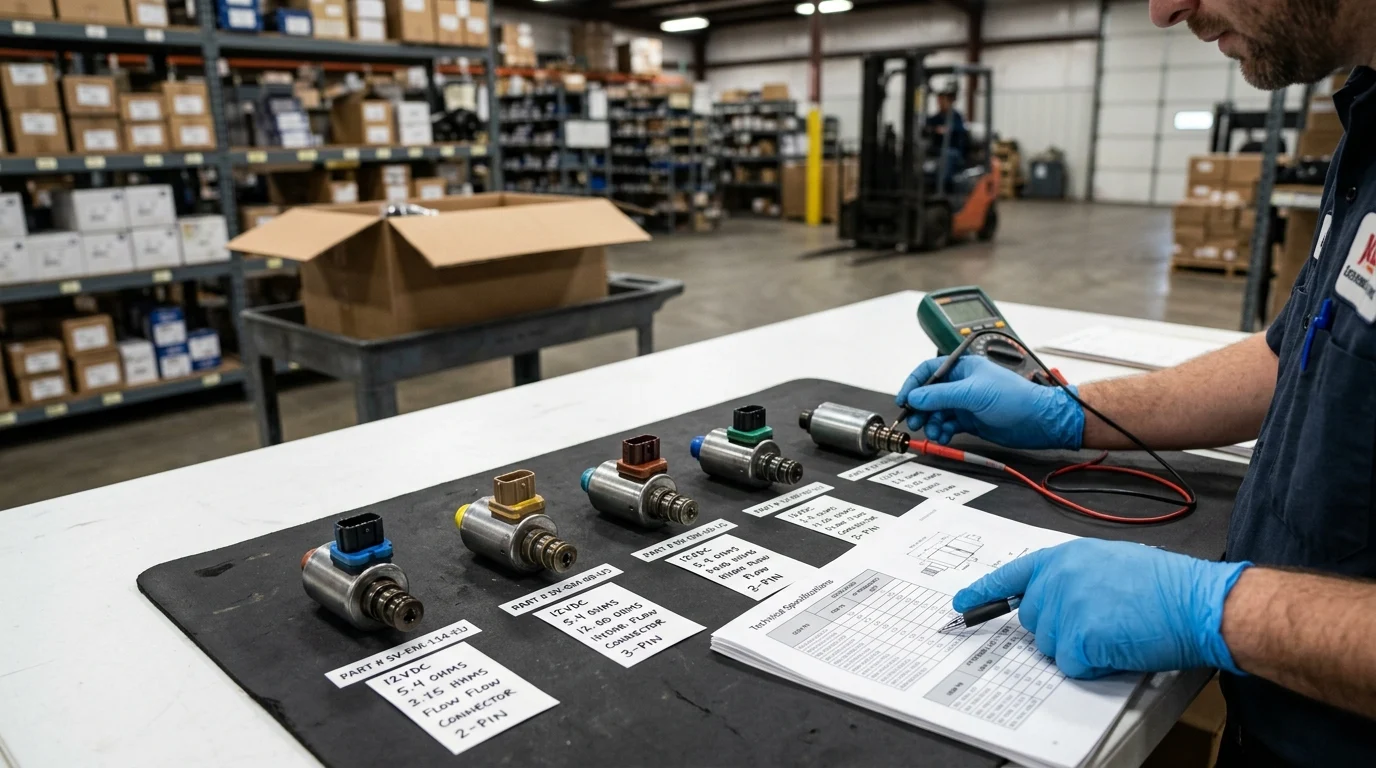
A reliable cross-referencing methodology relies on empirical data rather than visual similarity. Solenoid valves across different global platforms may share identical physical housings and mounting brackets but have completely different internal electrical characteristics.
Technical Identifiers to Compare Across Markets
Rebuilders should verify specific technical identifiers before approving an interchange. Primary theoretical metrics include coil resistance (measured in Ohms), connector pinout configurations, and operational duty cycles (Pulse Width Modulation vs. On/Off). For example, a normally high (NH) pressure control solenoid cannot be substituted for a normally low (NL) variant, even if the external dimensions align perfectly.
Note: The following values are illustrative industry averages. Actual specifications vary widely by specific transmission family (e.g., ZF 8HP vs. GM 6L80).
| Solenoid Type | Typical Resistance (Ohms) | Operating Pressure Range (psi) | Signal Type |
|---|---|---|---|
| Shift (On/Off) | 12.0 – 25.0 | 0 – 120 | 12V DC Direct |
| Linear (EPC/Pressure) | 3.5 – 6.0 | 0 – 90 | PWM (Variable) |
| TCC (Lock-up) | 10.0 – 15.0 | 0 – 100 | PWM (Variable) |
Validating these metrics prevents severe hydraulic pressure spikes that can rupture clutch drum seals. Furthermore, European transmission variants often utilize proprietary connector keys that differ slightly from their US-market counterparts, requiring meticulous physical comparison alongside electrical testing.
How to Separate Exact Matches from Supersessions
Distinguishing an exact match from a supersession dictates whether a TCM software re-flash is required post-rebuild. Exact matches feature identical flow dynamics and resistance profiles, allowing for seamless plug-and-play installation. Conversely, superseded parts often incorporate internal design upgrades—such as modified spool valve clearances or updated coil windings—to address chronic OEM failure points.
As a general guideline used by some rebuilders, when a supersession alters the flow rate by more than an estimated +/- 2% tolerance at a standardized 60 psi testing baseline, the TCM typically must undergo an adaptive relearn procedure or a complete calibration flash to prevent shift flares. Rebuilders should consult OEM technical service bulletins (TSBs) to determine if a newly superseded part number requires corresponding software updates. It is also important to note that flashing a TCM may require OEM-level diagnostic tools. In the EU, some powertrain calibrations fall under strict emissions and type-approval legal constraints. Fortunately, under EU RMI (Repair and Maintenance Information) Regulation 2023/1542, independent rebuilders have a legal right to access this OEM technical and calibration data.
Validation and Sourcing Workflow for Rebuilders
Implementing a standardized workflow for solenoid validation and procurement is essential for maintaining production efficiency. Rebuilders should integrate rigorous cross-referencing protocols directly into their initial diagnostic and teardown phases to eliminate downstream assembly delays.
Step-by-Step Verification Process
The verification process should follow a sequential standard operating procedure focused on physical and digital validation. First, technicians must extract the original equipment casting numbers and two-dimensional matrix codes directly from the solenoid body. This is also the time to verify genuine OEM markings—such as specific laser-etched QR codes versus generic stamped numbers, and valid date/lot codes—to avoid the major real-world risk of installing counterfeit or gray-market solenoids. Relying solely on the vehicle identification number (VIN) is risky; VIN-decoding limitations make electronic parts catalogs (EPCs) notoriously inaccurate for mid-year transmission production changes, and EPC data coverage in Europe can sometimes lag behind US databases for certain imported platforms.
Second, procurement managers should input these extracted identifiers into recognized industry resources—such as manufacturer EPCs, Sonnax lookup tools, Transtec guides, or OE TSB portals—to identify the exact OEM part number and any active supersessions. Third, rebuilders must verify the physical dimensions using digital calipers.
Key Takeaways
- Use the exact OEM solenoid part number as the primary reference before checking supersessions or aftermarket interchanges.
- Never approve a solenoid based on appearance alone, because identical housings can hide different resistance values, flow curves, and control logic.
- Verify coil resistance, connector pinout, PWM or on/off operation, and normally high or normally low behavior before installation.
- Track supersession chains carefully, as about 30% of late-model transmission solenoids may receive at least one part number update during a 10-year production cycle.
- Treat incorrect solenoid matching as a warranty risk, since one pressure-control-related comeback can cost a shop roughly $1,200 to $2,500.
- For ZF, Aisin, and other modern mechatronic units, confirm the specific solenoid calibration rather than relying on a broad transmission family label.
Frequently Asked Questions
Why is visual matching risky when replacing transmission solenoids?
Many solenoids share the same housing, bracket, or connector shape but differ internally. Coil resistance, flow curve, duty cycle, and normally high or normally low behavior can change shift timing, line pressure, and lock-up control.
What is an OEM transmission solenoid part number?
An OEM part number is the original factory identifier assigned to the solenoid used in production. It is the starting point for confirming fitment, supersessions, and approved aftermarket interchanges.
What does part number supersession mean?
Supersession means the manufacturer replaced an older part number with a newer version, often due to design updates, supplier changes, or durability improvements. Rebuilders should follow the full supersession chain before ordering.
Can a ZF 8HP solenoid be selected only by transmission model?
No. A label such as “ZF 8HP” is too broad. Rebuilders should verify the exact OEM number, color code, resistance range, hydraulic function, and application data before approving a replacement.
Which technical data should be checked before approving an interchange?
Check OEM number, supersession history, coil resistance, connector pinout, PWM or on/off operation, normally high or normally low type, flow calibration, valve body location, and vehicle application.
Post time: Sep-16-2026