
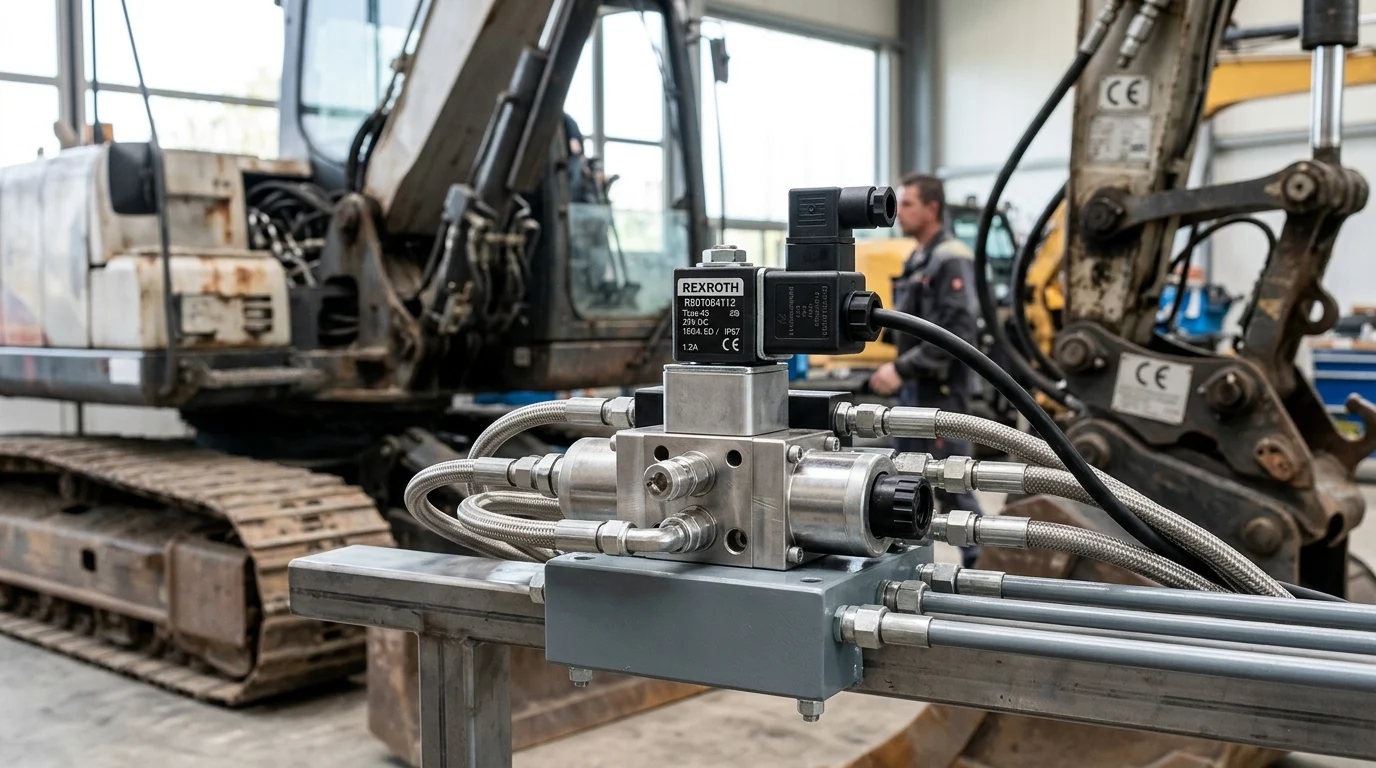
In modern mobile machinery, hydraulic precision is no longer a premium feature—it is essential for productivity, safety, and compliance. Excavators, forestry machines, and agricultural tractors operating under European regulatory and emissions pressures depend on proportional valves to meter flows that may reach 200 L/min at pressures of 250 to 350 bar. The solenoid coil behind that valve determines whether electrical commands become smooth, repeatable motion or inconsistent control under heat, vibration, and contamination. This article examines how engineers should specify high-performance solenoid coils for proportional hydraulic valves, focusing on current control, force linearity, hysteresis, thermal stability, and durability in harsh mobile applications.
Why Hydraulic Proportional Valves Need High-Performance Solenoid Coils
Mobile machinery operating under the EU Machinery Regulation (2006/42/EC) and Stage V emissions standards, such as forestry equipment, excavators, and agricultural tractors, relies heavily on advanced electro-hydraulic systems to execute controlled movements under variable loads. At the core of these systems are hydraulic proportional valves, which dictate fluid flow (typically ranging from 10 to 200 L/min) and pressure (often operating between 250 and 350 bar) based on electrical input signals. Unlike simple directional valves that operate in binary states, proportional valves require continuous, variable actuation. This necessitates high-performance solenoid coils capable of translating complex electrical commands into reliable mechanical force.
The operational environment in mobile machinery is notoriously harsh, featuring extreme temperature fluctuations (-40°C to +85°C ambient), severe vibration (frequently exceeding 15 to 20 Grms), and exposure to moisture and debris. Consequently, the solenoid coil is not merely an accessory but a critical powertrain component. Specifying the correct coil ensures that the proportional valve achieves the necessary resolution and reliability, directly impacting the machine’s overall productivity and safety.
Coil Force, Current Control, and Valve Accuracy
Proportional control depends on establishing a highly linear relationship between the applied electrical current and the resulting magnetic force acting on the valve armature. In high-performance solenoid coils, the winding geometry and core materials are optimized to produce a uniform magnetic flux density. This allows the valve spool (which typically has a total stroke of ±2 mm to ±10 mm) to be positioned with sub-millimeter accuracy, often achieving 0.05 mm to 0.1 mm resolution to meter hydraulic fluid in proportion to the operator’s joystick input or the central controller’s automated commands. Accurate proportional control usually requires closed-loop current feedback rather than open-loop voltage control to maintain this consistency.
To achieve this level of accuracy, the coil must maintain consistent electromagnetic characteristics. Operating currents in mobile hydraulics typically range from 0.8A to 2.5A (with 1.2A and 2.2A being standard benchmarks for 24V and 12V systems, respectively). At these levels, even minor variations in winding resistance can degrade control accuracy. Premium manufacturers ensure strict manufacturing tolerances. While a benchmark resistance tolerance of ±5% at a baseline temperature of 20°C is common, actual specifications vary by manufacturer, valve size, and application. This ensures the baseline force-to-current ratio remains stable across production batches without imposing unnecessary costs.
Hysteresis, Heat, and Long-Term Stability
Electromagnetic hysteresis is a primary enemy of proportional valve accuracy, causing the valve spool to assume different positions for the same command signal depending on whether the current is increasing or decreasing. High-quality solenoid coils utilize low-carbon magnetic steel alloys and specialized annealing processes to minimize residual magnetism. A general industry target keeps magnetic hysteresis below 2% to 3% of the maximum control signal (yielding repeatability within ±0.5%), though this benchmark heavily depends on the specific valve design, fluid viscosity, and operational context. High-quality coils typically target an MTBF (Mean Time Between Failures) exceeding 2 to 5 million actuation cycles.
Thermal management is equally vital for long-term stability. As current flows through the copper windings, the coil generates heat, leading to temperature rises that can exceed 80°C above ambient conditions, pushing internal core temperatures toward 130°C to 150°C. Because copper resistance increases with temperature (approximately 0.39% per °C), the drawn current—and therefore the mechanical force—will drop if the system relies on simple voltage control. Advanced coils are designed with superior thermal dissipation properties, often utilizing encapsulating resins with high thermal conductivity (e.g., >0.8 W/m·K) to prevent localized hotspots and ensure stable operation throughout a heavy-duty shift.
Key Solenoid Coil Specifications for Hydraulic Applications
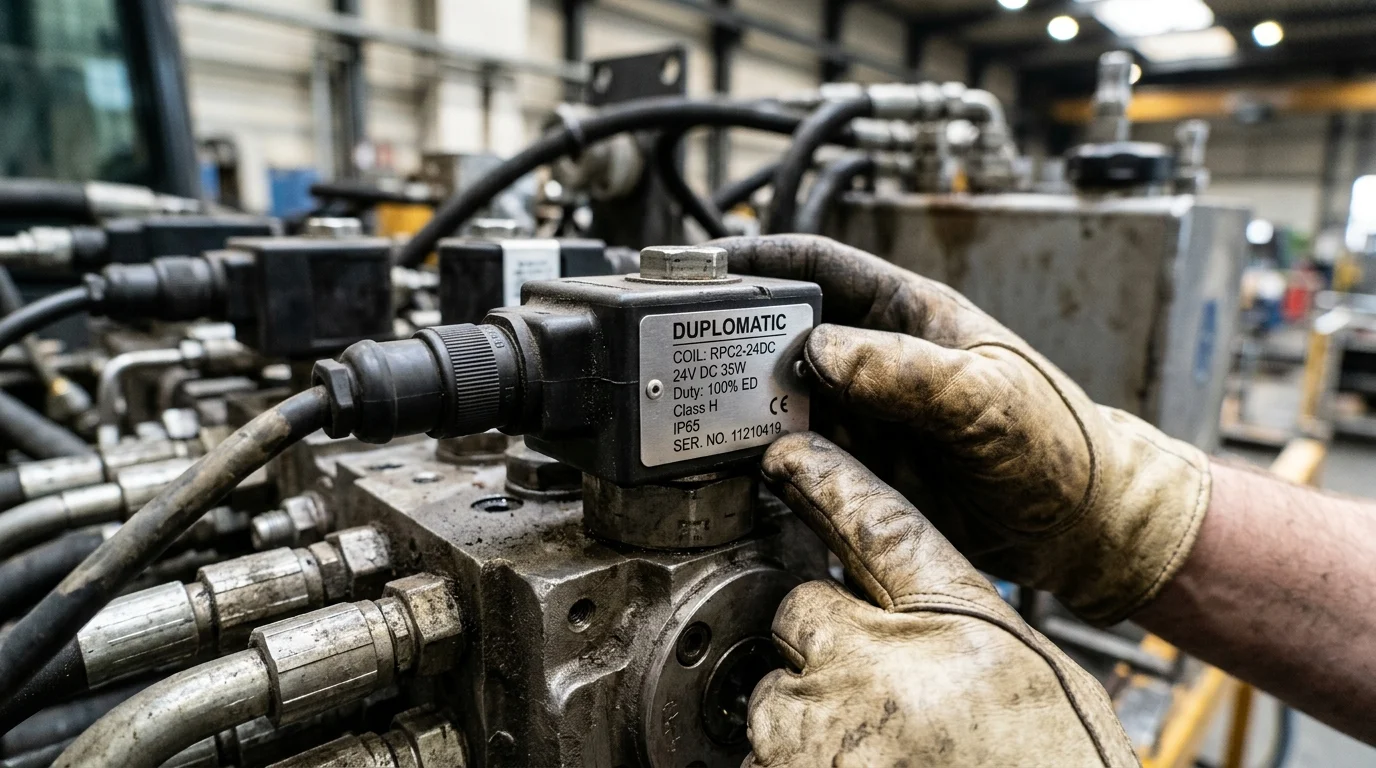
Selecting the optimal solenoid coil requires a deep understanding of electrical, thermal, and mechanical parameters. System engineers must match these specifications not only to the hydraulic valve’s mechanical requirements but also to the machine’s electronic control unit (ECU) capabilities and the harsh operating environments typical of construction and agricultural sites.
| Specification Category | Typical Range / Standard | Key Impact |
|---|---|---|
| Operating Voltage | 12VDC, 24VDC (±10% to ±15% tolerance) | Electrical system compatibility |
| Power Consumption | 15W – 30W | Magnetic force generation vs. thermal load |
| Coil Resistance | 5Ω – 30Ω (±5% at 20°C) | Current draw and ECU output matching |
| Insulation Class | Class H (up to 180°C) | High-temperature thermal durability |
| Ingress Protection | IP67, IP69K | Survivability against water, mud, and washdowns |
| Dither Frequency | 50 Hz – 250 Hz | Stiction reduction and hysteresis mitigation |
Beyond basic electrical traits, engineers must consider mechanical integration. Standardizing electrical connections using robust interfaces like EN 175301-803 (formerly DIN 43650/ISO 4400, rated up to 16A) or Deutsch DT connectors (rated for 13A continuous with <10 mΩ contact resistance) ensures mounting compatibility and reliable signal transmission in high-vibration environments. Additionally, engineers must choose between two primary armature designs, each offering distinct trade-offs:
- Wet-pin coils: Allow hydraulic fluid to lubricate and cool the armature tube, enhancing longevity and thermal stability while withstanding static pressures up to 350 bar. However, they require strict fluid compatibility and carry a higher contamination risk.
- Dry-armature coils: Isolate the fluid completely from the electromagnetic components, simplifying maintenance access and eliminating fluid contamination risks, though they may lack the cooling benefits of wet-pin designs.
Voltage, Power Rating, Duty Cycle, and Insulation Class
Mobile machinery operates on standard DC electrical architectures, making 12VDC and 24VDC the most common voltage ratings for proportional coils. Power consumption must be carefully balanced; while higher power yields greater magnetic force to overcome hydraulic flow forces, it also increases thermal load. Typical power ratings for these applications fall within the 15W to 30W band. Because proportional valves frequently hold intermediate positions for extended periods, the coil is often rated for a 100% ED (Continuous) duty cycle at maximum ambient temperatures of 85°C.
How OEMs Should Source and Validate Solenoid Coils
Sourcing reliable components for hydraulic proportional valves requires aligning technical specifications with rigorous regulatory frameworks. For OEMs producing mobile machinery, a systematic validation process ensures long-term operational stability under severe environmental stress.
Compliance, Quality Standards, and Supplier Capabilities
European mobile machinery must adhere to stringent safety and environmental directives. Procurement teams must prioritize suppliers demonstrating a robust Quality Management System (QMS), such as ISO 9001 or IATF 16949, which ensures full material traceability and defect reduction.
Key compliance benchmarks include CE marking, RoHS and REACH compliance, and high ingress protection ratings (IP67/IP69K). Established manufacturers, such as Feiniou (Ningbo) Electronic Technology Co., Ltd., represent the necessary baseline for supplier capabilities. By combining dedicated R&D for electromagnetic coils, pilot components, and actuators with a verified QMS, such enterprises can successfully support complex OEM validation cycles.
Practical Selection Process for Engineering and Procurement Team
s
To successfully execute the task of specifying high-performance solenoid coils for precise flow control in European mobile machinery, cross-functional teams must implement a structured evaluation framework.
- Electromagnetic Profiling: Engineers must validate the force-stroke curve to ensure linear hysteresis matches the proportional valve’s hydraulic flow requirements without magnetic saturation.
- Thermal Cycle Testing: Prototypes must undergo continuous duty cycles (100% ED) at maximum ambient temperatures to measure resistance drift and insulation degradation.
- Environmental Stress Screening: Coils must survive vibration profiles defined by European machinery standards.
| Validation Metric | Target Standard / Requirement | Testing Methodology |
|---|---|---|
| Vibration Resistance | ISO 13766-1 / EN 60068-2-6 | Multi-axis frequency sweep testing |
| Ingress Protection | IP67 / IP69K (EN 60529) | High-pressure, high-temperature water jet exposure |
| Thermal Endurance | Class H Insulation (180°C) | Accelerated life testing (ALT) under load |
By strictly enforcing these validation stages, OEMs mitigate the risk of premature valve failure, ensuring consistent machine performance across diverse European operational environments.
Key Takeaways
- Specify proportional valve coils for closed-loop current control rather than open-loop voltage control to maintain spool accuracy as resistance changes with temperature.
- Match coil selection to mobile machinery conditions, including -40°C to +85°C ambient temperatures, severe vibration, moisture, debris, and pressure-washing exposure.
- Use current benchmarks such as about 1.2A for 24V systems and 2.2A for 12V systems as starting points, then validate against the valve manufacturer’s requirements.
- Target low magnetic hysteresis, typically below 2% to 3% of the maximum control signal, to improve repeatability in precision flow control.
- Check resistance tolerance, commonly around ±5% at 20°C, because coil-to-coil variation can affect force output and proportional valve consistency.
- Select coils with robust materials and proven life ratings, often exceeding 2 to 5 million actuation cycles, for demanding European mobile machinery applications.
Frequently Asked Questions
Why do proportional hydraulic valves require higher-performance solenoid coils?
Proportional valves need continuous, variable actuation rather than simple on/off movement. A high-performance coil converts current into stable magnetic force, helping position the valve spool accurately for precise flow and pressure control.
What operating conditions should coils withstand in European mobile machinery?
Coils should be specified for harsh field conditions, including ambient temperatures around -40°C to +85°C, vibration that may exceed 15 to 20 Grms, and exposure to moisture, debris, and pressure-washing environments.
Is current control better than voltage control for proportional valves?
Yes. Closed-loop current control is generally preferred because it compensates for resistance changes caused by temperature and production tolerances, helping maintain a consistent force-to-current relationship.
What current ranges are typical for mobile hydraulic solenoid coils?
Typical operating currents range from about 0.8A to 2.5A. Common benchmarks are around 1.2A for 24V systems and 2.2A for 12V systems, depending on valve size and application.
How does hysteresis affect proportional valve performance?
Hysteresis can make the spool settle in different positions for the same command signal, reducing repeatability. High-quality coils use optimized magnetic materials and processes to keep hysteresis low.
Post time: Jul-02-2026