
Introduction
In Scandinavian cold chain facilities, solenoid coil selection directly affects uptime, product integrity, and maintenance risk when systems must operate through subzero storage, dock transitions, and outdoor exposure. The right coil is not simply one with a low temperature rating; it must also withstand thermal contraction, moisture ingress, icing, voltage variation, and continuous duty in refrigeration and automation circuits. This article outlines the key specifications to compare, the common failure modes standard coils face in Arctic conditions, and the practical factors engineers and buyers should review before specifying components for warehouses and logistics networks across Norway, Sweden, and Finland.
Why Low-Temperature Solenoid Coils Matter in Arctic Warehouses
Cold chain logistics in Scandinavia demand rigorous equipment standards to preserve perishable goods, pharmaceuticals, and biological assets. Facilities operating near or above the Arctic Circle, supporting networks across Norway, Sweden, and Finland, face extreme internal and external climates. Automated systems—including ammonia refrigeration circuits and pneumatic sorting lines—rely heavily on electromagnetic components to maintain continuous operation.
Solenoid coils, which control the flow of refrigerants and automation fluids within valve islands and pilot assemblies, must function flawlessly in environments where ambient temperatures routinely drop below -40°C. Standard electromagnetic components are highly susceptible to failure under these thermal extremes, making specialized low-temperature variants non-negotiable for regional supply chains.
Arctic warehouse operating challenges
The primary obstacle in these cold storage facilities is the drastic thermal contraction of internal components. When standard copper windings and thermoplastic bobbins are exposed to deep-freeze conditions, differing rates of thermal expansion cause micro-fractures in the insulation. These micro-fractures compromise the dielectric strength, eventually leading to short circuits when energized.
Additionally, the transition zones between deep-freeze storage (often maintained at -25°C) and loading docks create severe condensation issues. This moisture quickly freezes on external valve components. If the coil housing is not adequately sealed, ice penetration leads to mechanical binding of the armature and catastrophic electrical failures.
Specification criteria and review checklist
Engineers must rigorously evaluate environmental tolerances before approving components for Scandinavian deployment. The baseline requirement for arctic applications is an operating temperature range certified to at least -40°C, paired with superior ingress protection to withstand both frost melt and high-pressure washdowns during facility cleaning protocols.
Below is a comparative checklist highlighting the necessary specification shifts from standard to arctic-grade coils:
| Specification Parameter | Standard Industrial Coil | Arctic-Grade Solenoid Coil |
|---|---|---|
| Minimum Operating Temp | -10°C | -40°C (or lower) |
| Ingress Protection | IP65 | IP67 / IP69K |
| Encapsulation Material | Standard Nylon/Polyamide | Advanced Epoxy Resin |
| Moisture Resistance | Low to Moderate | High (Hermetically sealed) |
Ensuring compliance with these upgraded specifications prevents catastrophic valve failures during peak winter operations.
How to Compare Low-Temperature Solenoid Coil Options
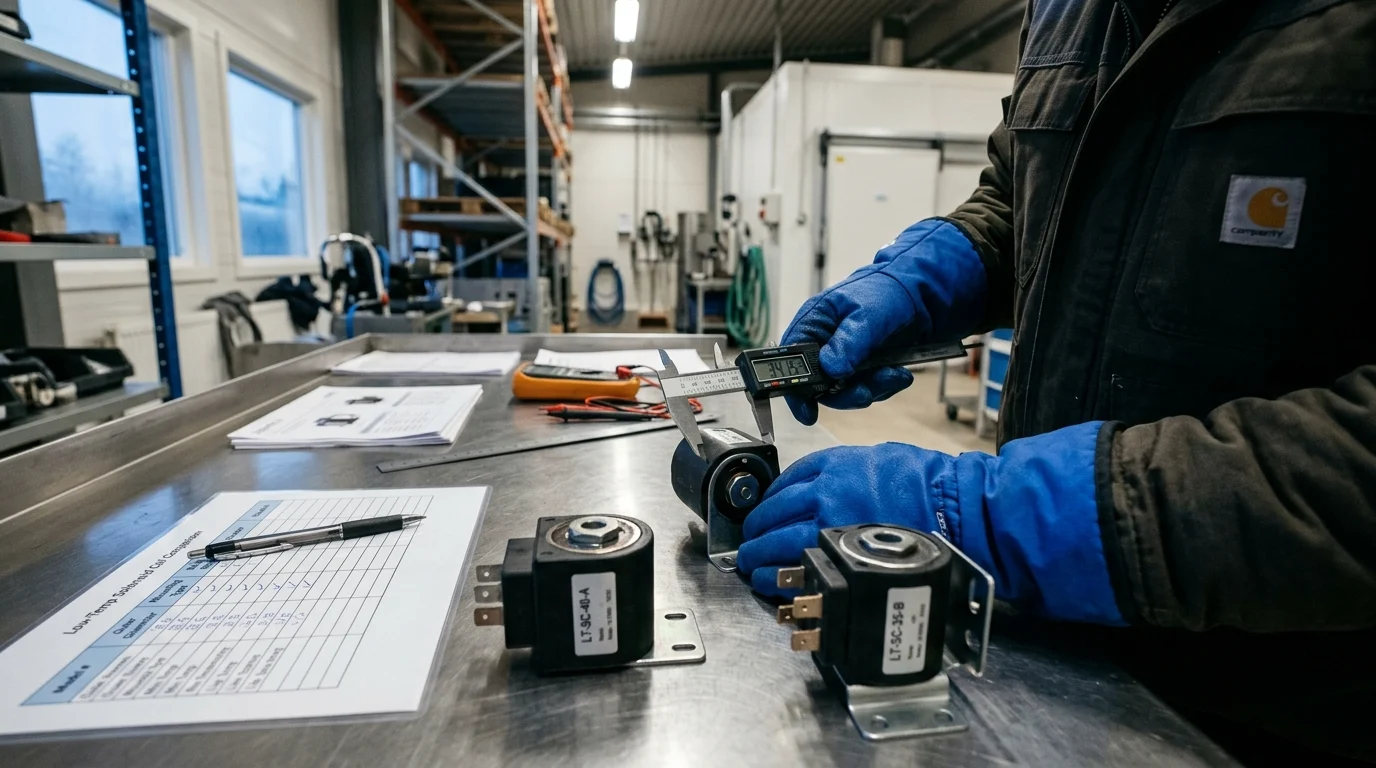
Moving beyond basic manufacturer datasheets, comparing low-temperature solenoid coil options requires a deep dive into electrical efficiency, thermal dynamics, and material science. Procurement teams must balance immediate unit costs against the long-term reliability of the automated fluid control systems.
The evaluation phase should focus closely on how the coil interacts with its accompanying pilot assemblies and actuators. A coil that performs well in a laboratory freezer may still fail in a dynamic warehouse environment if its power profile and material composition are not optimized for continuous, heavy-duty cycles.
Key technical selection criteria
Advanced encapsulation material is a primary differentiator among technical specifications. High-grade epoxy resins remain flexible and crack-resistant at sub-zero temperatures, whereas standard polyamides become brittle and prone to structural failure. Beyond physical materials, power consumption is a critical performance metric that dictates long-term viability.
Traditional coils drawing 15W to 20W of continuous power generate significant self-heating. In a sub-zero environment, this localized heat melts surrounding frost, which then refreezes into solid ice when the valve de-energizes—a destructive phenomenon known as ice jacking. Selecting dual-power modules or advanced pulse-controlled coils can reduce holding power consumption by up to 70%, effectively minimizing thermal cycling and subsequent ice buildup.
Vendor comparison factors
Evaluating suppliers involves scrutinizing their manufacturing capabilities and comprehensive quality management systems. Leading manufacturers, particularly those with strong backgrounds in automotive and engineering machinery components, often possess the rigorous testing infrastructure required for cold-chain reliability. Buyers must request detailed documentation, including accelerated weathering data and ISO-certified quality reports.
Furthermore, supply chain logistics and production flexibility must be considered. Specialized arctic-grade coils often carry different minimum order quantities (MOQs) than standard off-the-shelf units. Typical custom production runs for specialized epoxy-sealed coils may require MOQs ranging from 500 to 1,000 pieces. Assessing a vendor’s lead time, production capacity, and inventory buffering strategy is essential to avoid seasonal stockouts before the harsh Scandinavian winter sets in.
How to Finalize Selection and Deployment
Finalizing the selection of low-temperature solenoid coils involves transitioning from theoretical specifications to practical, field-ready deployment strategies. Successful implementation in highly automated Scandinavian warehouses relies on strict testing protocols, precise installation procedures, and a comprehensive understanding of lifecycle economics.
Facility managers must ensure that the transition minimizes downtime. Integrating new coils into existing valve islands, drainage valves, and pulse control instruments requires cross-departmental coordination between procurement, engineering, and maintenance teams.
Procurement, testing, and maintenance steps
Before full-scale facility rollout, sample units must undergo rigorous thermal shock testing. A standard validation protocol involves rapidly cycling the components from -40°C to +20°C for a minimum of 1,000 cycles to verify hermetic seal integrity and material stability. During installation, technicians must strictly adhere to torque specifications, as cold metal threads and connector pins are highly susceptible to shearing or stripping.
Once procured and installed, maintenance teams must adopt specialized winterization protocols. This includes routine visual inspections of junction boxes and positioning connectors for micro-fissures. Applying dielectric grease to electrical contacts prevents moisture ingress, while regular monitoring of the coil’s electrical resistance serves as an early warning system for internal winding degradation before complete operational failure occurs.
Supplier quality and lifecycle cost review
A total cost of ownership (TCO) analysis strongly favors investing in premium low-temperature components. While a standard commercial solenoid coil might carry an initial procurement cost of roughly $15, its high failure rate in arctic conditions can trigger emergency maintenance, spoiled inventory, and facility downtime costing upward of $5,000 per incident.
In contrast, an arctic-rated epoxy-encapsulated coil may require an initial investment of $35 to $50 but offers a reliable operational lifespan exceeding five years.
Key Takeaways
- The most important conclusions and rationale for Selecting Low-Temperature Solenoid Coils for Arctic Warehouses and Cold Chain Logistics in Scandinavia
- Specs, compliance, and risk checks worth validating before you commit
- Practical next steps and caveats readers can apply immediately
Frequently Asked Questions
What minimum temperature rating should a solenoid coil have for Scandinavian cold stores?
Choose coils certified for at least -40°C operation. This helps prevent insulation cracking and electrical failure in arctic warehouses and cold chain loading areas.
Why are IP67 or IP69K ratings important in freezer warehouses?
They protect coils against condensation, frost melt, and washdown water. In cold chain sites, this reduces ice ingress, armature sticking, and short-circuit risk.
Which encapsulation material is better for arctic solenoid coils?
Advanced epoxy resin is usually the safer choice. It stays more crack-resistant in sub-zero conditions than standard nylon or polyamide housings.
How can lower power coils improve reliability in cold chain logistics?
Dual-power or pulse-controlled coils cut holding power and self-heating. That reduces frost melting and refreezing, helping prevent ice jacking around valves.
What should buyers ask suppliers before ordering low-temperature coils?
Request low-temperature test data, ISO quality records, ingress protection details, MOQ, and lead time. This helps avoid winter stockouts and mismatched specifications.
Post time: Jun-04-2026