
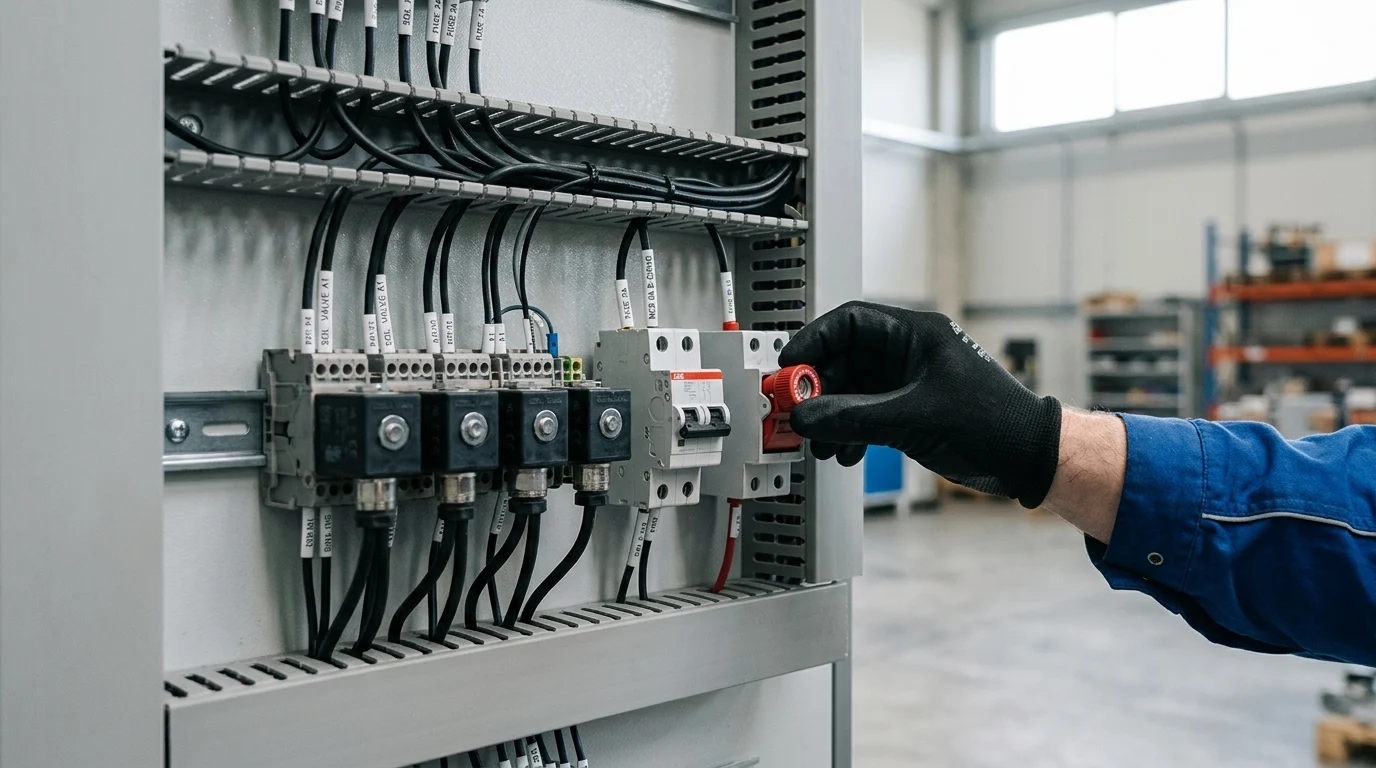
Introduction
Solenoid coils in European control panels may seem like small loads, but a short circuit in one coil can escalate quickly into wiring damage, nuisance trips, or broader panel failure. Choosing protection is not as simple as matching nominal current: inductive behavior, inrush current, coil failure modes, and coordination with panel wiring all affect whether a fuse or circuit breaker will clear a fault fast enough without interrupting normal operation. This article explains why coil circuits need dedicated short-circuit protection, how AC and DC coil characteristics influence device selection, and what to consider when applying fuses or breakers within common European panel design practices.
Why Short-Circuit Protection Matters for Solenoid Coils
Reliable operation of European control panels relies heavily on the integrity of inductive load circuits, particularly solenoid coils used in valves, actuators, and pneumatic systems. Without adequate short-circuit protection, a localized fault in a solenoid coil can cascade, causing catastrophic panel damage, production downtime, and severe safety hazards.
Solenoid Coil Failure Modes and Inrush Current
Solenoid coils are highly inductive components that experience unique electrical stresses during operation. When an alternating current (AC) solenoid is energized, the initial absence of back-electromotive force (EMF) results in a severe inrush current. This transient spike typically reaches 5 to 10 times the nominal holding current and lasts for 10 to 30 milliseconds until the magnetic armature fully seats.
If the plunger mechanically jams due to contamination or wear, the coil sustains this maximum inrush current, leading to rapid thermal degradation of the winding insulation. Once the internal insulation fails, turn-to-turn short circuits develop. This drastically lowers the coil’s overall impedance, causing an exponential rise in current draw that requires immediate interruption before the wiring infrastructure melts.
Scope and Key Protection Concepts
Effective protection strategies must differentiate between sustained overloads and instantaneous short circuits. While overload protection safeguards against gradual thermal buildup, short-circuit protection must act within milliseconds to prevent structural melting, arc flashes, and fire. In industrial control panels, the protective device must possess sufficient short-circuit breaking capacity, typically rated between 10 kA and 50 kA depending on the panel’s prospective fault current.
The primary objective is to minimize let-through energy during a fault. Ensuring that thermal stress during the fault-clearing time does not exceed the withstand capacity of the control wiring and adjacent switching components is critical for maintaining panel integrity.
How to Select Short-Circuit Protection for Solenoid Coils

Designing a protection scheme for solenoid coils requires balancing rapid fault clearance with high immunity to nuisance tripping. Engineers must evaluate the load characteristics to determine whether miniature circuit breakers (MCBs) or fuses offer the optimal solution for a given control panel architecture.
Fuse and Circuit Breaker Selection Criteria
Fuses and MCBs dictate different coordination approaches. For fuse-based protection, European panels frequently utilize cylindrical gG (general purpose) or aM (motor-associated) characteristics. The aM fuses are specifically engineered to withstand high inrush currents without degrading, requiring a fault current of approximately 10 to 12 times their rated current to clear rapidly.
Conversely, MCBs utilize specific magnetic trip curves. Type C circuit breakers trip instantaneously at 5 to 10 times the rated current, which may cause nuisance tripping with highly inductive AC solenoids. Therefore, Type D breakers, which trip at 10 to 20 times the rated current, are frequently specified for heavy-duty solenoid applications to ride through the initial energization phase without compromising short-circuit safety.
Sizing, Coordination, and Comparison Methods
Sizing the protective device requires calculating the maximum steady-state load, factoring in the enclosure’s ambient temperature, and cross-referencing the inrush profile against the device’s time-current curve. Engineers must also ensure selectivity, meaning the protective device closest to the faulty solenoid clears the short circuit before the main panel feeder trips.
| Protection Type | Trip/Clearance Speed | Inrush Tolerance | Resetability | Typical Cost per Pole |
|---|---|---|---|---|
| aM Class Fuse | Very Fast (< 5 ms for dead shorts) | High | Replace only | €2.00 – €5.00 |
| Type C MCB | Fast (10 – 20 ms) | Moderate (5-10x nominal) | Manual Reset | €10.00 – €25.00 |
| Type D MCB | Fast (10 – 20 ms) | High (10-20x nominal) | Manual Reset | €15.00 – €30.00 |
Selecting between these options requires analyzing the specific downtime costs and maintenance protocols of the facility. Fuses offer superior current limitation for sensitive circuits, while MCBs provide operational convenience, immediate visual fault indication, and rapid recovery times.
Compliance and Best Practices for Solenoid Coil Protection

Deploying solenoid coils within the European Union requires strict adherence to international electrotechnical standards. Panel builders must validate that their protection schemes comply with local directives to achieve CE marking and ensure operational safety across diverse industrial environments.
Regional Standards and Safety Requirements
The primary standard governing the electrical equipment of machines in Europe is EN 60204-1. This directive stipulates strict requirements for control circuits, mandating that circuits supplied by a transformer must incorporate short-circuit protection capable of clearing a fault within a maximum of 5 seconds to prevent hazardous thermal events.
Furthermore, the protective devices themselves must comply with IEC 60947-2 for circuit breakers or IEC 60269 for low-voltage fuses. When designing panels, engineers must ensure that the selected protective devices are appropriately rated for the specific control voltage—often 24V DC or 230V AC—and that the dielectric properties of the components can withstand the inductive kickback voltages generated during the solenoid’s de-energization cycle.
Implementation Recommendations for Manufacturers
To achieve robust system reliability, manufacturers should implement physical segregation between high-power circuits and sensitive control logic. Utilizing advanced solenoid technologies and precision components, such as those developed by FeiNiu Electronic Technology, can further mitigate systemic risks. Integrating dual-power modules or pulse control instruments drastically reduces the steady-state holding current, thereby lowering the thermal baseline of the coil and extending its insulation lifespan.
Additionally, engineers should utilize surge suppressors, such as freewheeling diodes or metal-oxide varistors (MOVs), directly across the solenoid coils. This practice limits high-voltage transients that can prematurely degrade coil insulation, ultimately reducing the statistical probability of a turn-to-turn short circuit and ensuring the uninterrupted operation of the entire industrial control panel.
Key Takeaways
- The most important conclusions and rationale for The Importance of Short-Circuit Protection for Solenoid Coils in European Control Panels: Fusing and Circuit Breaker Selection
- Specs, compliance, and risk checks worth validating before you commit
- Practical next steps and caveats readers can apply immediately
Frequently Asked Questions
Why do solenoid coils need dedicated short-circuit protection?
A coil fault can escalate in milliseconds, overheating wiring and damaging the control panel. Dedicated protection isolates the fault quickly and limits let-through energy.
When should I choose an aM fuse instead of an MCB?
Use an aM fuse when high inrush current and strong current limitation are priorities. It is often preferred for sensitive wiring and fast fault clearing.
Is a Type C MCB suitable for AC solenoid coils?
Sometimes, but it may nuisance-trip if the coil inrush is high. Check the coil’s startup current against the breaker’s magnetic trip curve before selecting it.
Why is a Type D MCB often used for solenoid applications?
Type D breakers tolerate higher inrush, typically 10–20 times rated current, so they are less likely to trip during energization while still providing short-circuit protection.
What should be checked to meet European panel requirements?
Verify breaking capacity, device coordination, conductor protection, and applicable IEC/EN standards for CE-marked panels. Also confirm selectivity so the branch device clears before the main feeder.
Post time: May-07-2026