
A slight flare, a harsh 2-3 shift, or an unexpected limp-in event can turn into real downtime when a fleet vehicle is working under load. In electronically controlled automatics, shift feel is largely a pressure-control problem, and the transmission solenoid valve is the component translating TCM commands into hydraulic force. This article examines how solenoid construction, coil stability, spool clearances, fluid condition, and diagnostic procedure influence clutch apply timing and driver-perceived shift quality. For North American fleet technicians, understanding these details helps separate a true solenoid failure from wiring, valve body, ATF, or control-system issues before parts are replaced.
Why Transmission Solenoid Valve Quality Determines Shift Feel
Modern commercial fleet vehicles rely on electronically controlled automatic transmissions to optimize fuel efficiency, maintain torque delivery, and ensure payload stability. At the core of this operation is the transmission solenoid valve, an electro-hydraulic actuator responsible for translating electrical signals from the Transmission Control Module (TCM) into precise hydraulic pressure. This pressure, frequently ranging between 150 and 250 psi, actuates clutches and bands to execute gear changes.
When fleet technicians encounter shift quality complaints—whether a shift is seamless, harsh, or flaring—the solenoid's inability to modulate fluid pressure accurately over its operational lifecycle is frequently a primary factor. Solenoid behavior interacts heavily with valve body bore wear, clutch pack condition, TCM adaptive strategies, and Automatic Transmission Fluid (ATF) quality. While solenoid quality is critical, it is part of a broader hydraulic and electronic ecosystem that collectively determines shift feel.
How to Define Solenoid Valve Quality
Defining the quality of a transmission solenoid requires examining its dimensional tolerances, material composition, and thermal stability. Premium solenoid valves are manufactured to exacting standards that minimize spool valve clearances. Maintaining these microscopic clearances is critical to preventing internal hydraulic leakage when ATF reaches peak operating temperatures during heavy towing or frequent stop-and-go duty cycles.
Furthermore, high-quality solenoids utilize advanced materials such as anodized aluminum or hardened steel for the spool and armature, alongside high-grade copper windings coated in heat-resistant enamel. These material choices prevent the physical distortion and magnetic degradation that plague inferior components under continuous thermal cycling.
Symptoms of Hydraulic, Electrical, and Control Issues
Component degradation manifests across three distinct domains: hydraulic, electrical, and control.
- Hydraulic: Abrasive wear inside the solenoid bore allows pressurized fluid to bleed off. Diagnostic clue: Pressure tap readings fall below TCM-commanded values. Customer symptom: A leaking variable-force solenoid (VFS), for example, causes apply-pressure lag, resulting in a noticeable shift flare and localized friction plate heat buildup that rapidly accelerates transmission failure.
- Electrical: Prolonged exposure to heat and vibration degrades the coil windings. As the internal insulation fails, resistance drifts outside the TCM's acceptable parameters, triggering diagnostic trouble codes (DTCs). Diagnostic clue: Solenoid codes (e.g., P0750-series) often indicate wiring or connector issues rather than the solenoid itself; technicians should verify harness continuity and TCM driver output before condemning the valve. Customer symptom: The transmission defaults to harsh fail-safe or limp-in modes.
- Control: The solenoid armature becomes sluggish due to magnetic hysteresis or debris accumulation. Diagnostic clue: Advanced electrical testing can reveal erratic signatures. Customer symptom: Unpredictable shift timing and uncommanded gear drops that disrupt fleet operations.
Key Specifications That Predict Shift Consistency
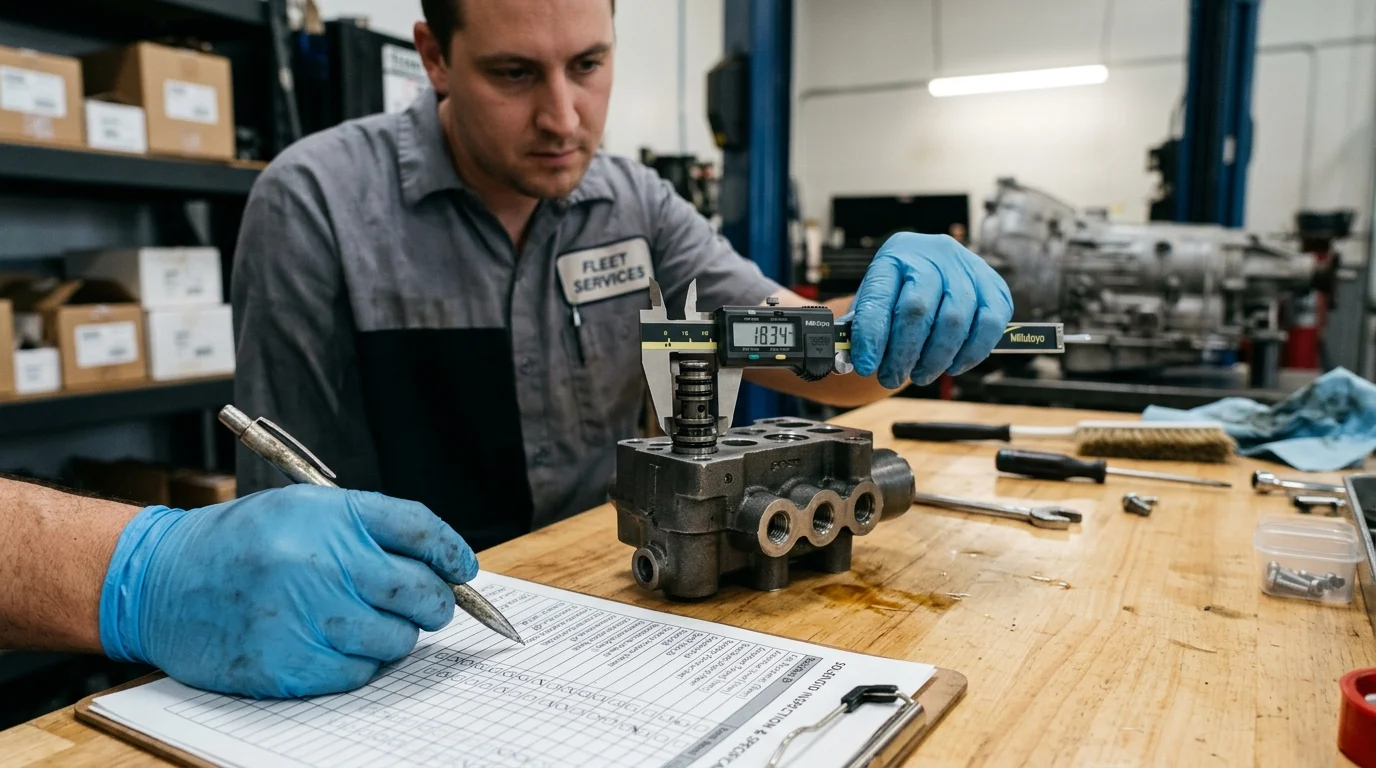
For fleet maintenance programs to minimize transmission-related downtime, technicians must evaluate replacement solenoids based on empirical data rather than brand recognition alone. Commercial transmission solenoids are subjected to extreme duty cycles over their operational lifespan. Ensuring consistent shift feel across this duration requires strict adherence to specific electro-mechanical specifications.
Note: The following metrics represent generalized industry benchmarks; actual specifications vary significantly by OEM, transmission model, and fundamentally across solenoid types.
Response Time, Flow Control, and Coil Resistance
A critical specification governing shift feel is response time—the duration required for the solenoid to reach its target pressure after receiving the TCM command. In modern multi-speed transmissions, a delayed response time can result in noticeable shift overlap or flaring. Precision flow control is equally vital, demanding linear pressure output relative to the pulse-width modulation (PWM) signal provided by the TCM.
Coil resistance stability directly impacts the magnetic force generated to move the internal pintle or spool. If resistance fluctuates wildly with temperature changes, the resulting hydraulic pressure will be inconsistent, confusing the TCM's adaptive learning algorithms.
While these metrics are often measured in a lab, technicians without specialized bench equipment can sanity-check them on-vehicle by comparing coil resistance to factory specifications at full operating temperature before moving to advanced scan tool and oscilloscope diagnostics during installation.
| Metric | On/Off Solenoid | PWM / Variable-Force |
|---|---|---|
| Actuation Response Time | < 25 ms | < 15 ms |
| Coil Resistance Tolerance | ± 10% | ± 2% |
| Spool-to-Bore Clearance | 10 microns | 5 microns |
| Maximum Operating Temp | 220°F (104°C) | 260°F (126°C) |
OEM vs Aftermarket Evaluation Criteria
When selecting replacement units, fleet managers must weigh Original Equipment Manufacturer (OEM) components against aftermarket alternatives using a clear decision framework. OEM solenoids guarantee exact factory flow rates and TCM compatibility, making them the safest choice for warranty-active units to ensure baseline shift consistency.
However, for out-of-warranty transmissions, some factory designs contain inherent flaws, such as premature bore wear. Premium aftermarket manufacturers often reverse-engineer these components to correct factory weaknesses, utilizing upgraded materials like encapsulated coils or oversized spools to restore valve body integrity. This makes certified aftermarket parts advantageous for addressing known factory flaws. Crucially, technicians must remember that oversized spools and encapsulated coils can alter hydraulic characteristics, and some TCM strategies may not tolerate these flow-rate deviations. To mitigate risks, fleets should evaluate aftermarket suppliers based on rigorous quality control metrics, specifically demanding components manufactured under IATF 16949 certification to ensure that non-OEM replacements deliver reliable, long-term shift consistency.
How Fleet Technicians Should Choose and Validate Solenoid Valves
Proper procurement and installation protocols are the final barriers against transmission comebacks, which can lead to costly vehicle downtime. Even the highest-quality solenoid will fail to resolve shift complaints if the integration process is flawed.
Installation, Scan Tool Checks, Fluid, and Relearn Steps
Successful installation extends beyond bolting the solenoid into the valve body. Technicians should implement a practical diagnostic workflow: perform resistance and current-ramp testing per solenoid, compare pressure tap readings against TCM commanded pressure, and utilize solenoid flow or bench testing if available. On-vehicle, technicians must utilize bi-directional scan tools to verify electrical integrity, command individual solenoids, and monitor oscilloscope signatures for voltage drops or erratic waveforms before reassembly.
Fluid quality is non-negotiable; introducing degraded or incorrect ATF alters the fluid's friction
Key Takeaways
- Verify hydraulic pressure against TCM-commanded values because low pressure at the tap can indicate internal solenoid leakage or valve body wear.
- Do not condemn a solenoid based only on a P0750-series code; inspect connectors, harness continuity, and TCM driver output first.
- Choose replacement solenoids with tight dimensional tolerances and heat-stable materials to maintain consistent pressure control in heavy-duty fleet cycles.
- Treat shift flare as a high-priority symptom because delayed apply pressure can overheat friction plates and accelerate transmission failure.
- Evaluate solenoid performance as part of the full transmission system, including ATF condition, clutch pack health, valve body wear, and adaptive TCM strategy.
Frequently Asked Questions
How does a transmission solenoid valve affect shift feel?
It converts TCM electrical commands into hydraulic pressure that applies clutches and bands. If the solenoid cannot regulate pressure accurately, shifts may feel harsh, delayed, flared, or inconsistent.
What pressure range do transmission solenoids typically control?
In many electronically controlled automatic transmissions, solenoids help regulate hydraulic pressures commonly around 150 to 250 psi, depending on transmission design, operating load, temperature, and OEM strategy.
What are common signs of a weak or leaking solenoid?
Common signs include shift flare, delayed engagement, harsh fail-safe shifting, erratic shift timing, solenoid-related DTCs, and pressure tap readings that do not match TCM-commanded values.
Should technicians replace a solenoid as soon as a P0750-series code appears?
Not automatically. P0750-series codes can also be caused by wiring, connector faults, or TCM driver issues, so harness continuity, power, ground, and command output should be verified first.
Why do premium solenoids perform better in fleet duty cycles?
Higher-quality solenoids use tighter spool clearances, thermally stable materials, hardened or anodized components, and heat-resistant copper windings, helping them maintain pressure control under towing, heat, vibration, and stop-and-go operation.
Post time: Sep-21-2026